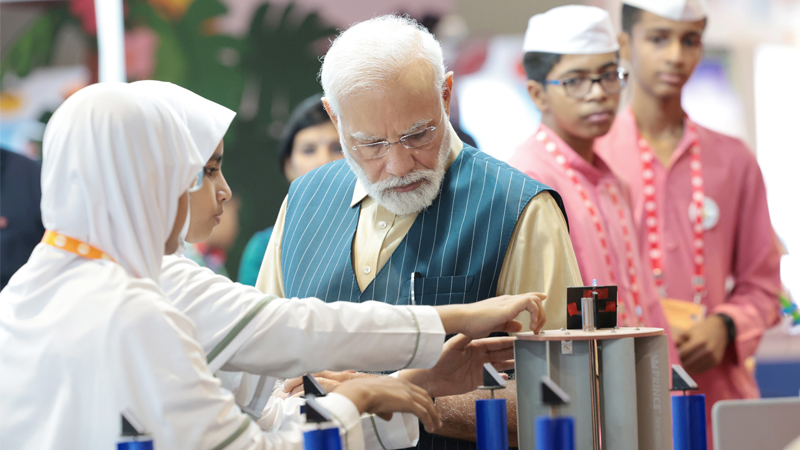
PM spends time with children at the sidelines of Akhil Bharatiya Shiksha Samagam

| Published on:

The Prime Minister, Shri Narendra Modi spent time with children at Bal Vatika on the sidelines of Akhil Bharatiya Shiksha Samagam at Bharat Mandapam today.

He tweeted that it is very refreshing and energizing to spend time with children.

“मासूम बच्चों के साथ आनंद के कुछ पल! इनकी ऊर्जा और उत्साह से मन उमंग से भर जाता है।”

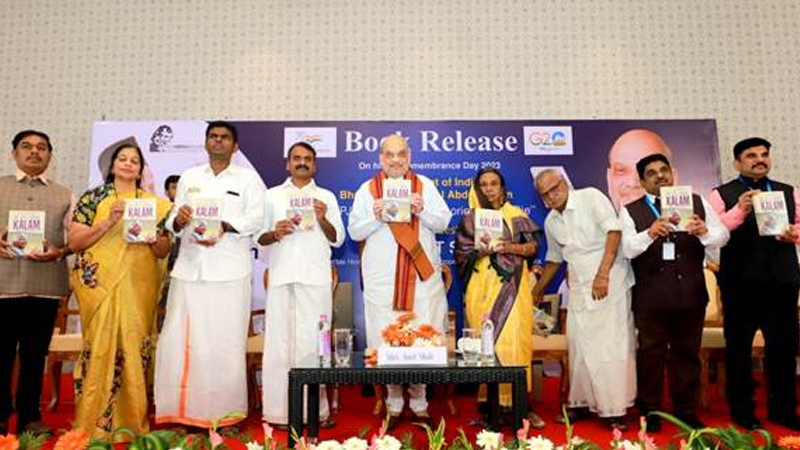
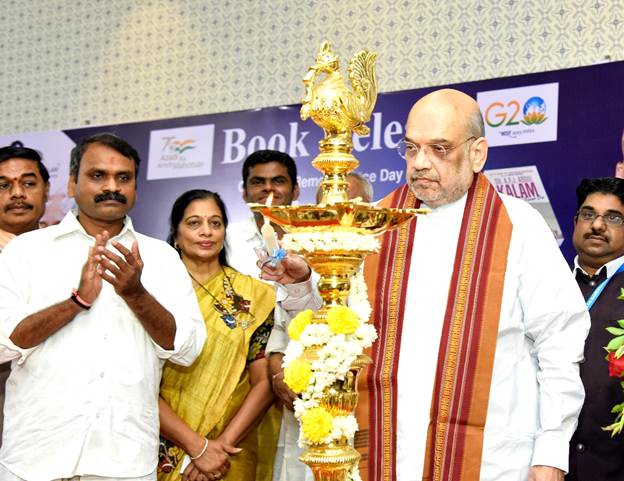
Union Home Minister releases ‘Dr. APJ Abdul Kalam: Memories Never Die’ book in Rameshwaram

| Published on:

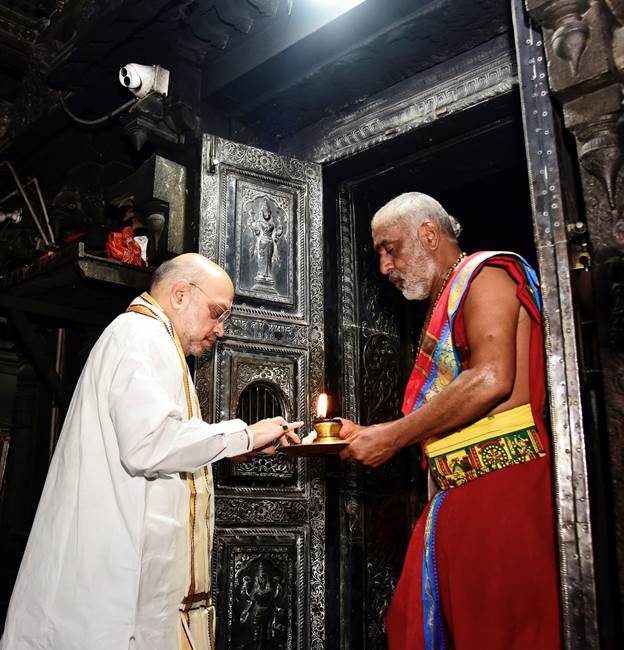
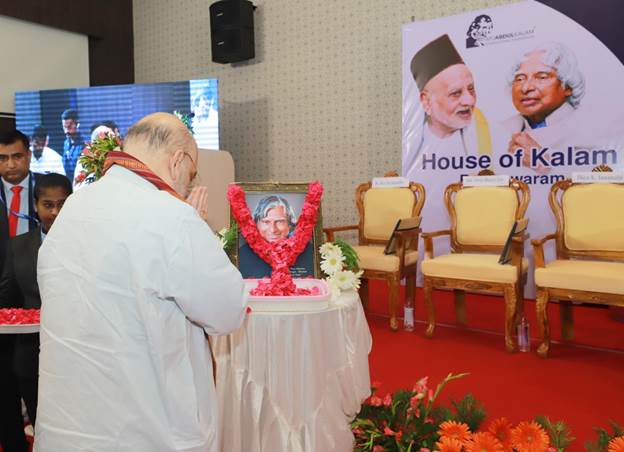
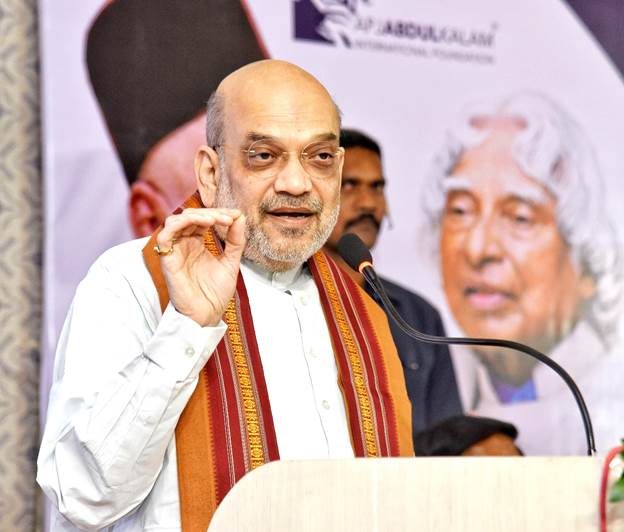
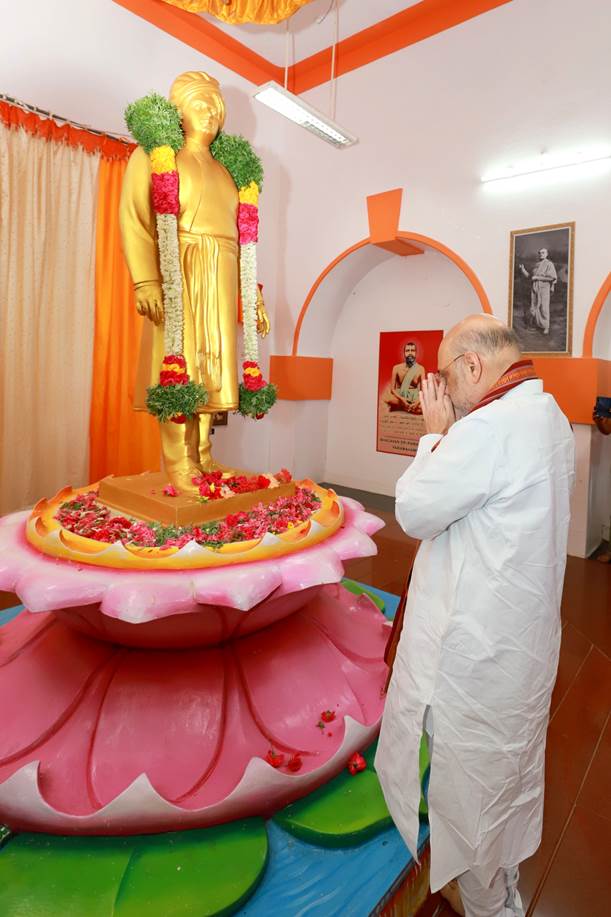
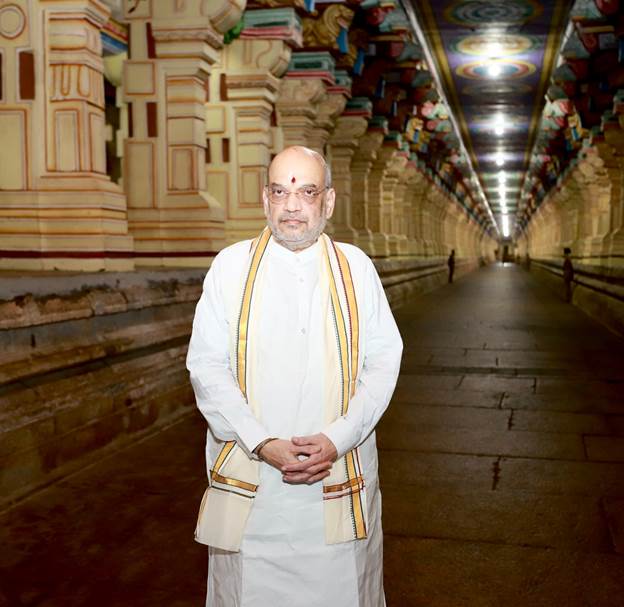
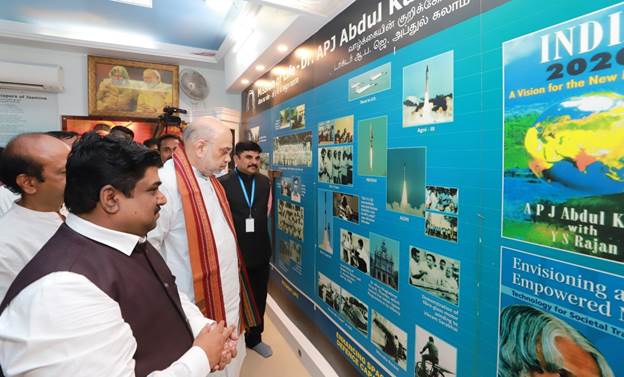
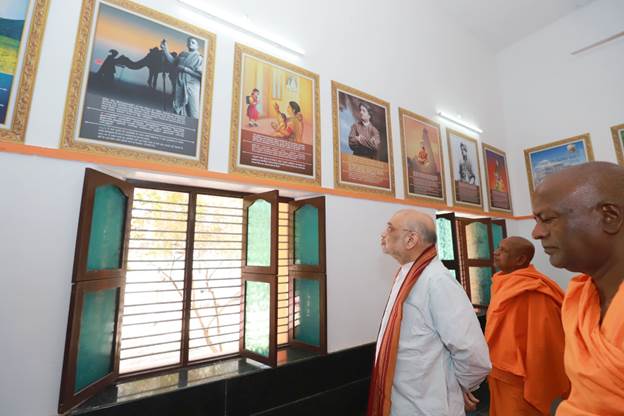
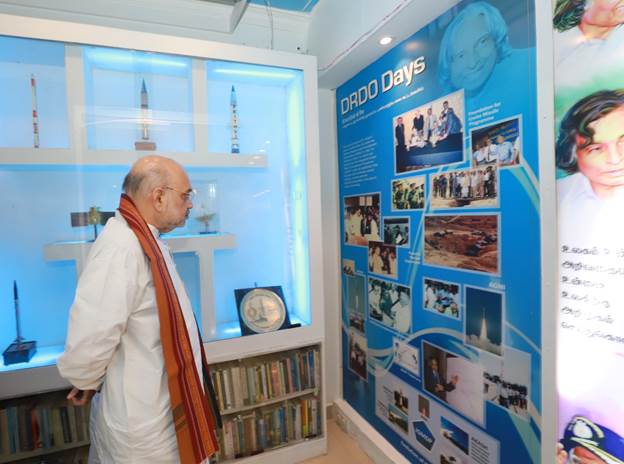
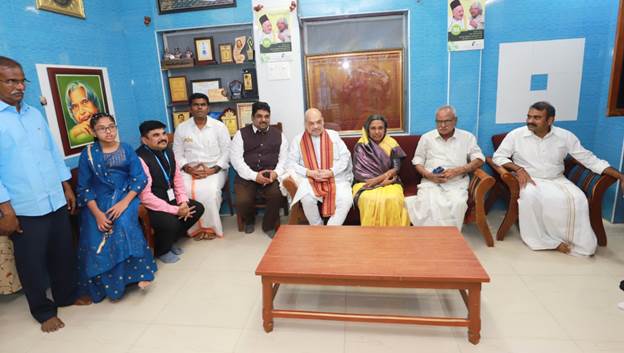
Union Home Minister and Minister of Cooperation, Shri Amit Shah released the ‘Dr. APJ Abdul Kalam: Memories Never Die’ book in Rameshwaram, today. The Union Home Minister  visited Dr. APJ Abdul Kalam House, Mission of Life Gallery Museum and Dr. APJ Abdul Kalam National Memorial. He also visited the Vivekananda Memorial. Shri Amit Shah also offered prayers at the world famous Rameshwaram temple. In his tweet, he said that the Rameswaram temple is  symbol of the ancient and glorious Sanatan Culture. Lord Shri Ram worshiped Lord Shiva at Shri Rameshwaram which is one of the 12 Jyotirlingas. Having darshan here on the auspicious occasion of ‘Aadi Thiruvizha’, is a very fortunate and a great feeling. I have prayed to Bholenath for the well-being of the countrymen and the prosperity of the nation. Several dignitaries including Union Minister of State Dr. L. Murugan were present on the occasion of the release of the book ‘Dr. APJ Abdul Kalam: Memories Never Die’.

https://static.pib.gov.in/WriteReadData/userfiles/image/image001PG1I.jpg

In his address, Shri Amit Shah said that with the release of the book ‘Dr. APJ Abdul Kalam: Memories Never Die’, readers across the country will definitely get an opportunity to know, understand and follow Dr. Kalam. He said that this book assimilates the history of Indian rocketry, science, technology and innovation, beautiful representation of Indian politics and administrative system and description of many incidents related to wishes and imagination of Dr. Kalam. In this book there is a complete and honest description of the incidents related to Dr. APJ Abdul Kalam.

https://static.pib.gov.in/WriteReadData/userfiles/image/image0028QW9.jpg

The Union Home Minister and Minister of Cooperation said that this book would prove to be very helpful in understanding the struggle of an ordinary boy born in a poor household in Rameshwaram to reach the highest peak of Indian politics. He added that this book brings to the readers  Dr. Kalam’s love for literature and art, his exhortations about the poems of Thirukural and Bharthiyar and many unknown aspects of his life. Shri Shah said that Dr. APJ Abdul Kalam was a great team player. He implemented the principles of management in his life.

Shri Amit Shah said that the book describes an experience of Dr. Sivathanu Pillai, Founder and CEO of BrahMos Private Limited. According to this, when SLV3-E01 failed, the whole team was disappointed, but being the team leader, Dr. Kalam encouraged everyone and motivated them to prepare for SLV3-E02. The successful launch of SLV3-E02 took India to the next level. Shri Shah said that similarly when the first launch of Agni missile was postponed two-three times due to some problems, even then the whole team was disappointed. But Dr. APJ Abdul Kalam encouraged them and stayed at the place of missile launching for one and a half months and worked all day and night. After successful launching, Agni missile became a symbol of India’s missile power in the whole world. He said that under the leadership of Dr. APJ Abdul Kalam, a big work was done in the country regarding five missiles. The names of those five missiles Prithvi, Agni, Akash, Nag and Trishul show that Dr. APJ Abdul Kalam was connected with nature and spirituality. He said that a scientist can work for the welfare of the world only when his soul is connected to science as well as spirituality.

https://static.pib.gov.in/WriteReadData/userfiles/image/image00469HC.jpg

Paying tribute to the great patriot, scientist and People’s President Dr. APJ Abdul Kalam, the Union Home Minister and Minister of Cooperation said that in the year 1995, Abdul Kalam had become a well-known scientist of the country and in 1997 he was awarded the Bharat Ratna. Citing the example of simplicity of Dr. APJ Abdul Kalam, he said that when he reached Rashtrapati Bhavan to receive Bharat Ratna, he was very nervous because he did not feel comfortable in suit and tie.

https://static.pib.gov.in/WriteReadData/userfiles/image/image00544NX.jpg

Shri Amit Shah said that the great scientist Dr. APJ Abdul Kalam, who brought many successes to India in the field of rocket and space in a single year, presented his vision for the country’s future in 1998. He said that in the book India 2020: A Vision for the New Millennium, Dr. APJ Abdul Kalam outlined the road map for India’s future and development. Shri Shah said that in this book, Dr Kalam put three main things in front of the youth of the country, first – India as a nation has to develop by recognizing its potential and bringing it to the front. Secondly, we have to develop technology based economy. Thirdly, by adopting balance growth model and striking a balance between both the village and the city, agriculture and industry, development will have to be taken forward. He said that today, under the leadership of Prime Minister Shri Narendra Modi India has moved forward in the direction of becoming a developed nation by realizing these three things.

https://static.pib.gov.in/WriteReadData/userfiles/image/image0067Z09.jpg

The Union Home Minister and Minister of Cooperation said that Dr. APJ Abdul Kalam laid the foundation in the field of space technology and today, under the leadership of Prime Minister Shri Narendra Modi, milestones like 55 spacecraft missions, 50 launch vehicle missions, 11 student satellites, 1 Atmosphere Re-entry Mission and launch of 104 satellites together have been achieved. He said that to realise the dreams of Dr. Abdul Kalam, Shri Modi has opened new doors for startups and the youths in the field of space sector, the day is not far when India will lead the whole world in space sector. Shri Shah expressed confidence that due to the initiatives taken by the Prime Minister Shri Narendra Modi the dream of Dr. APJ Abdul Kalam for space science, will definitely come true and India will lead the whole world in the field of space.

https://static.pib.gov.in/WriteReadData/userfiles/image/image007AOMG.jpg

Shri Amit Shah said that Dr. APJ Abdul Kalam, being the President, brought the common citizen of India to the centre of democracy and today, the Prime Minister of the country, Shri Narendra Modi has succeeded to bring the poor and underprivileged people to the centre of democracy. This shows that when a poor man connected to its roots reaches the peak of democracy, then democracy is dedicated to the poor and it focuses on their development and welfare.

https://static.pib.gov.in/WriteReadData/userfiles/image/image008QY6I.jpg

The Union Home Minister and Minister of Cooperation said that even today, whenever the name of Dr. APJ Abdul Kalam comes up, a smile appears on the faces of children and students across the country. He said that this smile is the smile of the dreams, hopes, enthusiasm and passion for the bright future of the country shown by Dr. APJ Abdul Kalam and the future of the country is reflected in this smile. Shri Shah said that the youth and students across the country should remember the words of Dr. APJ Abdul Kalam that ‘Dreams are not those which are seen in sleep, but dreams are those which do not let us sleep’. Missile Man Dr. APJ Abdul Kalam spent his whole life in teaching and even in his last breath he was teaching students in Meghalaya. This is a sign of his commitment.

https://static.pib.gov.in/WriteReadData/userfiles/image/image009E7QX.jpg

Shri Amit Shah said that Dr. APJ Abdul Kalam’s journey from Fisherman’s Committee to International Space Club is very inspiring. After coming back from school, Dr. Kalam used  to sell newspapers at bus stands for the education of the rest of his family. He said that it is the success of the struggle of Dr. APJ Abdul Kalam that a poor child who used to sell newspapers had the fortune of becoming the headlines of the newspapers. Shri Shah said that the person from the farthest place of southern India and from poor economic background got the privilege of becoming the first citizen of the country. He said that Dr. APJ Abdul Kalam received many national and international honors in his life. The name of Dr. APJ Abdul Kalam will always be written in golden letters in the history of DRDO and ISRO for giving new directions to these institutions.

https://static.pib.gov.in/WriteReadData/userfiles/image/image010WJIF.jpg

The Union Home Minister and Minister of Cooperation said that Dr. APJ Abdul Kalam had worked on a project to make a low-flying fighter plane in the final year of his graduation. While making the project, the idea of becoming a fighter pilot came to his mind and he also tried to become a pilot but could not succeed. However, he did not give up his dream and after becoming the President in 2002, he fulfilled his dream by flying the fighter jet Sukhoi in 2006. Shri Shah said that Dr. APJ Abdul Kalam made India self-reliant in the field of guided missiles and conducted the successful launch of Agni and Prithvi missiles. In 1998, under his leadership a successful nuclear test was conducted in Pokhran.

https://static.pib.gov.in/WriteReadData/userfiles/image/image011G10D.jpg

Shri Amit Shah said that Dr. Kalam proved that humanity is the biggest religion. As President, Dr. Kalam set such examples that are worth emulating for people in public life for many years. Shri Shah said that once 52 members of Dr. Kalam’s family stayed in Rashtrapati Bhavan for 9 days. The people who live in Rashtrapati Bhavan are state guests, but Dr. Abdul Kalam had deposited the bill of Rs 9.52 Lakh for their stay of 9 days in Rashtrapati Bhavan. This gesture of Dr. Kalam is a shining example of transparency in public life. He said that Dr. APJ Abdul Kalam never associated himself with His Excellency. This is the reason why the people of India still remember him with great respect as the People’s President. He said that Dr. APJ Abdul Kalam had a lot of respect for the officers and brave soldiers of the army in his heart.

The Union Home Minister and Minister of Cooperation Minister said that Dr. APJ Abdul Kalam has said in his book Wings of Fire that my story will end with me as I have no family. But this is not true, 140 crore Indians are his family who will always be proud of Dr. APJ Abdul Kalam. Shri Shah said that in the history of India, Dr. APJ Abdul Kalam will always be remembered by every child of India as a visionary, scientist and simple living person and a great patriot.

PM condoles deaths in mishap at a cracker factory in Krishnagiri, Tamil Nadu

| Published on:

The Prime Minister, Shri Narendra Modi has condoled deaths in a mishap at a cracker factory in Krishnagiri, Tamil Nadu. He announced that an ex-gratia of Rs. 2 lakh from PMNRF would be given to the next of kin of each deceased. The injured would be given Rs. 50,000.

The Prime Minister Office tweeted :

“Deeply saddened by the tragic mishap at a cracker factory in Krishnagiri, Tamil Nadu, resulting in the loss of precious lives. My thoughts and prayers are with the families of the victims during this extremely difficult time. May the injured recover soon. An ex-gratia of Rs. 2 lakh from PMNRF would be given to the next of kin of each deceased. The injured would be given Rs. 50,000: PM “

Future is Bright and the Future is India in the global semiconductor ecosystem: Rajeev Chandrasekar

| Published on:

Union Minister of State for Skill Development & Entrepreneurship and Electronics & IT Shri Rajeev Chandrasekhar kickstarted the second day of the Semicon India conference 2023. He addressed attendees who included stakeholders from universities, startups, major semiconductor companies and various government partners in India.

In his address, the Minister talked about the progress made in the semiconductor industry in less than two years since its inception. He spoke about India’s aim to become a strong global player in semiconductors within the next decade.

“We intend to build a robust, vibrant, globally competitive presence in the global semiconductor ecosystem in the next 10 years with the capital that PM Narendra Modi ji has given us. We certainly want to do what countries to the North of us took 200 billion dollars in 30 years and could not succeed. The Future is Bright and the Future is India in the semiconductor ecosystem,” the Minister said during his address at the conference.

The Minister highlighted how India has successfully built strong global partnerships with other countries, including Japan and the US in critical areas of technology, including semiconductors. He mentioned that in the past 15 months, there have been important visits and agreements between India and other nations, marking significant milestones that were never seen before.

“Our Prime Minister had a significant visit to the US where he made a historic agreement with President Biden, focusing on critical emerging technologies. There was also an agreement with Japan, covering various areas, including semiconductors. India entered into an agreement with the European Union with their Trade and Technology Council. There is an alignment of global interests, a global vision of the future of the semiconductor ecosystem and India’s own ambitions and capabilities,” the Minister added.

Speaking about startups and incubation centres, Shri Rajeev Chandrasekhar emphasized how the government is offering benefits to support them. “So far, 7 chip design startups have been approved for funding and assistance in developing their products. This initiative is steadily gaining confidence and support. It’s a relatively new opportunity for startups to delve into deep tech and semiconductor design. We are envisaging that the programme should eventually include larger companies as well. We have launched a Digital India RISC-V program(DIR-V) and a large number of startups and incubation centres built around academic institutions are focusing on the future of RISC-V and on the devices it operates on,” the Minister explained.

While speaking about India’s progress in semiconductor research, Shri Rajeev Chandrasekhar mentioned the creation of the “India Semiconductor Research Centre.” This institution is intended to be a collaborative effort involving both public and private partnerships, with numerous overseas and academic institutions, global semiconductor companies, Indian enterprises, and the government as the main contributors. “The goal is to establish a strong network of hardworking partners working together to develop the institution’s design. This research centre holds great significance as it will serve as a placeholder for our research ambitions and play an important role in shaping the research ecosystem we aim to build,” he further added.

On the second day of the Semicon India Conference 2023, three significant announcements were made including forging new partnerships to develop a cutting-edge skilling curriculum, identifying two promising startups eligible for incentives in the semiconductor ecosystem, and the introduction of programmes to boost startups within this space.

During a press conference, CDAC announced a partnership with Arm, the world’s leading semiconductor IP company, to empower semiconductor startups in India through the Arm Flexible Access for Startups Program.

Two more startups/MSMEs involved in semiconductor design were announced as participants in the SemiconIndia futureDESIGN DLI scheme. One of them is Aheesa Digital Innovations Private Limited (Aheesa), located in Chennai. Aheesa focuses on Telecom, Networking, and Cyber Security domains. The other startup is Calligo Technologies, based in Bengaluru, India, and it serves global companies in HPC, Big Data, and AI/ML segments.

An important collaboration was also initiated through a Memorandum of Understanding   (MoU) between the Centre for Nano Science and Engineering (CeNSE) at the Indian Institute of Science (IISc), Bengaluru, and Lam Research India. They aim to develop a specialized course for Indian universities, teaching semiconductor fabrication technology using Lam Research’s SemiverseTM Solutions virtual fabrication software, SEMulator3D.

These announcements were made in the presence of the MoS Rajeev Chandrasekhar. He highlighted the significance of these partnerships in supporting India’s semiconductor market growth.

The Semicon India Conference 2023 was inaugurated by Prime Minister Shri Narendra Modi yesterday. This is the second edition of the conference, first held in 2022. Since its inception, the Indian semiconductor industry has witnessed the addition of several new products, technologies, and professionals, which have contributed to its overall growth.

PM inaugurates SemiconIndia 2023 in Gandhinagar, Gujarat

| Published on:

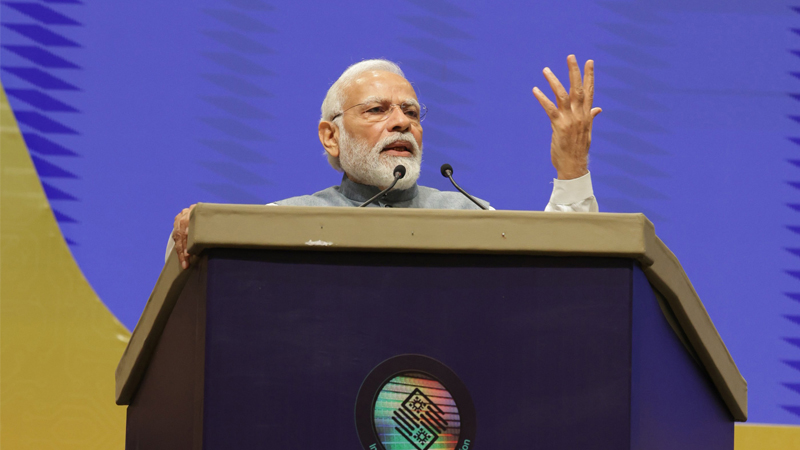
The Prime Minister, Shri Narendra Modi inaugurated SemiconIndia 2023 at Mahatma Mandir in Gandhinagar, Gujarat today. The theme of the Conference is ‘Catalysing India’s Semiconductor Ecosystem’. It showcases India’s semiconductor strategy and policy which envisions making India a global hub for semiconductor design, manufacturing and technology development.

Industry leaders expressed their views on the occasion. President and CEO SEMI Shri Ajit Minocha said that for the first time in India’s history, geopolitics, domestic politics and private secret capacities are aligned in India’s favor to become a player in semiconductor production. He said investment by Micron is making history in India and will set the stage for others to follow. He said having leadership that understands the semiconductor ecosystem is what makes the present system different. He said India would be the next powerhouse in semiconductor in Asia.

Mr Mark Papermaster, EVP and CTO AMD, recalled CEO AMD meeting with the Prime Minister at the White House recently. He announced that AMD will invest approximately 400 million dollars in the next 5 years. He said AMD will enhance its R&D capabilities. “We will build our largest design center in Bengaluru”, he said.

Dr Prabu Raja, President Semiconductor Product Group Applied Materials said that with the strong vision of Prime Minister Modi India is poised to play a central role in the global semiconductor industry. “We firmly believe that this is India’s time to shine”, he said. No company or country can overcome challenges in the sector alone. It’s time for collaborative partnership in this sector. This new collaborative model can provide us to be a catalyst in the sector,  he emphasized. “I would like to thank you for considering us a valuable partner in India’s semiconductor vision”, he added.

Shri Anirudh Devgan, President and CEO Cadence said it is really good to see India finally investing into semiconductors. He expressed happiness that the government is investing in the entire ecosystem.

Shri Anil Aggrawal, Chairman, Vedanta Group said that experts feel that Gujarat is the right place for the silicon valley of India. He highlighted the Prime Minister’s vision of creating new opportunities for the youth of India. “We have seen how India has transformed in the last decade and aspirations of young Indians are really high.

Shri Sanjay Mehrotra, President and CEO of Micron Technology thanked the Prime Minister for the global vision to turn India into a global semiconductor hub. Mr Mehrotra expressed pride in the setting up of a semiconductor assembly and test facility for memory in the state of Gujarat and said that this project is going to create nearly 5,000 jobs along with 15,000 additional jobs within the community in the coming years. He thanked both the Central and State Governments for their support in setting up the semiconductor industry in the state. He also thanked the Prime Minister for his support in fostering an environment of innovation, business growth and social progress that is creating solid results. “Digital India and Make in India are creating a truly transformative energy that will continue to drive positive progress”, he further said.

Mr Young Liu, Chairman of Foxconn highlighted the buffalo spirit of the Taiwan Semiconductor Industry, which is the ability to work hard without complaining and said that the same spirit can be applied in India. Referring to the high ‘say-do’ ratio of the Indian Government, Mr Liu underlined the importance of trust and working together to overcome the challenges just like Taiwan did many years ago. Mr Liu expressed confidence and optimism in the will and determination of the Indian Government to lead the semiconductor industry. “IT stands for India and Taiwan”, Mr Liu said quoting the Prime Minister and assured that Taiwan will be India’s most trusted and reliable partner in the semiconductor industry.

Addressing the gathering, the Prime Minister emphasized that events like Semicon are like software update where experts and industry leaders meet and share with each other. “It is important for the synchronization of our relationship,” the Prime Minister said. Shri Modi who witnessed the exhibition set on the venue, expressed delight in the innovations and energy of the sector. The Prime Minister urged everyone, especially the younger generations to visit the ongoing exhibition and understand the power of the new technology.

Recalling the participation in the first edition of Semicon last year, the Prime Minister highlighted the questions raised at the time about investing in India in the semiconductor industry. He underlined that the questions have transformed over a period of one year from ‘Why invest in India’ to ‘Why not invest in India’. “There has been a directional change due to the efforts of the industry leaders”, Shri Modi said as he felicitated them for showing their belief in India. He said that the industry leaders have conjoined the aspirations and the capability of India with their own future and dreams. “India does not disappoint”, he exclaimed. Shri Modi underlined the abundance of opportunities in India of the 21st century and said that the country’s democracy, demography and dividend will double and triple the businesses in India.

Referring to Moore’s Law with exponential growth at its heart. He said that we are witnessing the same exponential growth in India’s digital and electronic manufacturing sector. He informed that India’s share in global electronic manufacturing has increased manifold. In 2014 India’s electronic manufacturing was less than 30 billion dollars, which has crossed 100 billion dollars today. The export of electronics and mobile devices has doubled in the last 2 years. Throwing light on the technological developments in India post 2014, the Prime Minister informed that there were only two mobile manufacturing units in India before 2014 whereas today, this number has gone beyond 200. He also informed that the number of broadband users in the country increased from 6 crores to 80 crores while the number of internet connections rose from 25 crores to more than 85 crores today. Referring to these statistics, the Prime Minister emphasized that it not only signifies India’s progress but is also an indicator for growing businesses in the country. Shri Modi highlighted the crucial role of India in the semicon industry’s target of exponential growth.

“The world is witnessing the Industry 4.0 revolution today”, Shri Modi remarked as he noted that the basis for any industrial revolution in the world is the aspirations of the people in that particular sector. “Industrial Revolutions in the past and the American Dream had the same relationship”, the Prime Minister said as he drew an analogy between the Industry 4.0 revolution and Indian aspirations.  He said that Indian aspirations are the driving force behind the development of India. He touched upon the recent report which states that poverty is declining at a very fast rate leading to the emergence of a neo-middle class in the country. Noting the tech-friendly nature and the eagerness of the Indian people towards technology adoption, the Prime Minister said that cheap data rates, quality digital infrastructure and seamless power supply in the villages are burgeoning the consumption of digital products. “Be it health, agriculture or logistics, India is working towards a vision of smart technology usage”, Shri Modi said. He noted that there are people in India who may not have used a basic home appliance but are going to make use of interconnected smart devices. Similarly, the Prime Minister said, a particular student population might not have used a bicycle before, but they are primed to use smart electric bikes today. “The growing neo-middle class of India has become the powerhouse of Indian aspirations”, the Prime Minister said. He underlined that the chip-making industry is a market filled with opportunities and expressed confidence that those who begin early are bound to get a first-mover advantage over others.

Referring to the side effects of the pandemic and the Russia-Ukraine war, the Prime Minister said that the world needs a reliable supply chain. “Who can be a more trusted partner than the world’s largest democracy”, he said. He expressed happiness about the growing global trust in India. “Investors trust India as it has a stable, responsible and reform-oriented government. The industry has faith in India as infrastructure is developing in every sector. The tech sector believes in India as technology is growing here. The Semiconductor Industry trusts India as we have a massive talent pool”, he said. “Skilled engineers and designers are our strength. Anyone who wants to be a part of the world’s most vibrant and unified market has faith in India. When we tell you to make in India, it also includes that let’s make for India, Make for the world”, he added.

The Prime Minister said that India understands its global responsibilities and is working on a comprehensive roadmap with friendly countries. That’s why India is building a vibrant semiconductor ecosystem. Recently, the National Quantum Mission was approved. Furthermore, the National Research Foundation Bill is also going to be introduced in the Parliament. The engineering curriculum to create a semiconductor ecosystem is being revamped. He informed that more than 300 such prominent colleges have been identified in India where courses on semiconductors will be available. The Chips to Startups Program will help engineers. “It is estimated that in the next 5 years, more than one lakh design engineers are going to be produced in our country. India’s growing start-up ecosystem is also going to strengthen the semiconductor sector”, he added.

Giving the analogy of a conductor and insulator where energy can pass through conductors and not through insulators, the Prime Minister said that India is ticking every checkbox to become a good energy conductor for the semiconductor industry. Noting the crucial requirement of electricity for this sector, the Prime Minister informed that  India’s solar power installed capacity has increased more than 20 times in the last decade and a new target of 500 GW of renewable energy capacity has been set to be achieved by the end of this decade. He also touched upon major steps taken for the production of solar PV modules, green hydrogen and electrolyzers. He underlined that the policy reforms taking place in India will have a positive impact on the construction of the semiconductor ecosystem. He also informed about the several tax exemptions that have come into effect for the new manufacturing industry and highlighted the lowest corporate tax rate in India, faceless and seamless taxation process, abolition of archaic laws, compliances to increase ease of doing business and special incentives for the semiconductor industry. Shri Modi stated that these decisions and policies are a reflection of the fact that India is rolling out red carpets for the semiconductor industry. “As India moves forward on the path of reform, new opportunities will be created. India is becoming an excellent conductor for semiconductor investments”, he added.

The Prime Minister said that India understands the needs of the global supply chain, raw materials, trained manpower and machinery. “The sector in which we have worked closely with private players has touched new heights. Be it the space sector or geospatial sector, we have got excellent results everywhere”, the Prime Minister emphasized.  He also informed about the critical decisions taken on the basis of feedback received. He talked about the increased incentive under the Semicon India Programme. He elaborated that now technology firms will be given 50 percent financial assistance to set up semiconductor manufacturing facilities in India. “We are continuously carrying out policy reforms to accelerate the growth of the country’s semiconductor sector”, Shri Modi said.

Reflecting on India’s G20 theme of ‘One Earth, One Family, One Future, the Prime Minister emphasized that the same spirit is applied behind making India a semiconductor manufacturing hub. He emphasized that India wants the whole world to benefit from its skill, capacity and capability. He stressed boosting India’s potential for Global Good and a better world. The Prime Minister welcomed the participation, suggestions and thoughts in this venture and assured the industry leaders that the Government of India stands with them at every step. Concluding the address, the Prime Minister recalled his address from the Red Fort and said, “This is the time. This is the right time. Not just for India but the whole world.”

Chief Minister of Gujarat, Shri Bhupendra Patel, Union Minister for Electronics & Information Technology, Shri Ashwini Vaishnav, Union Minister of State for Electronics & Information Technology, Shree Rajeev Chandrasekhar, CEO of Cadence, Shri Anirudh Devgan, Chairman of Foxconn, Mr Young Liu, Chairman of Vedanta, Shri Anil Aggarwal, CEO of Micron, Shri Sanjay Mehrotra, CTO of AMD, Mr Mark Papaermaster and President of Semiconductor Products Group AMAT, Shri Prabhu Raja were present on the occasion.

Background

The theme of the Conference is ‘Catalysing India’s Semiconductor Ecosystem’. It aims to bring together global leaders from industry, academia and research institutions. It showcases India’s semiconductor strategy and policy which envisions making India a global hub for semiconductor design, manufacturing and technology development. SemiconIndia 2023 will witness the participation of representatives of major companies such as Micron Technology, Applied Materials, Foxconn, SEMI, Cadence, and AMD among others.


PM addresses G20 Environment and Climate Ministers’ Meet in Chennai

| Published on:

The Prime Minister, Shri Narendra Modi addressed the G20 Environment and Climate Ministers’ Meet in Chennai via video message today.

Welcoming the dignitaries to Chennai, the Prime Minister remarked that the city is rich in culture and history. He also urged them to explore the ‘must visit’ destination of Mamallapuram which is a UNESCO World Heritage site and one can experience inspiring stone carvings and its great beauty.

Quoting the great poet Thiruvalluvar from about two thousand years ago, the Prime Minister said, “Even the oceans will shrink, if the cloud that has drawn its waters up, does not give it back in the form of rain”. Speaking about nature and its ways of becoming a regular source of learning in India, the Prime Minister quoted another Sanskrit Shlok and explained, “Neither rivers drink their own water nor trees eat their own fruits. Clouds also don’t consume grains produced by their water”. The Prime Minister emphasized providing for nature as nature provides for us. He said that protecting and caring for Mother Earth is our fundamental responsibility and today, it has taken the shape of ‘Climate Action’ as this duty was ignored by many for a very long time. Based on India’s traditional knowledge, the Prime Minister said that Climate Action must follow ‘Antyodaya’ which means ensuring the rise and development of the last person in the society. Noting that countries of the Global South are particularly impacted by Climate Change and environmental issues, the Prime Minister stressed the need to enhance action on commitments under the ‘UN Climate Convention’ and the ‘Paris Agreement’ as it can be crucial in helping the Global South fulfill its developmental aspirations in a climate-friendly way.

The Prime Minister expressed pride in informing that India has led the way through its ambitious ‘Nationally Determined Contributions’. He mentioned achieving the installed electric capacity from non-fossil fuel sources 9 years ahead of the target of 2030 and now setting the bar even higher through updated targets. He also mentioned that today India is one of the top 5 countries in the world, in terms of installed renewable energy capacity and informed that the country has set a target of attaining ‘Net Zero’ by 2070. Shri Modi expressed optimism as India continues to collaborate with its partners through alliances including International Solar Alliance, CDRI, and the ‘Leadership Group for Industry Transition’.

“India is a mega-diverse country”, the Prime Minister remarked as he highlighted the consistent actions taken on biodiversity conservation, protection, restoration and enrichment. He expressed happiness that the restoration of priority landscapes impacted by forest fires and mining is being recognized through the ‘Gandhinagar Implementation Roadmap and Platform’. He mentioned the recently launched ‘International Big Cat Alliance’ for the conservation of seven big cats on the planet and credited the learnings of the ‘Project Tiger’, a pioneering conservation initiative. He informed that 70 percent of the world’s tigers are found in India today as a result of Project Tiger. The Prime Minister also touched upon work being underway on Project Lion and Project Dolphin.

Underlining that India’s initiatives are powered by people’s participation, the Prime Minister mentioned ‘Mission Amrit Sarovar’ which is a unique water conservation initiative where more than 63,000 water bodies have been developed in just about one year. He informed that the mission has been implemented entirely through community participation, and aided by technology. He also touched upon ‘Catch the Rain’ campaign which has led to the construction of more than 280,000 water harvesting structures to conserve water along with the construction of nearly 250,000 re-use and recharge structures. “All this was achieved through people’s participation and focused on local soil and water conditions”, the Prime Minister added. Shri Modi also touched upon effectively utilizing community participation in the ‘Namami Gange Mission’ to clean the river Ganga which has resulted in the major achievement of the reappearance of the Gangetic Dolphin in many stretches of the river. Referring to the 75 wetlands designated as Ramsar sites in wetland conservation, the Prime Minister said that India has the largest network of Ramsar sites in Asia.

Referring to the ‘Small Island States’ as ‘Large Ocean Countries’, the Prime Minister said that the oceans are a crucial economic resource for them while also supporting the livelihoods of over three billion people across the globe. He said that it is home to extensive biodiversity and stressed the importance of responsible use and management of oceanic resources. The Prime Minister expressed optimism for the adoption of ‘G20 High Level Principles for a Sustainable and Resilient Blue and Ocean-based Economy’ and called on the G20 to work constructively for an effective international legally-binding instrument to end plastic pollution

The Prime Minister recalled launching Mission LiFE – Lifestyle for Environment along with the UN Secretary General last year and said that Mission LiFE as a global mass movement will nudge individual and collective action to protect and preserve the environment. In India, the Prime Minister said, environment-friendly actions by any person, company or local body will not go unnoticed. He informed that green credits can now be earned under the recently announced ‘Green Credit Programme’. He explained that activities like tree plantation, water conservation, and sustainable agriculture can now generate revenue for individuals, local bodies and others

Concluding the address, the Prime Minister reiterated that we should not forget our duties towards Mother Nature.  He expressed confidence that the G20 Environment and Climate Ministers’ Meet would be productive and successful. “Mother nature does not favor a fragmented approach. She prefers “Vasudhaiva Kutumbakam” – One Earth, One Family, One Future”, Shri Modi concluded.

FM launches the AMC Repo Clearing Limited (ARCL) and Corporate Debt Market Development Fund (CDMDF)

| Published on:

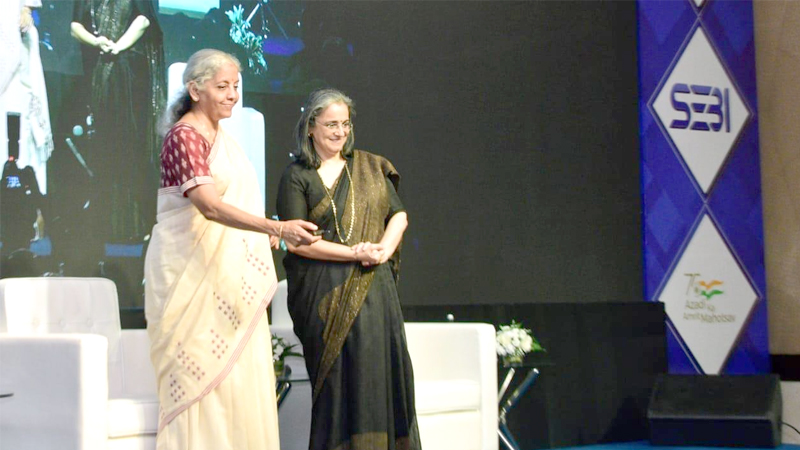
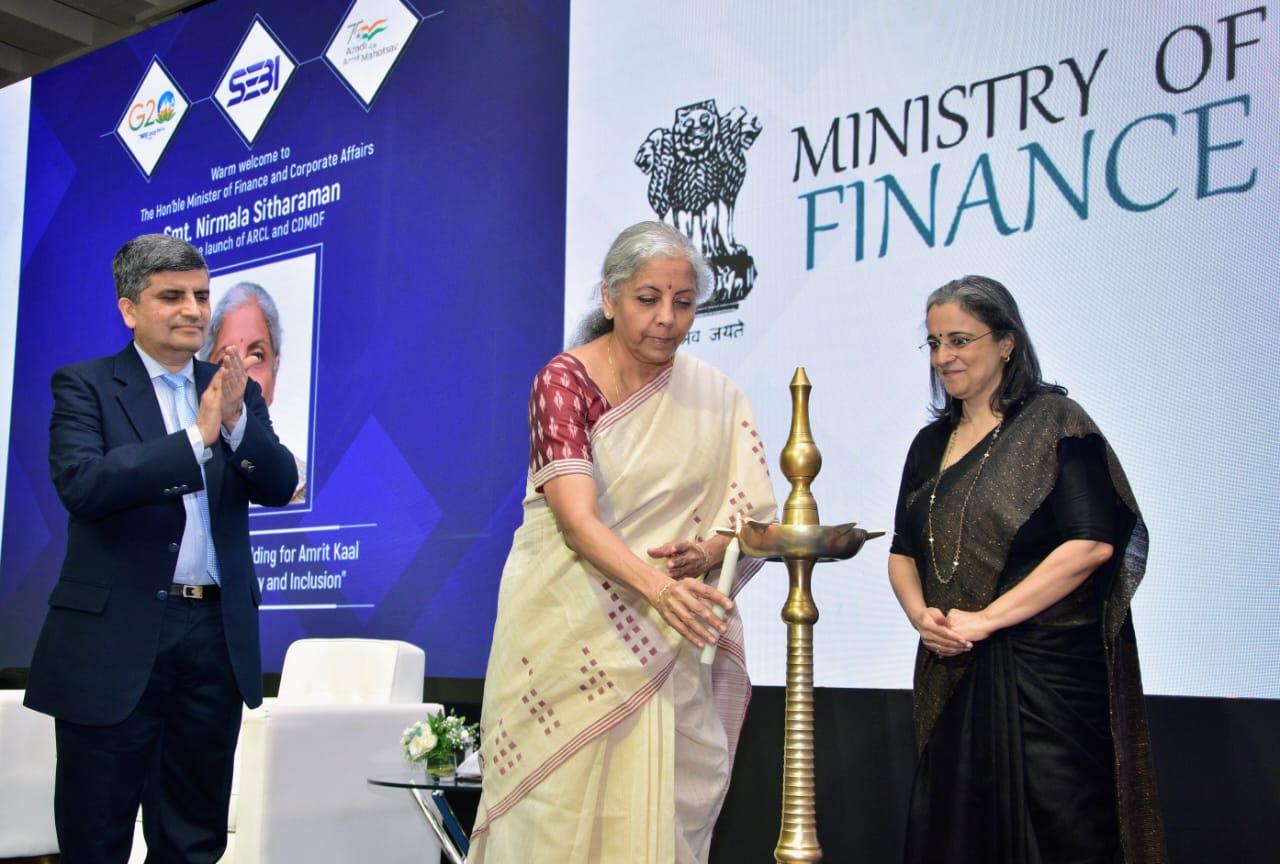
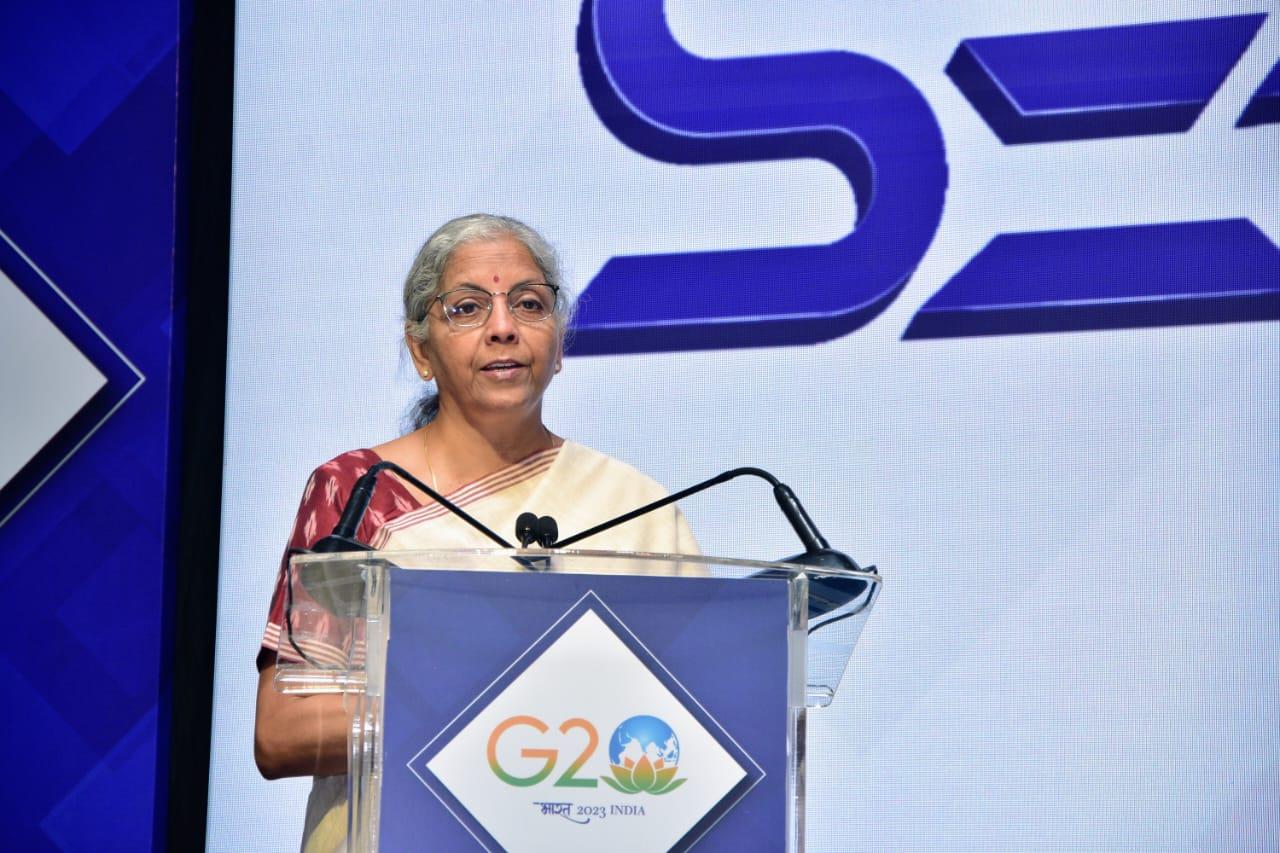
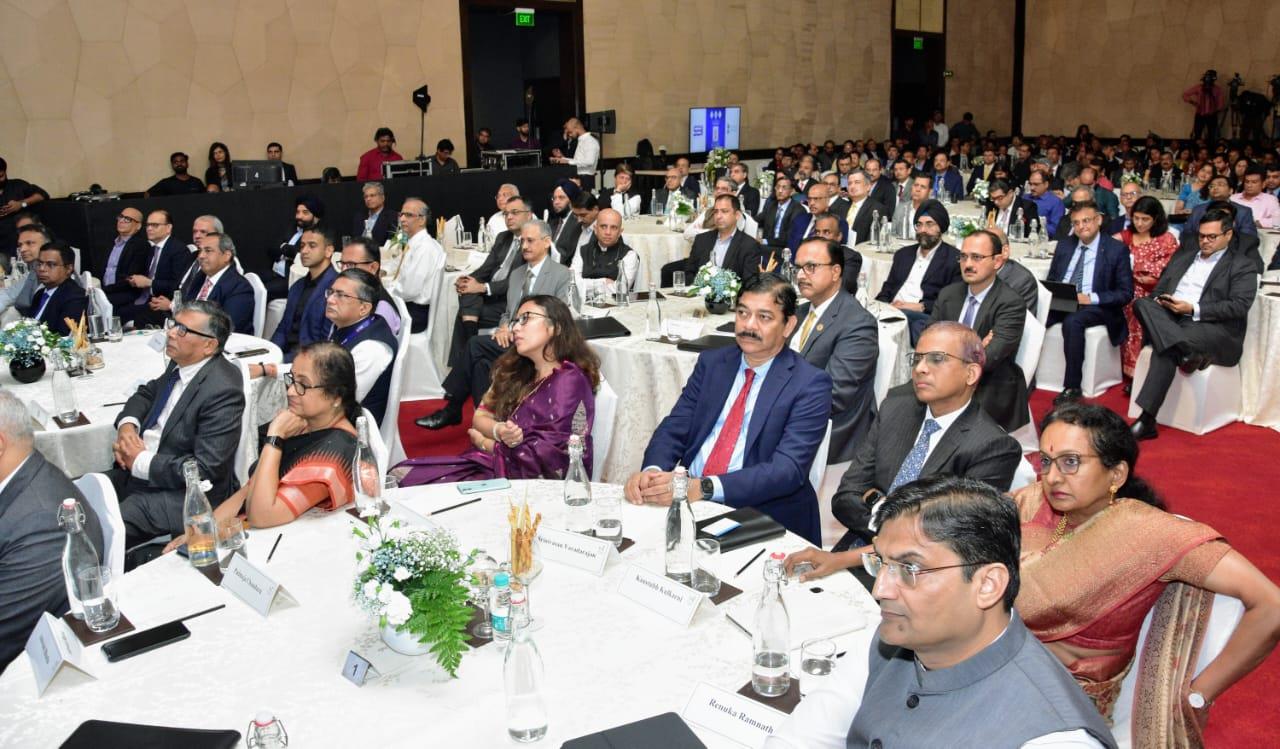
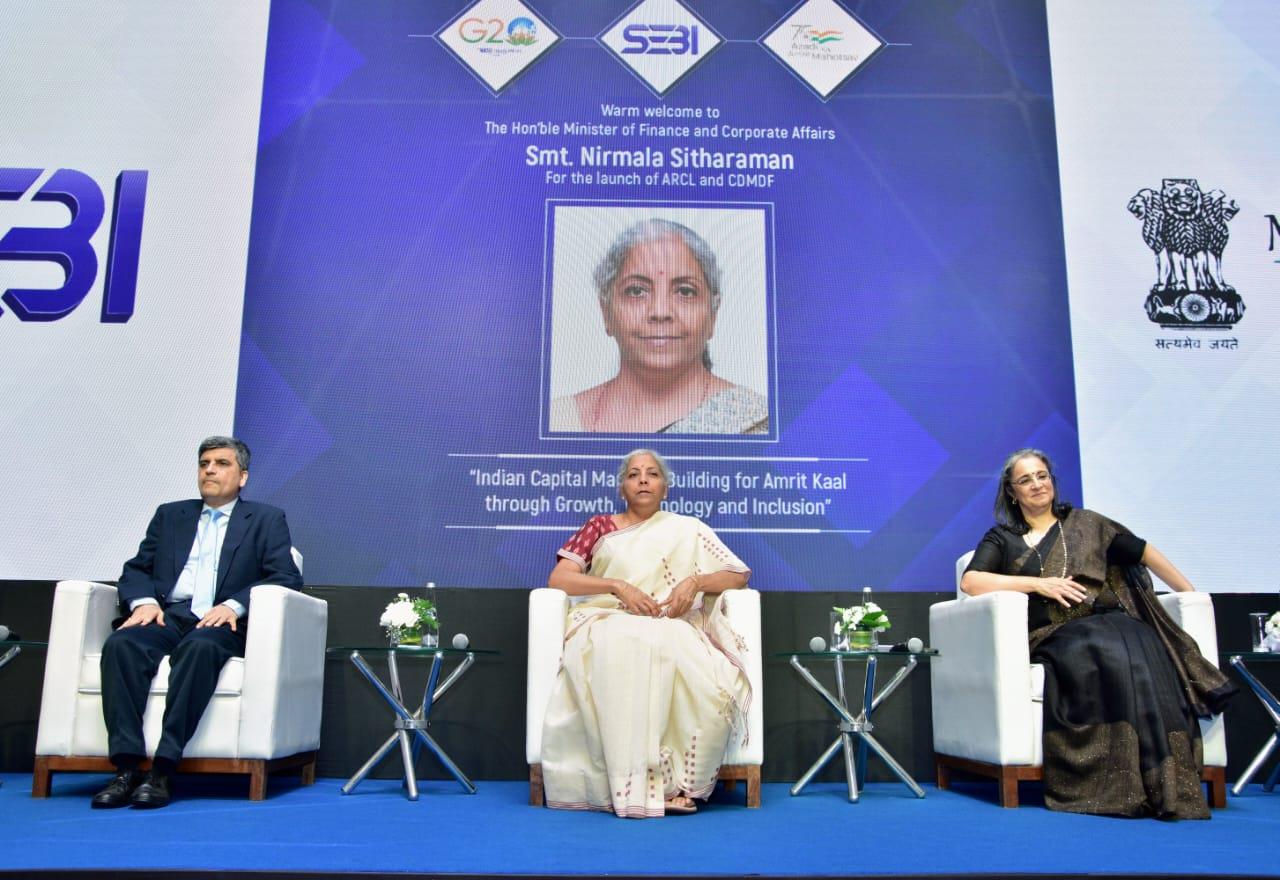
Union Minister of Finance and Corporate Affairs Smt. Nirmala Sitharaman inaugurated the Corporate Debt Market Development Fund (CDMDF) and initiated the muhurat trading on Limited Purpose Clearing Corporation mechanism called AMC Repo Clearing Limited (ARCL), in Mumbai today. The Secretary, Department of Economic Affairs (DEA) Shri Ajay Seth; Chairperson, Securities and Exchange Board of India (SEBI) Smt. Madhabi Puri Buch; and many leading market participants were present on the occasion. Both the initiatives intend to deepen the functioning of the corporate debt markets.

The Union Finance and Corporate Affairs Minister, in her speech for the Union Budget of 2021-22, had announced the creation of a permanent institutional framework to enhance secondary market liquidity in the Corporate Bond market during stressed and normal times, thereby instilling confidence amongst participants in corporate bond market. The Budget announcement has today manifested in the form of the Corporate Debt Market Development Fund (CDMDF).
Speaking on the occasion, Union Finance and Corporate Affairs Minister Smt. Nirmala Sitharaman said, Indian capital markets have been a trendsetter of sorts in many aspects of trading, including being one of the fastest in terms of settlement of trade and also in certain areas related to risk mitigation and governance. Our equity markets have witnessed broad-based participation from all segments – retail investors with more than 11.5 crore Demat accounts on one side of the spectrum to Small and Medium Enterprises (SMEs) raising funds through IPOs on the other. We are witnessing a robust and all-around growth of financial markets today, remarked the Finance Minister.
The Finance Minister announced that the Government has taken a decision to enable direct listing of listed/unlisted companies on IFSC exchanges, which will be operationalised shortly enabling start- ups and companies of like nature to access global market through GIFT IFSC. This will also facilitate access to global capital and result in better valuation for Indian companies. Smt. Sitharaman said that Government’s vision for GIFT-IFSC transcends much beyond the realm of traditional finance and ventures into the realm of thought leadership. We envision it as the true embodiment of Atma Nirbhar Bharat, a hub of ingenuity and innovation, she added.

Corporate Bond Market
Finance Minister Smt. Nirmala Sitharaman said that the growing size of the corporate bond market is accompanied by growing diversity of issuers and markets. We now have issuances by new types of entities, e.g. REITs and InvITs pursuant to the Union Budget 2021 providing a legal framework for these entities to issue corporate debt securities. Another important area is the issue and listing of municipal debt securities which has enabled market-based financing of infrastructure projects. As announced in this year’s budget, through property tax governance reforms and ring-fencing user charges on urban infrastructure, the Government is incentivising cities to improve their credit worthiness for municipal bonds, further stated the Finance Minister.
The Finance Minister said that the market for repo in government securities is one of the most liquid markets in the country. However, for repo in corporate bonds to take off, lack of Central counterparty has been cited as one of the reasons.
Smt. Sitharaman stated that setting up of Limited Purpose Repo Clearing Corporation with the triparty repo services and the central counterparty services of AMC Repo Clearing Limited (ARCL) in the bond market are expected to offer better efficiency in collateral and settlement for its members, which will widen and deepen the corporate bond repo market. This institution will serve manifold purposes – will allow market makers to access cost-effective funding for their inventory, holders of bonds to meet their short-term liquidity needs without having to liquidate their assets and the opportunity to entities with short-term surpluses to deploy their funds in a safe and efficient manner.
Based on experience gained in regulating the debt market over the years and feedback received on the subject from time to time, and particularly in light of the disruption observed in the corporate debt market due to the impact of COVID-19 pandemic, the Finance Ministry had proposed to create a permanent institutional framework – a backstop facility – to instill confidence amongst the participants in the Corporate Bond Market during times of stress and to enhance secondary market liquidity. This is a significant initiative as it is borne out of a collaboration of industry, regulator and the Government towards building market institutions where both issuers and investors in the debt market stand to benefit, stated the Finance Minister. In this context, she mentioned that she is extremely happy to inaugurate both the ARCL and CDMDF initiatives today.

Regulations:
The Finance Minister said that quality, proportionality and effectiveness of regulations matter the most for ease of doing business, ease of investing and ease of living. Taking into account national priorities, Smt. Sitharaman urged that regulatory environment must strive to balance, at all times, the creation of a conducive environment for starting and running businesses, maintenance of market integrity and sustenance of market stability. It is a possible trinity, she stated. The Finance Minister called for constant dialogue, consultation and understanding between policymakers, regulators and market participants and the creation of mechanisms for that to happen with regularity.
The Union Finance Minister also said that the main focus of our financial sector regulation should be market development and investor protection. Our markets should enable ease of raising capital – both equity and debt and ease of doing investment by reducing the cost of intermediation and boost productive investments, she said.
Speaking on the scale of growth in Capital Markets in recent years, Finance Minister Smt. Sitharaman informed that 10 years ago, our country’s Market Capitalisation stood at Rs. 74 lakh crore. It has almost doubled every 5 years, reaching Rs. 300 lakh crore today. It is now ranked 5th among the top-10 most-valued countries. India’s weight in the MSCI Emerging Markets Index, one of the most followed indices globally, in 2013 was only 6.3%. It has now more than doubled to 14.6% and also, the number of retail Demat accounts has increased from around 2 crore in 2013 to more than 11.5 crore today – more than 6 crore have been added in the last 3 years, she stated. The number of unique Mutual Fund investors has grown from under 1 crore in 2014 to about 4 crore today, stated the Finance Minister. She also said, REITs and InvITs have also witnessed tremendous growth over the last 5 years, with their combined NAV surging from under 10,000 crore to about Rs. 2.5 lakh crore today.

Backstop Facility:
The Department of Economic Affairs, Ministry of Finance, Government of India, has notified the establishment of ‘Guarantee Scheme for Corporate Debt’ (GSCD) for the purpose of providing guarantee cover against debt to be raised by Corporate Debt Market Development Fund (CDMDF) which will act as a backstop in the corporate debt market, in times of market dislocation. The genesis of backstop facility was set forth as part of the Union Budget 2021-22 announcement, wherein the Central Government, with the aim to develop the corporate debt market in India announced:
“To instill confidence amongst the participants in the Corporate Bond Market during times of stress and to generally enhance secondary market liquidity, it is proposed to create a permanent institutional framework. The proposed body would purchase investment grade debt securities both in stressed and normal times and help in the development of the Bond market”.
The GSCD is envisaged to be managed by the Guarantee Fund for Corporate Debt (GFCD), a Trust Fund formed by DEA with a corpus of Rs 310 crore. The GFCD will be managed by National Credit Guarantee Trustee Company Ltd. (NCGTC), a wholly owned company of the Department of Financial Services (DFS), Ministry of Finance, Government of India.  The Trust would provide guarantee cover for loans not exceeding Rs. 30,000 crore, to be raised by CDMDF during times of market dislocation. NCGTC will give the guarantee as a standing facility, initially for 15 years. The SEBI Board shall decide the trigger of debt market disruption warranting the Backstop Facility to operate in times of market dislocation and consequently the need for activation of the guarantee by the NGCTC.
CDMDF is notified as an Alternative Investment Fund (AIF) in the form of a Trust under SEBI (AIF) Regulations. It would purchase investment grade debt securities both in stressed and normal times and help in development of the bond market. The units of CDMDF shall be subscribed by Asset Management Companies (AMCs) of Mutual Funds (MFs) and “specified debt-oriented MF Schemes. Hence the issue of moral hazard is also addressed by way of ensuring contributions by AMCs and the Mutual Fund schemes.
In times of market dislocation, CDMDF shall purchase and hold eligible corporate debt securities from the participating investors (i.e., specified debt-oriented MF schemes to begin with) and sell as markets recover. The Scheme will act as a key enabler for facilitating liquidity in the corporate debt market and to respond quickly in times of market dislocation.

Limited Purpose Clearing Corporation:
As another initiative to deepen corporate bond markets, the Limited Purpose Clearing Corporation (LPCC) named as AMC Repo Clearing Corporation Limited started functioning with the first transaction done today. LPCC has been set up with the purpose of clearing and settlement of corporate bond repo transactions and to develop an active repo market, which will, in turn, improve liquidity in the underlying corporate bond market. This institution will create a vibrant corporate bond repo market that allows market makers to access cost effective funding for their inventory, that allows holders of bonds to meet their short term liquidity needs without having to liquidate their assets and the opportunity to entities with short term surpluses to deploy their funds in a safe and efficient manner, can all be achieved through this institution.

Chemical and petrochemical industry crucial in India’s economic progress : Piyush Goyal

| Published on:

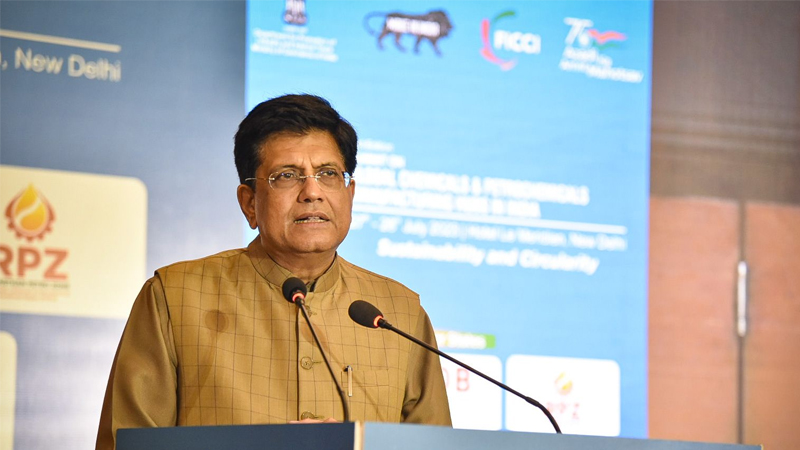
Union Minister of Commerce and Industry, Consumer Affairs, Food & Public Distribution and Textiles, Shri Piyush Goyal said that the chemical and petrochemical industry play a crucial role in India’s economic progress and is expected to continue being a key driver of growth in the future. While addressing the Session on ‘FTAs – Connecting the world- Vasudhaiva Kutumbakam- One Earth, One Family, One Future’ as the Chief Guest at the 3rd Edition Summit on ‘India: Global Chemicals and Petrochemicals Manufacturing Hubs’ (GCPMH 2023) in New Delhi yesterday Sh. Goyal appreciated the contribution of the chemical and petrochemical industry to India’s economy, innovation ecosystem and employment generation.

The Minister said that the Free Trade Agreements (FTAs) play an important role in enhancing exports and encourage the growth of multiple sectors collectively.  He said that GCPMH 2023 Summit acts as a forum to explore the ways in which FTAs can facilitate trade, investment and collaboration in the chemicals and petrochemicals industry.

Sh. Goyal lauded GCPMH 2023 for providing a platform for industry leaders, policymakers, and experts to discuss and exchange ideas on leveraging FTAs to enhance the competitiveness and sustainability of this vital sector. He said that FTAs can help in attracting foreign investment into India’s chemical and petrochemical industries. The Minister highlighted that this would lead to creation of new jobs and development of new infrastructure strengthening the industry’s ability to connect with the world.

Sh. Piyush Goyal highlighted the importance of sustainability in our goal towards becoming a developed nation. He also mentioned how important it is for the present generation to create a sustainable India for the future generation. The Minister applauded the efforts and dedication of all stakeholders for promoting sustainable practices and commitment to finding sustainable solutions.

He said that sharing best practices, and fostering collaboration will undoubtedly pave the way for a more sustainable and prosperous future in the chemical and petrochemical industries. Sh. Goyal urged the present generation to work with a sense of duty and commitment towards the coming generations. He quoted Mahatma Gandhi and said that “All of us have inherited the planet Earth as trustees for the next generation.”

India has become the Pharmacy of the World, now it is time for India to become the Factory of the World: Dr. Mansukh Mandaviya

| Published on:

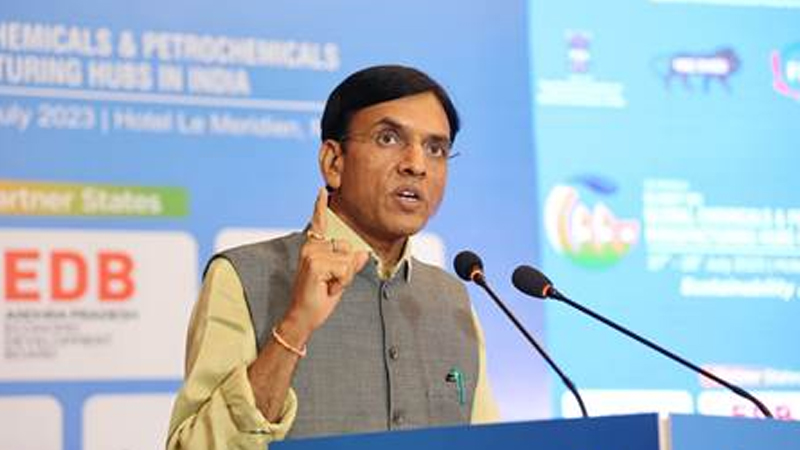
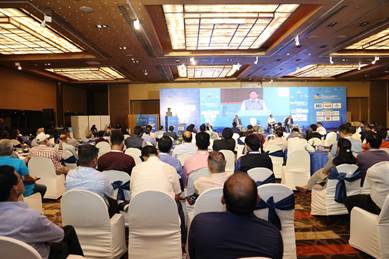
“India has become the Pharmacy of the World, now it is time for India to become the Factory of the World.” This was stated by Dr. Mansukh Mandaviya as he delivered the closing address at the Valedictory Session, of the 3rd Edition of the Summit on “Global Chemicals and Petrochemicals Manufacturing Hubs in India” (GCPMH 2023). Themed “Sustainability and Circularity,” and hosted by the Federation of Indian Chambers of Commerce and Industry (FICCI), the GCPMH 2023 Summit witnessed enthusiastic participation from various sectors and stakeholders.

The Minister stressed that a vibrant industry is essential for the economy and aatmanirbharta of any nation. In this regard he highlighted the role of the government to support the industry. “As a government we don’t think in token, but in total. We want to build a holistic ecosystem to ensure maximum governance, and minimum government for the industry at large.” Dr. Mandaviya further invited suggestions which will drive innovative and sustainable solutions for positive change and progress in this sector.

Shri Arun Baroka, Secretary, Department of Chemicals & Petrochemicals, Union Ministry of Chemicals and Fertilizers, recapped the two-day event, and said, “This summit has served as a collaborative platform for the central and state government, as well as the industry to interact.” He highlighted the focus on certain essential parts of the chemicals and petrochemicals industry like funding, as well as environmental clearances, which were in line with the theme of the event.

The event saw the participation of several industry leaders whose engagement has played a pivotal role in advancing the sustainable growth of the industry.

PM dedicates Rajkot International Airport to the nation in Rajkot, Gujarat

| Published on:

The Prime Minister, Shri Narendra Modi dedicated to the nation, Rajkot International Airport and multiple development projects worth over Rs 860 crores in Rajkot, Gujarat today. The projects include Sauni Yojana Link 3 Package 8 and 9, upgradation of Dwarka Rural Water Supply and Sanitation (RWSS), conservation, restoration & development of Uparkot Fort Phase I & II; construction of a water treatment plant, sewage treatment plant, and flyover bridge among others. The Prime Minister also took a walkthrough of the terminal building of the newly inaugurated Rajkot International Airport.

Addressing the gathering, the Prime Minister said that today is a huge day not only for Rajkot but the entire Saurashtra region. He paid tributes to those who suffered losses due to natural calamities in the region such as a cyclone and the recent floods. The Prime Minister remarked that the government and the people have faced the crisis together and assured that those affected are being rehabilitated with the assistance of the state government. He also mentioned that the central government is providing every possible support to the state government.

The Prime Minister said that now Rajkot is recognized as the growth engine of Saurashtra. He said despite its industry, culture and cuisine, the need for the International Airport was felt which has been met today. The Prime Minister recalled that Rajkot chose him as MLA for the first time and said that the city has taught him a lot. “The debt from Rajkot is always there and I always try to reduce that”, he added.

Referring to the airport inaugurated today, the Prime Minister said that apart from ease of travel, industries of the region will be hugely benefited from the airport. The Prime Minister said that Rajkot has realized the vision of ‘Mini Japan’ that he saw as the new Chief Minister. He said in the shape of the Airport, Rajkot has received a powerhouse that will give it new energy and flight.

Speaking about the Sauni Yojna under which various projects have been inaugurated today, the Prime Minister said that the completion of projects will lead to water supply for drinking and irrigation to dozens of villages in the region. The Prime Minister congratulated the people of Rajkot for the development projects of today.

In the last 9 years, the Prime Minister said that the central government has worked towards making the lives of every social class and region easier. “We have guaranteed ‘Sushasan’ or good governance and we are also accomplishing it today”, the Prime Minister said, “Be it the poor, dalits, tribals or the backward class, we have always worked towards improving their lives.” Underlining that the levels of poverty in the country are reducing at a very fast rate, the Prime Minister cited a recent report which states that 13.5 crore citizens have come out of poverty in the last 5 years and said that these people are emerging as a neo-middle class in the country. Therefore, the Prime Minister said, both the neo-middle class and the middle class are the government’s priority encapsulating the entire middle class.

The Prime Minister dwelled on the middle classes’ long pending demand of the past about connectivity. He listed the steps taken in the last 9 years to improve connectivity. In 2014, only 4 cities had Metro Network, today Metro network has reached more than 20 cities in India. Modern trains like Vande Bharat are running on 25 routes; the number of airports have more than doubled from 70 in 2014 during this period. “Expansion of air services has given new heights to India’s aviation sector. Indian companies are purchasing aircrafts worth crores of rupees”, he said. He also informed that Gujarat is moving forward in the direction of building aircrafts.

“Ease of living and quality of life is among the top priorities for the government”, the Prime Minister remarked. Recalling the inconveniences faced by people in the past, the Prime Minister mentioned the long queues at hospitals and utility payment centers, insurance and pension-related problems, and hassles in filing tax returns. He further stated that all these issues have been tackled by the Digital India campaign. He mentioned the ease of mobile banking and online filing for tax returns and also underlined that the returns are transferred directly into the bank accounts in a short time.

Talking about the importance of housing, the Prime Minister said “We took care of the housing needs of the poor and also fulfilled the middle class’s  dream of a house.”   He mentioned a special subsidy of up to 18 lakh Rs under the PM Awas Yojna for the middle class. More than 6 lakh families have benefitted, including 60 thousand in Gujarat, he informed.

The Prime Minister touched upon the fraud that took place in the name of housing and mentioned that the possession of the house was not given for many years during previous governments due to the absence of law. He further added that it is the present government which enacted the RERA law and safeguarded the interests of the people. “Today, the RERA law is preventing lakhs of people from being robbed of their money”, he added.

The Prime Minister said that in the past inflation rate had touched 10 per cent. He said that the current government kept inflation under control despite the pandemic and the war. “Today, inflation is increasing at the rate of 25-30 percent in our neighboring countries. But this is not the case in India. We have been trying to control inflation with full sensitivity and will continue to do so in the future”, he said.

The Prime Minister underlined that along with saving the expenses of the poor and the middle class, the government is also ensuring maximum savings in the pockets of the middle class. He mentioned that 9 years ago, tax was levied on annual income of Rs 2 lakh, but today those earning up to Rs 7 lakhs have to pay zero tax. “There is no tax on the income of Rs 7 lakhs”, the Prime Minister said as he noted that it is saving thousands of rupees every year for middle-class families living in cities. He also mentioned higher interest payouts on small savings and 8.25 percent interest being fixed on EPFO.

The Prime Minister gave the example of mobile phone usage cost to illustrate how policies are saving money for the citizens. He said that 1 GB of data used to cost 300 Rs in 2014. Today on average, 20 GB of data is used per person per month. This has resulted in a saving of more than 5000 rupees per month for an average citizen, he said.

Speaking about the Jan Aushadhi Kendras offering medicines at a cheaper price, the Prime Minister said that it is a blessing for those who ought to take regular medicines and informed that these kendras have helped save about Rs 20,000 crores of the poor and middle class. “A sensitive government for the poor and the middle class works like this”, he added.

The Prime Minister said that the government is working with full sensitivity for the development of Gujarat and Saurashtra. He touched upon the change that the Sauni scheme brought to the water situation of the region. “Dozens of dams and thousands of check dams in Saurashtra have become sources of water today. Under the Har Ghar Jal Yojana, crores of families in Gujarat are now getting tap water”, he added.

Concluding the address, the Prime Minister said that this model of governance which has been developed in the last 9 years adheres to the needs and aspirations of every section of the society. “This is our way to build a Viksit Bharat. We have to prove the resolutions of Amrit Kaal by walking this very path”, the Prime Minister concluded.

Chief Minister of Gujarat, Shri Bhupendra Patel, Union Minister for Civil Aviation, Shri Jyotiraditya Scindia, Member of Parliament, Shri C R Patil, Ministers from Government of Gujarat and Gujarat Legislative Assembly were present on the occasion among others.

Background

The Prime Minister’s vision to improve air connectivity across the country gets a fillip with the development of a new International Airport in Rajkot. The Greenfield Airport has been developed in a total land area of more than 2500 acres and at a cost of more than Rs 1400 crores. The new airport has an amalgamation of modern technology and sustainable features. The terminal building is GRIHA -4 compliant (Green Rating for Integrated Habitat Assessment) and the New Terminal Building (NITB) is equipped with various sustainability features like Double Insulated Roofing System, skylights, LED Lighting, Low Heat Gain Glazing etc.

Rajkot’s cultural vibrancy has inspired the design of the terminal of the airport and it will depict art forms from Lippan art to Dandiya dance through its dynamic external façade and splendid interiors. The Airport will be the epitome of the local architectural heritage and will reflect the cultural glory of art and dance forms of the Kathiawar region of Gujarat.  The new airport in Rajkot will contribute not only towards the development of the local automobile industry of Rajkot but will also encourage trade, tourism, education and industrial sectors throughout Gujarat.

The Prime Minister also inaugurated development projects worth over Rs 860 crores. Sauni Yojana Link 3 Package 8 and 9 will help further strengthen irrigation facilities and provide drinking water benefits for the Saurashtra region. Upgradation of Dwarka RWSS will help provide adequate and potable water to villages by pipeline. Other projects being taken up include the Conservation, Restoration & Development of Uparkot Fort Phase I & II; construction of a water treatment plant; sewage treatment plant; flyover bridge, among others.

PM lays foundation stone and dedicates to nation various development projects in Sikar, Rajasthan

| Published on:

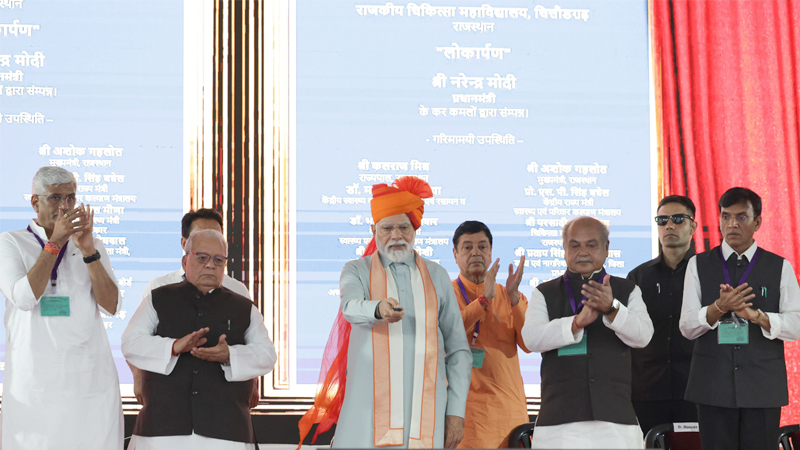
The Prime Minister, Shri Narendra Modi laid the foundation stone and dedicated to the nation various development projects in Sikar, Rajasthan today. The projects include dedicating to the nation more than 1.25 lakh PM Kisan Samriddhi Kendras (PMKSKs), launching Urea Gold – a new variety of Urea coated with Sulphur, onboarding 1600 Farmer Producer Organisations (FPOs) on Open Network for Digital Commerce (ONDC), releasing 14th installment amount of about Rs 17,000 crores under the Pradhan Mantri Kisan Samman Nidhi (PM-KISAN) to 8.5 crore beneficiaries, inaugurating 5 new medical colleges at Chittorgarh, Dholpur, Sirohi, Sikar and Sri Ganganagar, laying the foundation stone for 7 medical colleges at Baran, Bundi, Karauli, Jhunjhunu, Sawai Madhopur, Jaisalmer and Tonk, and inaugurating 6 Eklavya Model Residential Schools located in districts of Udaipur, Banswara, Partapgarh and Dungarpur and Kendriya Vidyalaya Tivri, Jodhpur.

Upon arriving at the venue, the Prime Minister took a walkthrough of the model of PM Kisan Samriddhi Kendra. Addressing the gathering, the Prime Minister paid tributes to the crores of farmers that have joined today’s program from numerous places in the country and said that the land of Khatu Shyam ji reassures the pilgrims from every nook and corner of India. He expressed gratitude for getting the opportunity to initiate various development programs from the heroic land of Shekhawati and mentioned the direct transfer of the installment under the Pradhan Mantri Kisan Samman Nidhi (PM-KISAN) to crores of farmer-beneficiaries. Speaking about the dedication of more than 1.25 lakh PM Kisan Samriddhi Kendras in the country, the Prime Minister said that it would directly benefit crores of farmers at the village and block level. He also mentioned the onboarding of Farmer Producer Organisations (FPOs) on Open Network for Digital Commerce (ONDC) and said that it would make it easier for the farmers to take their produce to the market from any part of the country. He also mentioned the launch of Urea Gold, new medical colleges and Eklavya Model Schools. The Prime Minister congratulated the people of India as well as crores of farmers for today’s development projects.

Noting the importance of farmers of the Sikar and Shekhawati regions, the Prime Minister paid tribute to their hard work despite the hardships of the terrain. The Prime Minister said that the current government at the center understands the pains and needs of the farmers. The Prime Minister explained how, from seed to market (Beej se Bazaar tak) new systems have been created in the last 9 years. He recalled that the Soil Health Card scheme was launched in Suratgarh in 2015. Through the scheme, crores of farmers are making optimal decisions based on the knowledge about the health of the soil. He said 1.25 PM Kisan Samriddhi Kendras (PMKSKs) will pave the way for the prosperity of the farmers. These Kendras are being developed as one-stop shops for the needs of the farmers. These centers will also provide advanced modern information on agriculture-related issues to the farmers. And these kendras will also provide timely information regarding agriculture schemes of the government also. The Prime Minister advised the farmers to keep visiting the kendras and benefit from the knowledge available there. The Prime Minister informed that an additional 1.75 lakh PM Kisan Samriddhi Kendras (PMKSKs) will be established before the end of the year.

The Prime Minister said that the present Government is working in all earnest to reduce the expenses of the farmers and support them in their time of need. Referring to PM Kissan Samman Nidhi, the Prime Minister said that it is the largest scheme in the world where funds are directly transferred into the bank accounts of farmers. He informed that more than 2 lakh 60 thousand crore rupees have been directly transferred to the bank accounts of farmers so far if today’s 14th installment is to be included which has been beneficial to the farmers in covering various expenses. He said that the price of urea in the country is an example of the government saving the farmers’ expenses. Referring to the Coronavirus pandemic and the Russia-Ukraine war which led to huge disruptions in the fertilizer sector, the Prime Minister underlined that the present government did not let this affect the farmers of the country. Speaking about the prices of fertilizers, the Prime Minister informed that the bag of urea which costs Rs 266 in India costs about Rs 800 in Pakistan, about Rs 720 in Bangladesh, about Rs 2100 in China and about Rs 3000 in USA. “The government will not let the urea prices bother our farmers”, Shri Modi said, “When a farmer goes to buy urea, he has the belief that it is Modi’s guarantee.”

The Prime Minister talked about the promotion of millet and measures like branding millets as Shree Anna. He said that through the promotion of Shree Anna, its production, processing and export are increasing. He recalled the presence of millets in the Official White House dinner during his recent visit.

The Prime Minister said “India’s development is possible only if its villages develop. India can be Viksit only with Viksit villages. That is why the government is working to make all the facilities available in the villages, which were so far available only in the cities”. Mentioning the expanding health infrastructure, the Prime Minister said that Rajasthan had only ten medical colleges till 9 years ago. Today this number has reached 35. This is improving medical facilities in nearby areas and giving opportunities for quality education for the medical students. He said that medical colleges being inaugurated today and those for which the foundation stone is being laid will improve medical infrastructure in many areas of the state. As medical education is being made accessible, the Prime Minister also mentioned the step to provide medical education in the mother tongue, further democratizing it and opening avenues for the deprived sections. “Now any son or daughter of a poor person will not be deprived of the opportunity to become a doctor due to not knowing English. This too is a guarantee of Modi.”

For decades, the Prime Minister said that the villages and the poor were also left behind due to a lack of good schools and education in the villages and lamented that the children of backward and tribal societies had no means to fulfill their dreams. Shri Modi mentioned that the present government increased the budget and resources for education and opened Eklavya residential schools which have hugely benefited the tribal youth.

“Success becomes big only when the dreams are big”, the Prime Minister said. Noting that Rajasthan is a state whose splendor has enchanted the world for centuries, the Prime Minister emphasized preserving the heritage of the land while taking Rajasthan to the height of modern development. That is why, the Prime Minister said, it is our priority to create modern infrastructure in Rajasthan. He mentioned the inauguration of two hi-tech expressways in the last few months and said that Rajasthan is writing a new saga of development through a major section of the Delhi-Mumbai Expressway and the Amritsar-Jamnagar Expressway. He also mentioned the Vande Bharat Express train being run from the state. Shri Modi stated that the Government is investing in infrastructure and developing facilities related to tourism which will result in new opportunities for Rajasthan as well. “Expressways and better rail facilities will welcome the tourists when Rajasthan calls out ‘Padharo mahare desh’”, he said. The Prime Minister also touched upon the expansion of facilities in Khatu Shyam Ji Temple under the Swadesh Darshan scheme and expressed confidence that the development of Rajasthan will gain more momentum with the blessings of Shri Khatu Shyam. “We all will give a new identity to the pride and heritage of Rajasthan in the whole world”, Shri Modi said.

The Prime Minister ended by wishing good health to the Chief Minister of Rajasthan, Shri Ashok Gehlot, who is ailing for some time and could not come to the event.

Governor of Rajasthan, Shri Kalraj Mishra, Union Minister for Agriculture and Farmers’ Welfare, Shri Narendra Singh Tomar, Union Minister for Jal Shakti, Shri Gajendra Singh Shekhawat,  Union Minister for Health and Family Welfare, Shri Mansukh Mandaviya, Union Minister for Law and Justice, Shri Arjun Ram Meghwal, and Union Minister of State for Agriculture and Farmers’ Welfare, Shri Kailash Choudhary were present on the occasion among others.

Background

In a significant move benefiting farmers, the Prime Minister dedicated more than 1.25 lakh PM Kisan Samriddhi Kendras (PMKSKs) to the nation. PMKSKs are being developed to provide a one-stop solution for all farmers’ needs. From information on agri-inputs (fertilizers, seeds, implements) to testing facilities for soil, seeds, and fertilizers, to information regarding various government schemes, PMKSKs are envisaged to become a reliable support system for farmers in the country. They will also ensure regular capacity building of fertilizer retailers at block/district level outlets.

The Prime Minister launched Urea Gold – a new variety of Urea that is coated with Sulphur. The introduction of Sulphur Coated Urea will address sulfur deficiencies in the soil. This innovative fertilizer is more economical and efficient than neem-coated urea, improves nitrogen use efficiency in plants, reduces consumption of fertilizer, and enhances crop quality.

During the programme, the Prime Minister launched the onboarding of 1600 Farmer Producer Organisations (FPOs) on Open Network for Digital Commerce (ONDC). ONDC empowers FPOs with direct access to digital marketing, online payment, Business-to-business (B2B) and Business-to-consumer transactions, and encourages local value addition, catalyzing growth of logistics in rural areas.

In a step that will showcase yet another example of the Prime Minister’s commitment towards the welfare of farmers, the 14th installment amount of about Rs. 17,000 crores under the Pradhan Mantri Kisan Samman Nidhi (PM-KISAN), was released through direct benefits transfer to more than 8.5 crore beneficiaries.

Rajasthan will witness a major expansion in health infrastructure as Prime Minister inaugurated five new medical colleges at Chittorgarh, Dholpur, Sirohi, Sikar and Sri Ganganagar and lay the foundation stone for seven medical colleges at Baran, Bundi, Karauli, Jhunjhunu, Sawai Madhopur, Jaisalmer and Tonk. The medical colleges are being established under the Centrally Sponsored Scheme for “Establishment of new medical colleges attached with existing district/ referral hospitals”. The five medical colleges inaugurated by the Prime Minister have been developed at a cumulative cost of more than Rs 1400 crore, while the seven medical colleges whose foundation stone will be laid will be built at a cumulative cost of Rs 2275 crore. Until 2014, there were only 10 medical colleges in the State of Rajasthan. Through dedicated efforts of the Central Government, the number of medical colleges in the State has grown to 35, which is a 250% increase. The establishment of these 12 new medical colleges would increase the number of MBBS seats in the State to 6275 seats from 1750 seats in 2013-14, which would be a 258% increase.

Further, the Prime Minister inaugurated six Eklavya Model Residential Schools located in the districts of Udaipur, Banswara, Partapgarh and Dungarpur which will benefit the tribal population residing in these districts. He will also inaugurate Kendriya Vidyalaya Tivri, Jodhpur during the programme.

FM inaugurates ‘3Rd Summit on Global Chemicals & Petrochemicals Manufacturing hubs in India’

| Published on:

Union Minister of Finance and Corporate Affairs Smt.  Nirmala Sitharaman inaugurated the 3rd Edition of Summit on “Global Chemicals and Petrochemicals Manufacturing Hubs in India” (GCPMH 2023) today at New Delhi. Minister of State for Chemicals and Fertilisers Shri Bhagwant Khuba was also grace the occasion. Minister of Industries, MSME & Energy, Govt of Odisha Shri Pratap Keshari, Secretary, Department of Chemicals and Petrochemicals Shri Arun Baroka, Chairman-FICCI Petrochemicals Committee and MD & CEO Shri Prabh Das and Senior Officers of Ministry, Senior Captains of the Industry, Academicians, Policy makers and others with interest in the emerging opportunities in the Chemical & Petrochemical Industry were also present on this occasion.

The Department of Chemical & Petrochemical, Ministry of Chemicals and Fertilisers  in association with the Federation of Indian Chambers of Commerce and Industry (FICCI) is organizing this summit.

On this occasion, Smt. Nirmala Sitharaman said that the Indian chemical and petrochemicals sector has huge potential and it also impacts other sectors of the economy. The importance of the sector can be gauged from the fact that it deals with more than 80,000 chemicals products which involves sectors like Agriculture, Infrastructure, Textiles, Pharma, Packaging, etc.

She also stated that India is all set to become energy independent by 2047 and achieving net zero by 2070. She highlighted the need to focus on Green growth and reduction in carbon intensity. The combined exports of major chemicals and petrochemicals in 2022-23 was $9 billion but imports also increased to $ 13.33 billion. Many of these imports included items which can be produced in India itself and the Government is putting all out efforts in this direction as well.

The Finance minister also brought attention towards the market of Specialty chemicals which is growing exponentially at 12% CAGR. Thus, there is need for more robust support for specialized chemicals. The emergence of this market is driven by country’s strong process engineering capabilities, low-cost manufacturing capabilities and abundant manpower.

Shri Bhagwanth Khuba said that the government is working with state governments to set-up chemical parks in the country and the process of setting up plastic parks is already in place. Government is also creating Center of Excellences to bring industry and academia together along with promoting skill development. The market size of the Chemical and Petrochemical sector is around $ 190 billion and is likely to reach $ 300 billion by 2025 and $ 1 trillion by 2040 with huge opportunities for investments.

In his address, Shri Pratap Keshari Deb said that the State is growing domestically at 8 per cent in the chemicals sector and to sustain this over the next 10 years, Odisha would need 40 per cent growth in the capacity. The Industrial Policy Resolution, 2022 of Odisha is very industrial friendly with provisions like tax breaks for manufacturing units, electrical duty exemption etc.

Shri Arun Baroka, Secretary said that India is poised for a very high growth in Chemicals & Petrochemicals sector supported by the policy reforms along with increasing demand. If India grows at the prevailing rate, the chemicals sector will increase to USD 1 Trillion by 2047. Four PCPIRs is helping the growth of this sector. Along with this the proposed Chemical Parks will go a long way to help the industry grow at a faster rate.