Prime Minister’s meeting with President of Egypt

| Published on:

Prime Minister Shri Narendra Modi was received by the President of the Arab Republic of Egypt, H.E. Mr. Abdel Fattah Al-Sisi at Al-Ittihadiya Palace on 25 June 2023.

The two leaders warmly recalled the State Visit of President Sisi as the Chief Guest at the Republic Day celebrations in January 2023, and welcomed the momentum it has imparted to bilateral relations. They agreed that the newly established ‘India Unit’ in Egyptian Cabinet was a useful tool in steering bilateral collaborations.

The leaders discussed ways to further deepen the partnership between the two countries, particularly in areas like trade and investment, information technology, defence and security, renewable energy, agriculture, health, culture and people to people ties.

Prime Minister and President Sisi also discussed further cooperation in G-20, highlighting the issues of food and energy insecurity, climate change and the need for Global South to have a concerted voice. Prime Minister looked forward to welcoming President Sisi in New Delhi in September 2023 for the G20 Leaders Summit.

An agreement to elevate the bilateral relationship to a “Strategic Partnership” was signed by the to leaders. Three MoUs in the fields of Agriculture, Archaeology & Antiquities and Competition Law were also signed.

Prime Minister of Egypt, H.E. Mr. Mostafa Madbouly and a number of other senior Cabinet Ministers were present. From the Indian side, EAM, NSA and senior officials were present.

Prime Minister conferred with the Order of the Nile

| Published on:

In a special ceremony at the Presidency in Cairo on 25 June 2023, President of the Arab Republic of Egypt, H.E. Mr. Abdel Fattah El-Sisi, conferred Prime Minister Shri Narendra Modi with the ‘Order of the Nile’, the highest civilian award of Egypt.

Prime Minister thanked President Sisi for the honor on behalf of the people of India.

Prime Minister is the first Indian to receive the award.

Prime Minister’s Interaction with the Indian Community in Egypt

| Published on:

Prime Minister Shri Narendra Modi interacted with Indian community members on 24 June 2023 in Cairo, during his State visit to Egypt.

In his interaction with them, Prime Minister lauded the community for their contribution towards strengthening India-Egypt ties.

Over 300 members of the Indian diaspora, comprising students, professionals, and businesspersons, participated in the event.

Prime Minister’s interaction with Indian community members in USA

| Published on:

Prime Minister Shri Narendra Modi interacted with the members of the Indian community on June 23, 2023 at the Ronald Reagan Centre in Washington D.C.

In his address, Prime Minister congratulated Indian community members for the success in their respective fields in USA and invited them to contribute to India’s growth during Amrit Kaal. Prime Minister also thanked them for playing a significant role in strengthening India-USA ties, and highlighted future areas of bilateral partnership.

PM’s meeting with Sundar Pichai, CEO of Alphabet Inc. and Google

| Published on:

Prime Minister Shri Narendra Modi met CEO of Alphabet Inc. and Google, Mr. Sundar Pichai on June 23, 2023 in Washington DC.

Prime Minister invited Mr. Pichai to explore further avenues of collaboration in the domains of Artificial Intelligence (AI); fintech; cybersecurity products & services; as well as mobile device manufacturing in India.

Prime Minister and Mr. Pichai also discussed collaboration between Google and academic institutions in India to promote R&D and skill development.

PM’s participation in the India-US Hi-Tech Handshake event

| Published on:

Prime Minister Shri Narendra Modia and President of USA H.E. Mr. Joseph R. Biden, participated in a India-US Hi-Tech Handshake event at the White House in Washington D.C. today. The event was moderated by US Secretary of Commerce, H.E. Ms. Gina Raimondo, and saw the participation of leading Indian and American CEOs of tech companies and startups. The thematic focus of the forum was on ‘AI for All’ and ‘Manufacturing for Mankind’.

The event was an opportunity for both leaders to review the deepening technology collaboration between India and USA. Discussions focused on the role and potential of the India-US Technology Partnership in driving the adoption of an AI enabled inclusive economy to meet the needs of their citizens and the world. The CEOs explored ways of leveraging existing linkages between the two tech ecosystems, India’s talented workforce and advances made by India in Digital Public Infrastructure, to build global collaborations. They called for regular engagement between the respective industries to kickstart strategic collaborations, cooperate on standards and foster innovation.

In his remarks, Prime Minister underlined the immense potential of harnessing India-US tech cooperation for socio-economic growth. He also applauded the contribution of India’s talented youth in fostering a culture of innovation. President Biden called on CEOs to help expand India-US tech partnership to new fields including biotechnology and quantum. Both leaders underscored that India-US partnership would play an instrumental role in building a better future for our people and for the world.

The following business leaders participated in the event:

From USA:

1. Revathi Advaithi, CEO, Flex
2. Sam Altman, CEO, OpenAI
3. Mark Douglas, President and CEO, FMC Corporation
4. Lisa Su, CEO, AMD
5. Will Marshall, CEO, Planet Labs
6. Satya Nadella, CEO, Microsoft
7. Sundar Pichai, CEO, Google
8. Hemant Taneja, CEO and Managing Director, General Catalyst
9. Thomas Tull, Founder, Tulco LLC
10.Sunita Williams, NASA Astronaut

From India:

1. Mr. Anand Mahindra, Chairman, Mahindra Group
2. Mr. Mukesh Ambani, Chairman & MD, Reliance Industries
3. Mr. Nikhil Kamath, Co-Founder, Zerodha & True Beacon
4. Ms. Vrinda Kapoor, Co-Founder, 3rdiTech

Prime Minister’s meeting with President of USA

| Published on:

Prime Minister Shri Narendra Modi is on Official State Visit to USA. He visited the White House today morning, where he was accorded a ceremonial welcome by H.E. Mr. Joseph Biden and First Lady Dr. Jill Biden. Thousands of Indian-Americans were also present at the occasion to welcome the Prime Minister.

Prime Minister, thereafter, had productive conversations with President Biden, in restricted and delegation-level formats. The leaders highlighted the long-standing friendship and growing cooperation between the two countries, which spans areas like trade and investment, defence and security, energy, climate change, and people-to-people ties.

Both leaders underscored the mutual trust and understanding, as well as the shared values between the two countries, which provide a strong foundation to take the relationship to new levels. They appreciated the rapid progress made through initiatives such as the Critical and Emerging Technologies(iCET) and the keen desire to elevate strategic technology collaborations to build resilient supply chains. They welcomed the deepening cooperation in critical minerals and space sectors.

Both leaders reiterated their commitment to combating climate change and achieving a sustainable future. They discussed ways to promote clean and renewable energy and collaborate on climate initiatives.

Both leaders expressed their determination to further deepen the multifaceted Comprehensive Global Strategic Partnership between India and USA for the benefit of their peoples and the global community. Discussions also covered regional and global issues of mutual interest.

Prime Minister expressed his appreciation for the warm welcome extended by President Biden and the First Lady. He looked forward to welcoming President Biden in New Delhi for the G20 Leaders’ Summit in September 2023.

Address by PM to the Joint Session of the US Congress

| Published on:

Mister Speaker,

Madam Vice President,
Distinguished Members of the US Congress,
Ladies and Gentlemen,
Namaskar!

It is always a great honour to address the United States Congress. It is an exceptional privilege to do so twice. For this honour, I extend my deepest gratitude on behalf of the 1.4 billion people of India. I see that nearly half of you were here in 2016. I feel your warmth as old friends. I can also see the enthusiasm of a new friendship in the other half. I remember Senator Harry Reid, Senator John McCain, Senator Orrin Hatch, Elijah Cummings, Alcee Hastings and others, who I met here in 2016, and who are sadly no longer with us.

Mister Speaker,

Standing here, seven Junes ago, that’s the June when Hamilton swept all the awards, I said that the hesitations of history were behind us. Now, when our era is at a crossroads, I am here to speak about our calling for this century. Through the long and winding road that we have travelled, we have met the test of friendship. A lot has changed since I came here seven summers ago. But a lot has remained the same – like our commitment to deepen the friendship between India and the United States. In the past few years, there have been many advances in AI – Artificial Intelligence. At the same time, there have been even more momentous developments in another AI – America and India.

Mister Speaker and Distinguished Members,

The beauty of democracy is the constant connect with the people, to listen to them, and feel their pulse. And, I know this takes a lot of time, energy, effort, and travel. It is a Thursday afternoon – a fly-out day for some of you. So, I am grateful for your time. I also know how busy you have been this last month.

Being a citizen of a vibrant democracy myself, I can admit one thing Mister Speaker – you have a tough job! I can relate to the battles of passion, persuasion and policy. I can understand the debate of ideas and ideology. But I am delighted to see you come together today, to celebrate the bond between world’s two great democracies – India and the United States. I am happy to help out whenever you need a strong bipartisan consensus. There will be – and there must be – a contest of ideas at home. But, we must also come together as one when we speak for our nation. And, you have shown that you can do it. Congratulations!

Mister Speaker,

The foundation of America was inspired by the vision of a nation of equal people. Throughout your history, you have embraced people from around the world. And, you have made them equal partners in the American dream. There are millions here, who have roots in India. Some of them sit proudly in this chamber. There is one behind me, who has made history! I am told that the Samosa Caucus is now the flavour of the House. I hope it grows and brings the full diversity of Indian cuisine here. Over two centuries, we have inspired each other through the lives of great Americans and Indians. We pay tribute to Mahatma Gandhi and Martin Luther King Junior. We also remember many others who worked for liberty, equality and justice. Today, I also wish to pay a heartfelt tribute to one of them – Congressman John Lewis.

Mister Speaker,

Democracy is one of our sacred and shared values. It has evolved over a long time, and taken various forms and systems. Throughout history, however, one thing has been clear.

Democracy is the spirit that supports equality and dignity.

Democracy is the idea that welcomes debate and discourse.
Democracy is the culture that gives wings to thought and expression.
India is blessed to have such values from times immemorial.
In the evolution of the democratic spirit, India is the Mother of Democracy.
Millennia ago, our oldest scriptures said,
‘एकम् सत् विप्रा बहुधा वदन्ति’.
It means – the truth is one but the wise express it in different ways.
Now, the US is the oldest and India the largest democracy.
Our partnership augurs well for the future of democracy.
Together, we shall give a better future to the world, and a better world to the future.

Mister Speaker,

Last year, India celebrated 75 years of its independence. Every milestone is important, but this one was special. We celebrated a remarkable journey of over 75 years of freedom, after a thousand years of foreign rule in one form or another. This was not just a celebration of democracy, but also of diversity. Not just of Constitution, but also of its spirit of social empowerment. Not just of our competitive and cooperative federalism, but also of our essential unity and integrity.

We have over two thousand five hundred political parties. Yes, you heard that right- two thousand five hundred. About twenty different parties govern various states of India. We have twenty-two official languages and thousands of dialects, and yet, we speak in one voice. Every hundred miles, our cuisine changes. From Dosa to Aloo Prantha and from Srikhand to Sandesh. We enjoy all of these. We are home to all faiths in the world, and we celebrate all of them. In India, diversity is a natural way of life.

Today, the world wants to know more and more about India. I see that curiosity in this House too. We were honoured to receive over hundred Members of the US Congress in India over the last decade. Everyone wants to understand India’s development, democracy and diversity. Everyone wants to know what India is doing right and how. Among close friends, I am happy to share the same.

Mister Speaker,

When I first visited the US as Prime Minister, India was the tenth largest economy in the world. Today, India is the fifth largest economy. And, India will be the third largest economy soon. We are not only growing bigger but we are also growing faster. When India grows, the whole world grows. After all, we are one sixth of the world’s population! In the last century, when India won its freedom, it inspired many other countries to free themselves from colonial rule. In this century, when India sets benchmarks in growth, it will inspire many other countries to do the same. Our vision is सबका साथ, सबका विकास, सबका विश्वास, सबका प्रयास. It means: Together, for everyone’s growth, with everyone’s trust and everyone’s efforts.

Let me share with you how this vision is translating into action, with speed and scale. We are focusing on infrastructure development. We have given nearly forty million homes to provide shelter to over hundred and fifty million people. That is nearly six times the population of Australia! We run a national health insurance programme that ensures free medical treatment for about five hundred million people. That is greater than the population of South America! We took banking to the unbanked with the world’s largest financial inclusion drive. Nearly five hundred million people benefited.

This is close to the population of North America! We have worked on building Digital India. Today, there are more than eight hundred and fifty million smart phones and internet users in the country. This is more than the population of Europe! We protected our people with two point two billion doses of made in India COVID vaccines, and that too free of cost! I may be running out of continents soon, so I will stop here!

Distinguished members,

The Vedas are one of the world’s oldest scriptures. They are a great treasure of humanity, composed thousands of years ago. Back then, women sages composed many verses in the Vedas. And today, in modern India, women are leading us to a better future. India’s vision is not just of development which benefits women. It is of women-led development, where women lead the journey of progress. A woman has risen from a humble tribal background, to be our Head of State.

Nearly one point five million elected women lead us at various levels and that is of local governments. Today, women serve our country in the Army, Navy and Air Force. India also has the highest percentage of women airline pilots in the world. And, they have also put us on Mars, by leading our Mars Mission. I believe that investing in a girl child lifts up the entire family. Empowering women, transforms the nation.

Mister Speaker,

India is an ancient nation with a youthful population. India is known for its traditions. But the younger generation is also making it a hub of technology. Be it creative reels on Insta or real time payments, coding or quantum computing, machine learning or mobile apps, FinTech or data science, the youth of India are a great example of how a society can embrace latest technology. In India, technology is not only about innovation but also about inclusion. Today, digital platforms are empowering the rights and dignity of people, while protecting privacy.

In the last nine years, over a billion people got a unique digital biometric identity connected with their bank accounts and mobile phones. This digital public infrastructure helps us reach citizens within seconds with financial assistance. Eight hundred and fifty million people receive direct benefit financial transfers into their accounts. Three times a year, over hundred million farmers receive assistance in their bank accounts at the click of a button. The value of such transfers has crossed three hundred and twenty billion dollars, and we have saved over twenty five billion dollars in the process. If you visit India, you will see everyone is using phones for payments, including street vendors.

Last year, out of every 100 real time digital payments in the world, 46 happened in India. Nearly four hundred thousand miles of optical fibre cables, and cheap data have ushered in a revolution of opportunities. Farmers check weather updates, the elderly get social security payments, students access scholarships, doctors deliver tele-medicine, fishermen check fishing grounds and small businesses get loans, with just a tap on their phones.

Mister Speaker,

A spirit of democracy, inclusion and sustainability defines us. It also shapes our outlook to the world. India grows while being responsible about our planet.

We believe:

माता भूमि: पुत्रो अहं पृथिव्या:

This means- “the Earth is our Mother and we are her children.”

Indian culture deeply respects the environment and our planet. While becoming the fastest growing economy, we grew our solar capacity by Two Thousand Three Hundred Percent! Yes, you heard it right – Two Thousand Three Hundred Percent!

We became the only G20 country to meet its Paris commitment. We made renewables account for over forty percent of our energy sources, nine years ahead of the target of 2030. But we did not stop there. At the Glasgow Summit, I proposed Mission LiFE- Lifestyle for Environment. This is a way to make sustainability a true people’s movement. Not leave it to be the job of governments alone.

By being mindful in making choices, every individual can make a positive impact. Making sustainability a mass movement will help the world reach the Net Zero target faster. Our vision is pro-planet progress. Our vision is pro-planet prosperity. Our vision is pro-planet people.

Mister Speaker,

We live by the motto of वसुधैव कुटुंबकम or The World is One Family. Our engagement with the world is for everyone’s benefit. The “One Sun, One World, One Grid” seeks to join us all in connecting the world with clean energy. “One Earth, One Health” is a vision for global action to bring quality healthcare to everyone, including animals and plants.

The same spirit is also seen in the theme when we Chair the G20 – “One Earth, One Family, One Future.” We advance the spirit of unity through Yoga as well. Just yesterday, the whole world came together to celebrate the International Day of Yoga. Just last week, all nations joined our proposal at the UN to build a Memorial Wall to honour the peacekeepers.

And this year, the whole world is celebrating the International Year of Millets, to promote sustainable agriculture and nutrition alike. During Covid, we delivered vaccines and medicines to over hundred and fifty countries. We reach out to others during disasters as first responders, as we do for our own. We share our modest resources with those who need them the most. We build capabilities, not dependencies.

Mister Speaker,

When I speak about India’s approach to the world, the United States occupies a special place. I know our relations are of great importance to all of you. Every Member of this Congress has a deep interest in it. When defence and aerospace in India grow, industries in the states of Washington, Arizona, Georgia, Alabama, South Carolina, and Pennsylvania thrive. When American companies grow, their research and development centres in India thrive. When Indians fly more, a single order for aircrafts creates more than a million jobs in forty four states in America.

When an American phone maker invests in India, it creates an entire ecosystem of jobs and opportunities, in both countries. When India and the US work together on semi-conductors and critical minerals, it helps the world in making supply chains more diverse, resilient and reliable. Indeed, Mister Speaker, we were strangers in defence cooperation at the turn of the century. Now, the United States has become one of our most important defence partners. Today India and the US are working together, in space and in the seas, in science and in semi-conductors, in start-ups and sustainability, in tech and in trade, in farming and finance, in art and artificial intelligence, in energy and education, in healthcare and humanitarian efforts.

I can go on and on. But, to sum it up, I would say,
The scope of our co-operation is endless,
The potential of our synergies is limitless,
And, the chemistry in our relations is effortless.

In all this, Indian Americans have played a big role. They are brilliant in every field, not just in Spelling Bee. With their hearts and minds, talent and skills, and their love for America and India, they have connected us; they have unlocked doors; they have shown the potential of our partnership.

Mister Speaker, Distinguished Members,

Every Indian Prime Minister and American President of the past has taken our relationship further. But our generation has the honour of taking it to greater heights. I agree with President Biden that this is a defining partnership of this century. Because it serves a larger purpose. Democracy, demography and destiny give us that purpose. One consequence of globalisation has been the over-concentration of supply chains.

We will work together to diversify, decentralize, and democratise supply chains. Technology will determine the security, prosperity and leadership in the Twenty First century. That is why our two countries established a new “Initiative for Critical and Emerging Technologies.” Our knowledge partnership will serve humanity and seek solutions to the global challenges of climate change, hunger and health.

Mister Speaker and distinguished Members,

The last few years have seen deeply disruptive developments. With the Ukraine conflict, war has returned to Europe. It is causing great pain in the region. Since it involves major powers, the outcomes are severe. Countries of the Global South have been particularly affected. The global order is based on the respect for the principles of the UN Charter, peaceful resolution of disputes, and respect for sovereignty and territorial integrity.

As I have said directly and publicly, this is not an era of war. But, it is one of dialogue and diplomacy. And, we all must do what we can to stop the bloodshed and human suffering. Mister Speaker, The dark clouds of coercion and confrontation are casting their shadow in the Indo Pacific. The stability of the region has become one of the central concerns of our partnership.

We share a vision of a free, open and inclusive Indo Pacific, connected by secure seas, defined by international law, free from domination, and anchored in ASEAN centrality. A region where all nations, small and large, are free and fearless in their choices, where progress is not suffocated by impossible burdens of debt, where connectivity is not leveraged for strategic purposes, where all nations are lifted by the high tide of shared prosperity.

Our vision does not seek to contain or exclude, but to build a cooperative region of peace and prosperity. We work through regional institutions and with our partners from within the region and beyond. Of this, Quad has emerged as a major force of good for the region.

Mister Speaker,

More than two decades after 9/11 and more than a decade after 26/11 in Mumbai, radicalism and terrorism still remain a pressing danger for the whole world. These ideologies keep taking new identities and forms, but their intentions are the same. Terrorism is an enemy of humanity and there can be no ifs or buts in dealing with it. We must overcome all such forces sponsoring and exporting terror.

Mister Speaker,

COVID-19’s biggest impact was the human loss and suffering it caused. I wish to remember Congressman, Ron Wright and the staff members who lost their lives to Covid. As we emerge out of the pandemic, we must give shape to a new world order. Consideration, care and concern are the need of the hour. Giving a voice to the Global South is the way forward. That is why I firmly believe that the African Union be given full membership of G20.

We must revive multilateralism and reform multilateral institutions, with better resources and representation. That applies to all our global institutions of governance, especially the United Nations. When the world has changed, our institutions too must change. Or, risk getting replaced by a world of rivalries without rules. In working for a new world order based on international law, our two countries will be at the forefront, as partners.

Mister Speaker and Distinguished members,

Today, we stand at a new dawn in our relationship that will not only shape the destiny of our two nations, but also that of the world. As the young American Poet Amanda Gorman has expressed:

“When day comes we step out of the shade,
aflame and unafraid,
the new dawn blooms as we free it.
For there is always light,
if only we’re brave enough to see it.”

Our trusted partnership is like the Sun in this new dawn that will spread light all around.

I am reminded of a poem that I once wrote :

आसमान में सिर उठाकर
घने बादलों को चीरकर
रोशनी का संकल्प लें
अभी तो सूरज उगा है ।
दृढ़ निश्चय के साथ चलकर
हर मुश्किल को पार कर
घोर अंधेरे को मिटाने
अभी तो सूरज उगा है।।

If I were to say it in English, it would be:

Raising its head in the skies,
Piercing through the dense clouds,
With the promise of light,
The sun has just risen.
Armed with a deep resolve,
Overcoming all the odds,
To dispel the forces of darkness,
The sun has just risen.

Mister Speaker and Distinguished Members,

We come from different circumstances and history, but we are united by a common vision. And, by a common destiny. When our partnership progresses, economic resilience increases, innovation grows, science flourishes, knowledge advances, humanity benefits, our seas and skies are safer, democracy will shine brighter, and the world will be a better place.

That is the mission of our partnership. That is our calling for this century. Mister Speaker and Distinguished members, Even by the high standards of our partnership, this visit is one of a great positive transformation. Together, we shall demonstrate that democracies matter and democracies deliver. I count on your continued support to the India-US partnership.

When I was here in 2016, I had said that “our relationship is primed for a momentous future”. That future is today. Thank you once again Mister Speaker, Madam Vice-President and the Distinguished Members for this honour.

God Bless America.

Jai Hind.

Long Live India-US friendship.

PM addresses G20 Education Ministers’ Meet

| Published on:

The Prime Minister, Shri Narendra Modi addressed the G20 Education Ministers’ Meet held in Pune via video message today.

Addressing the gathering, the Prime Minister said that education is not only the foundation upon which our civilization has been built, but it is also the architect of humanity’s future. The Prime Minister referred to the Education Ministers as the Sherpas and said that they are leading mankind in its effort for development, peace, and prosperity for all. Shri Modi highlighted that the Indian scriptures describe the role of education as the key to bringing joy. Reciting a Sanskrit Shlok which means ‘True knowledge gives humility, from humility comes worthiness, from worthiness one gets wealth, wealth enables a person to do good deeds, and, this is what brings joy’, the Prime Minister said that India has embarked on a holistic and comprehensive journey. Shri Modi emphasized that foundational literacy forms a strong base for the youth and India is combining it with technology. He highlighted the ‘National Initiative for Proficiency in reading with Understanding and Numeracy”, or ‘Nipun Bharat’ initiative by the Government and expressed happiness that ‘Foundational Literacy and Numeracy’ has been identified as a priority by G20 as well. He also stressed working on it in a time-bound manner by 2030.

The Prime Minister emphasized the need to adapt and use new e-learning innovatively and said that the objective must be to provide quality education with better governance. He highlighted the several initiatives taken by the Government in this direction and mentioned ‘Study Webs of Active-learning for Young Aspiring Minds’, or ‘Swayam’, an online platform that hosts all courses from Class 9 to the post-graduate level and enables students to learn remotely while focussing on access, equity and quality. “With over 34 million enrolments and more than 9000 courses, it has become a very effective learning tool”, the Prime Minister added. He also mentioned the ‘Digital Infrastructure for Knowledge Sharing’ or ‘Diksha Portal’ which aims to deliver school education through distance learning. Shri Modi informed that it supports learning in 29 Indian and 7 foreign languages and has witnessed over 137 million course completions so far. Shri Modi also pointed out that India would be happy to share these experiences and resources, particularly with those in the Global South.

Underlining the need to make our youth future-ready by continuously skilling, reskilling and up-skilling them, the Prime Minister emphasized aligning their competencies with evolving work profiles and practices. In India, the Prime Minister added, we are undertaking skill mapping where the Education, Skill and Labour Ministries are working in tandem on this initiative. Shri Modi also suggested that G-20 countries can undertake skill mapping at the global level and find gaps that need to be plugged in.

The Prime Minister remarked that digital technology serves as an equalizer and promotes inclusivity. He said that it is a force multiplier in increasing access to education and adapting to future needs. He also touched upon the potential of Artificial Intelligence which offers great potential in the field of learning, skilling and education. He also stressed the role of G-20 in striking the right balance between the opportunities and challenges posed by technology.

Throwing light on the emphasis laid on research and innovation, the Prime Minister highlighted that India has set up ten thousand ‘Atal Tinkering Labs’ across the country which act as research and innovation nurseries for our school children. He informed that more than 7.5 million students are working on more than 1.2 million innovative projects in these labs. The Prime Minister stressed that G20 countries with their respective strengths can play a crucial role in promoting research & innovation, especially in the Global South. He urged the dignitaries to create a path for increased research collaborations.

Highlighting the significance of the G20 Education Ministers’ Meet towards the future of our children and youth, the Prime Minister expressed delight that the group has identified green transition, digital transformations and women’s empowerment as accelerators for achieving Sustainable Development Goals. “Education is at the root of all these efforts”, the Prime Minister said, as he expressed confidence that the outcome of the meeting will be an inclusive, action-oriented and future-ready education agenda. “This would benefit the whole world in the true spirit of Vasudhaiva Kutumbakam – One Earth, One Family, One Future”, the Prime Minister concluded.

Prime Minister participates in “India and USA: Skilling for Future” event with First Lady of USA

| Published on:

Prime Minister Shri Narendra Modi and First Lady of USA Dr. Jill Biden participated in an event focused on “India and USA: Skilling for Future” at National Science Centre in Washington DC.

The event focused on workforce redevelopment across higher education institutions to expand and enhance access to quality education across society.

Prime Minister highlighted the numerous steps taken by India to promote education, skilling and innovation. He appreciated ongoing bilateral academic exchanges, and collaborations between Indian and US academic and research ecosystems. Prime Minister presented 5-point proposals for energising India-USA collaboration in education and research sector, as follows:

  • Integrated approach bringing together government, industry and academia
  • Encouraging exchange of Teachers & Students
  • Organising Hackathons on various subjects between the two countries
  • Mutual recognition of vocational skills qualifications
  • Encouraging visits of people associated with education and research.

The event was attended by the President of Northern Virginia Community College, President of Association of American Universities, President and CEO of Micron Technology, and students.

Narendra Singh Tomar launches PM Kisan Mobile App with Face Authentication Feature

| Published on:

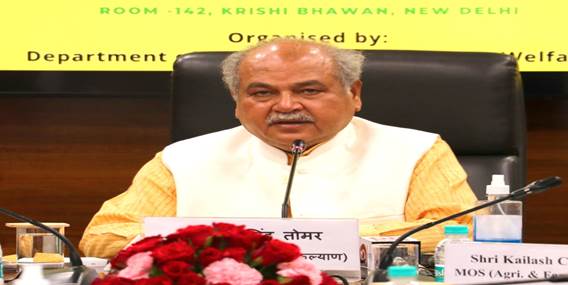
The PM-Kisan Mobile App with Face Authentication Feature was launched by Union Agriculture and Farmers’ Welfare Minister Shri Narendra Singh Tomar under the central government’s ambitious and popular scheme for income support to farmers “Pradhan Mantri Kisan Samman Nidhi”. Best example of modern technology using Face Authentication Feature from this app farmer can complete e-KYC remotely, sitting at home easily by scanning face without OTP or fingerprint and helped 100 other farmers to do e-KYC at their home. Recognizing the need to make e-KYC mandatory, the Government of India has extended the ability of farmers to perform e-KYC to officers of state governments, so that each officer can complete the e-KYC process for 500 farmers.

Thousands of farmers present in Krishi Vigyan Kendras across the country, as well as officers of the Central and State Governments and representatives of various government agencies and agricultural organizations were virtually connected to the event held at Krishi Bhavan, New Delhi. On this occasion, Union Minister Shri Tomar said that Prime Minister Kisan Samman Nidhi is a very comprehensive and ambitious scheme of the Government of India, in the implementation of which the state governments have performed their role very diligently, as a result of which we are in a position to pay the installment of the scheme about 8.5 crore farmers after KYC. The more refined this platform the more it will be useful for PM-Kisan and whenever any benefit has to be given to the farmers, complete data will be available with the Central and State Governments, so that no problem can arise in data verification.

Shri Tomar stated that PM-Kisan is an innovative scheme whose benefits are being given by the central government to the farmers without any middlemen. Today, it has become possible to give benefits to such a large number of farmers only with the help of technology. No one can question the implementation of this entire scheme which is a very important achievement. The work has become much easier by using technology the GoI developed this App. The Government of India has made all the necessary facilities available to the states, now if the states work more quickly, then we will reach to all the beneficiaries and achieve the set target.

Union Minister Shri Tomar said that Prime Minister Shri Narendra Modi has been continuously insisting that if sufficient funds are available for the scheme, then we have reached saturation. Work is going on in this direction in other states including Uttar Pradesh and on completion of which, maximum number of eligible farmers will be able to get the 14th installment of the scheme. Shri Tomar requested that all the state governments should act in this regard.

In the program, Union Minister of State for Agriculture and Farmers’ Welfare Shri Kailash Choudhary said that the agriculture sector is benefiting from technology and the new facility of this app will also provide a lot of convenience to the farmers. Union Agriculture Secretary Shri Manoj Ahuja also kept his views. Additional Secretary Shri Pramod Kumar Mehrada explained the features of the app. The program was coordinated by the departmental advisor Shri Manoj Kumar Gupta. On this occasion, officials of state governments also shared their experiences related to the benefits of scheme and app. Efforts will also be made to connect more and more farmers with the app through the youth and on the basis of the prescribed criteria, certificates will be given by the Ministry of Agriculture and Farmers’ Welfare to the youth who help in this.

PM Kisan is one of the world’s largest DBT schemes in which farmers get Rs 6,000 directly transferred through Aadhaar  linked bank accounts in three installments in a year. 2.42 lakh crore has been transferred to the accounts of more than 11 crore farmers, of whom more than 3 crore were women. PM Kisan Yojana proved to be a strong partner for the farmers even during the lockdown at the time of covid. The scheme has ensured necessary facilities by providing direct financial assistance to the farmers and has given them confidence in difficult times. Now the difficulties related to Aadhaar verification and bank account details updation on PM Kisan Portal have been resolved by effective use of digital public goods.

For the first time, it is seen that more than 8.1 crore farmers were successfully paid the 13th installment of PM Kisan directly into their Aadhaar linked bank accounts through Aadhaar Enabled Payment only, which is a record in itself. The new app is very easy to use and easily available for download on the Google Play Store. The app will also provide very important information related to the scheme and PM Kisan accounts to the farmers. In this, farmers can know the status of landseeding, linking of Aadhaar with bank accounts and e-KYC using the No User Status Module. The department has also roped in India Post Payment Bank (IPPB) to open Aadhaar linked bank accounts for beneficiaries at their doorstep and asked CSCs to organize village-level e-KYC camps with the help of States/UTs.

Dr Jitendra Singh proposes mechanism to follow up the progress of StartUps

| Published on:

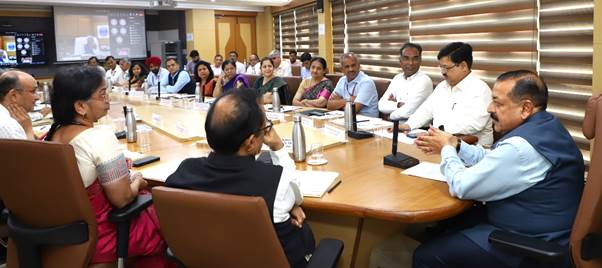
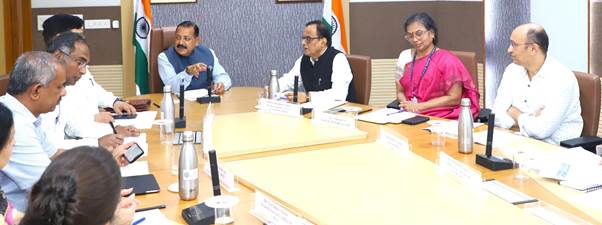
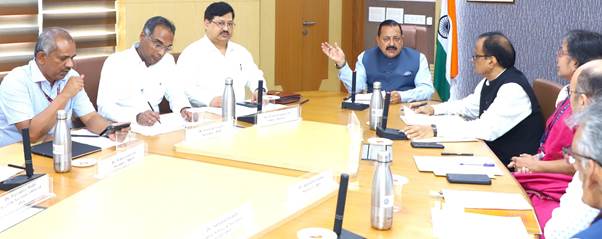
Union Minister of State (Independent Charge) Science & Technology; MoS PMO, Personnel, Public Grievances, Pensions, Atomic Energy and Space, Dr Jitendra Singh today said that a mechanism needs to be put in place to follow up the progress of Startups as their number have risen to more than a lakh.

“Such a mechanism is sought to be developed that will closely follow up the growth of these Startups, see how to sustain them so as to ensure that they are not lost out, especially those Startups that have received technical and financial support from the Government,” the Minister said, chairing a high-level joint meeting of different Science Ministries and Departments, including Science & Technology, Biotechnology, CSIR, Earth Sciences and Atomic Energy.

Dr Jitendra Singh had, some time back, desired that a presentation be prepared, in collaboration with the NITI Aayog, seeking to identify factors which could possibly be constraints for some StartUps. Accordingly, a presentation was made at today’s meeting by Dr Chintan Vaishnav from the NITI Aayog.

It was projected in the presentation that lack of innovation, lack of skilled workforce or lack of funds could possibly be the major factors adversely affecting the sustainability of some Startups. The Minister proposed that an exercise could be undertaken to assess whether the Startups could be identified by a “Unique ID” for effective monitoring across all sectors.

Dr Jitendra Singh said, this is the age of innovation and ideas. Under Prime Minister Narendra Modi, the government is providing every kind of technical as well as financial support for ideas and innovations to grow and sustain.  As a result, India has emerged as the leading StartUp ecosystem in the world with more than one lakh StartUps and more than 100 Unicorns and the time has come to strategise sustainability, he added.

The meeting was held as part of the monthly review meetings of Science Secretaries, initiated by Dr Jitendra Singh in order to break the silos and evolve a synergistic integrated approach among different scientific streams.

Principal Scientific Advisor to Government of India, Prof Ajay Kumar Sood and CEO, Atal Innovation Mission, Dr Chintan Vaishnav also addressed the meeting.

Secretary, DSIR & DG, CSIR, Dr N Kalaiselvi; Secretary, Department of Science & Technology, Dr Srivari Chandrasekhar; Secretary, DBT, Dr Rajesh Gokhale; Secretary (Earth Sciences), Dr M Ravichandran; and Chairman, AEC & Secretary, DAE, Dr AK Mohanty attended the deliberations. Senior Officers of the Science Ministries and Departments, including Science & Technology, Biotechnology, CSIR, Earth Sciences and Atomic Energy were also present.