PM addresses Post Budget Webinar on ‘Ease of Living using Technology’

| Published on:

The Prime Minister, Shri Narendra Modi, addressed a Post Budget Webinar on the subject of ‘Ease of Living using Technology’. It is the fifth of a series of 12 post-budget webinars organized by the government to seek ideas and suggestions for the effective implementation of the initiatives announced in the Union Budget 2023.

Addressing the gathering, the Prime Minister said that India of the 21st century is constantly empowering its citizens with the use of technology. He underlined that every budget in the past few years has stressed the ease of living for people with the help of technology. In this year’s budget, the Prime Minister emphasised,  the priority is given to technology and a human touch.

Highlighting the contradictions in the priorities of the previous governments, the Prime Minister recalled how a particular section of people always looked for government intervention and expected it to do good for the people. However, the Prime Minister said that their entire life was spent in the absence of these facilities. He also highlighted another section of people that wanted to move ahead but were dragged down by pressure and obstacles created by government intervention. The Prime Minister noted the changes that have taken place and said that the policies and their positive effects have been observed in situations where it is most necessary while making lives simpler and enhancing the ease of living. He also noted that government intervention has been reduced and citizens do not consider the government to be an obstacle. Instead, the Prime Minister said that citizens are looking at the government as a catalyst where technology plays a huge role.

The Prime Minister elaborated upon the role of technology in this by giving examples of One Nation One Ration Card and JAM (Jan Dhan-Aadhar-Mobile) trinity, Arogya Setu and CoWin App, railway reservation and Common Service Centers. With these decisions, the Prime Minister said that the government has enhanced the ease of living of the citizens.

The Prime Minister also highlighted the popular feeling about ease of communication with the government as the dialogue has become easy and people are getting quick resolutions. He gave examples of the faceless resolution of Income tax system-related grievances. “Now between your grievances and the redressal there is no person, just technology”, he said. The Prime Minister asked various departments to collectively think about using technology for solving their problems and reaching global standards. “Going a step further, we can identify the areas where dialogue with the government can be further eased”, he added.

The Prime Minister touched upon Mission Karmyogi and informed that the government employees are being trained with a view to becoming more citizen-centric. He also emphasised the need to keep updating the training process and highlighted that with modifications based on the feedback from the citizens, significant improvement can be witnessed. The Prime Minister suggested creating a system where feedback can be easily submitted to improve the training.

The Prime Minister highlighted the equal opportunities that technology is providing to everyone and said that the government is investing heavily in technology. Along with creating modern digital infrastructure, the government is ensuring that the benefits of digital infrastructure reach everyone equally. He illustrated this by talking about the GeM portal that is giving a presence to small businessmen and even street vendors in government procurement. Similarly, e-NAM is allowing farmers to get linked with buyers at different places.

Referring to 5G and AI and their impact on industry, medicine, education and agriculture the Prime Minister emphasized the need to set a few targets. He asked about the ways through which these technologies can be deployed for the welfare of the common citizens, and the sectors to be focussed. “Can we identify 10 such problems of the society which can be solved by AI”, he said.

Giving examples of the use of technology in the government, the Prime Minister touched upon the Digilocker services for entities where companies and organizations can store their documents and also share them with government agencies. He suggested exploring ways to expand these services so that more people can benefit from them.

In the last few years, the Prime Minister informed that several significant steps have been taken to support MSMEs and stressed the need to brainstorm and identify the obstacles faced by MSMEs. Highlighting that time is money in business terms, the Prime Minister pointed out the government’s efforts to reduce the compliance cost for small enterprises thereby reducing time. He suggested that this is the correct time to make a list of unnecessary compliances as the government has put an end to more than forty thousand appliances in the past.

“The lack of trust between the government and the people is the result of a mindset of slavery”, the Prime Minister remarked as he pointed out that the government has won back the trust of the citizens by decriminalizing petty offences and becoming a loan guarantor for MSMEs. He also stressed gaining experience from best practices around the world about the work carried out in other countries to build trust between the government and citizens.

Highlighting the role of technology, the Prime Minister pointed out that technology can help in creating a finished product that can help in capturing the global market. He suggested that one should not limit themselves to only the internet and digital technology. Concluding the address, the Prime Minister stressed that the success of the budget or any government policy depends on how well it is prepared but also highlighted the importance of people’s cooperation. He referred to India’s talented youth, skilled manpower and willingness to adopt technology in the villages and suggested finding ways to make the most out of it. “You must discuss how to make the most out of the budget”, the  Prime Minister concluded.

Dr Jitendra Singh launches VAIBHAV Fellowships for Indian Diaspora abroad

| Published on:

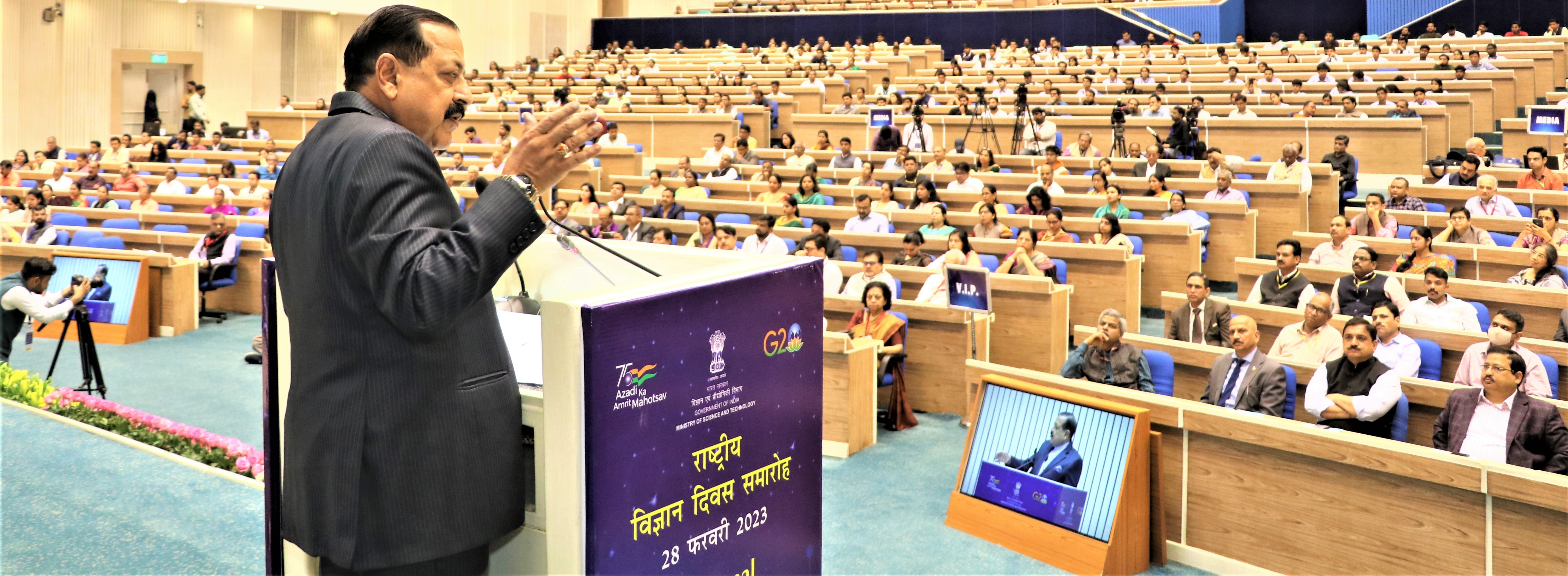
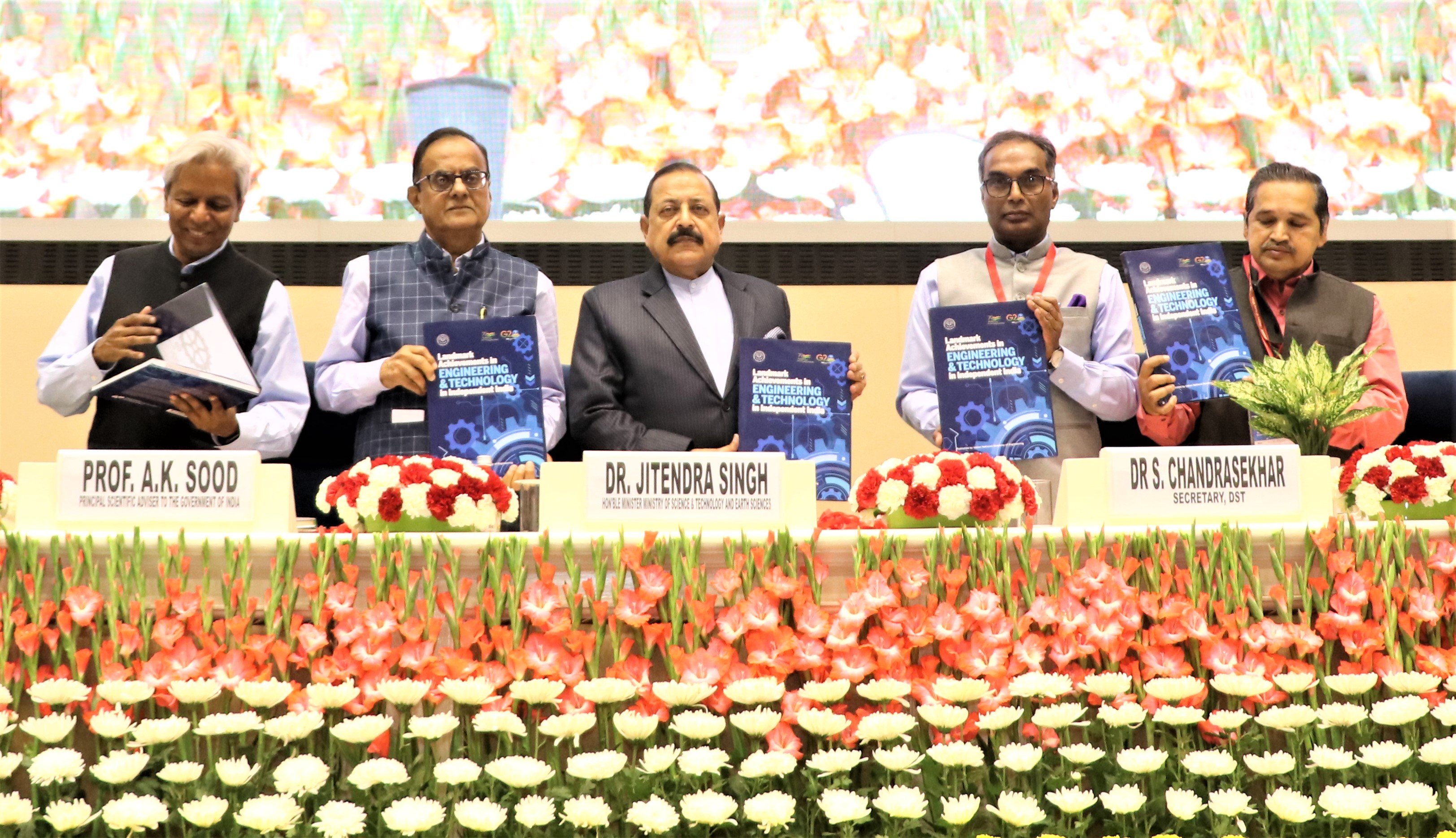
On the occasion of the “National Science Day” today, Union Minister of State (Independent Charge) Science & Technology; Minister of State (Independent Charge) Earth Sciences; MoS PMO, Personnel, Public Grievances, Pensions, Atomic Energy and Space, Dr Jitendra Singh today launched VAIBHAV Fellowshipscheme for the Indian Diaspora abroad.

Speaking at an event at Vigyan Bhavan, Dr Jitendra Singh said, the Vaibhav Fellowship  aims at improving the research ecosystem of India’s Higher Educational Institutions by facilitating academic and research collaborations between Indian Institutions and the best institutions in the world through mobility of faculty/researcher from overseas institutions to India. He said, the best of Diaspora minds will collaborate with domestic Minds to deliver world class projects and products.

The Minister said, the applicant should be Non-Resident Indian (NRI), Persons of Indian Origin (PIO) or Overseas Citizen of India (OCI) and she or he must have obtained Ph.D/M.D/M.S degree from a recognized University. Moreover, the applicant must be a researcher engaged in an overseas academic / research / industrial organization with a proven track record of research & development and plan to work for a minimum of 1 month to a maximum of 2 months a year in a research institution / academic institution in India.

Delivering the keynote address, Dr Jitendra Singh said, since May, 2014, when Prime Minister Narendra Modi took charge, there has been a visible change in priorities and shift in goals for the Science and Technology Ministry and other Science Departments like Space, Atomic Energy, and Ministry of Earth Sciences. He said, there was no dearth of talent and capabilities, but the vindication came in 2014, both at the policy planning level as well as at the political dispensation.

Dr Jitendra Singh reminded the august audience that in each of his nine Independence Day addresses as Prime Minister till now, Modi has announced the pathbreaking Scientific Initiatives. He recalled starting from 15th August, 2014, when the Swachh Bharat Mission was announced to build individual household toilets, thus giving a huge sigh of relief to the rural poor, especially the young girls and women in terms of health and hygiene. Similarly, the other historic announcement “Start-Up India, Stand-Up India” was made by him onIndependence Day of 2015, then Digital India, which led to DBT, JAM Trinity and UPI, followed by Gaganyaan Mission, Digital Health, Deep Sea Mission and last year his pitch for Innovation with the clarion call of “Jai Jawan, Jai Kisan, Jai Vigyan and Jai Anusandhan”. Subsequently, PM Modi spoke of Digital Health Mission and in his two consecutive Independence addresses of 2021 and 2022 he spoke of Deep Sea Mission, added the Minister.

Dr Jitendra Singh said, out of 130 countries, we were at number 81 in the Global Innovation Index till 2015, but we have jumped to 40th position in 2022. Today India is among the top three countries in the world in terms of PhDs and among the top three countries in the world in terms of start-up ecosystem”. The Minister also added that there has been a significant rise in the country’s overall performance in terms of a number of publications (globally ranked 3rd now from 6th in 2013 based on National Science Foundation database), patents (globally ranked 9th in terms of resident patent filing) and quality of research publications (globally ranked 9th now from 13th in 2013) during the last 9 years.

Dr Jitendra Singh concluded by saying that India’s Scientific Prowess will define and determine India’s Future Economy in the Amrit Kaal of next 25 years.

In his address, Prof Ajay Kumar Sood, Principal Scientific Advisor to the Government of India said that the theme of this year’s National Science Day “Global Science for Global Wellbeing” was chosen by Dr Jitendra Singh to coincide with India’s Presidency of G-20. He said, India is committed to working with G-20 and other countries to drive scientific progress for the betterment of All. He said, Science, Technology and Innovation has become the core pillar of India’s Economic Progress.

Dr S. Chandrasekhar, Secretary, DST said, STI has a critical role to play in realizing Prime Minister’s vision of Atmanirbhar Bharat. He also informed that the Government of India is giving huge priority to the Science Streams and even this year budget for S&T ministry also got enhanced allocation.

Former PSA, Prof K Vijay Raghvan, Secretary, DBT, Dr Rajesh Gokhale, Secretary, Ministry of Earth Sciences, Dr M Ravichandran, former Secretaries and scientists took part in the celebrations.

Like the soldier, the spirit of our farmers is also very high : Narendra Singh Tomar

| Published on:

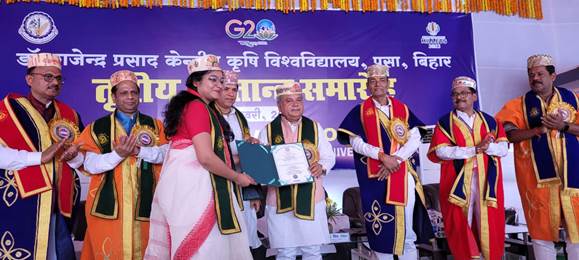
Union Agriculture and Farmers Welfare Minister Shri Narendra Singh Tomar has said that the spirit of our farmers is like that of the Indian soldier, – the way soldiers protect the nation by standing bravely on the borders, in the same way our farmer brothers and sisters generate agricultural produce, making an exemplary contribution to Food Security. If farmers don’t work in the fields then we will not have food grains to fill our stomach despite having money. Our Agriculture sector is very important for 140 crore Indians, farmers should be treated with respect. Shri Tomar said this today as the chief guest at the Third Convocation ceremony of Dr. Rajendra Prasad Central Agricultural University (Pusa, Samastipur, Bihar).

Union Minister Shri Tomar said that in view of the importance of agriculture in the country, the government under the leadership of Prime Minister Shri Narendra Modi has given priority to this sector. Till before 2014, the budget of Agriculture sector used to be about 25,000 crores, whereas today in the Modi Government the Agriculture budget is Rs. 1,25,000 crores. For the development of agriculture, work is being done through technology. Concrete work is being done to improve the financial condition of 86 percent small farmers of the country. The Central Government is constituting 10,000 new FPOs, on which Rs 6,865 crore is being spent. As technology advances, educated youth will get more employment opportunities in the villages; with the increase in employment in the villages, the Agriculture sector will emerge a bigger pillar of strength of the country. Shri Tomar said that the agriculture sector is full of challenges, facing which the government is moving ahead with positivity. Pradhan Mantri Fasal Bima Yojana has been implemented to compensate the loss of farmers, in which, as compared to the farmers premium of Rs. 25,000 crores, claims worth Rs. 1.30 lakh crore has been paid as claims. Pradhan Mantri Kisan Samman Nidhi has been implemented for income support to Small Farmers, in which Rs. 6,000 is being given annually in 3 installments with complete transparency, disbursed directly into farmers’ bank accounts. Till now, more than Rs. 2.40 lakh crore has been given to crores of farmers.

Shri Tomar said that due to the hard work of farmers, efficiency of scientists and visionary policies of Prime Minister Shri Modi, India has today become a country that supplies to the world. The whole world is amazed to see the determination, technology and positive thinking with which the government is moving forward under the efficient leadership of the Prime Minister. More than 100 countries of the world look towards India with the expectation that India will help when needed, we have to accept this challenge and work. It is our responsibility to meet the needs of the country, while keeping in mind the expectations of the world, we have to prepare for the needs of the year 2050 from now itself. To attract the new generation to the traditional field of agriculture, there is a need to make timely changes. Crop diversification and new techniques will have to be adopted. Today, entire world is left spellbound with India’s achievements in various fields including cashless transactions. We are also ahead in the production of agricultural products. We also have a leading role in Animal Husbandry, Fisheries & Beekeeping.

He said that whenever it comes to economic analysis, some countries do not want to praise us, but still they are bound to say that India will emerge as the fastest growing economy in the coming times. For the next 25 years, during the ‘Amritkaal’, our speed should be faster. Looking at the political conditions of the world, we have to develop ourselves in such a way that when we celebrate the centenary year of the country’s Independence, we should be included in the category of Developed countries. For this, the villages and farmers will have to be strengthened.

During the convocation, degrees were awarded to 635 students, including 260 girls. Ms. Purva Sharan, a student of Fisheries College, was bestowed the Visitor’s Gold Medal for securing the highest marks. Ms. Rinto Nandi of Tirhut Agricultural College, Dholi, was awarded the Chancellor’s Gold Medal for the best performance in the postgraduate examination. Ms. Manisha Bhardwaj of Pt. Deendayal Upadhyay Forestry College, Piprakothi, Ms. Nikita of Agricultural Engineering College, Ms. Jayanti Kumari of Humanities College and Mr. K.M. Veethi of Community Science College were awarded the Gold Medal.

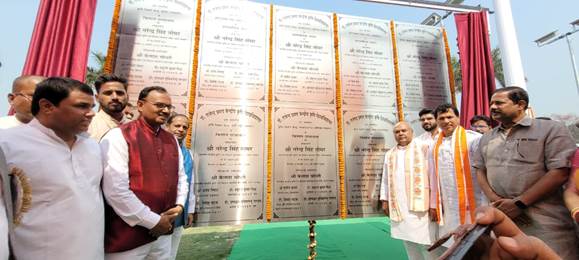
In the program, ‘Mushroom Samosa’, prepared by the University, was released, which has recently received a patent. Advanced varieties of sugarcane and various technical books were released. On the occasion, Shri Tomar inaugurated the administrative building and farmers’ hostel of Krishi Vigyan Kendra, Sukhet (Madhubani), Narkatiaganj (West Champaran), Lada (Samastipur), Turki (Muzaffarpur), complex of Tiranga Park, Banana Research Center at Goraul (Vaishali) and the sprawling Agricultural Museum of the University. The program was attended by the Union Minister of State for Agriculture & Farmers Welfare, Shri Kailash Choudhary, Vaishali MP Smt. Veena Devi, Muzaffarpur MP Shri Ajay Nishad, Samastipur MP Shri Prince Raj, Director General of ICAR, Dr. Himanshu Pathak, Chancellor Shri Prafulla Mishra and Vice Chancellor Dr. P.S.  Pandey among other dignitaries.

Indo-Danish Green Strategic Partnership is an appropriate forum to exchange ideas, best practices, knowledge, technology and capacity building: Bhupender Yadav

| Published on:

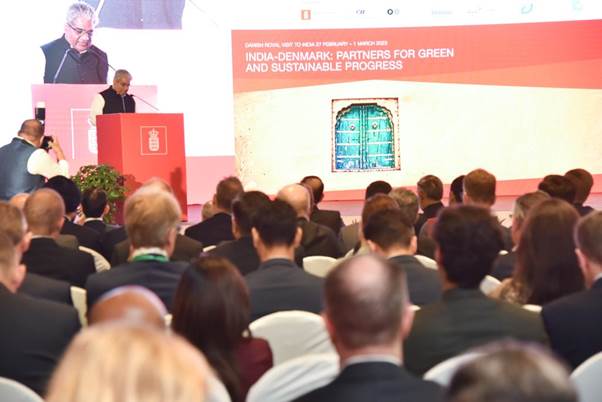
Union Minister of Environment, Forest and Climate Change, Shri Bhupender Yadav  said the Indo-Danish Green Strategic Partnership is an appropriate forum to exchange ideas, best practices, knowledge, technology, capacity building for promoting sustainable lifestyles including LiFE, not only in Denmark and India, but for Europe and the whole world.

Addressing The India – Denmark: Partners for Green and Sustainable Progress Conference  today in New Delhi  Shri Yadav said that since the launch of the “Green Strategic Partnership” during the Virtual Summit on 28 September 2020 between Prime Minister of Denmark, Her Excellency, Ms. Mette Frederiksen and Prime Minister Shri Narendra Modi, the bilateral cooperation is focussed on promoting green and sustainable development. He said that during the visit of Prime Minister Shri Narendra Modi to Denmark in May, 2022, India and Denmark agreed to further strengthen the Green Strategic Partnership with a focus on green hydrogen, renewable energy and waste water management. The Minister said that Green Strategic Partnership between the Denmark and India opened a new chapter in the friendly and cooperative relations between the countries.

Shri Yadav said that India and Denmark have set very ambitious national targets on climate and energy that will contribute to an ambitious implementation of the Paris Agreement. Together, the two countries can show the world that delivering on ambitious climate and sustainable energy goals is possible. It is also necessary, at the same time, to commit ourselves to the founding principles of the Rio Convention, he added.

The Minister said that unsustainable production and consumption needs urgent attention, if we are to confront the global environmental and climate change related challenges that we face today. We need to act fast before it is too late. Shri Yadav said that at the recently concluded COP27 in Sharm El-Sheikh, the importance of sustainable lifestyles and sustainable patterns of consumption and production (SCP) in global efforts to combat climate change was underscored.

In this connection, Shri Yadav called the attention of the gathering to LiFE or Lifestyle for Environment, announced and launched by the Prime Minister . He said that in line with the global commitment to achieve the SDGs by 2030, Mission LiFE contributes directly or indirectly to almost all the SDGs, including on sustainable cities and communities (SDG 11), responsible production and consumption (SDG 12), climate change (SDG 13), life on land (SDG 15), and life under water (SDG 14).

Shri Yadav emphasized that everyone needs to ensure that lifestyles are in sync at all levels with the resources available on the planet. “Let’s resolve to work together tirelessly, to build a sustainable and inclusive future, where no one is left behind!”,  He further said that as the world’s most populous democracy and a vibrant emerging economy, India seeks to lead by example, and invited the global community to be a part of Mission LiFE for individual, family and community-based actions. He said that India is making rapid strides towards inclusive and overall sustainable development, especially in the environment dimension and this is being done both at national level and globally through international partnerships.

The Minister said that India and Denmark’s shared commitment to address climate change is exemplified by strategic sector cooperation on offshore wind and renewable energy, as well as the India-Denmark Energy Partnership (INDEP) on capacity building and technology transfer in the areas of offshore wind, energy modelling, and integration of renewable energy.

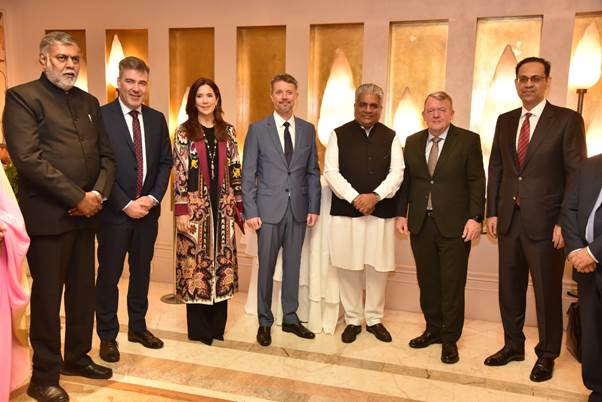
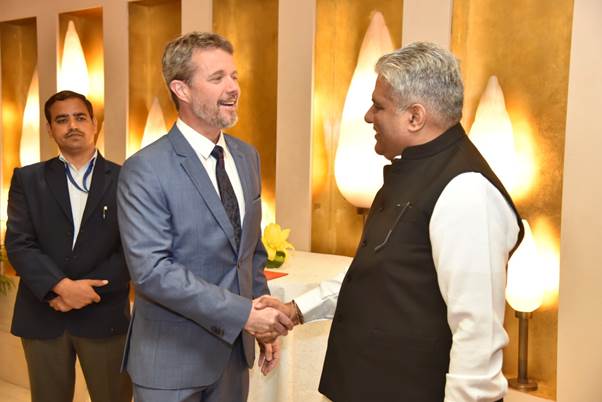
The event was attended by their Royal Highness Crown Prince Frederik and Crown Princess Mary of Denmark.

PM applauds spirit of Yuva Sangam

| Published on:

The Prime Minister, Shri Narendra Modi has applauded the spirit of Yuva Sangam as students from Assam visit Amul Cooperative’s dairy plant in Anand, Gujarat.

Replying to a tweet thread by Member of Parliament from Tezpur Assam, Pallab Lochan Das, the Prime Minister tweeted;

“Such opportunities enable our youth to explore diverse cultures and understand different aspects of India.”

PM lays foundation stone and dedicates to the nation multiple development projects worth more than Rs 2,700 crore in Belagavi, Karnataka

| Published on:

The Prime Minister, Shri Narendra Modi laid the foundation stone and inaugurated multiple development projects worth more than Rs 2,700 crore in Belagavi, Karnataka today. He released the 13th installment amounting to about Rs. 16,000 crores under PM-KISAN. The Prime Minister dedicated the redeveloped Belagavi Railway Station building to the nation. He also laid the foundation stone of six multi-village scheme projects under Jal Jeevan Mission.

Addressing the gathering, the Prime Minister said that the incomparable love and blessings of the people of Belagavi inspire the government to work for the welfare of the people and become a source of strength. “Coming to Belgavi is no less than a pilgrimage”, the Prime Minister said as he highlighted that it is the land of Queen Chennamma of Chittoor and revolutionary Krantiveer Sangolli Rayanna who are remembered even today for raising their voice against the colonial rule.

The Prime Minister highlighted the contributions of Belagavi and said that it finds a place in the fight for today and the reemergence of India. Drawing an analogy to the startup culture of Karnataka, the Prime Minister said that Belagavi was home to startups hundred years ago and gave the example of Baburao Pusalkar who established a unit which turned Belagavi into a base for various industries. The Prime Minister emphasized that the double-engine government wants to further strengthen this role of Belagavi in the present decade.

Throwing light on the projects whose foundation stones are laid and those that are inaugurated today, the Prime Minister said that it will bring in new energy and pace in the development of Belagavi. He congratulated the citizens of this region for projects worth hundreds of crores associated with connectivity and water facilities. Through Belagavi, the Prime Minister said that every farmer in the nation has received a special gift where another tranche of funds from PM-KISAN was released. “Just by the click of a button, 16,000 crore rupees have been transferred to the bank accounts of crores of farmers in the country”, the Prime Minister remarked. He said that such a huge amount transferred without the involvement of a middleman has also drawn the attention of people from across the world. Drawing comparisons to the Congress regime, the Prime Minister recalled that the then Prime Minister said that only 15 paise reaches the poor when 1 rupee is transferred. “But this is Modi ki Sarkar”, the Prime Minister interjected, “Every penny belongs to you and it is for you.” The Prime Minister also wished a very prosperous Holi to all the farmers of India and said that they have received a special gift before Holi.

The Prime Minister said that today’s changing India is accomplishing development projects one after the other while giving priority to the deprived and mentioned that small farmers are a priority for the current government. He informed that till now 2.5 lakh crore rupees have been deposited in the accounts of the small farmers via PM KISAN Samman Nidhi out of which more than 50 thousand crores were deposited in the accounts of women farmers. This money, the Prime Minister said, is taking care of the small but critical needs of the farmers.

The Prime Minister reiterated that the agricultural budget of the country which was 25,000 crores before 2014 has now been increased to 1,25,000 crores which is a five-time increase. He said that it is proof of the BJP government’s commitment to supporting the farmers of the country. The Prime Minister emphasized the use of technology which is directly benefiting the farmers and gave the example of Jan Dhan bank accounts, mobile connections and aadhar. He underlined that the government is connecting farmers to Kisan Credit Cards with the objective that the farmers can avail of the support of banks at any required step.

The Prime Minister emphasized that this year’s Budget addresses the future needs of agriculture along with the current concerns. He said today’s need is for storage and reducing the costs in farming, organizing small farmers. That is why this Budget emphasizes storage facilities and focuses on cooperatives.  Similarly, focusing on natural farming will reduce the costs for the farmer. He said measures like the PM PRANAM scheme will further reduce the expenses on fertilizers.

“The Government is focussed on strengthening the agricultural sector of India while analyzing the challenges of the future”, the Prime Minister remarked. Highlighting the challenge of climate change, the Prime Minister stressed reviving the traditional strength of coarse grains or millets and informed that these food grains have the capability to withstand any climate. Referring to this year’s budget, the Prime Minister highlighted that coarse grains have a new found identity as Shri Anna. He added that Karnataka has been the main center of millets where Shri Anna was popularly known as Shri Dhanya and different kinds of Shri Anna are cultivated by the farmers of the region. The Prime Minister recalled the significant campaign run by the then BS Yeddyurappa government to promote Shri Anna and said that we now have to present it to the world. Listing out the benefits of Shri Anna, the Prime Minister said that it requires less effort as well as less water while it doubles the benefits for farmers.

The Prime Minister spoke at length about the needs of sugarcane farmers as Karnataka is a major sugarcane state. He mentioned this year’s Budget provision providing rebate on tax on cooperative sugarcane payment of the amount payable before 2016-17 which will give relief to the sugar cooperative to the tune of 10 thousand crores. Speaking about the government’s push for ethanol blending, the Prime Minister informed that the production of ethanol is helping in increasing the income of sugarcane farmers. He informed that ethanol blending in petrol has increased from 1.5 percent to 10 percent in the last 9 years and the government is already targeting 20 percent ethanol blending in petrol.

The Prime Minister remarked that agriculture, industry, tourism and education are strengthened only with better connectivity. He informed that in the five years prior to 2014, the total budget of the Railways in Karnataka was Rs 4,000 crore whereas this year, 7,500 crore rupees have been allocated for the railways in Karnataka. He noted that work is underway in Karnataka on railway projects worth about 45 thousand crore rupees today. He also referred to the newly inaugurated modern railway station in Belagavi and said that it is not just the facilities that get a boost but the faith in the railways is also increasing. “Many stations in Karnataka are being brought to the fore in such a modern avatar”, he said. The Prime Minister mentioned that the doubling of the Londa-Ghatprabha line will make the journey faster and safer. Noting that Belagavi is an important hub for education, tourism and healthcare, the Prime Minister said that the improved railway connectivity will give a boost to these sectors.

“The double-engine government is a guarantee for fast-paced development”, the Prime Minister said. Giving the example of Jal Jeevan Mission, the Prime Minister informed that only 25 percent of households in Karnataka’s villages had piped water connections before 2019 whereas the coverage has expanded to 60 percent today. In Belagavi too,  the Prime Minister said that less than 2 lakh houses used to get tap water but this number has crossed 4.5 lakhs today. He said that 60,000 crore rupees have been allocated in this budget for this.

“The government is engaged in empowering every small section of the society which was neglected by the previous governments”, the Prime Minister remarked. Noting that Belagavi has been a city of artisans and handicrafts men famous as Venugram i.e. bamboo village, the Prime Minister recalled how previous governments had banned the harvesting of bamboo for a long time but it is the present government that reformed the law and opened the way for bamboo cultivation and trade. He also touched upon the PM Vishwakarma Yojana that was introduced for the first time in this year’s budget to support artisans and handicrafts men.

The Prime Minister pointed out the Congress government’s abomination for Karnataka where disrespecting the leaders of Karnataka became a tradition. “History is proof of how leaders like S  Nijalingappa and Virendra Patil ji were insulted before the Congress family”, the Prime Minister remarked. Speaking about his adoration and respect for Mallikarjun Kharge ji and his devotion to public service, the Prime Minister expressed sadness at how the most senior member was not even considered worthy of being given an umbrella in the scorching sun at a Congress function in Chhattisgarh. “Kharge ji is the Congress President, but the entire world knows who holds the remote control by the way he is treated”, the Prime Minister interjected. Shri Modi pointed out that many political parties in the country are plagued by ‘parivarvaad’ (nepotism) and stressed the need to free the country from its clutches. He also warned the people of Karnataka to stay alert from parties like Congress.

Concluding the address, the Prime Minister said, “True development takes place when work is carried out with true intentions.” He highlighted the true intentions of the double-engine government and its commitment to development. “To speed up the development of Karnataka and the country, we have to move ahead with Sabka Prayas”, the Prime Minister concluded.

Chief Minister of Karnataka, Shri Basvaraj Bommai, Union Minister for Agriculture and Farmers’ Welfare, Shri Narendra Singh Tomar, Union Minister for Parliamentary Affairs, Shri Pralhad Joshi, Union Minister of State for Agriculture and Farmers’ Welfare, Ms Shobha Karandlaje and Ministers from Government of Karnataka were present on the occasion among others.

Background

In a step that will showcase yet another example of the commitment of the Prime Minister towards the welfare of farmers, the 13th installment amount of about Rs. 16,000 crores under the Pradhan Mantri Kisan Samman Nidhi (PM-KISAN) was released through direct benefits transfer to more than 8 crore beneficiaries. Under the scheme, eligible farmer families are provided with a benefit of Rs. 6000 per year in three equal installments of Rs. 2000 each.

During the Programme, the Prime Minister dedicated the redeveloped Belagavi Railway Station building to the nation. This Railway Station is redeveloped at an approximate cost of about Rs 190 Crore to provide world-class amenities to the passengers. Another railway project that will be dedicated to the nation by the Prime Minister is the rail line doubling project between Londa-Belagavi-Ghataprabha section at Belagavi. This project, developed at the cost of about Rs 930 Crores, will enhance line capacity along the busy Mumbai – Pune – Hubballi – Bengaluru railway line, promoting trade, commerce and economic activities in the region.

The Prime Minister also laid the foundation stone of six multi-village scheme projects under Jal Jeevan Mission in Belagavi, which will be developed at a cumulative cost of about Rs 1585 crore and will benefit about 8.8 lakh population of more than 315 villages.

PM inaugurates & lays foundation stone of multiple development projects worth more than Rs 3,600 crore in Shivamogga, Karnataka

| Published on:

The Prime Minister, Shri Narendra Modi laid the foundation stone and inaugurated multiple development projects worth more than Rs 3,600 crore at Shivamogga, Karnataka today. He also inaugurated the Shivamogga Airport and took a walk-through of the facilities. The Prime Minister also laid the foundation stone for two railway projects in Shivamogga which include Shivamogga – Shikaripura – Ranebennur new Railway line and Koteganguru Railway coaching depot. He also laid the foundation stone for multiple road development projects to be developed at a cumulative cost of more than Rs 215 crore. He also inaugurated and laid the foundation stone of multi-village schemes worth more than Rs 950 crore under the Jal Jeevan Mission. He also inaugurated 44 Smart City Projects worth more than Rs 895 Crores in Shivamogga city.

Addressing the gathering, the Prime Minister bowed his head to the land of national poet Kuvempu whose sense of dedication towards Ek Bharat Shreshtha Bharat has been kept alive even today. Referring to the newly inaugurated airport in Shivamogga, the Prime Minister said that the needs of the citizens have been fulfilled today after a long time. Remarking on the splendid beauty and construction of the airport, the Prime Minister highlighted the amalgamation of the traditions and technology of Karnataka.  He remarked that it is not just an airport but a campaign where the dreams of the younger generations can take off. He also touched upon the road and rail projects along with the ‘Har Ghar Nal Se Jal’ projects whose foundation stones are being laid today and congratulated the citizens of these districts.

The Prime Minister wished Shri BS Yeddyurappa on his birthday today and recalled his contribution to public life. He said his recent speech in the Assembly is an inspiration for everyone in public life. The Prime Minister’s request to honor Shri BS Yeddyurappa by raising the flashlights of the mobiles evoked a massive response among the crowd and people expressed their love for the senior leader.

The Prime Minister said that the development of Karnataka is on the move. This path of progress, the Prime Minister said, is paved by strides in roadways, airways and iways (digital connectivity. The Prime Minister said that the double-engine government of Karnataka is powering the chariot of the progress of Karnataka. The Prime Minister also highlighted the wider spread of development in Karnataka to villages and tier 2-3 cities under the double-engine government as opposed to the big city-centric development of the earlier times. “The development of Shivamogga is the result of this thinking process”, he said.

The Prime Minister reiterated that the airport in Shivamogga is being inaugurated at a time when the enthusiasm for air travel is at an all-time high in India. He informed that only recently, Air India completed a deal to purchase the largest passenger aircraft in the world. He pointed out that before 2014 during the Congress regime, Air India was generally discussed in a negative light and its identity had always been associated with scams where it was deemed a loss-making business model. Highlighting the Air India of today, the Prime Minister said that it is recognized as the potential of the new India where it is soaring to the heights of success. He noted the expanding aviation market of India and informed that the country will require thousands of aircrafts in the near future where thousands of youthful citizens will be needed as a workforce. Even though we are importing these aircraft today, the Prime Minister emphasized that the day is not far when the citizens of India will fly in Made in India passenger aeroplanes.

The Prime Minister elaborated upon the policies of the government that have led to an unprecedented expansion of the aviation sector. He informed that, unlike the approach of previous governments, the current government pushed for airports in smaller cities. He informed that till 2014 the country had 74 airports in the first 7 decades of independence whereas in the last 9 years, 74 more airports have been added, connecting many smaller cities. The Prime Minister also mentioned the UDAN scheme for affordable air travel to realize his vision that Hawai Chappal-wearing common citizens should be able to travel in Hawai Jahaj.

“The new airport is going to open doors of development for Shivamogga, the land of nature, culture and agriculture”, the Prime Minister said. He informed that Shivamogga is a gateway to the Malenadu region which is famous for the Western Ghats and home to greenery, wildlife sanctuaries, rivers, the famous Jog Falls and Elephant Camp, Lion Safari in Simha Dham and the mountain ranges of Agumbe. Recalling the adage, the Prime Minister said that life remains incomplete for those who have not taken a dip in the Ganges and drank the water of the Tungabhadra river.

Talking about the cultural richness of Shivamogga, the Prime Minister mentioned Rashtrakavi  Kuvempu and the world’s only living Sanskrit village Mattur and many centers of faith in Shivamogga. He also mentioned the freedom struggle of Issuru village.

Mentioning the agricultural uniqueness of Shivamogga, the Prime Minister said that it is among the most fertile regions of the country. He touched upon the impressive variety of the crops of the region. This agricultural wealth is getting a push by robust connectivity measures being undertaken by the double-engine government.  The Prime Minister said that the new airport will help in increasing tourism and resulting economic activity and employment opportunities. The rail connectivity will ensure new markets for the farmers, he added.

The Prime Minister emphasized that Haveri and Davangere districts will also be benefitted when the Shivamogga – Shikaripura – Ranibennur new line is completed. He underlined that there will be no level crossing in this line making it a safe rail line where fast trains will be able to run smoothly. He highlighted that the capacity of Kotagangaur station, which used to be a short halt station, will get a boost after the construction of a new coaching terminal. He informed that it is now being developed with 4 railway lines, 3 platforms and a railway coaching depot. Noting that Shivamogga is an educational hub of the region, the Prime Minister said the increased connectivity will make it easier for students from nearby regions to visit Shivamogga. He also noted that it will open new doors for businesses and industries in the region. “Infrastructure with good connectivity is going to create new employment opportunities in the entire region”, the Prime Minister said.

The Prime Minister called the Jal Jeevan Mission in the region a big campaign to provide ease of living to women of Shivamogga. He informed that out of 3 lakh families in Shivamogga only 90 thousand had tap water connections before the start of the Jal Jeevan Mission. Now, the double-engine government has provided tap water connections to 1.5 lakh families and work is going on to ensure saturation. In the last 3.5 years, 40 lakh families have received tap water connections.

“The double-engine government belongs to the villages, the poor, our mothers and sisters”, the Prime Minister said. Giving examples of toilets, gas connections and tapped water supply, the Prime Minister said that the government is trying to tackle all the problems related to the mothers and sisters. He reiterated that the double-engine government strives to make piped water available in every household with all honesty.

The Prime Minister remarked, “The people of Karnataka know very well that this is the Amrit Kaal of India, the time to make a developed India.” He underlined that this is the first time in the history of India’s independence that such an opportunity has come knocking and India’s voice is being heard on the global stage. He noted that investors from all over the world want to invest in India and it benefits Karnataka and its youth here. Concluding the address, the Prime Minister assured everyone that this campaign for the development of Karnataka will pick up more pace. “We have to walk together. We have to move forward together”, the Prime Minister concluded.

Chief Minister of Karnataka, Shri Basvaraj Bommai, Former Chief Minister of Karnataka, Shri BS Yeddyurappa, Union Minister for Parliamentary Affairs, Shri Pralhad Joshi and Ministers from Government of Karnataka were present on the occasion among others.

Background

The Prime Minister’s emphasis on improving air connectivity all across the country will get yet another boost with the inauguration of Shivamogga Airport. The new airport is developed at a cost of around Rs 450 crore. The Passenger Terminal Building of the airport can handle 300 Passengers per hour and will improve connectivity and accessibility of Shivamogga and other neighbouring areas in the Malnad region.

The Prime Minister laid the foundation stone for two railway projects in Shivamogga. This includes Shivamogga – Shikaripura – Ranebennur new Railway line and Koteganguru Railway coaching depot. The Shivamogga – Shikaripura – Ranebennur new Railway line, will be developed at a cost of Rs. 990 Crore and will provide enhanced connectivity of the Malnad region with the Bengaluru-Mumbai mainline. Koteganguru Railway coaching depot at Shivamogga city will be developed at a cost of more than Rs 100 crores to help start new trains from Shivamogga and decongest maintenance facilities at Bengaluru and Mysuru.

The Prime Minister laid the foundation stone for multiple road development projects. The projects, which will be developed at a cumulative cost of more than Rs 215 crore, include the construction of a new Bypass road for Shikaripura Town on NH 766C connecting Byndur – Ranibennur; widening of NH-169A from Megaravalli to Agumbe; and construction of a new bridge at Bharathipura in Thirthahally Taluk on NH 169.

The Prime Minister also inaugurated and laid the foundation stone of multi-village schemes worth more than Rs 950 crore under the Jal Jeevan Mission during the programme. This includes the inauguration of one multi-village scheme for Gowthamapura and 127 other villages and laying the foundation stone for three other multi-village schemes to be developed at a total cost of more than Rs 860 crore. The four schemes will provide functional household piped water connections and are expected to benefit a total of more than 4.4 lakh people.

The Prime Minister also inaugurated 44 Smart City Projects worth more than Rs 895 Crores in Shivamogga city. The projects include 8 smart road packages of 110 km length; integrated command & control center and multi-level car parking; smart bus shelter projects; an intelligent solid waste management system; development of heritage projects like Shivappa Naik Palace into an interactive museum, 90 conservancy lanes, creation of parks and riverfront development projects, among others.

BJP National President interacts with the Students of Delhi University under “Know BJP” Campaign

| Published on:

The Bharatiya Janata Party National President Shri Jagat Prakash Nadda ji today interacted with the students of the Delhi University under the “Know BJP” initiative of the party at an event held at the party headquarters in Delhi. He introduced the students with the Bharatiya Janata Party’s ideology, principles, its mission and work culture.

Those present at the meeting included the Bharatiya Janata Party Rajya Sabha MP and the party’s National Media Head Shri Anil Baluni and BJP MP Shri Rakesh Sinha. The group of the Delhi University students who interacted with the BJP National President represented almost all the states. The ‘Know BJP’ initiative of the party was started on the 42nd Foundation Day of the Bharatiya Janata Party on April 6, 2022.

The Bharatiya Janata Party National President discussed the party’s work culture with the students and said that the Bharatiya Janata Party governments at the Centre and in the states are dedicated towards the empowerment and welfare of all sections of the society, particularly our villagers and farmers, Dalits and Tribals, youth and women, backward and oppressed classes. He also answered the questions of the students.

Shri Nadda said the nine years of the Narendra Modi Government are full of accomplishments and achievements and are devoted to service of all communities, good governance and welfare and empowerment of the poorest of the poor.

The Bharatiya Janata Party National President said the focus of our Honourable Prime Minister Shri Narendra Modi ji is speed ( to speed up the progress and development of our country), skill ( to make our youth and working class skilled to improve their employment opportunities) and scale ( to transform the thought process and vision of our citizens).

Shri Nadda said the Narendra Modi Government has given deep focus on infrastructure development and seamless connectivity. The Bharatiya Janata Party National President specially discussed the flagship schemes of the Narendra Modi Government — PM Gati Shakti Yojana and PLI scheme — which are transforming our country and economy. Shri Nadda appealed to the students to contribute in the conservation and development of our great heritage, history and culture.

The Bharatiya Janata Party National President also introduced to the Delhi University students about the various aspects of Indian politics and asked them to hone their skills in politics and other aspects of our polity and economy. Shri Nadda also told students about various facets of his politics during his college days.

Discussing about the G-20 Presidency of India, the Bharatiya Janata Party National President said it is a matter of great honour for our country. This Presidency belongs to the entire country, it is a great opportunity for all of us and it gives us a unique chance to show our capabilities and prowess to the world. G-20 Presidency has brought a special opportunity for all Indians. It will also enhance India’s image at the global platform. It will also help India at the domestic and international levels. Shri Nadda also told the students how the Bharatiya Janata Party functions and how the party works as an important bridge between the government and the people of the country.

PM addresses Budget Webinar on ‘Reaching the last mile’

| Published on:

The Prime Minister, Shri Narendra Modi, addressed a Budget Webinar on the subject of ‘Reaching the last mile’. It is the fourth of a series of 12 post-budget webinars organized by the government to seek ideas and suggestions for the effective implementation of the initiatives announced in the Union Budget 2023.

At the outset the Prime Minister, while acknowledging the importance of the debate on Budget in Parliament, said that the government has gone a step further and for the last few years have started the new tradition of brainstorming with the stakeholders after the Budget. “This is important from the point of view of implementation and time-bound delivery. This also ensures proper utilization of every penny of taxpayers money”, he said.

The Prime Minister said that along with money, political will is needed for the development. Emphasizing the importance of good governance and constant monitoring for the desired goals, the Prime MInister said “The more emphasis we put on good governance, the more easily our goal of reaching the last mile will be accomplished.” He gave the example of  new approaches in the immunization and vaccine coverage in Mission Indradhanush and Corona pandemic to illustrate the power of good governance in the last mile delivery.

Explaining the thinking behind the policy of saturation, the Prime Minister said that the approach of reaching the last mile and saturation policy complement each other. He said as opposed to the earlier scenario when the poor were running after the government for basic facilities, now the government is reaching the doorstep of the poor.  “The day we decide that every basic facility will be provided to every citizen in every area, then we will see what a big change will come in the work culture at the local level. This is the spirit behind the policy of saturation. When our aim is to reach everyone, then there will be no scope for discrimination and corruption. And only then, we will also be able to complete the goal of reaching the last mile”, the Prime Minister added.

Giving examples of this approach, the Prime Minister cited PM SVANidhi Scheme that linked the street vendors to formal banking, Development and Welfare Board for De-notified, Nomadic and Semi-Nomadic Communities, 5 lakh common service centers in villages and milestone of 10 crore cases of tele-medicine.

The Prime Minister said that this year’s Budget has paid special attention to taking the mantra of reaching the last mile to tribal and rural areas. He said that for this, thousands of crore rupees have been allocated to the Jal Jeevan Mission. He said that work has started on more than 60 thousand Amrit Sarovar, out of which 30 thousand Sarovars have already been constructed. “These campaigns are improving the standard of living of those Indians living far and wide, who have been waiting for such facilities for decades. We do not have to stop here. We have to create a mechanism for new water connections and the pattern of water consumption. We also have to review what can be done to further strengthen the water committee”, he said.

The Prime Minister asked the stakeholder to discuss the ways of linking housing with technology for finding ways of making strong but affordable houses, finding easy ways of benefiting from solar power and group housing models acceptable in both urban and rural areas. He said that this year’s Budget has kept Rs 80 thousand crore for housing for the poor.

The Prime Minister said “for the first time, the country is  tapping the huge potential of the tribal society of our country at this scale. Tribal development has been given prominence in this budget as well.” Referring to the robust allocations for the staffing of the Eklavya Residential Schools, the Prime MInister asked the gathering to see the feedback from the teachers and students from these schools and how students of these schools can get exposure of the big cities. He asked them to deliberate on the ways of creating more Atal Tinkering Labs in these schools and workshops for aspects related with startups.

The Prime Minister said that for the first time a special mission is being launched for the most deprived among the tribal communities. “We have to rapidly provide facilities to our tribal friends in more than 22 thousand villages in more than 200 districts of the country. The Prime Minister also mentioned Pasmanda Muslims in this regard. A target has also been set in this budget to completely get rid of sickle cell. For this Whole of the nation approach is needed. That’s why every stakeholder related to health will have to work fast”, he added.

The Aspirational District Program has emerged as a successful model in terms of Reaching The Last Mile, the Prime Minister said. Taking this approach further, an Aspirational Block programme is now being started in 500 blocks of the country. “For the Aspirational Block programme, we have to work keeping in mind the comparative parameters in the same way as we have worked for the Aspirational Districts. We have to create an environment of competition with each other at the  block level as well”, the Prime Minister concluded.

Sarbananda Sonowal exhorted young researchers and scientist to work on evidence based scientific research

| Published on:

Ministry of Ayush first “Chintan Shivir” was inaugurated by Union Minister of Ayush Shri Sarbananda Sonowal today at Kaziranga National Park, Assam. Minister talked about tremendous potential of Ayush sector and exhorted young researchers and scientist to work on evidence based scientific research and explain the benefits and research of Ayush system of medicine in native languages so that it reaches larger masses.

Shri Sarbananda Sonowal added that Ayush is pivotal to Heal in India and Heal by India ecosystem. Ayush is very important to the vision of one earth, one family, one future. Under visionary leadership of Hon’ble Prime Minister India’s traditional medicine system has been globally positioned.

Dr. Munjapara Mahendrabhai, Union Minister of state for Ayush, Vaidya Rajesh Kotecha, secretary, Ministry of Ayush, Shri Pramod Kumar Pathak, special secretary, MoA along with other senior officials from Ministry and eminent speakers, experts, and dignitaries are participating in the Chintan Shivir.

Union Minister of State for Ayush Dr. Mahendra Munjpara, participated in the first session on Digital health and technology in Ayush and said, “Now the world is realizing the power of Ayush. With the help of digital health, Ayush Grid, digital and technological advances, the power of Ayush can be capitalized from primary healthcare to specialised health centers.”

Both ministers along with Ministry of Ayush officials participated in Y-break conducted by Dr. Ishwar V. Basavaraddi, Director, Morarji Desai National Institute of Yoga, New Delhi

The first session on day one was on digital health and technology in Ayush, second session on Ayush Research: Future strategy, challenges and way forward and third on Ayush education: Future initiatives, capacity building, employment generation and NEP.

The Second day will see sessions on current challenges and way forward in Ayush Drug industries, services and standardization of Ayush products. The fifth session will be on Ayush in public health, challenges and way forward and will end with presentation of reports with deliverables and roadmap.

The two-day Chintan Shivir is being organized to build the road-map for the up-gradation of Ayush institutions and their integration with the technological advancements, and the identification of ways to integrate Ayush with the New Education Policy, while also identifying current services with potential of improvements to take advantage of Ayush.


PM addresses UP Rozgar Mela

| Published on:

The Prime Minister Shri Narendra Modi today addressed the Rozgar Mela of Uttar Pradesh Government via a video message. In the Mela, appointment letters were provided to direct recruits for Sub Inspectors in UP Police and equivalent posts in Nagrik Police, Platoon Commanders and Fire Department Second Officers.

Addressing the occasion, the Prime Minister expressed happiness that he is getting an opportunity to address a Rozgar Mela almost every week in BJP ruled states and the country is continuously getting many talented youth who bring new thinking and efficiency in the government system.

Highlighting the special importance of the UP Rozgar Mela today, the Prime Minister said that this will bring happiness to 9 thousand families and will enhance the sense of security in Uttar Pradesh as the new recruitments will strengthen the Police force in the state. The Prime Minister said that with more than 1.5 lakh new appointments in UP Police since 2017, both employment and security improved under the present dispensation.

Shri Modi emphasized that today, Uttar Pradesh is recognized for its law and order and development orientation, a far cry from the earlier image of the mafia and crushed law and order situation. This, he said, has led to new opportunities of employment, business and investment.

Highlighting the efforts of the double-engine government, the Prime Minister listed new airports, dedicated freight corridor, new defence corridor, new mobile manufacturing units, modern waterways, a new infrastructure that is bringing in unprecedented employment opportunities. He said that UP has the most number of expressways and highways are being developed constantly. These are not only creating employment but paving the way for more projects in the states. He pointed out the push to tourism by the state has led to a rise in employment. Shri Modi also noted the enthusiastic response in the recent Global Investor Summit and how that will push employment in the state.

“The combined power of security and employment has given new impetus to the economy of UP”, said the Prime Minister. He cited collateral- free loans up Rs 10 lakh under the Mudra Scheme, One District One Product scheme, flourishing MSME and vibrant startup ecosystem.

To the new appointees, the Prime Minister talked about the new challenges and responsibilities and asked them to keep the learner alive in them. He asked them to keep working on their personality development, progress and knowledge.

“When you come to this service, you get a ‘Danda’ from the police, but God has given you a heart too. That’s why you have to be sensitive and make the system sensitive” the Prime Minister told the new recruits. He dwelled on the training also that will improve sensitivity and modern areas like cyber crimes, forensic science to promote smart policing.

The Prime Minister stressed that new recruits will have the responsibility of both security and giving direction to society. “You can be a reflection of both service and strength for the people”, the Prime Minister concluded.

PM’s address in the 98th Episode of ‘Mann Ki Baat’

| Published on:

My dear countrymen, Namaskar.  I am feeling very happy to join you all in this 98th episode of ‘Mann Ki Baat’. In this journey towards a century, all of you have made ‘Mann Ki Baat’ a wonderful platform as an expression of public participation. Every month, in millions of messages, the ‘Mann Ki Baat’ of lots of people reaches out to me. You know the power of your mind… Similarly, how the might of the country increases with the strength of the society…this we have seen and understood in different episodes of ‘Mann Ki Baat’. And I have experienced it – have also accepted it. I remember the day when we talked about encouraging traditional sports of India in ‘Mann Ki Baat’. Immediately at that time, a wave arose in the country to join Indian Sports, to enjoy them, to learn them. In ‘Mann Ki Baat’, when we referred to Indian toys, the people of the country promoted this too, readily. Nowadays, Indian toys have become such a craze that their demand has increased even in foreign countries. When we spoke of Indian genres of story-telling in ‘Mann Ki Baat’, their fame also reached far and wide. People started getting attracted towards the Indian story-telling genre, more and more.

Friends, you might remember that on Sardar Patel’s birth anniversary i.e. ‘Unity Day’, we talked of three competitions in ‘Mann Ki Baat’. These competitions, ‘Geet’ – Patriotic Songs, ‘Lullabies’ and ‘Rangoli’ were associated with it. I am glad to inform you, that more than 5 lakh people from more than 700 districts across the country have participated in this enthusiastically. Children, adults and the elderly enthusiastically participated and entries have been sent in more than 20 languages. Many many congratulations to all the participants in these competitions from my side. Each one of you, in your own right is a champion, an art seeker. You all have shown how much love you have for the diversity and culture of your country.

Friends, today on this occasion it is very natural for me to remember Lata Mangeshkar ji, Lata Didi. Because on the day that this competition had started, Lata Didi had urged the countrymen by tweeting that they must join this endeavour.

Friends, in the lullaby writing competition, the first prize has been won by B.M. Manjunath ji of Chamrajnagar district in Karnataka. He received this award for his lullaby ‘Malagu Kanda’ written in Kannada. He got the inspiration to write this from the lullabies sung by his mother and grandmother. Listen to it, you will enjoy it too.

[Kannada Sound Clip (35 seconds)]

“Sleep, sleep, baby,

Sleep, my smart darling,

The day is gone and it is dark,

The goddess of sleep will arrive,

From the garden of the stars,

Will carve out dreams for you!

Go to sleep, Go to sleep,

Jojo…jo..jo..

Jojo…jo..jo..”

Dinesh Gowala, a resident of Kamrup district in Assam, has won the second prize in this competition. The lullaby he has written bears a reflection of the popular craft of the artisans who make clay and pot vessels locally.

[Assamese Sound Clip (35 seconds)]

Brother Potter has brought a bag,

Say, What’s in the bag?

Opened it and saw the potter’s bag,

There was a lovely bowl in the bag!

Our doll asked the potter,

What is this little bowl!

Just like songs and lullabies, the Rangoli Competition also turned out to be quite popular. The participants made many a beautiful Rangoli, one better than the other. In this, the winning entry proved to be that of Kamal Kumar from Punjab. He made very beautiful Rangoli of Netaji Subhash Chandra Bose and Amar Shaheed Veer Bhagat Singh. Sachin Narendra Avsari ji of Sangli Maharashtra, in his Rangoli, has depicted Jallianwala Bagh, the massacre and the bravery of Shaheed Udham Singh. Gurudutt Vantekar, a resident of Goa, made a Rangoli on Gandhiji, while Malathiselvam ji of Puducherry also focused on many great freedom fighters. The winner of the patriotic song competition, T. Vijay Durga ji is from Andhra Pradesh. She had sent her entry in Telugu. She has been greatly inspired by Narasimha Reddy Garu ji, the famous freedom fighter of her region. Do listen to this part of Vijay Durga ji’s entry

[Telugu Sound Clip (27 seconds)]

The Sun of Renadu State,

O brave Narasimha!

You are the seedling of the Indian Freedom Struggle and the restraint!

Look at the unjust and the autocratic repression tendencies of the British.

Your blood ignited and fire sprang up!

The Sun of Renadu State,

O brave Narasimha!
After Telugu, I will now make you listen to a clip in Maithili. It has been sent by Deepak Vats ji. He has also won a prize in this competition.

[Maithili Sound Clip (30 seconds)]

India is the pride of the world brother,

Our country is great

Surrounded by seas on three sides,

Kailash is strong in the north,

Ganga, Yamuna, Krishna, Kaveri,

Koshi, Kamla Balan,

Our country is great brother

Our life sustenance is our Tricolour!
Friends, I hope you have liked them. The list of such entries that entered the competition is very long. While visiting the website of the Ministry of Culture, do watch and listen to them with your family – you will be greatly inspired.
My dear countrymen, whether it is about Banaras or the Shehnai or Ustad Bismillah Khan ji, it is natural that my attention will be drawn in that direction. A few days ago, ‘Ustad Bismillah Khan Yuva Puraskar’ were conferred. These awards were given away to emerging, talented artists in the field of music and performing arts. These, along with the rising popularity of the art and music world are also contributing in their enrichment. These also include artists who have breathed new life into those instruments, whose popularity was decreasing with time. Listen carefully now to this tune.

[Sound Clip (21 seconds) Instrument- ‘Sursingar’, Artist -Joydeep Mukherjee]

Do you know what instrument this is? It could be possible that you may not be aware of it! The name of this musical instrumental mantra is ‘Sursingar’ and this tune has been composed by Joydeep Mukherjee. Joydeep ji is among the youth honored with the Ustad Bismillah Khan Award. It had become rare to hear tunes of this instrument since the late 50’s and 60’s. But, Joydeep is persevering towards making the Sursingar popular once again. Similarly, the efforts of sister Uppalpu Nagmani ji are also very inspiring, who has been awarded in the category of  Carnatic Instrumental on the Mandolin. On the other hand, Sangram Singh Suhas Bhandare ji has been awarded for Warkari Kirtan. This list doesn’t just pertain to music artistes – V Durga Devi ji has won this award for ‘Karakattam’, an ancient dance form. Another winner of the award, Raj Kumar Nayak ji, organized the Perini Odissi, which lasted for 101 days in 31 districts of Telangana. Today, people have started knowing him by the name of Perini Rajkumar. Perini Natyam, a dance dedicated to Lord Shiva, was quite popular during the Kakatiya Dynasty. The roots of this dynasty are still associated with Telangana. There is another award winner – Saikhom Surchandra Singh. He is known for his mastery in making Meitei Pung Instrument. This instrument has connections with Manipur. Pooran Singh is a Divyang Artist, who is popularizing various Music Forms such as –  Rajula-Malushahi, Nyuli, Hudka Bol, Jagar. He has also prepared many audio recordings related to them. The talented folk music artist of Uttarakhand, Puran Singh ji has also won many awards. Due to the limitation of time, I may not be able to talk about all the awardees here, but I am sure that you will definitely read about them. I hope that all these artists will continue to inspire everyone at the grassroots towards making performing arts more popular.
My dear countrymen, in our fast moving country, the power of Digital India is visible in every corner. Different apps play a big role in taking the power of Digital India to every home. There is one such App, E-Sanjeevani. Through this App Tele-consultation, that is, while sitting far away, through video conference, you can consult a doctor about your illness. Till now, the number of tele-consultants using this app has crossed the figure of 10 crores. You can imagine!… 10 crore Consultations through video conference….An amazing bond between patient and doctor – this is a big achievement. For this achievement, I congratulate all the doctors and patients who have availed of this facility. This is a living example of how the people of India have made technology a part of their lives. We have seen that in the time of Corona, E-Sanjeevani App has proved to be a great boon for the people. It also occurred to me…. Why not talk about this in ‘Mann Ki Baat’ with a doctor and a patient, communicate and convey the matter to you all!.  Let us try to know how effective Tele-consultation has been for the people. With us is Dr. Madan Mani ji from Sikkim. Dr. Madan Mani hails from Sikkim itself, but did his MBBS from Dhanbad and then did his MD from Banaras Hindu University. He has provided tele-consultation to hundreds of people in rural areas.

Prime Minister: Namaskar… Namaskar Madan Mani ji.

Dr. Madan Mani: Ji Namaskar Sir.

Prime Minister: This is Narendra Modi speaking!

Dr. Madan Mani: Yes… Yes Sir.

Prime Minister: You have studied in Banaras.

Dr. Madan Mani: Yes, I have studied in Banaras, Sir

Prime Minister: Your medical education took place there.

Dr. Madan Mani: Yes… Yes.

Prime Minister: So, did you ever go to see the Banaras of that time when you were there earlier and the changed Banaras of today?

Dr. Madan Mani: Ji Prime Minister ji, I have not been able to visit since I have come back to Sikkim, but I have heard that a lot has changed.

Prime Minister: So how many years have passed since you left Banaras?

Dr. Madan Mani: I have left Banaras since 2006 sir.

Prime Minister: O… then you must go.

Dr. Madan Mani: Yes… Yes.

Prime Minister: Well, I called because you are providing great services of teleconsultation to the people of Sikkim, living in remote mountains.

Dr. Madan Mani: Ji

Prime Minister: I would like to share your experience with the listeners of ‘Mann Ki Baat’.

Dr. Madan Mani: Yes.

Prime Minister: Tell me, how was the experience?

Dr. Madan Mani: It was a great experience Prime Minister ji…The fact is the nearest PHC in Sikkim… To go there also people have to board a vehicle and carry at least one or two hundred rupees. And whether a doctor would be available… this is also a problem. So through Tele Consultation, we connect directly with people….with people from faraway places. The CHOs of Health & Wellness Centres get them connected with us. And they tell us the reports of their old ailments, their present condition…. everything.

Prime Minister: That means you transfer the documents!

Dr. Madan Mani: Yes…Yes… We also transfer documents and if they are unable to transfer, they read out and tell us.

Prime Minister: The doctor of the Wellness Center there conveys!

Dr. Madan Mani: Yes, the CHO who lives in the Wellness Center, Community Health Officer.

Prime Minister: And the one who is a patient tells you about his difficulties directly.

Dr. Madan Mani: Yes, the patient also tells us about his difficulties. Then after seeing the old records, if we want to know any new things. For example, one has to auscultate someone’s chest… if his feet are swollen or not? If the CHO has not seen it, then we tell him to go and see whether there is swelling or not, look at the eyes, whether he has anaemia or not, if he has cough, then auscultate the chest and find out whether there are sounds there or not.

Prime Minister: Do you talk through Voice Call or do you also use Video Call?

Dr. Madan Mani: Yes, we use Video Call.

Prime Minister: So you see the patient as well.

Dr. Madan Mani: Can see the patient also, sir.

Prime Minister: What feeling does the patient get?

Dr. Madan Mani: The patient likes it because he can see the doctor closely. He is confused whether his medicine has to be increased or decreased, because most of the patients in Sikkim are of diabetes and hypertension and how far he will have to go to find a doctor to change the medicine for diabetes and hypertension. But through Tele Consultation, it is available there and medicine is also available through Free Drugs initiative in the Health & Wellness Center. So, the patient avails of the medicine from there itself.

Prime Minister: Well Madan Mani ji, you know that the patient has a tendency that until the doctor comes; until the doctor sees him; he is not satisfied and the doctor also feels that he will have to see the patient. Now since all the consultations there are done through Telecom, what does the doctor feel; what does the patient feel?
Dr. Madan Mani: Ji… we also feel that if the patient feels that he should see the doctor, then whatever things we want to see, we, by speaking to CHO, in the video only, we ask to see. And sometimes, by coming close to the patient in the video itself, the problems he is facing, if someone has a skin problem, then he shows us through the video itself. So those people remain satisfied.

Prime Minister: And later after treating him, does he get satisfaction… what does he feel? Are patients getting well?

Dr. Madan Mani: Yes, I get a lot of satisfaction. We also get satisfaction sir. Because I am currently in the health department and simultaneously do tele-consultation… it is a very good, pleasant experience for me to see the patient along with the file.

Prime Minister: On an average, how many patients would be there through Tele Consultation cases?

Dr. Madan Mani: So far I have seen 536 patients.

Prime Minister: Oh… that means you have mastered it a lot.

Dr. Madan Mani: Yes, it feels good.

Prime Minister: Okay, I wish you all the best. By using this technology, you are doing such a great service to the people living in the remote forests and mountains of Sikkim. And it is a matter of joy that such a good use of technology is being made even in the far-flung areas of our country. Fine… many congratulations to you from my side.

Dr. Madan Mani: Thank You!

Friends, it is clear from the words of Dr. Madan Mani how E-Sanjeevani App is helping them. After Dr. Madan ji, we now join another Madan ji. This is Madan Mohan Lal ji, a resident of Chandauli district of Uttar Pradesh. Now it is also a coincidence that Chandauli is also adjacent to Banaras. Come, let us know from Madan Mohan ji what his experience as a patient regarding E-Sanjeevani has been!

Prime Minister: Madan Mohan ji, Pranam!

Madan Mohan ji: Namaskar, Namaksar Sir!

Prime Minister: Namaskar! Well, I have been told that you are a diabetic patient.

Madan Mohan ji: Yes…yes

Prime Minister: And you take help of technology regarding your illness through teleconsultation!

Madan Mohan ji: Ji..ji

Prime Minister: As a patient, I want to listen to your experiences, so that I would like to convey to our countrymen how the people living in our villages can use today’s technology. Tell me, how do you do it?

Madan Mohan ji: It is like this Sir, hospitals are far away and when I got diabetes, I had to travel 5-6 kms away to get treatment done…to consult on it. And since the arrangement has been made by you, means that I go now, I am examined, it also makes us talk to doctors from outside and also provides us medicines. It is of great benefit to me and other people are also benefited by it.

Prime Minister: So every time is it the same doctor that sees you or the doctors keep changing?

Madan Mohan ji: Since they don’t understand, they show it to the doctor. It talks to us and makes us talk to another doctor.

Prime Minister: And the guidance that doctors give you, you get full benefit from it?

Madan Mohan ji: We are benefited. We have a great benefit through that. And the people of the village also benefit from it. Everyone there asks that brother, we have BP, we have sugar, test, check, tell us about the medicine. And earlier they used to go 5-6 kilometres away… there used to be long queues… there used to be queues in Pathology. There used to be a loss of an entire day’s time.

Prime Minister: Meaning, your time is also saved.

Madan Mohan ji: And money was also wasted and here all services are being done free of cost.

Prime Minister: Well, when you see the doctor in person, in front of you, a trust is formed. Okay…here’s a doctor, he has checked my pulse, my eyes… he has also checked my tongue. So it’s a different feeling. Now if they do Tele Consultation, do you get the same satisfaction?

Madan Mohan ji: Yes, there is satisfaction. I feel that they feel our pulse, check with a stethoscope, and I feel very happy that well…Such a good arrangement has been made by you… We earlier had to go there with difficulty, paying for transport fare…Had to line up in a queue there…Now, we are getting all the facilities sitting at home.

Prime Minister: Well, Madan Mohan ji, I wish you all the best. Even at this stage of age, you have learned technology, you use technology. Tell others too so that their time is saved… money too is saved and through whatever guidance they get, medicines can also be used in a better way.

Madan Mohan ji: Yes, of course!

Prime Minister: Fine, my best wishes to you Madan Mohan ji.

Madan Mohan ji: Sir, you have made Banaras Kashi Vishwanath Station, developed it. Our congratulations to you on that!

Prime Minister: I thank you. What have we made? The people of Banaras have made Banaras. Otherwise, we have been called by Mother Ganga to serve Mother Ganga, that’s all, nothing else. Ok ji, many best wishes to you. Pranam ji

Madan Mohan ji: Namaskar Sir!

Prime Minister: Namaskar ji!

Friends, E-Sanjeevani is becoming a life-saving app for the common man of the country, for the middle class, for the people living in hilly areas. This is the power of India’s digital revolution. And today we are seeing its effect in every field. You also know the power of India’s UPI. Many countries of the world are drawn towards it. Just a few days ago, UPI-Pay Now Link has been launched between India and Singapore. Now, people of Singapore and India are transferring money from their mobile phones in the same way as they do within their respective countries. I am glad that people have started taking advantage of it. Be it India’s E-SanjeevaniApp or UPI, these have proved to be very helpful in raising the Ease of Living.

My dear countrymen, when a species of bird, a living being which is going extinct in a country is saved, it is discussed all over the world. There are many such great traditions in our country which had disappeared, had been removed from the minds and hearts of the people, but now efforts are being made to revive them with the power of public participation, so for discussing that… What better platform than ‘Mann Ki Baat’.

What I am going to tell you now will make you really happy…you will be proud of our heritage. Shriman Kanchan Banerjee, who lives in America, has drawn my attention to one such campaign related to the preservation of heritage. I congratulate him. Friends, this month, ‘Tribeni Kumbho Mohotshav’ was organized in Bansberia of Hooghly district in West Bengal. More than eight lakh devotees participated in it…But do you know why it is so special? It is special, since this practice has been revived after 700 years. Although this tradition is thousands of years old, but unfortunately this festival which used to take place in Tribeni, Bengal was stopped 700 years ago. It should have been started after independence, but that too could not happen. Two years ago, the festival has been started again by the local people and through ‘Tribeni Kumbho Porichalona Shomiti’. I congratulate all the people associated with its organization. You are not only keeping alive a tradition, but are also protecting the cultural heritage of India.

Friends, Tribeni in West Bengal has been known as a holy place for centuries. It finds mention in various Mangalakavya, Vaishnava literature, Shakta literature and other Bangla literary works. Various historical documents suggest that this region was once a centre of Sanskrit, education and Indian culture. Many saints consider it a holy place for Kumbh Snan on Magh Sankranti. In Tribeni, you will find many Ganga Ghats, Shiva temples and ancient buildings decorated with terracotta architecture. Kumbh Mela was organized here last year to restore the cultural heritage of Tribeni and revive the glory of Kumbh tradition. Seven centuries later, the three-day Kumbh Mahasnan and the fair have infused a new energy into the region. A large number of people participated in the Ganga Aarti, Rudrabhishek and Yajna that took place every day for three days. Various ashrams, mutths and akhadas were also included in the festival this time. Various genres related to Bengali traditions such as Kirtan, Baul, Godiyo Nritto, Sree-Khol, Poter Gaan, Chou-Nach, became the center of attraction in the evening programmes. This is a very commendable effort to connect our youth with the golden past of the country. There are many other such practices in India, which need to be revived. I hope that the discussion about them will definitely inspire people in this direction.

My dear countrymen, Swachh Bharat Abhiyan has changed the meaning of public participation in our country. If something related to cleanliness takes place anywhere in the country people certainly inform me about it. That’s how my attention was drawn to a cleanliness campaign by the youth of Haryana. There is a village in Haryana – Dulhedi. The youth here decided that Bhiwani city has to be made exemplary in terms of cleanliness. He formed an organization called Yuva Swachhta Evam Janseva Samiti. The youth associated with this committee reach Bhiwani at 4 in the morning. Together they run cleanliness drives at different places in the city. These people have so far cleared tons of garbage from different areas of the city.

Friends, ‘Waste to Wealth’ is also an important dimension of the Swachh Bharat Abhiyan. Kamala Moharana, a sister from Kendrapada district of Odisha, runs a self-help group. The women of this group make many things like baskets and mobile stands from milk pouches and other plastic packing materials. This is becoming a good source of income for them along with ensuring cleanliness. If we resolve, we can make a huge contribution towards a clean India. At least we all should take a pledge to replace plastic bags with cloth bags. You will see, how much satisfaction your resolution will give you, and also inspire other people.

My dear countrymen, today you and I joined together and once again talked about many inspirational topics. We listened to everything sitting with family and will now hum it throughout the day. The more we talk about the industriousness of the country, the more energy we derive. Moving with this very energy flow, today we have reached the milepost of the 98th episode of ‘Mann Ki Baat’. Holi festival is just a few days from today. Happy Holi to all of you. We have to celebrate our festival with the resolve of ‘Vocal for Local’. Don’t forget to share your experiences with me too. Till then, I take leave of you. Next time we will meet again with new topics. Thank you very much, Namaskar!