PM meets the President of Asian Development Bank Mr. Masato Kanda

| Published on:

Prime Minister, Shri Narendra Modi, today, met with Mr. Masato Kanda, President of Asian Development Bank. “India’s rapid transformation over the last decade has empowered countless people and we are working to add further momentum in this journey”, Shri Modi stated.

The Prime Minister posted on X :

“Had a wonderful meeting with Mr. Masato Kanda, in which we shared perspectives on a wide range of issues. India’s rapid transformation over the last decade has empowered countless people and we are working to add further momentum in this journey!”

To appease her Muslim vote bank, Mamata Banerjee opposed Operation Sindoor : Amit Shah

| Published on:

Union Home Minister & Minister of Cooperation and Senior BJP leader Shri Amit Shah addressed the Vijay Sankalp Karyakarta Sammelan in Kolkata, West Bengal on Sunday. Shri Shah strongly criticized the Mamata Banerjee-led TMC government for encouraging infiltration, political violence, and appeasement politics. Shri Shah boosted the morale of BJP karyakartas, urging them to contest the upcoming Assembly elections with full enthusiasm and confidence. He asserted that only a BJP government can restore the state to its former glory as Sonar Bangla and ensure a fear-free West Bengal. During the event, West Bengal BJP President Shri Sukanta Majumdar, LoP in the West Bengal Assembly Shri Suvendu Adhikari, BJP National General Secretary Shri Sunil Bansal, Bihar Health Minister and West Bengal in-charge Shri Mangal Pandey, co-incharge Shri Amit Malviya, and other senior leaders were present on the stage.

Union Home Minister Shri Shah paid his respects to Rabindranath Tagore, Swami Vivekananda, Ramakrishna Paramhansa, Netaji Subhas Chandra Bose, and the founder of the Bharatiya Janata Party, the late Dr.Syama Prasad Mookerjee. Shri Shah said that West Bengal, the land of the great Bankim Chandra Chattopadhyay, the creator of ‘Vande Mataram’, has for years guided the whole of India in the fields of knowledge, science, religion, and the freedom struggle. Bengal was ruled for years by the communists, and after them, CM Mamata Banerji, who came to power with the slogan of ‘Ma, Maati, and Manush’, turned this great land of Bengal into a hub of infiltration, corruption, atrocities on women, crime, bomb blasts, and atrocities against Hindus.

Shri Shah remarked that electoral violence across the country came to an end after T. N. Seshan assumed the role of Chief Election Commissioner. However, West Bengal remains an exception—where even today, during elections and after Mamat Didi’s victory, hundreds of Bharatiya Janata Party karyakartas are brutally murdered. For how long will Didi continue shielding these criminals? Her time is up. In 2026, a Bharatiya Janata Party government will be formed in Bengal. And to the thousands of Mandal office bearers present here today, I make this promise: once the Trinamool government is ousted, we will hunt down the killers of our karyakartas—even if they’re hiding underground—and ensure they face justice. Violence has no place in a democracy. If you have the courage, conduct elections without violence and intimidation. 

Union Home Minister stated that Mamata Banerjee has crossed all limits of moral decay in the name of vote bank politics. Just a few days ago, in Pahalgam, Pakistan-backed terrorists killed our innocent citizens and passengers after questioning their religion, right in front of their families. To avenge the horrific killings, Hon’ble PM Shri Narendra Modi ji launched Operation Sindoor. To punish those terrorists, under the leadership of Hon’ble Prime Minister Shri Narendra Modi ji, Indian Army penetrated 100 km deep inside Pakistan and destroyed terrorist hideouts & Hundreds of terrorists were eliminated, and Mamata Didi feels the pain. If Didi had felt this much pain when the people of Bengal were being killed in Pahalgam, it would have been understandable, but she said nothing at that time. Now, after Hon’ble PM Shri Modi ji carried out Operation Sindoor, she opposed it with a petty political statement. Mamata Banerjee did not merely oppose Operation Sindoor—she tampered with the sentiments of millions of mothers and sisters across the country. He added that in the upcoming elections, Bengal’s mothers and sisters will teach Mamata ji, who questions ‘Operation Sindoor’, the true value of “Sindoor” and the gravity of insulting it.

 Shri Shah stated that since 1990, this country has endured terrorism, with over 40,000 lives lost to terror attacks. The Congress governments, and the UPA administrations—of which Mamata Banerjee was a minister—did nothing to address this menace. It was only after Hon’ble PM Shri Narendra Modi’s government came to power that the policy of responding to bullets with shells began. Mamata Didi can defend the terrorists as much as she likes—but let me be clear: this is Hon’ble PM Shri Narendra Modi’s BJP government, the government of the Bharatiya Janata Party, and Operation Sindoor is far from over. Whoever dares to challenge us now will be met with an equally strong response from Hon’ble Prime Minister Shri Narendra Modi ji. In Operation Sindoor, our brave BSF and armed forces showed tremendous valor. I salute all BSF personnel and soldiers with folded hands for their courage. Under the leadership of Hon’ble Prime Minister Shri Narendra Modi ji, much has been done for the development of Bengal. But along with development, Hon’ble Prime Minister Shri Narendra Modi ji has never forgotten Bengal’s rich culture. For years, the people of Bengal demanded Classical Language status for Bengali. Today, I have come to ask Mamata Didi: You were a minister in the central government for 10 years with full support—why didn’t you grant Bengali the status of a Classical Language?  Hon’ble PM Shri Narendra Modi ji has demonstrated this in action, yet Mamata Banerjee doesn’t even know how to thank him for it. 

Union Home Minister stated that the West Bengal elections are not just about the future of Bengal—they are directly linked to the country’s security. CM Mamata Banerjee has opened the borders of the country to Bangladesh, allowing infiltration into Bengal under her patronage. Only a Bharatiya Janata Party government can stop this infiltration. The Union government had requested land from Mamata Banerjee to ensure the presence of the BSF in border areas, but deliberately, the land was not given so that infiltration would continue, the vote bank would grow, and her hold on power would remain unchallenged. Since 2017, the Bharatiya Janata Party has been steadily strengthening its political base in Bengal. After the Lok Sabha victory in 2019, the BJP secured 77 seats in the 2021 Assembly elections. In the 2024 Lok Sabha elections, the BJP led in 97 Assembly constituencies, while in 143 seats, it secured over 40 percent of the vote share. BJP karyakartas are the true ‘Army of Narendra Modi,’ and in West Bengal, the party is just four to five percent away from forming the government. In 2026, the Bharatiya Janata Party is set to form the government in Bengal.

Shri Shah stated that CM Mamata Banerjee government has completely shattered the dream of ‘Sonar Bangla’ through corruption, infiltration, atrocities on women, and injustice against Hindus. Under the Trinamool rule, there have been scandals involving SSC recruitments, animal smuggling, deer lottery, coal, MNREGA, PM Awas Yojna, ration distribution, mid-day meals, municipal recruitments, the Gorkhaland Territorial Administration, and cow smuggling—resulting in loot worth thousands of crores. All this money belongs to the poor people of Bengal. Hon’ble Prime Minister Shri Narendra Modi ji sends funds for the development of West Bengal, but these fall victim to the syndicate system of the Trinamool government. However, the rightful owners of these funds are the women, daughters, youth, and poor people of Bengal. Jobs are being sold openly in Kolkata’s markets, and so much cash is found in politicians’ homes that even the currency counting machines tire, yet the money never runs out. This cycle must be stopped now. When the violence broke out in Murshidabad, the Home Ministry repeatedly urged Mamata Banerjee’s state government to call in the BSF. However, Mamata’s government refused, as the BSF protects Hindus. Eventually, following a court order, the BSF was deployed and they saved the Hindus. During the Murshidabad riots, ministers from Mamata Banerjee’s government only encouraged the rioters, clearly showing that the Murshidabad incident was a ‘state-sponsored riot.’ 

Referring to the attacks on Kartik Puja and Saraswati Puja in Beldanga, the Union Home Minister said these riots represent the peak of Muslim appeasement. When Hon’ble PM Shri Narendra Modi ji introduced the Waqf law, CM Mamata Banerjee opposed it. By opposing the Waqf law, Mamata Banerjee is encouraging encroachment on innocent people’s land. Let Mamata Didi continue to oppose—it is in 2026 that her government will be uprooted completely. Mamata Banerjee started paying salaries to mosque imams, sheltered Bangladeshis and Rohingyas, staged a Sadbhavana procession on the day of Ram Janmabhoomi pujan, stopped the immersion of Durga Puja idols, granted Muslim employees half-day leave during Ramadan, and imposed a ban on the ‘Kerala story.’ To appease the Muslim vote bank, Mamata Banerjee even opposed Operation Sindoor. For years, atrocities have been committed against poor mothers in Sandeshkhali, but Mamata Banerjee only cared about her vote bank because the main accused in Sandeshkhali belonged to her own Trinamool party. Even as the Chief Minister of the state, Mamata Banerjee shows no concern for the respect of mothers and sisters, which is shameful. No community—be it Adivasis, Rajbanshis, Koch, Matua, Gorkha, Kayastha, or fishermen—is satisfied with the Mamata government. Once the BJP government is formed, no cases will be filed against Gorkha brothers, and no leader will be sent to jail. After tormenting the entire Hindu society, now the Mamata government will not survive.

Union Home Minister said that when BJP MP Shri Shantanu Thakur brought to their attention that refugee Hindus were receiving notices to be removed from the voter list, he assured them there was no need to fear. He advised them to apply under the CAA, and the refugees would be granted citizenship. Even the husband of the sister martyred in Operation Sindoor was granted citizenship by the government within just two days. Shri Shah challenged Mamata Banerjee to explain what she has given Bengal after being in power at the Centre for 10 years, serving as Chief Minister for 15 years, and being part of the UPA and INDI alliances. The Sonia-Manmohan government gave Bengal ₹2.09 lakh crore in 10 years, whereas Hon’ble Prime Minister Shri Narendra Modi ji allocated ₹8.27 lakh crore worth of schemes in the same period. Yet, the funds sent by Hon’ble Prime Minister Shri Narendra Modi ji fell prey to the TMC’s syndicate system. Until a government of the lotus (BJP) is formed in Bengal, even if Hon’ble Prime Minister Shri Narendra Modi ji sends ₹50 lakh crore, the money will still not reach the people. 

Shri Shah urged party karyakartas and the people to give the Bharatiya Janata Party and Hon’ble PM Shri Narendra Modi ji a chance this time—for the nation’s security, to stop infiltration, eliminate corruption, ensure safety for mothers and sisters, and empower Hindus to live without fear. He called upon BJP karyakartas to remain united and committed, and to work tirelessly from today until the 2026 elections to uproot the Mamata Banerjee government.

Union Home Minister inaugurates new building of Central Forensic Science Laboratory (CFSL) in Kolkata, WB

| Published on:

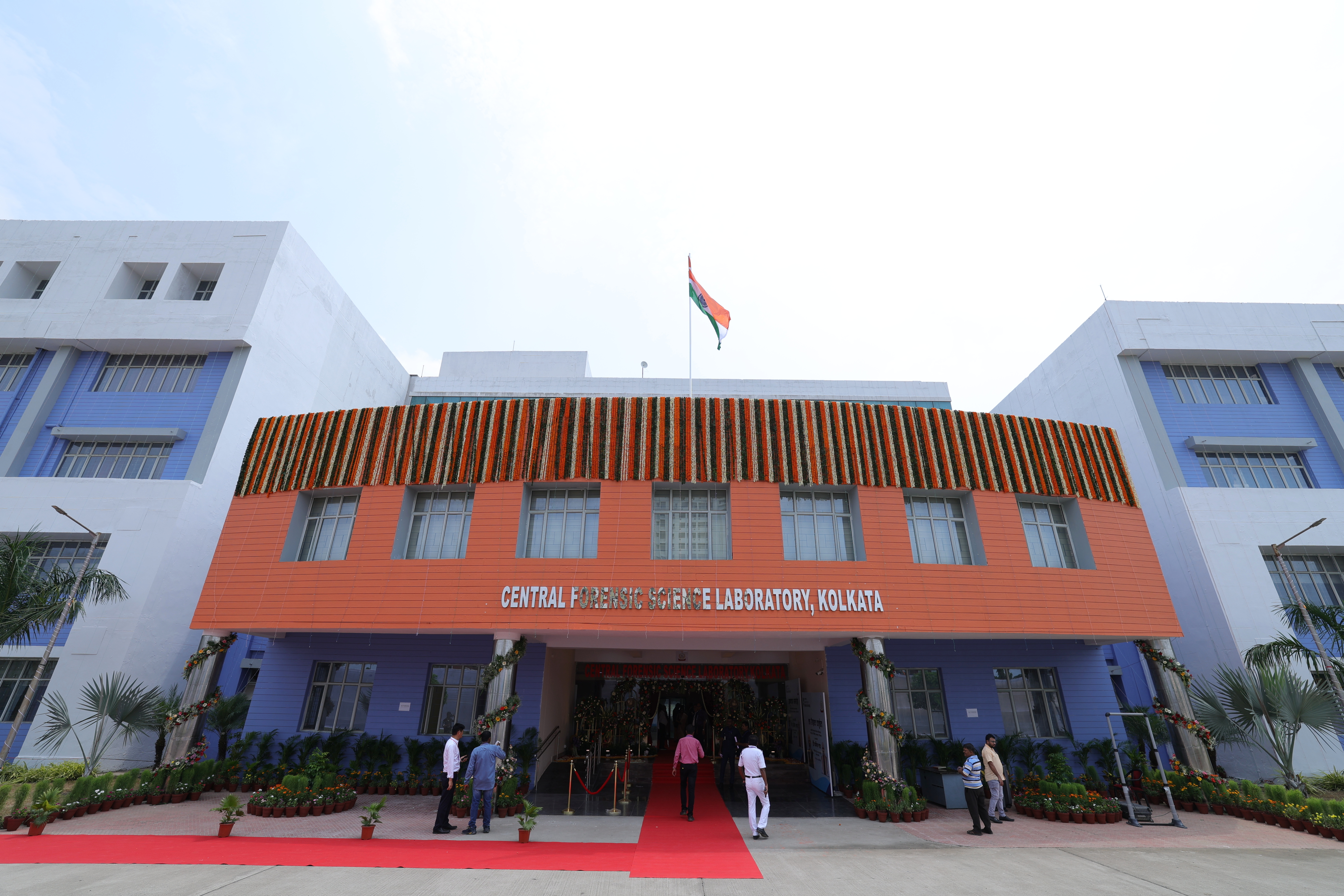
Union Home Minister and Minister of Cooperation, Shri Amit Shah, today inaugurated the new building of the Central Forensic Science Laboratory (CFSL), Kolkata, in West Bengal. On this occasion, the Union Home Secretary and several other dignitaries were present.

In his address, Union Home Minister and Minister of Cooperation, Shri Amit Shah said that under the leadership of Prime Minister Shri Narendra Modi, the Government of India is working with a vision to build a secure, transparent, and evidence-based criminal justice system. He said that today, another important link is being added to this effort. He stated that the Forensic Science Laboratory (FSL), built in Kolkata at a cost of ₹88 crore, will help West Bengal, Jharkhand, Bihar, Odisha, Assam, Sikkim, and all the states of the Northeast in developing an evidence-based criminal justice system and in fulfilling the role with a holistic approach. Shri Shah said that in the implementation of our three new criminal laws, this FSL will play a significant role in understanding, adopting, and delivering the importance of evidence, forensic science, and securing convictions to every police station.

Union Home Minister said that the Modi government is working to establish a network of FSLs across the country by forming clusters of 3–4 states to make their criminal justice systems evidence-based. He said that with this cluster approach, a campaign will be launched from January 2026 to take forensic science down to the police station level, to establish its importance as evidence in every court, and to make every investigating officer in police stations understand its significance. Through this, the criminal justice system across the country will be transformed from being based on argument to being evidence-based, ensuring that the guilty do not benefit from the benefit of doubt and that justice is delivered to the victim. Shri Shah said that this entire process is only possible when police stations, public prosecutors, and courts understand its importance, adopt it, and give it priority in their functioning. He added that by creating an FSL network and adopting a cluster approach, the involvement of experts in complex cases will lead to decisions being made more efficiently, resulting in a radical transformation of the entire criminal justice system. He also mentioned that today, the Narcotics Version 2.0 and Explosives Version 2.0 have been formally launched, which will simplify various tasks for forensic science laboratories across the country.

Shri Amit Shah said that today, in the 21st century, when our transactions, communication, identity, and basic details are all being stored in one place, the nature of crime is also changing rapidly. He said it is very important that those who prevent crime stay two steps ahead of the criminals, and if we do not use science and clear laws in this effort, we cannot stay ahead of the criminals. He stated that major financial scams are now being exposed through forensic audits, and our criminal justice system is entering a new era.

Union Home Minister and Minister of Cooperation said that the Bharatiya Nyaya Sanhita (BNS), the Bharatiya Nagarik Suraksha Sanhita (BNSS), and the Bharatiya Sakshya Adhiniyam (BSA) are laws made by the Parliament elected by the people of India to protect the constitutional rights of the people of India. He stated that under the leadership of Prime Minister Modi, the Government of India has abolished the 160-year-old laws made by the British and has introduced new laws for a new India. He said this is a revolutionary change in the direction of delivering justice to the people, as now the guilty will not be able to escape due to lack of evidence. He added that these laws have already incorporated and defined all potential technological changes that may occur in the next 100 years.

Shri Amit Shah said that the new criminal laws have provided a legal basis for the use of technology in crime scene investigation and trial. He stated that in offences punishable with more than seven years of imprisonment, the visit of a forensic science team has been made mandatory. He said that these laws ensure timely justice, with a provision for filing the chargesheet within 60 days. He added that now, in nearly 60 percent of cases, chargesheets are being filed within 60 days, which is a major achievement. He also stated that through “trial in absentia,” trials will be conducted and punishments will be pronounced even in the absence of absconders, and they will be brought back using international agreements. He said that 17,184 police stations in the country are connected to CCTNS, are online, and their data is being generated collectively.

Union Home Minister said that the Government of India has offered support for one forensic mobile van in every district, and many states have increased the number of vans on their own based on the number of FIRs registered. He stated that 16 campuses of the National Forensic Science University (NFSU) have been approved, 7 have been established, and the rest are in process. He said that, in addition to this, an NFSU college will be set up in every major state to ensure the availability of trained manpower. He noted that from 26 campuses across the country, 36,000 students will graduate annually with degrees, diplomas, and PhDs, while the country’s requirement is 30,000 trained professionals per year. In this way, the task of creating human resources as per the requirement has been completed in advance. Shri Shah added that 9 more NFSU campuses will be built at a cost of ₹1,300 crore, and 7 new CFSLs will be established at a cost of ₹860 crore in Uttar Pradesh, Chhattisgarh, Odisha, Rajasthan, Tamil Nadu, Kerala, and Bihar. He said the Ministry of Home Affairs has supported the forensic science infrastructure of the states. He also mentioned that a ₹2,080 crore plan is being introduced for the modernization of forensic capabilities, and a National Forensic Data Centre will be established at a cost of ₹200 crore.

Shri Amit Shah said that our Constitution-makers infused the spirit of freedom into the Constitution, but we have begun the work of implementing it on the ground very late. He said that it is our responsibility to ensure that even the poorest person can walk into a police station with dignity and confidence in the system, and receive justice through the legal process in the shortest possible time.

Lavender has given the small J&K town of Bhaderwah a national identity : Dr Jitendra Singh

| Published on:

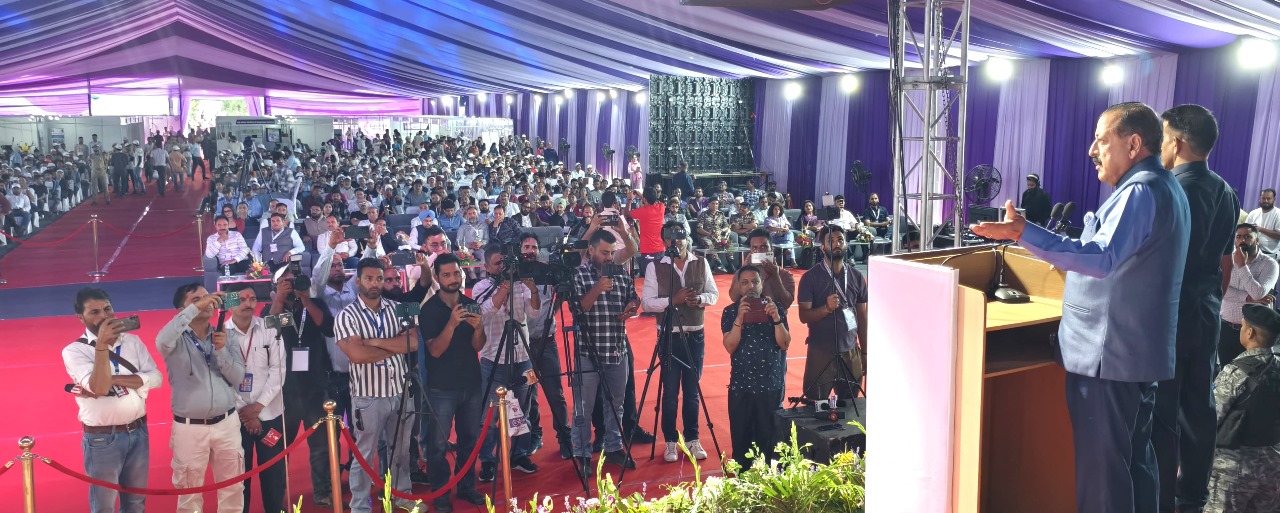
“Lavender has given the small J&K town of Bhaderwah a national identity and also a national role in India’s economic growth,” said Union Minister Dr. Jitendra Singh here today while inaugurating 2-day Lavender festival 2025 organized by CSIR- IIIM Jammu in Bhaderwah town of Jammu.

Union Minister of State (Independent Charge) for Science and Technology, Minister of State (Independent Charge) for Earth Sciences, Minister of State in the Prime Minister’s Office, Department of Atomic Energy, Department of Space, and Personnel, Public Grievances, and Pensions, Dr. Jitendra Singh lauded the Agri-Startup model of Lavender farming as a transformative force that has rewritten the narrative of entrepreneurship in remote and hilly terrains.

“Bhaderwah, once a quiet hilly town, is now a beacon of India’s rural startup revolution. Lavender has not just added fragrance to these mountains—it has added identity, income, and inspiration,” said Dr. Singh

“This single mission has answered multiple challenges,” Dr Jitendra Singh said, “It busted the myth that StartUps are limited to IT or require foreign degrees. Our youth in Jammu & Kashmir, in collaboration with CSIR-IIIM, have shown that passion, perseverance, and learning can build sustainable ventures rooted in agriculture.”

He proudly shared that young entrepreneurs in Bhaderwah are earning an average of Rs 65 lakhs annually through lavender cultivation and value-added products, motivating many others to leave conventional jobs and pursue farming as a lucrative business opportunity.

Dr. Jitendra Singh credited Prime Minister Narendra Modi for introducing Bhaderwah and the Purple Revolution to the national stage. “When the Prime Minister dedicated nearly ten minutes in his ‘Mann Ki Baat’ to talk about this Lavender mission in detail, it gave the best possible global introduction to Bhaderwah—one that we couldn’t have imagined,” Dr. Jitendra Singh said.

The Minister emphasised that it was PM Modi’s vision of StartUp India and StandUp India, announced from the ramparts of the Red Fort, that ignited the entrepreneurial spirit in regions that previously needed long explanations to justify their existence on the developmental map.

Dr. Jitendra Singh revealed that there are currently 50 distillation units operational in Bhaderwah, with lavender-derived products being supplied to markets in Maharashtra and other states. The model has not only attracted attention from neighboring states like Himachal Pradesh and Uttarakhand, but also from the North-Eastern states, whose representatives were present at the festival to gain first-hand insights.

“This is a new paradigm the world is witnessing – a rural, agriculture-based startup revolution that is both scalable and sustainable,” he remarked. Another myth that Dr. Jitendra Singh addressed was the misconception that StartUps are only for the young. He shared that a special exhibition featuring 60+ age group entrepreneurs will be showcased in the next edition of the festival.

Drawing a broader economic context, Dr. Jitendra Singh said, “India has moved from the 5th largest to the 4th largest economy, and sectors like lavender cultivation will further fuel our rise. These unexplored areas, when empowered, will become pillars of value addition and employment generation.”

He also addressed skepticism around India’s economic resilience amid aggressive defence postures. “Despite challenging times and operations like Sindoor, India’s economy has not only remained buoyant but also grown. That is a fitting reply to skeptics,” he asserted.

Concluding his address, Dr. Jitendra Singh praised Dr. Zabeer and the CSIR-IIIM team for organizing an unprecedented event in Bhaderwah that drew visitors from all over India. He invited everyone to visit the lavender fields over the next 10–15 days during peak bloom and hear directly from the entrepreneurs themselves.

PM lays foundation stone, inaugurates various projects worth around Rs 47,600 crore at Kanpur (UP)

| Published on:

The Prime Minister Shri Narendra Modi laid the foundation stone, inaugurated various projects worth around Rs 47,600 crore at Kanpur, Uttar Pradesh today. Addressing the gathering, he informed that the tour to Kanpur, initially scheduled on 24th April 2025 had to be cancelled due to the terrorist attacks in Pahalgam. He paid tribute to Shri Shubham Dwivedi, a son of Kanpur, who fell victim to this barbaric act. The Prime Minister remarked that he deeply felt the pain, suffering, anger and collective anguish of sisters and daughters across the country. This collective fury, he stated, was witnessed worldwide as Operation Sindoor unfolded. He underscored the success of Operation Sindoor, where terrorist hideouts in Pakistan were destroyed, and the Pakistani military was forced to plead for an end to the conflict. The Prime Minister saluted the valor of the armed forces, emphasizing that he pays homage to their courage from the land of the independence struggle. He firmly reiterated that the enemy, who begged for mercy during Operation Sindoor, must not be under any illusion as Operation Sindoor is not yet over. The Prime Minister outlined India’s three clear principles in its fight against terrorism. First, India will deliver a decisive response to every terrorist attack. The timing, method, and conditions of this response will be determined solely by the Indian armed forces. Second, India will no longer be intimidated by nuclear threats, nor will it make decisions based on such warnings. Third, India will view both the masterminds of terrorism and the governments that shelter them in the same light. The distinction between Pakistan’s state and non-state actors will no longer be accepted. The Prime Minister asserted unequivocally that wherever the enemy may be, it will be eliminated.

“Operation Sindoor showcased India’s indigenous defense capabilities and the strength of Make in India to the world”, exclaimed Shri Modi, adding that India’s homegrown weapons, including the BrahMos missile, struck targets with precision, causing destruction deep within enemy territory. This capability, he remarked, is a direct result of India’s commitment to Atmanirbhar Bharat. Shri Modi noted that there was a time when India depended on foreign nations for its military and defense needs. However, the country has begun transforming those circumstances, striving to become self-sufficient in defense production. He underscored that self-reliance in defense is not only vital for the economy but also essential for national pride and sovereignty. Reiterating that to free India from this dependence, the government launched the Atmanirbhar Bharat initiative, Shri Modi expressed pride in Uttar Pradesh’s major contributions to achieving defense self-sufficiency. He pointed out that, like Kanpur’s historic ordnance factory, seven ordnance factories have been transformed into advanced defense production units. He also highlighted the establishment of a major Defense Corridor in Uttar Pradesh, with the Kanpur node emerging as a key center for Atmanirbhar Bharat in the defense sector.

Noting that while traditional industries once relocated, major defense sector companies are now establishing their presence, the Prime Minister highlighted that the production of AK-203 rifles has already commenced in Amethi. He emphasized that the BrahMos missile, which played a crucial role in Operation Sindoor, now has a new home in Uttar Pradesh, signifying the state’s rising prominence in defense production. The Prime Minister remarked that in the future, Kanpur and Uttar Pradesh will lead India’s journey to becoming a major defense exporter. He further stated that new factories will be established, significant investments will flow in, and thousands of local youth will gain excellent employment opportunities.

Emphasizing that taking Uttar Pradesh and Kanpur to new heights of development is the top priority of the Union and State governments, Shri Modi stated that this progress would be achieved by promoting industries and restoring Kanpur’s historic glory. He remarked that previous governments neglected the requirements of modern industries, leading to the decline of industrial presence in Kanpur. He pointed out that family-driven governments remained indifferent, resulting in not just Kanpur but all of Uttar Pradesh falling behind in development.

The Prime Minister stressed that two essential pillars for the state’s industrial progress are self-sufficiency in the energy sector—ensuring a steady power supply—and strong infrastructure and connectivity. He announced the inauguration of several major power plants, including the 660 MW Panki Power Plant, 660 MW Neyveli Power Plant, 1320 MW Jawaharpur Power Plant, 660 MW Obra-C Power Plant, and 660 MW Khurja Power Plant. He remarked that these projects represent a significant step toward fulfilling Uttar Pradesh’s energy needs. The Prime Minister highlighted that with these power plants operational, electricity availability in the state will increase, further accelerating industrial growth. He also stated that development projects over ₹47,000 crore have been inaugurated and foundation stones laid for various initiatives, reinforcing the commitment to progress. The Prime Minister noted that Ayushman Vay Vandana Cards have been distributed to senior citizens, ensuring free medical treatment, while other beneficiaries have received assistance through various welfare schemes. He underscored that these initiatives and development projects reflect the government’s unwavering dedication to the progress of Kanpur and Uttar Pradesh.

Emphasising that both the Union and State governments are actively working toward building a modern and developed Uttar Pradesh, Shri Modi highlighted that the infrastructure, amenities, and resources once exclusive to major metro cities are now becoming visible in Kanpur. He recalled that a few years ago, the government gave Kanpur its first metro service, and today, the Orange Line of Kanpur Metro has reached Kanpur Central. He noted that the metro network, which started as elevated, has now expanded to underground, seamlessly connecting key areas of the city. Shri Modi remarked that the expansion of Kanpur Metro is not an ordinary project but a testament to how determined leadership, strong willpower, and a government with honest intent can drive the nation’s development. He addressed how people used to doubt whether metro services or major infrastructure improvements could ever be implemented in Kanpur due to overcrowded areas, narrow roads, and lack of modern urban planning. He noted that these challenges led Kanpur and other major cities in Uttar Pradesh to fall behind in the race for development, worsening traffic congestion and slowing down the city’s progress. He asserted that today, the same Kanpur and Uttar Pradesh are setting new benchmarks in development. Shri Modi highlighted the direct benefits of metro services for Kanpur’s people, noting that, as a major commercial hub, the metro will make travel to Naveen Market and Bada Chauraha easier for traders and customers alike. He emphasized that students from IIT Kanpur and the general public will also save significant travel time in reaching Central Railway Station. Shri Modi reaffirmed that a city’s speed determines its progress and that these enhanced connectivity and transport facilities are shaping a new, modern image of Uttar Pradesh’s development.

Highlighting Uttar Pradesh’s remarkable advancements in infrastructure and connectivity, stating that the state has moved far beyond its former identity of pothole-ridden roads, the Prime Minister emphasized that UP is now known for its extensive network of expressways. He remarked that while people once avoided stepping out after dusk, highways in Uttar Pradesh are now bustling with travelers 24/7. He noted that the people of Kanpur understand this transformation better than anyone. The Prime Minister announced that soon, the Kanpur-Lucknow Expressway will reduce travel time to Lucknow to just 40–45 minutes. Additionally, direct connectivity will be established between Lucknow and the Purvanchal Expressway, while the Kanpur-Lucknow Expressway will be linked to the Ganga Expressway—cutting down travel distance and time in both directions. He acknowledged that Kanpur residents have long faced challenges due to the single-line railway track in the Farrukhabad-Anwarganj section. He noted that commuters have struggled with 18 railway crossings, facing frequent closures that disrupted travel. The Prime Minister announced that ₹1,000 crore will be invested in constructing an elevated rail corridor in the region, significantly improving traffic flow, increasing speed, and reducing pollution. Most importantly, he emphasized that this initiative will save precious time for the people of Kanpur.

Shri Modi underlined the ongoing transformation of Kanpur Central Railway Station, stating that it is being upgraded to a world-class facility. He remarked that soon, the station will resemble an airport in terms of modern amenities and infrastructure. He also noted that the government is developing over 150 railway stations in Uttar Pradesh under the Amrit Bharat Railway Station initiative, further enhancing connectivity and passenger experience. Emphasizing that Uttar Pradesh has already become the state with the highest number of international airports in India, Shri Modi remarked that with advancements in highways, railways, and airways, the state is progressing rapidly in all sectors. He reaffirmed the government’s commitment to making Uttar Pradesh a hub of industrial opportunities. He highlighted the launch of Mission Manufacturing in this year’s budget, designed to bolster Make in India by promoting local industries and production. Shri Modi further remarked that cities like Kanpur will benefit significantly from this initiative. He acknowledged that Kanpur’s industrial strength has historically been driven by its MSMEs and small-scale industries. He emphasized that the government is actively working to meet the expectations of these industries, ensuring their growth and sustainability.

Highlighting the transformation in the MSME sector, noting that earlier, small businesses were defined in a way that discouraged expansion, the Prime Minister stated that the government has revised these definitions, increasing turnover and scaling limits to promote growth. He announced that the latest budget has further expanded the scope of MSMEs, granting them additional exemptions. The Prime Minister acknowledged that credit availability was a major challenge for MSMEs in the past. However, he highlighted that over the last ten years, the government has taken multiple decisive steps to resolve this issue. He noted that young entrepreneurs looking to start their businesses now receive immediate financial support through the Mudra Yojana. Additionally, small and medium enterprises are being financially strengthened through the Credit Guarantee Scheme. Stating that MSME loan guarantees have been increased to ₹20 crore in this year’s budget, the Prime Minister said furthermore, MSMEs are being provided with credit cards with limits of up to ₹5 lakh to support their growth. He emphasized that the government is actively creating a business-friendly environment for MSMEs and new industries by simplifying processes and regulations. The Prime Minister also highlighted that Kanpur’s traditional leather and hosiery industries are being empowered through initiatives like One District, One Product. He remarked that these efforts will not only benefit Kanpur but also contribute to the overall industrial development of districts across Uttar Pradesh.

Emphasising that Uttar Pradesh has created an unprecedented and secure environment for investment, Shri Modi remarked that welfare schemes for the poor are being implemented with transparency, ensuring effective ground-level execution. He reaffirmed the government’s commitment to fulfilling the aspirations of the middle class, stating that the administration stands firmly with them. He announced that this year’s budget has made income up to ₹12 lakh entirely tax-free, bringing renewed confidence and financial strength to millions of middle-class families. The Prime Minister  concluded by reiterating that the government will continue progressing rapidly with its commitment to service and development, leaving no stone unturned in taking the nation—and Uttar Pradesh—to new heights.

The Chief Minister of Uttar Pradesh, Shri Yogi Adityanath, Deputy Chief Ministers Shri Keshav Prasad Maurya and Shri Brajesh Pathak were present among other dignitaries.

Background

Prime Minister laid the foundation stone and inaugurated multiple development projects aimed at boosting the region’s infrastructure and connectivity. He inaugurated the Chunniganj Metro Station to Kanpur Central Metro Station section of Kanpur Metro Rail Project worth over Rs 2,120 crore. It will include 14 planned stations with five new underground stations integrating key city landmarks and commercial hubs into the metro network. Additionally, he also inaugurated road widening and strengthening work of G.T. Road.

In order to boost power generation capacity in the region, multiple projects will be undertaken. Prime Minister laid the foundation stone of a 220 kV substation in Sector 28 at Yamuna Expressway Industrial Development Authority (YEIDA), Gautam Buddh Nagar to meet the growing energy demands of the region. He also inaugurated 132 kV Substations worth over Rs 320 crore at Ecotech-8 and Ecotech-10 in Greater Noida.

Prime Minister inaugurated a 660 MW Panki Thermal Power Extension Project in Kanpur worth over Rs 8,300 crore enhancing Uttar Pradesh’s energy capacity. He also inaugurated three 660 MW units of Ghatampur Thermal Power Project worth over Rs 9,330 crore bolstering the power supply significantly.

Prime Minister also inaugurated Rail over bridges over Panki Power House Railway Crossing and over Panki Dham Crossing on Panki Road at Kalyanpur Panki Mandir in Kanpur. It will support the Panki Thermal Power Extension Project’s logistics by facilitating coal and oil transport while also alleviating traffic congestion for the local population.

Prime Minister inaugurated a 40 MLD (Million Liters per Day) Tertiary Treatment Plant at Bingawan in Kanpur worth over Rs 290 crore. It will enable the reuse of treated sewage water, promoting water conservation and sustainable resource management in the region.

In a major boost to road infrastructure in the region, Prime Minister laid the foundation stone for widening and strengthening of Gauria Pali Marg for industrial development in Kanpur Nagar District; and widening and strengthening of road to connect Narwal Mode (AH-1) on Prayagraj Highway to Kanpur Defence Node (4 lane) under Defence Corridor in Kanpur Nagar District which will significantly improve connectivity for the Defence Corridor, enhancing logistics and accessibility.

Prime Minister also distributed certificates and cheques to the beneficiaries of PM Ayushman Vay Vandana Yojna, National Livelihood Mission and PM Surya Ghar Muft Bijli Yojana.

PM greets the people of Goa on their Statehood Day

| Published on:

Prime Minister, Shri Narendra Modi, has greeted the people of Goa on the occasion of their Statehood Day. “Goa’s unique culture is India’s pride. Goan people have made a strong mark in diverse sectors. This state has always been drawing people from all over the world”, Shri Modi stated.

The Prime Minister posted on X :

“Greetings to my sisters and brothers of Goa on the occasion of their Statehood Day. Goa’s unique culture is India’s pride. Goan people have made a strong mark in diverse sectors. This state has always been drawing people from all over the world. Over the last decade, a lot of work has been done that is furthering Goa’s progress. May the state continue to scale new heights of development in the times to come.”

PM lays the foundation stone, dedicates multiple development projects worth over Rs 48,520 crore at Karakat, Bihar

| Published on:

The Prime Minister Shri Narendra Modi laid the foundation stone, dedicated to the nation multiple development projects worth over Rs 48,520 crore at Karakat, Bihar today. Addressing the gathering, he mentioned that he had the privilege of accelerating Bihar’s development on this sacred land and highlighted the inauguration and foundation laying of projects over ₹48,000 crore. The Prime Minister acknowledged the large gathering that had come to bless him and expressed his deep gratitude for their affection and love for Bihar, emphasizing that he always holds their support in the highest regard. He extended his sincere appreciation to the mothers and sisters of Bihar.

Remarking on the significance of Sasaram, emphasizing that even its name carries the legacy of Lord Ram, Shri Modi highlighted the deep-rooted traditions of Lord Ram’s lineage, underscoring the principle of unwavering commitment—once a promise is made, it must be fulfilled. He affirmed that this guiding philosophy has now become the policy of New India. Shri Modi recalled the recent terrorist attack in Pahalgam, which claimed the lives of many innocent citizens. He noted that just a day after the heinous attack, he had visited Bihar and made a solemn pledge to the nation that the masterminds of terror would face justice, with a punishment beyond their imagination. He stated that today, as he stands in Bihar once again, he has fulfilled that pledge. “Those who sat in Pakistan and destroyed the Sindoor of our sisters, our armed forces turned their hideouts into ruins”, exclaimed Shri Modi. “The power of Sindoor of the daughters of India was seen by Pakistan as well as the world”, he added, asserting that terrorists who once felt secure under the protection of the Pakistani military have been brought to their knees by India’s forces in a single decisive action. Shri Modi underscored that Pakistan’s airbases and military installations were destroyed within minutes, declaring, “This is the new India—an India of immense power and resilience” .

Underlining that Bihar is the land of Veer Kunwar Singh, known for its valiant spirit, the Prime Minister highlighted the contribution of thousands of young men from Bihar who serve in the Indian Armed Forces and the Border Security Force (BSF) to safeguard the nation. He emphasized the extraordinary valor and indomitable courage displayed by the BSF during Operation Sindoor, stating that the world has witnessed their unparalleled bravery. The Prime Minister affirmed that the BSF personnel stationed at India’s borders are an unbreakable shield of security, with their foremost duty being the protection of Mother India. He also paid tribute to BSF Sub-Inspector Shri Imtiaz, who was martyred on May 10 while fulfilling his duty at the border, expressing his deep respect for Bihar’s brave son. PM reiterated his statement from Bihar, underscoring that the power demonstrated by India in Operation Sindoor was merely one arrow from its quiver.

“India’s fight is against every enemy of the nation, whether they operate across the border or within the country”, asserted Shri Modi, highlighting that Bihar has witnessed how violent and disruptive forces have been eliminated over the years. He recalled the past conditions in Sasaram, Kaimur, and surrounding districts, emphasizing how Naxalism had once dominated the region and the fear of masked militants armed with guns was a constant threat to the people. Shri Modi further remarked that while government schemes were announced, they often failed to reach the people in Naxal-affected villages with no hospitals or mobile towers, and schools burned down. Road construction workers were frequently targeted and killed. Shri Modi stated that these elements had no faith in BabaSaheb Ambedkar’s Constitution. He acknowledged that despite these challenging circumstances, Nitish Kumar worked towards development, emphasizing that since 2014, efforts in this direction had accelerated significantly. Shri Modi highlighted that Maoists were brought to justice for their actions, and efforts were made to integrate young people into the mainstream of development. He noted that the results of 11 years of determined efforts are now visible. Before 2014, over 125 districts in India were affected by Naxalism, but today, only 18 districts remain affected, he added. “Our government is not only providing roads but also employment opportunities, that the day is not far when Maoist violence will be completely eradicated, ensuring uninterrupted peace, security, education, and development across villages”, affirmed Shri Modi. He asserted that India’s fight against terrorism has neither stopped nor slowed down, declaring, “if terror raises its head again, India will pull it out from its hiding and crush it decisively”.

Emphasizing that security and peace pave the way for new avenues of development, the Prime Minister highlighted that under the leadership of Nitish Kumar, the departure of the ‘Jungle Raj’ government marked Bihar’s progress on the path of prosperity. He remarked that the days of broken highways, deteriorated railways, and limited flight connectivity are now a thing of the past. Noting that Bihar once had only one airport—Patna—but today, Darbhanga Airport is operational, offering direct flights to cities like Delhi, Mumbai, and Bengaluru, the Prime Minister acknowledged the longstanding demand of Bihar’s people for the modernization of Patna Airport’s terminal and affirmed that this demand has now been fulfilled. He highlighted that last evening, he had the privilege of inaugurating the new terminal building of Patna Airport, which is now capable of handling one crore passengers. He also stated that ₹1,400 crore is being invested in Bihta Airport.

Highlighting the extensive development of four-lane and six-lane roads across Bihar, Shri Modi emphasized the rapid progress in key infrastructure projects, including highways connecting Patna to Buxar, Gaya to Dobhi, and Patna to Bodh Gaya. He also mentioned the Patna–Ara–Sasaram Greenfield Corridor, where work is advancing at a swift pace. Shri Modi remarked on the construction of new bridges over major rivers such as the Ganga, Son, Gandak, and Kosi, underscoring their role in fostering new opportunities and possibilities for Bihar. He stated that these projects, worth thousands of crores, are creating employment for thousands of young people and boosting both tourism and trade in the region.

Mentioning the transformation of Bihar’s railway infrastructure, Shri Modi highlighted the introduction of world-class Vande Bharat trains in Bihar and the ongoing process of doubling and tripling railway lines. He remarked that work is progressing rapidly in areas such as Chhapra, Muzaffarpur, and Katihar. He further stated that multi-tracking between Son Nagar and Andal is underway, which will significantly improve train movement. Shri Modi also announced that over 100 trains now halt at Sasaram, demonstrating the region’s growing connectivity. He affirmed that while long-standing challenges are being resolved, efforts are also being made to modernize the railway network.

The Prime Minister emphasized that these developments could have been implemented earlier, but those responsible for modernizing Bihar’s railway system exploited recruitment processes for personal gain, depriving the people of their rightful opportunities. He urged the people of Bihar to remain vigilant against deceit and false promises from those who previously ruled under ‘Jungle Raj.’ Underlining that development is incomplete without electricity, stating that industrial progress and ease of life depend on reliable power supply, the Prime Minister noted that Bihar has significantly focused on electricity generation over the past few years. He remarked that electricity consumption in Bihar has increased fourfold compared to a decade ago. The Prime Minister announced that a major NTPC power project is under construction in Nabinagar, with an investment of ₹30,000 crore and this project will provide Bihar with 1,500 megawatts of electricity. He also highlighted the initiation of new thermal power plants in Buxar and Pirpainti.

Underscoring the government’s focus on the future, particularly in advancing Bihar towards green energy, Shri Modi highlighted the construction of a solar park in Kajra as part of the state’s renewable energy initiatives. He remarked that under the PM-KUSUM scheme, farmers are being provided with opportunities to generate income through solar energy, while renewable agriculture feeders are supplying electricity to farms, further improving agricultural productivity. He stated that as a result of these efforts, people’s lives have improved, and women feel safer. Shri Modi emphasised that modern infrastructure brings the greatest benefits to villages, the poor, farmers, and small industries, as they can connect with large national and international markets. He highlighted that new investments in the state create new opportunities and drive economic growth. Recalling the Bihar Business Summit held last year, where a large number of companies came forward to invest in the state, Shri Modi said that industrial growth within the state reduces the need for labor migration, allowing people to find employment closer to home. He noted that improved transportation facilities enable farmers to sell their produce across greater distances, further strengthening the agricultural sector.

Underlining the continuous efforts of the government to increase farmers’ income in Bihar, the Prime Minister stated that more than 75 lakh farmers in Bihar are receiving financial assistance under the PM-Kisan Samman Nidhi scheme. He announced the establishment of the Makhana Board, emphasizing that Bihar’s Makhana has been granted a GI tag, which has significantly benefited Makhana farmers. He further noted that this year’s budget includes the announcement of a National Institute for Food Processing in Bihar. The Prime Minister remarked that just two to three days ago, the Cabinet approved an increase in the Minimum Support Price (MSP) for 14 crops, including paddy, for the Kharif season, asserting that this decision will ensure better prices for farmers’ produce and lead to higher incomes.

Taking a jibe at the opposition, the Prime Minister remarked that those who have deceived Bihar the most are now using false narratives of social justice to regain power. He highlighted that during their rule, Bihar’s poor and marginalized communities were forced to leave the state in search of a better life. “For decades, Dalits, backward classes, and tribal communities in Bihar lacked even basic sanitation facilities”, stated the Prime Minister, emphasising that these communities were deprived of access to banking, often denied entry into banks, and remained largely homeless, with millions living without proper shelter. He questioned whether the suffering, hardships, and injustice endured by Bihar’s people under past governments were the social justice promised by the opposition parties. He asserted that there could be no greater injustice than this. The Prime Minister remarked that the opposition never truly cared for the struggles of Dalits and backward communities and  criticized them for bringing foreign delegations to showcase Bihar’s poverty instead of working towards its development. The Prime Minister stated that now, after Dalits, marginalized groups, and backward communities have distanced themselves from the opposition due to its wrongdoings, the party is attempting to revive its identity by invoking social justice.

Highlighting that under their government, Bihar and the nation have witnessed a new dawn of social justice, Shri Modi emphasized that the government has ensured access to essential services for the poor and is working towards delivering these benefits to 100% of eligible recipients. He stated that four crore new houses have been provided, and three crore women are being empowered through the ‘Lakhpati Didi’ initiative. He further added that over 12 crore households now have tap water connections, improving the quality of life across the country. Shri Modi  highlighted that every elderly citizen above 70 years of age is entitled to free medical treatment worth up to ₹5 lakh. He noted that free ration is being provided every month to support those in need. “Our government stands firmly with every poor and underprivileged individual, ensuring their well-being and upliftment”, affirmed Shri Modi.

The Prime Minister emphasized the government’s commitment to ensuring that no village or eligible family is left out of its welfare initiatives and expressed satisfaction that Bihar has launched the Dr. Bhimrao Ambedkar Samagra Seva Abhiyan with this vision. He highlighted that under this campaign, the government is reaching villages and communities with 22 essential schemes simultaneously and aims to directly benefit Dalits, Mahadalits, backward classes, and the poor. The Prime Minister noted that over 30,000 camps have been organized so far, and lakhs of people have been connected to the campaign. He underscored that when the government reaches beneficiaries directly, discrimination and corruption are eliminated and affirmed it as an approach which is the true embodiment of social justice.

Underlining the vision of transforming Bihar into the Bihar envisioned by Baba Saheb Ambedkar, Karpoori Thakur, Babu Jagjivan Ram, and Jayaprakash Narayan, Shri Modi stated that the ultimate goal is a developed Bihar, contributing to a developed India. He remarked that whenever Bihar has progressed, India has reached new heights globally. He concluded by expressing confidence that together, everyone will accelerate the pace of development and extended his congratulations to the people for these developmental initiatives.

The Governor of Bihar, Shri Arif Mohammed Khan, Chief Minister of Bihar, Shri Nitish Kumar, Union Ministers Shri Jitan Ram Manji, Shri Giriraj Singh, Shri Rajiv Ranjan Singh, Shri Chirag Paswan, Shri Nityanand Rai, Shri Satish Chandra Dubey, Dr. Raj Bhushan Choudhary were present among other dignitaries at the event.

Background

Boosting power infrastructure in the region, Prime Minister laid the foundation stone for the Nabinagar Super Thermal Power Project, Stage-II (3×800 MW) in Aurangabad district worth over Rs 29,930 crore, which will aim at ensuring energy security for Bihar and eastern India. It will boost industrial growth, create job opportunities, and provide affordable electricity in the region.

In a major boost to the road infrastructure and connectivity in the region, Prime Minister laid the foundation stone for various road projects including the Four-Laning of the Patna–Arrah–Sasaram section of NH-119A, and the Six-Laning of the Varanasi–Ranchi–Kolkata highway (NH-319B) and Ramnagar–Kacchi Dargah stretch (NH-119D), and construction of a new Ganga bridge between Buxar and Bharauli. These projects will create seamless high-speed corridors in the state along with boosting trade and regional connectivity. He also inaugurated the four Laning of Patna – Gaya – Dobhi section of NH – 22, worth around Rs 5,520 crore and four Laning of the elevated highway and at grade improvements at Gopalganj Town on NH – 27, among others.

In line with his commitment to improving rail infrastructure across the country, Prime Minister dedicated to the nation the 3rd Rail Line between Son Nagar – Mohammad Ganj worth over Rs 1330 crore, among others.


Operation Sindoor is India’s frontal assault against terrorism : Raksha Mantri

| Published on:

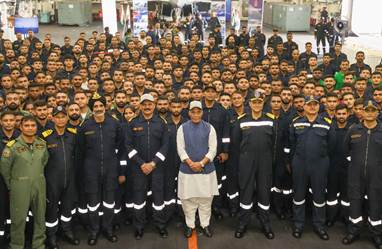
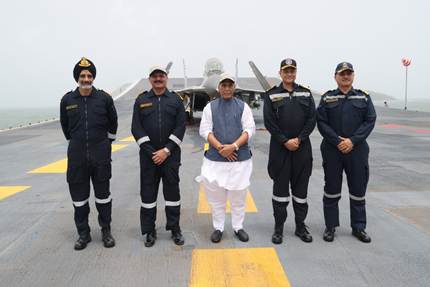
Operation Sindoor is not just a military action, but India’s frontal assault against terrorism, and if Pakistan resorts to anything evil or unethical, it will, this time, face the firepower and ire of the Indian Navy,” said Raksha Mantri Shri Rajnath Singh while addressing officers & sailors onboard India’s first indigenous aircraft carrier INS Vikrant off the Goa coast on May 30, 2025. Commending the Indian Navy’s “silent service” during Operation Sindoor, Raksha Mantri stated that the mighty Carrier Battle Group ensured that the Pakistani Navy did not venture out, or else it would have faced the consequences. He sent a clear message to Pakistan that if it tries to cast an evil eye, the opening of New Delhi’s response will be at the hands of the Indian Navy.

Shri Rajnath Singh asserted that Pakistan needs to understand that the time is up for the dangerous game of terrorism it has been playing since Independence. “Now, if Pakistan instigates any terrorist act against India, it will have to bear the consequences and face defeat. India will not hesitate. It will use every method to root out the menace of terrorism,” he said.

Raksha Mantri added that anti-India activities are being carried out openly from Pakistani soil and India is completely free to carry out every kind of operation against terrorists on both sides of the border and the sea. Today, the whole world is acknowledging India’s right to protect its citizens against terrorism, he said, emphasising that Pakistan must uproot the nursery of terrorism operating on its soil with its own hands.

Shri Rajnath Singh called for the handing over of terrorists like Hafiz Saeed and Masood Azhar to India. “Both of them are not only in India’s list of ‘Most Wanted Terrorists’, they are also UN Designated Terrorists. Tahawwur Rana, an accused in the Mumbai attacks, has been brought to India recently. Hafiz Saeed is also guilty of the Mumbai attacks, and justice must be done for his crime,” he said.

On Pakistan’s repeated offer of talks, Raksha Mantri again clarified: “If there are talks, it will only be on terrorism and PoK. If Pakistan is serious about talks, it should hand over terrorists like Hafiz Saeed and Masood Azhar to India so that justice is served.”

Describing the Indian Navy’s role in the integrated operation as praiseworthy, Shri Rajnath Singh stated that when the Indian Air Force destroyed the terror bases on Pakistani soil, the Navy’s aggressive deployment in the Arabian Sea, its unmatched maritime domain awareness and supremacy confined the Pakistani Navy to its own shores. “Our Western Fleet ships deployed at sea, within 96 hours of the Pahalgam terrorist attack, carried out successful firings of surface-to-surface & surface-to-air missiles and torpedoes on the western & eastern coast. It demonstrated the combat readiness of our platforms, systems & crew and our intent & readiness, forcing the enemy to come into a defensive posture,” he said.

Raksha Mantri added that the force projection of the Carrier Battle Group effectively indicated India’s intent and capability. The tremendous power of the Indian Navy, its military acumen and destructive capabilities have broken the enemy’s morale, he said. He urged the Navy to continue leaving no stone unturned in its preparations, reiterating Prime Minister Shri Narendra Modi’s clear message that if any terrorist attack takes place on the Indian soil, it will be considered as an ‘Act of War’ and responded in the same way.

Shri Rajnath Singh reasserted that Operation Sindoor is not yet over; it is just a pause, a warning. He added that if Pakistan makes the same mistake again, India’s answer will be harsher.

Lauding the speed, depth and clarity of the Armed Forces during Operation Sindoor, Raksha Mantri stated that the precision strikes displayed seamless synergy among the three Services as well as coordination among Ministries and Government agencies. He added that the operation sent a clear message to the terrorists & its patrons that India will no longer tolerate and give a befitting reply. “Within a very short span of time, we destroyed Pakistan’s terrorist base and its intentions. Our response was so strong that Pakistan pleaded to stop. We stopped our military actions on our own terms. Our forces had not even started showing their might,” he said.

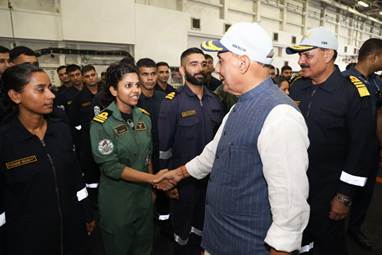
On his interactions with the Army and Air Force personnel and now the Naval warriors post-Operation Sindoor, Shri Rajnath Singh expressed satisfaction that whether land, sky or sea, India is fully prepared to deal with any situation anywhere. He recalled the contribution of the older version of INS Vikrant during the Liberation of Goa, stating that the aircraft carrier had led the Indian Navy’s fleet during the operation in 1961, and now, in its new indigenous avatar, it is spearheading India’s resolve against terrorism.

Raksha Mantri concluded his address by saying: “Today, we are in an era where wars are not fought only with bullets and bombs, but also through cyber space, data dominance and strategic deterrence. It is a matter of pride that the Navy is moving ahead in these areas.” He described the Indian Navy as not just the sentinel of the Indian Ocean, but a strategic force that strengthens India’s presence in the region. It warns the enemy that India is no longer just a regional power, but is moving towards becoming a global power, he said.

Onboard INS Vikrant, Shri Rajnath Singh was accompanied by the Chief of the Naval Staff Admiral Dinesh K Tripathi; Flag Officer Commanding-in-Chief Western Naval Command Vice Admiral Sanjay J Singh and other senior officials of the Indian Navy.

Raksha Mantri reached Goa on May 29, 2025, and interacted with the Indian Navy personnel who participated in the initial phase of Operation Sindoor. Apart from INS Vikrant, he embarked on other key frontline warships, which were part of the Carrier Battle Group and played a pivotal role in compelling Pakistani Navy units to operate close to Makran Coast.

Upon his arrival at INS Hansa, Shri Rajnath Singh was presented a Guard of Honour. He was, thereafter, given an insight on the progress of operations on the maritime front and overall preparedness of the units at sea.

Union Home Minister addresses Border Security Force (BSF) personnel in Poonch, J&K

| Published on:

Union Home Minister and Minister of Cooperation Shri Amit Shah addressed Border Security Force (BSF) personnel in Poonch, Jammu and Kashmir today. On this occasion, the Lieutenant Governor of Jammu and Kashmir, the Union Home Secretary, the Director of the Intelligence Bureau, the Director General of the Border Security Force, and several other distinguished individuals were present.

In his address, the Union Home Minister said that he had come to express gratitude on behalf of the 140 crore people of India to all the border guards of the BSF. He stated that whenever there is any kind of attack on India’s borders, it is the BSF personnel who face it first. In any situation, 365 days a year and 24 hours a day, BSF personnel remain available, vigilant, and dedicated. Shri Shah emphasized that due to the BSF personnel, no attack can directly cause damage within India’s borders because the first line of defence is the chest of a BSF soldier.

Shri Amit Shah said that for this reason, every child in the country recognizes BSF border guards as the first line of defence for national security. He said that during Operation Sindoor, while upholding their traditions, BSF personnel deployed at the Jammu and Rajasthan frontiers and the remote Kutch border protected the nation’s borders with utmost vigilance. Shri Shah noted that when Pakistan attacked our residential areas in retaliation for the Indian Army’s strikes on terrorists in Pakistan, BSF personnel in the Jammu frontier destroyed and damaged over 118 Pakistani posts. He added that the BSF dismantled Pakistan’s entire surveillance system.

Union Home Minister stated that even during peacetime, the BSF maintained a sharp watch on Pakistan’s posts, and during Operation Sindoor, based on precise intelligence and in the shortest possible time they inflicted maximum damage on Pakistani posts. Shri Shah said that the BSF caused the most damage to Pakistan’s surveillance equipment. He remarked that such bravery is witnessed only when there is pride in the nation, a spirit of patriotism in the heart, and zeal to make the supreme sacrifice. Home Minister added that the dedication, valor, courage, and sacrifice of BSF personnel are on the lips of every child in the country today.

PM addresses the Viksit Krishi Sankalp Abhiyan

| Published on:

The Prime Minister Shri Narendra Modi addressed the Viksit Krishi Sankalp Abhiyan via videoconferencing today. Delivering his remarks on the occasion, he remarked that the launch of the Viksit Krishi Sankalp Abhiyan as a significant initiative for farmers and an unique effort to support agricultural development. The Prime Minister highlighted that as the monsoon approaches and preparations for the Kharif season begin, over the next 12 to 15 days, 2000 teams consisting of scientists, experts, officials, and progressive farmers will travel across 700+ districts and reach millions of farmers across villages. He extended his best wishes to all farmers and participants in these teams, acknowledging their dedication to strengthening India’s agricultural sector.

Highlighting that agriculture has traditionally been a state subject, with each state formulating policies and taking initiatives for farmers’ welfare, Shri Modi emphasised that however with rapidly changing times, India’s agricultural sector also requires significant transformation. He remarked that Indian farmers have achieved record production, filling grain reserves, but the market dynamics and consumer preferences are evolving. He asserted that it is imperative to bring modern reforms to agricultural systems in collaboration with states and farmers. Shri Modi noted that under this campaign, scientific teams will transition from lab to land, bringing comprehensive data to farmers and equipping them with advanced agricultural knowledge. He emphasized that these teams will stand ready to assist farmers before the Kharif season begins.

Underlining the significant research advancements made by India’s agricultural scientists over the decades, emphasizing their positive impact on farming outcomes, the Prime Minister praised progressive farmers who have successfully experimented with new techniques, achieving impressive yields. Underscoring the importance of ensuring that scientific research and successful farming practices reach the broader farming community, the Prime Minister noted that while efforts have been ongoing, there is now a need to accelerate these initiatives with renewed energy. “Viksit Krishi Sankalp Abhiyan presents a valuable opportunity to bridge this knowledge gap, enabling farmers to benefit from cutting-edge agricultural insights”, the Prime Minister stated.

Shri Modi emphasized that for a Viksit Bharat, India’s agriculture must also evolve, highlighting several key focus areas of the central government aimed at transforming the agricultural sector. He outlined critical issues, including ensuring fair prices for farmers’ produce, strengthening the agricultural economy, and aligning crop production with national requirements. “India must not only fulfill its own needs but also emerge as a global food supplier”, stated Shri Modi, remarking that tackling climate change challenges, enhancing grain production with minimal water use, protecting soil health from harmful chemicals, modernising the farming techniques and taking science and technology to the fields are essential. He emphasized that over the last 10-11 years, the government has undertaken extensive efforts in these areas. He urged all participants in the campaign to maximize farmer awareness, ensuring they are well-informed about modern agricultural advancements.

Stressing the importance of providing farmers with additional sources of income beyond traditional agriculture, the Prime Minister highlighted key initiatives aimed at expanding opportunities for farmers. He remarked that installing solar panels along field boundaries can generate additional revenue. He noted the impact of the Sweet Revolution, stating that beekeeping is benefiting farmers and must be expanded to involve more participants. The Prime Minister also stressed the need to convert agricultural residues into energy, transforming waste into wealth. He highlighted the significance of identifying suitable areas for cultivating ‘Shri Anna’ and enhancing value addition in agricultural products. Prime Minister further pointed out that even non-milking cattle are now contributing to the economy through the Gobardhan Yojana, which creates income-generating opportunities. He called for widespread farmer awareness about these innovations to ensure maximum participation and benefits.

“India’s agriculture must become a cornerstone of a developed India”, emphasised Shri Modi underscoring the magnitude of this mission. He urged farmers to actively engage with visiting scientists, encouraging them to ask questions and seek valuable insights. Shri Modi called upon scientists and officials to recognize the significance of their mission, stating that their commitment must go beyond routine government work and reflect a spirit of national service. He urged them to address farmers’ queries comprehensively while also documenting their valuable suggestions. “Viksit Krishi Sankalp Abhiyan will open new avenues of progress for India’s farmers, driving modernization in agriculture”, declared Shri Modi and concluded by extending his best wishes to all the stakeholders.

PM lays foundation stone of City Gas Distribution project worth over Rs 1010 crore in Alipurduar, WB

| Published on:

In a significant step towards expanding the City Gas Distribution (CGD) network in India, Prime Minister Shri Narendra Modi laid the foundation stone of the CGD project in Alipurduar, West Bengal today. Addressing the gathering, he extended his greetings to the people of West Bengal from the historic land of Alipurduar. He highlighted the region’s rich cultural significance, emphasizing that it is not only defined by its borders but also by its deep-rooted traditions and connections. The Prime Minister remarked that Alipurduar shares its boundary with Bhutan, while Assam welcomes it on the other side, flanked by the natural beauty of Jalpaiguri and the pride of Cooch Behar as integral parts of the region. He expressed his privilege to visit this prosperous land, underscoring its role in Bengal’s heritage and unity.

“As India moves towards becoming a developed nation, Bengal’s participation is both expected and essential”, emphasised Shri Modi, highlighting the Central government’s continuous efforts to accelerate infrastructure, innovation, and investment in the region. “Bengal’s development as a foundational pillar of India’s future”, said Shri Modi, remarking that today marks the addition of another strong milestone in that journey. He announced the launch of the City Gas Distribution Project in Alipurduar and Cooch Behar, which will provide clean, safe, and affordable piped gas to over 2.5 lakh households. Shri Modi noted that this initiative will eliminate the concern of purchasing LPG cylinders, ensuring secure gas supply to families. Additionally, the expansion of CNG stations will enhance access to green fuel, resulting in cost savings, time efficiency, and environmental benefits. He congratulated the citizens of Alipurduar and Cooch Behar on this new beginning. “City Gas Distribution Project is not merely a pipeline initiative but a testament to the government’s commitment to doorstep delivery of essential services”, he emphasised.

Underscoring India’s remarkable advancements in the energy sector, emphasizing the country’s rapid transition towards a gas-based economy, the Prime Minister highlighted that in 2014, city gas services were available in only 66 districts, whereas today, the City Gas Distribution Network has expanded to over 550 districts across the country. The Prime Minister noted that this network is now reaching villages and smaller towns, ensuring access to piped gas for millions of households. He remarked that the widespread adoption of CNG has transformed public transport, contributing to a significant reduction in pollution levels. He emphasized that this shift not only improves the health of citizens but also eases financial burdens.

Stressing that the Pradhan Mantri Ujjwala Yojana has accelerated India’s transition towards a gas-based economy, Shri Modi highlighted that the scheme, launched in 2016, has significantly improved the lives of millions of poor women by providing them relief from smoke-filled kitchens, improving their health, and fostering dignity in household cooking spaces. Shri Modi also pointed out that in 2014, the country had fewer than 14 crore LPG connections, whereas today, the number has surpassed 31 crore, bringing the vision of universal gas access to reality. He stressed that the government has strengthened the gas distribution network nationwide, ensuring its reach to every corner of the country. Shri Modi further noted that the number of LPG distributors has more than doubled, stating that before 2014, India had fewer than 14,000 LPG distributors, while today, the number has increased to over 25,000. He emphasized that now, gas cylinders are easily available even in rural areas, making clean cooking fuel accessible to households across the nation.

Prime Minister emphasized the significance of the Urja Ganga Project, calling it a revolutionary step towards a gas-based economy. He highlighted that under this initiative, gas pipelines have been extended to connect the eastern states of India, significantly enhancing gas accessibility in West Bengal and other regions. The Prime Minister noted that these efforts by the Central government have not only expanded energy access but also created new employment opportunities across urban and rural areas. He remarked that from pipeline construction to gas supply, job generation has increased at multiple levels, strengthening the industrial ecosystem reliant on gas-based industries. “India is now progressing towards a future where energy is affordable, clean, and universally accessible”, the Prime Minister stated.

Emphasising that West Bengal has been a major center of India’s culture, knowledge, and scientific advancements, Shri Modi asserted that the vision of a developed India cannot be realized without Bengal’s growth. He noted that keeping this in mind, the Central government has initiated developmental projects worth thousands of crores over the past decade. He highlighted key infrastructure projects such as Purva Expressway, Durgapur Expressway, the modernization of Shyama Prasad Mukherjee Port, the expansion of Kolkata Metro, the transformation of New Jalpaiguri Station, and the introduction of new trains on the Dooars route—all aimed at accelerating Bengal’s progress. “The newly launched project is not merely a pipeline, but a lifeline of progress”, said Shri Modi, reiterating the government’s commitment to making life easier for citizens and ensuring a bright future for Bengal. He concluded by expressing hope that West Bengal will continue advancing towards development and extended his best wishes to the people of the state.

Union Minister Dr. Sukanta Majumdar, Leader of Opposition, West Bengal Assembly, Shri Suvendu Adhikari, Member of Parliament, Alipurduar, Shri Manoj Tigga were present among other dignitaries at the event.

Background

The City Gas Distribution (CGD) project, worth over Rs 1010 crore, aims to provide Piped Natural Gas (PNG) to more than 2.5 Lakh households, over 100 commercial establishments and industries besides providing Compressed Natural Gas (CNG) to vehicular traffic by establishing around 19 CNG stations in line with the Minimum Work Program (MWP) targets stipulated by the Government. It will provide convenient, reliable, environment-friendly and cost-effective fuel supply and create employment opportunities in the region.

PM addresses the ‘Sikkim@50’ celebrations

| Published on:

The Prime Minister Shri Narendra Modi addressed the ‘Sikkim@50’ programme in Gangtok via videoconferencing today. The theme of the event was ‘Where Progress Meets Purpose, and Nature Nurtures Growth’. Speaking on the occasion, he greeted the people of Sikkim on this special day, marking the 50th anniversary of the statehood of Sikkim. He said that he wanted to witness the fervor, energy and enthusiasm of the people in person, but due to inclement weather, he could not be present. He promised to visit Sikkim in near future and be part of their achievements and celebrations. The Prime Minister remarked that today was the day to celebrate their achievements of the past 50 years, lauding the Sikkim Chief Minister and his team’s energy in making the grand event memorable. He once again greeted the people of Sikkim on the golden jubilee celebrations of their statehood.

“50 years ago, Sikkim charted a democratic future for itself. The people of Sikkim not only connected with India’s geography but also with its soul”, said Shri Modi, remarking that there was a belief that when every voice is heard and rights are secured, equal opportunities for development will emerge. He stated that today, the trust of every family in Sikkim has grown stronger. Shri Modi emphasized that the country has witnessed the results of this trust in Sikkim’s remarkable progress. “Sikkim is the pride of the nation”, he declared, noting that over the past 50 years, Sikkim has become a model of progress alongside nature. It has transformed into a vast sanctuary of biodiversity, achieved the status of a 100% organic state, and emerged as a symbol of cultural and heritage prosperity. Shri Modi highlighted that today, Sikkim is among the states with the highest per capita income in the country. These achievements, he affirmed, are a testament to the capabilities of the people of Sikkim. Shri Modi recognized the many stars that have emerged from Sikkim over the last five decades, illuminating India’s horizon. He acknowledged the contribution of every community in Sikkim towards its rich culture and prosperity.

Emphasizing that since 2014, his government has followed the principle of Sabka Saath, Sabka Vikas—development for all, with everyone’s support, the Prime Minister highlighted that a developed India requires balanced development, ensuring that no region is left behind while another progresses. “Every state and region of India has its own unique strengths, keeping this vision in mind, the government has placed the Northeast at the center of development in the past decade”, stated the Prime Minister, underscoring, “Government is advancing the ‘Act East’ policy with the spirit of ‘Act Fast’”. Recalling the recent Northeast Investment Summit which took place in Delhi, the Prime Minister said that leading industrialists and major investors participated in the event, who announced significant investments across the Northeast, including Sikkim. He stated that in the coming years, this will generate numerous employment opportunities for the youth of Sikkim and the Northeast region.

“Today’s event offers a glimpse into Sikkim’s future journey”, remarked Shri Modi, highlighting that several projects related to Sikkim’s development have been inaugurated and foundation stones have been laid. He emphasized that these projects will enhance healthcare, tourism, cultural, and sports facilities in the region. He extended his heartfelt congratulations to everyone on the successful launch of these projects.

“Sikkim, along with the entire Northeast, is becoming a shining chapter in India’s development story”, exclaimed the Prime Minister, highlighting that where distance from Delhi once posed a barrier to progress, the same region is now opening new doors of opportunities. He emphasized that the biggest reason for this transformation is the improvement in connectivity, a change that the people of Sikkim have witnessed firsthand. The Prime Minister further recalled a time when travel for education, healthcare, and employment was a major challenge. However, he noted that the situation has changed significantly over the past decade. He pointed out that nearly 400 kilometers of new national highways have been built in Sikkim during this period. Hundreds of kilometers of new roads have been constructed in villages. Remarking that the construction of Atal Setu has enhanced Sikkim’s connectivity with Darjeeling, Shri Modi said that work is progressing rapidly on the road linking Sikkim with Kalimpong. He added that the Bagdogra-Gangtok Expressway will make travel to and from Sikkim much easier. Looking ahead, he announced plans to connect this expressway with the Gorakhpur-Siliguri Expressway, further strengthening the region’s infrastructure.

Highlighting the efforts to connect the capital cities of all Northeastern states to the railway network are progressing rapidly, Shri Modi underlined that the Sevoke-Rangpo rail line will integrate Sikkim into the national rail network. He emphasized that where roads cannot be built, ropeways are being constructed as an alternative. Shri Modi also noted that several ropeway projects were inaugurated earlier today, further improving convenience for the people of Sikkim. He remarked that in the past decade, India has advanced with new resolutions, and enhancing healthcare has remained a major priority. He pointed out that over the last 10-11 years, large hospitals have been established in every state. Shri Modi further highlighted the significant expansion of AIIMS and medical colleges across the country, announcing the dedication of a 500-bed hospital to the people of Sikkim to ensure quality healthcare for even the most underprivileged families.

The Prime Minister remarked that while the government is focused on building hospitals, it is also ensuring affordable and high-quality healthcare. He highlighted that under the Ayushman Bharat scheme, more than 25,000 people in Sikkim have received free treatment. He announced that across the country, all senior citizens above 70 years of age are now eligible for free medical treatment up to ₹5 lakh. He further assured that families in Sikkim will no longer have to worry about their elderly members’ healthcare, as the government will take care of their treatment.

“The foundation of a developed India rests on four strong pillars—empowerment of the poor, farmers, women, and youth”, stated Shri Modi, highlighting that the country is continuously strengthening these pillars. He praised the farmers of Sikkim, acknowledging their significant contributions to India’s agricultural advancements. “Sikkim is leading the way in the new wave of agricultural development”, said Shri Modi, emphasising that the export of organic products from Sikkim is increasing. He noted that recently, the famous Dalle Khursani chili from Sikkim was exported for the first time and the first consignment was sent abroad in March 2025. Shri Modi remarked that in the coming years, many more products from Sikkim will be exported globally. He affirmed that the central government is working shoulder to shoulder with the state government to support these efforts.

Underlining that the Union government has taken another step to further enrich Sikkim’s organic basket, the Prime Minister announced that the country’s first organic fisheries cluster is being established in Soreng district. He stated that this initiative will give Sikkim a new identity at both the national and global levels. Prime Minister emphasized that along with organic farming, Sikkim will now also be recognized for organic fishing, noting that there is a significant global demand for organic fish and fish products. He remarked that this development will create new opportunities for the youth of Sikkim in the fisheries sector.

Recalling the recent NITI Aayog Governing Council meeting in Delhi focused on the need for each state to develop a tourism destination that gains international recognition, Shri Modi emphasized that the time has come for Sikkim to evolve beyond being just a hill station and establish itself as a global tourism destination. “Sikkim’s potential is unmatched, offering a complete tourism package”, he stressed, highlighting that Sikkim is home to both natural beauty and spirituality as well as lakes, waterfalls, mountains, and serene Buddhist monasteries. Shri Modi pointed out that Kanchenjunga National Park, a UNESCO World Heritage Site, is a heritage that fills not just India but the entire world with pride. He stated that today, as a new skywalk is being constructed, the Golden Jubilee Project is being inaugurated, and a statue of Atal Bihari Vajpayee is being unveiled, all these projects symbolize Sikkim’s new heights of progress.

“Sikkim has immense potential for adventure and sports tourism” , emphasised the Prime Minister, adding that activities such as trekking, mountain biking, and high-altitude training can thrive in the region. He stated that the vision is to establish Sikkim as a hub for conference tourism, wellness tourism, and concert tourism. Remarking that the Golden Jubilee Convention Center is a crucial part of this future preparation, the Prime Minister expressed his aspiration for renowned global artists to perform in the scenic landscapes of Gangtok and agree with the view that Sikkim perfectly embodies the harmony of nature and culture.

Highlighting that bringing G-20 Summit meetings to the Northeast was a step towards showcasing the region’s potential to the world, Shri Modi expressed his satisfaction with how the Sikkim government is swiftly bringing this vision to life. He stated that India is now a major global economic force and is on the path to becoming a sports superpower. He emphasized that the youth of the Northeast, especially Sikkim, will play a vital role in achieving this dream. Shri Modi acknowledged Sikkim’s rich sporting legacy, mentioning figures like football legend Bhaichung Bhutia, Olympian Tarundeep Rai, and athlete Jaslal Pradhan. He envisioned a future where every village and town in Sikkim produces a new champion. “Sports should not just be about participation but about winning with determination”, said Shri Modi, noting that the new sports complex in Gangtok will become a training ground for future champions. He emphasized that under the Khelo India scheme, Sikkim is receiving special attention. He highlighted that talent identification, training, technology, and tournaments are being supported at every level. He expressed confidence that the energy and passion of Sikkim’s youth will propel India to Olympic glory.

“The people of Sikkim understand the power of tourism and tourism is not just entertainment but a celebration of diversity”, remarked the Prime Minister. Underlining that the attack in Pahalgam was not just an assault on Indians but an attack on humanity and the spirit of brotherhood, he highlighted that the terrorists not only stole the happiness of many families but also attempted to divide the people of India. “Today, the world is witnessing India’s unprecedented unity and the nation has come together to send a clear message to terrorists and their supporters” declared Shri Modi. He stated that they caused pain by wiping the sindoor off the foreheads of Indian daughters, but India responded with Operation Sindoor against the perpetrators. He said that after the destruction of terrorist bases, Pakistan attempted to target Indian civilians and soldiers but was exposed in the process. Shri Modi emphasized that India responded by dismantling several of Pakistan’s airbases, demonstrating the nation’s strategic capabilities.

“Sikkim’s 50-year milestone as a state serves as an inspiration for all and the journey of development will now accelerate further”, stated Shri Modi. Underlining that 2047 will mark 100 years of India’s independence and 75 years of Sikkim as a state, he stressed the need to set goals for what Sikkim should look like at this milestone. Urging collective efforts to envision, plan, and periodically review a roadmap for Sikkim’s future, Shri Modi stressed on the importance of boosting Sikkim’s economy and shaping it into a ‘wellness state’. He remarked that special focus should be given to creating more opportunities for the youth. “Sikkim’s young generation must be prepared not just for local needs but also for global demands”, urged Shri Modi underlining the necessity of establishing new skill development opportunities in sectors where youth are in high demand worldwide.

The Prime Minister called upon everyone to take a collective pledge to propel Sikkim to the highest peak of development, heritage, and global recognition over the next 25 years. “Our dream is that Sikkim should become a Green Model State not only for India but for the entire world”, said the Prime Minister, emphasising the goal of ensuring a secure home for every citizen of Sikkim. He also underlined the vision of bringing solar-powered electricity to every household. “Sikkim should emerge as a leader in agro-startups and tourism startups and should establish its identity globally in organic food exports”, envisioned Shri Modi. He added that Sikkim should be a place where every citizen embraces digital transactions and a state where waste-to-wealth initiatives are elevated to new heights. “The next 25 years is dedicated to achieving these ambitious goals and establishing Sikkim’s presence on the global stage”, concluded Shri Modi urging everyone to move forward with this spirit and continue building upon their rich heritage.

The Governor of Sikkim, Shri Om Prakash Mathur, Chief Minister of Sikkim, Shri Prem Singh Tamang were present among other dignitaries at the event.

Background

Marking 50 glorious years of Statehood, Prime Minister participated in Sikkim@50: Where Progress meets purpose and nature nurtures growth. The Government of Sikkim has planned a year long series of activities under the theme “Sunaulo, Samriddha and Samarth Sikkim”, celebrating the essence of Sikkim’s cultural richness, tradition, natural splendour and its history.

Prime Minister also laid the foundation stone and inaugurated multiple development projects in Sikkim. Projects include a new 500-bedded District hospital worth over Rs 750 crore in Namchi district; Passenger Ropeway at Sangachoeling, Pelling in Gyalshing District; Statue of Bharat Ratna Atal Bihari Vajpayee ji at Atal Amrit Udyan at Sangkhola in Gangtok District among others.

Prime Minister also released the Commemorative coin, souvenir coin and stamp of 50 years of Statehood.