India to emerge as a developed nation and number one military power in the world: Raksha Mantri

| Published on:

Raksha Mantri Shri Rajnath Singh laid out a compelling vision for a self-reliant and future-ready India at a Defence Conclave in New Delhi today on April 17, 2025. With a clear focus on indigenisation, innovation, and global leadership, he declared that India is not only securing its borders but also positioning itself as a key player in the international defence ecosystem. “The day is not far when India will not only emerge as a developed country, but our Military Power will also emerge as the number one in the world,” he added.

Raksha Mantri reiterated that under the leadership of Prime Minister Shri Narendra Modi, the revival and strengthening of the defence sector is one of the biggest priorities for the government. He further stated that the government’s first and foremost challenge was to change the mindset that India would simply import to meet its defence needs. “India will reduce its dependency on imports and create a defence industrial complex that will not only meet India’s needs but will also strengthen the potential of defence exports,” he emphasised.

“Today, while India’s defence sector is moving ahead on the path of self-reliance, it is also ready to play a very important role in making global supply chains resilient,” Raksha Mantri emphasised. He added that the Make in India program is not only strengthening the country’s defence production but also has the capability to make the global defence supply chain resilient and flexible. He further stated that while India’s defence manufacturing capabilities are aimed at national security and strategic autonomy, they are also insulating manufacturing from global supply shocks.

Shri Rajnath Singh underlined that India’s growing defence capability is not meant to provoke conflict. “Our defence capabilities are like a credible deterrence, to maintain peace and tranquillity. Peace is possible only when we remain strong,” he added.

On the evolving nature of warfare, Shri Rajnath Singh underscored that in the coming days, conflicts & wars will be more violent and unpredictable. The Cyber & Space Domains are rapidly emerging as new battlefields and along with this, a war of narrative & perception is also being fought all over the world. To address these challenges, he mentioned that the focus is on holistic capacity building and continuous reforms. Raksha Mantri also announced that the Ministry of Defence had declared 2025 as the ‘Year of Reforms’.

Reflecting on reforms, Shri Rajnath Singh highlighted that corporatising the over 200-year-old Ordnance Factories was a bold but necessary step. “Today Ordnance Factories are performing very well in their new form and have become profit making units. I believe that changing a structure that is more than two hundred years old is a very big reform of this century” he added.

Raksha Mantri also outlined the government’s indigenisation drive, noting the release of five positive indigenization lists by the Armed Forces and five by Defence Public Sector Undertakings (DPSUs). “The total number of defence equipment, weapon systems and platforms included in the list of the Services is 509. These will now be produced in India. Similarly, the total number of items included in the DPSU lists is 5,012 including strategically-important Line Replacement Units, sub-systems, spares and components,” he said.

Shri Rajnath Singh also underlined the fact that the government has reserved 75 per cent of the defence budget for procurement from domestic companies. He pointed out that defence production in India has risen from Rs 40,000 crore in 2014 to over Rs 1.27 lakh crore today. “This year, defence production should cross Rs 1.60 lakh crore, while our target is to produce defence equipment worth Rs 3 lakh crore by the year 2029,” he added.

On defence exports, Raksha Mantri underscored that the figures had surged from Rs 686 crore in 2013–14 to Rs 23,622 crore in 2024–25. “Defence products made in our country are being exported to about 100 countries. “our defence exports should reach Rs 30,000 crore this year and Rs 50,000 crore by the year 2029,” he announced.

Shri Rajnath Singh underlined the government’s commitment to fostering innovation, particularly among the youth and start-ups. He stated that to encourage cutting-edge technology in the defence sector, iDEX was launched, which offers financial support of up to Rs 1.5 crore to selected start-ups. Building on its success, iDEX Prime was introduced, enhancing this support to Rs 10 crore. Further, the newly launched ADITI scheme provides assistance of up to Rs 25 crore to help scale breakthrough innovations. “The target is to strengthen the hands of our start-ups and MSMEs and for this, the Ministry of Defence has approved purchases worth more than Rs 2,400 crore from start-ups/MSMEs, and projects worth more than Rs 1,500 crore have been approved for development of new technology,” he added.

Highlighting India’s growing strategic capabilities, Raksha Mantri mentioned that the country now stands shoulder to shoulder with developed nations in critical areas such as missile technology (Agni, BrahMos), submarines (INS Arihant), aircraft carriers (INS Vikrant), artificial intelligence, drones, cyber defence and hypersonic systems. “Aero engine manufacturing remains a challenge,” he said, while also pointing to significant progress under the Kaveri engine project and ongoing discussions with global players like Safran, GE and Rolls Royce to build domestic capabilities.

With emphasis on India’s success in shipbuilding, Shri Rajnath Singh stated that more than 97% of the war ships of Indian Navy and Indian Coast Guard are now built in Indian shipyards. Ships built by India are also being exported to friendly countries like Mauritius, Sri Lanka, Vietnam and Maldives.

Senior officials, experts and dignitaries including former Chief of Army Staff General Manoj Pande, former Chief of Naval Staff Admiral Sunil Lanba, former Chief of the Air Staff Air Chief Marshal VR Chaudhari, Secretary (Defence Production) Shri Sanjeev Kumar, Secretary, Department of Defence R&D and Chairman DRDO Dr Samir V Kamat and former Defence Secretary Shri Sanjay Mitra also attended the conclave.

Union Home Minister addresses the CRPF Day Parade-2025 in Neemuch, Madhya Pradesh

| Published on:

Union Home Minister and Minister of Cooperation Shri Amit Shah addressed the Central Reserve Police Force (CRPF) Day Parade as the Chief Guest at Neemuch, Madhya Pradesh today. Many dignitaries including Madhya Pradesh Chief Minister Dr. Mohan Yadav and Director General, CRPF were present on the occasion.

In his address, Union Home Minister and Minister of Cooperation recalled the supreme sacrifice made by 2,264 CRPF personnel for the security of the country and paid tribute to them on behalf of the grateful nation. He said that India is moving towards becoming leader in the world in every field by 2047 and the sacrifices of martyred CRPF personnel have significantly contributed in achieving this goal. Shri Shah said that the immortal saga of bravery of CRPF martyrs will be inscribed in golden letters in the golden book of 100 years of independence. He said that the CRPF personnel have always made supreme sacrifice to maintain the unity and integrity of the country. That is why the presence of CRPF personnel at the places of unrest builds the confidence that they will certainly emerge victorious.

Shri Amit Shah said that after the formation of the government for the second term under the leadership of Prime Minister Shri Narendra Modi in 2019, it was decided that the foundation day of all the security forces would be celebrated in different parts of the country. Under the decision, this annual parade of CRPF is being organized in Neemuch today. He said that the contribution of the CRPF cannot be seen separately from the country’s security. Union Home Minister stated that whether it is fighting terrorists in Kashmir, maintaining peace in the Northeast, or limiting the activities of ruthless Naxals to only four districts, our CRPF personnel have made a significant contribution in all these areas.

Union Home Minister said that CRPF was formed in 1939 under the name of Crown Representative Police. The work of giving this force its current new form and flag was done by the country’s first Home Minister Sardar Vallabhbhai Patel. He said that Sardar Patel not only established CRPF and gave it the flag but also did the work of clearly identifying its charter. CRPF has completed a long glorious journey on the path shown by Sardar Patel. He said that today about 3 lakh CRPF jawans are deployed for the peace and security of the country in 248 battalions, 4 zonal headquarters, 21 sector headquarters, 2 operational sector headquarters, 17 ranges and 39 administrative ranges. Shri Shah said that CRPF has the pride of being the largest paramilitary force not only in India but in the world.

Shri Amit Shah said that in the 76-year history of independence, there have been numerous occasions when CRPF protected the country’s honour and pride. He said that on 21 October 1959, CRPF soldiers were martyred while fighting the Chinese army in Hot Spring, Ladakh and that is why all the police forces of the country celebrate 21 October every year as Police Smriti Diwas. He said that in 2018, Prime Minister Shri Narendra Modi has proudly immortalised the martyrdom of Hot Spring by building the National Police Memorial in memory of the martyred policemen and Central Armed Police Forces (CAPFs) across the country.

Union Home Minister and Minister of Cooperation said that in 1965, CRPF soldiers were posted at Sardar Post in the Rann of Kutch who gave a befitting reply to the Pakistan Army and that is why every year on 9th April, the whole country celebrates Shaurya Diwas. He said that in 2001, the Parliament House, a symbol of our democracy, was attacked by terrorists which was foiled by CRPF. Similarly, in 2005, there was a terrorist attack on Shri Ram Janmabhoomi and CRPF foiled the attack and kept the temple safe. Shri Shah said that the Naxalites who dreamt of spreading red terror from Pashupatinath to Tirupati are today confined to 4 districts, the biggest contribution in this is of CRPF. He said that the biggest role and contribution of CRPF will be in making the country free from Naxalism. The dreaded Naxalites tremble on seeing the CRPF’s Cobra Battalion coming. He said that under the leadership of Cobra Battalion, other CRPF soldiers have made a huge contribution towards eliminating Naxalism. Home Minister said that by March 31, 2026, Naxalism will be eliminated from the country forever and this goal has been set on the strength of CRPF.

Shri Amit Shah said that whether it is maintaining peace in Kashmir after the abrogation of Article 370 or ensuring peaceful conduct of every election, CRPF jawans have performed their duty with a true heart everywhere. He said that after the removal of Article 370, assembly elections were held in Kashmir and at that time people had many kinds of apprehensions, but our CRPF and other security forces ensured security and neither was there any news of a single booth being looted nor of firing of even a single bullet. Shri Shah said that this is a very big achievement. He said that CRPF has established more than 400 forward operating bases in Naxal-affected areas in the last 5 years and due to this, Naxal violence has reduced by more than 70 percent in 10 years.

Union Home Minister said that CRPF personnel have worked to establish peace under the United Nations peacekeeping missions in many places including Sri Lanka, Haiti, Kosovo and Liberia. He said that till date CRPF has received a total of 2708 different medals which is the highest among all CAPFs. He said that whether it is Amarnath Yatra, Mata Vaishno Devi Yatra, security of Ramjanmabhoomi, security of Krishna Janmabhoomi or the occasion of Maha Kumbh, CRPF personnel have contributed their full efforts in maintaining law and order with promptness everywhere.

Shri Amit Shah said that CRPF has implemented many campaigns like Swachh Bharat, Har Ghar Tiranga, Ek Bharat Shreshtha Bharat, Swachhata Hi Seva, Ek Ped Maa Ke Naam very well and has also proved that CRPF is always on alert mode to work for the country and society. He said that a target of planting 5 crore saplings in the last 5 years was set by all CAPFs. The Home Minister said that under this campaign, he himself planted the first sapling at the CRPF Group Center in Gurugram, the one-croreth sapling was planted at the CRPF Nanded campus, the four-croreth sapling was planted at the CRPF camp in Uttar Pradesh, and today, by planting over 6 crore saplings, all CAPFs have worked to raise awareness about the environment.

Union Home Minister and Minister of Cooperation said that under the leadership of Prime Minister Shri Narendra Modi, the Government of India has taken several steps for the welfare of all CAPFs. He said that air courier service was started in 7 remote areas of the country and recently the Government of India has also announced the Eighth Pay Commission for continuous improvement in salaries and allowances. He said that more than 42 lakh Ayushman CAPF cards have been given under which thousands of hospitals are available today for CAPF personnel and their families. He said that under the housing scheme, the housing satisfaction ratio has increased by about 9.5 per cent, an effort has been made to provide vacant houses to 6.5 lakh CAPF personnel by launching the CAPF e-Housing web portal and more than one lakh houses have also been allotted. He said that now women are also being recruited in the forces and 124 barracks have been approved for them, out of which 109 have been built and the Home Ministry has decided to build 450 more barracks. Shri Shah said that under the Pradhan Mantri Scholarship Scheme, educational facilities have been provided to the children of CAPF personnel, the Central Ex-gratia has been made scientific, the disability ex-gratia has been increased by 50 per cent and the Central Police Welfare Stores have also been made more people-oriented through 119 Master Stores and 1794 Sub-Stores.

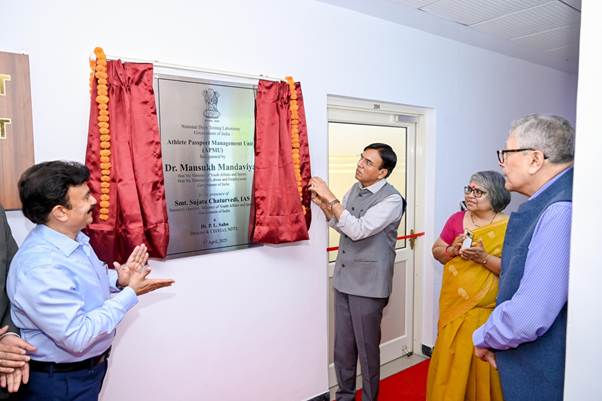
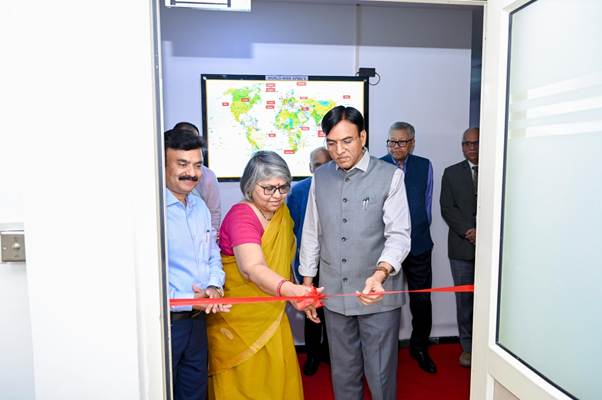
Dr. Mansukh Mandaviya inaugurates Athlete Passport Management Unit in New Delhi

| Published on:

Union Minister of Youth Affairs & Sports and Labour & Employment, Dr. Mansukh Mandaviya, inaugurated the Athlete Passport Management Unit (APMU) at the National Dope Testing Laboratory (NDTL) in New Delhi today. This initiative reaffirms India’s commitment to promoting clean and transparent sports practices on both national and international platforms.

Speaking during the occasion, Dr. Mandaviya said, “APMU is a key milestone in India’s fight against doping, enabling the longitudinal tracking of Athletes Biological profiles through the Athlete Biological Passport (ABP) system. This innovative mechanism will help in detecting doping patterns and protect the fairness of sports by identifying unethical practices”.

Calling the APMU as a beacon of support for Global South, Union Minister said it will help our neighbouring countries that don’t have enough resources to set up similar systems. “By sharing knowledge and tools, India can support these nations in keeping their sports free from unfair practices. Such initiatives underline the spirit of solidarity and contribute to strengthening sports integrity across Global South”, he added.

Dr. Mandaviya emphasized the potential of regional collaboration, highlighting India’s readiness to extend support to neighbouring countries by sharing expertise and resources through the APMU. He said that there is a need for greater involvement of Sports Federations, Organizations, Universities and Institutes of early education on Doping and the launch of awareness companion in Rural Areas. Further, he mentioned that scientists working in the laboratories may give education to the students of various schools / universities about Anti – Doping Science to sensitize the students about doping.

The NDTL’s APMU is designed to align with the World Anti-Doping Agency (WADA) guidelines, strengthening anti-doping programme globally. By tracking parameters like blood and steroidal profiles over time, this unit will safeguard the credibility of clean athletes while ensuring a level playing field in sports.

Notably, this is the 17th Athlete Passport Management Unit in the world which is established in India. It will serve as a specialized body responsible for monitoring and managing biological passports of athletes.

As India continues to excel on the international sports stage, the Athlete Passport Management Unit highlights the nation’s strong dedication to maintaining fair play, integrity in sports and also sets a benchmark for ethical sports practices worldwide.

The event was attended by Smt. Sujata Chaturvedi, Secretary (Sports), Shri Kunal, Joint Secretary (Sports), other officers of the Ministry of Youth Affairs and Sports including Eminent–Scientists and Prof. (Dr.) P. L. Sahu, Director & CEO(I/c), NDTL.

Background:

The concept of the “athlete biological passport” emerged when scientists identified monitoring blood markers as a way to detect doping. With input from stakeholders and medical experts, the World Anti-Doping Agency (WADA) refined and standardized this idea, leading to the Athlete Biological Passport (ABP).

A biological passport is an electronic document that compiles data on an athlete’s biological markers over time. By tracking variables such as blood parameters, hormonal levels, and other physiological markers, the APMU can detect any anomalies or trends indicative of doping without directly identifying banned substances.

PM inaugurates, lays foundation stone of development projects in Yamuna Nagar, Haryana

| Published on:

The Prime Minister Shri Narendra Modi inaugurated and laid the foundation stone of various development projects in Yamuna Nagar, Haryana today. Extending his greetings to the people of Haryana, he paid homage to the sacred land of Haryana, acknowledging it as the origin of Maa Saraswati, the abode of Mantra Devi, the site of Panchmukhi Hanuman Ji, and the blessed Kapalmochan Sahib. “Haryana is a confluence of culture, devotion, and dedication”, he described. He also conveyed his heartfelt wishes to all citizens on the 135th birth anniversary of Babasaheb Ambedkar, highlighting Babasaheb’s vision and inspiration, which continue to guide India’s journey toward development.

“Yamunanagar is not just a city but a vital part of India’s industrial landscape, contributing significantly to the economy with its industries ranging from plywood to brass and steel”, said Shri Modi, highlighting the cultural and historical significance of the region, mentioning the Kapal Mochan Mela, the sacred land of Rishi Ved Vyas, and the site of Guru Gobind Singh Ji’s weaponry. He shared his personal connection with Yamunanagar, recalling his frequent visits from Panchkula during his tenure as Haryana’s in-charge. He expressed gratitude for the dedicated workers he collaborated with and acknowledged the enduring tradition of hard work and commitment in the region.

Underlining that Haryana is witnessing the double speed of development under the Union and State governments for the third consecutive term, the Prime Minister emphasized the commitment to a developed Haryana as part of the vision for a developed India. He highlighted the government’s dedication to serving the people of Haryana and fulfilling the aspirations of its youth by working at greater speed and scale. He pointed to the development projects launched today as a testament to this commitment and extended his congratulations to the people of Haryana for these new development initiatives.

Expressing pride in his government’s commitment to advancing the vision of Babasaheb Ambedkar, Shri Modi highlighted Babasaheb’s belief that industrial development was a pathway to social justice. He noted that Babasaheb identified the issue of small landholdings in India and emphasized that Dalits, lacking sufficient agricultural land, would benefit the most from industrialization. He shared Babasaheb’s vision that industries would provide greater employment opportunities for Dalits, improving their standard of living. He also acknowledged Babasaheb’s significant role in India’s industrialization efforts, working alongside the country’s first Industry Minister, Dr. Syama Prasad Mukherjee, to drive progress in this direction.

Remarking that the synergy between industrialization and manufacturing was also recognized by Deenbandhu Chaudhary Chhotu Ram Ji as the foundation for rural prosperity, the Prime Minister highlighted Chhotu Ram Ji’s belief that true prosperity in villages would come when farmers enhance their income through small industries alongside agriculture. He further noted that Chaudhary Charan Singh Ji, who dedicated his life to the welfare of villages and farmers, shared a similar vision, emphasizing Charan Singh Ji’s perspective that industrial development should complement agriculture, as both are pillars of the economy.

Emphasising that the essence of ‘Make in India’ and ‘Aatmanirbhar Bharat’ lies in fostering manufacturing, Shri Modi underscored the government’s focus on manufacturing, as reflected in this year’s budget announcement of ‘Mission Manufacturing’. “The mission aims to create maximum employment opportunities for Dalit, backward, underprivileged, and marginalized youth, provide them with essential training, reduce business costs, strengthen the MSME sector, equip industries with modern technology, and ensure Indian products are world-class”, he stated. Underscoring the importance of uninterrupted power supply to achieve these goals and highlighting the significance of today’s event, he announced the commencement of work on the third unit of the Deenbandhu Chaudhary Chhotu Ram Thermal Power Plant, which will benefit Yamunanagar and Haryana. The Prime Minister noted that Yamunanagar produces half of India’s plywood and is a hub for manufacturing aluminum, copper, and brass utensils. He added that petrochemical plant equipment from Yamunanagar is exported to several countries. He emphasized that increased power production will benefit these industries and support ‘Mission Manufacturing’.

Underlining the critical role of electricity in building a developed India, the Prime Minister highlighted the government’s multifaceted efforts to enhance power availability, including initiatives like One Nation-One Grid, new coal power plants, solar energy projects, and the expansion of the nuclear sector. “Increasing electricity production is essential to ensure that power shortages do not hinder nation-building”, he stressed recalling the frequent blackouts before 2014 under previous dispensation’s rule, stating that such crises would have persisted if Congress had remained in power. He noted that during those times, factories, railways, and irrigation systems were severely affected. He shared that over the past decade, India has nearly doubled its electricity production capacity and now exports power to neighboring countries. He highlighted the benefits of their government’s focus on electricity production for Haryana, which currently generates 16,000 MW of power. He also announced the goal of increasing this capacity to 24,000 MW in the coming years.

Highlighting the government’s dual approach of investing in thermal power plants while empowering citizens to become power generators themselves, Shri Modi mentioned the launch of the PM Suryagarh Muft Bijli Yojana, enabling individuals to install solar panels on their rooftops, eliminate electricity bills, and even earn by selling surplus power. He noted that over 1.25 crore people across the country have registered under this scheme, with lakhs from Haryana applying to join. He expressed satisfaction with the scheme’s expansion, which is fostering a growing service ecosystem. He emphasized that the solar sector is creating new skills, generating opportunities for MSMEs, and opening numerous avenues for youth employment.

Prime Minister underscored the government’s focus on ensuring adequate electricity and financial resources for small industries in smaller towns. He mentioned that during the COVID-19 pandemic, the government provided financial assistance worth lakhs of crores to support MSMEs. He further said that the definition of MSMEs has been revised to allow small industries to expand without fear of losing government support as they grow, while mentioning the introduction of special credit cards for small industries and an increase in credit guarantee coverage. He noted the recent 10-year milestone of the Mudra Yojana, under which ₹33 lakh crore in collateral-free loans have been disbursed. He emphasized that over 50% of the beneficiaries of this scheme are from SC, ST, and OBC families. He expressed the government’s commitment to enabling small industries to fulfill the big dreams of India’s youth.

Lauding the hard work of Haryana’s farmers, which contributes to every Indian’s plate, the Prime Minister emphasized that the governments at Center and state stands as a steadfast partner in the joys and challenges of farmers. He highlighted efforts to empower Haryana’s farmers, noting that the state government now procures 24 crops at MSP. He shared that lakhs of farmers in Haryana have benefited from the PM Fasal Bima Yojana, with claims exceeding ₹9,000 crore under the scheme. Additionally, he mentioned that ₹6,500 crore has been disbursed to Haryana’s farmers through the PM Kisan Samman Nidhi, further supporting their livelihoods and growth.

Underlining the Haryana government’s decision to abolish the colonial-era water tax, relieving farmers from paying taxes on canal water, Shri Modi noted that over ₹130 crore in outstanding dues under this tax have also been waived. He emphasized the efforts of the Union and state government in providing new income opportunities for farmers and livestock owners. He mentioned the Gobardhan Yojana, which enables farmers to manage waste and generate income by producing biogas from cow dung, agricultural residues, and other organic waste. He shared that this year’s budget includes the announcement of 500 Gobardhan plants across the country. He highlighted the foundation stone laying of a new Gobardhan plant in Yamunanagar, which will save ₹3 crore annually for the municipal corporation. “Gobardhan Yojana is also contributing to the Swachh Bharat Abhiyan, furthering the mission of cleanliness and sustainability”, he further said.

Prime Minister underlined Haryana’s rapid progress on the path of development, mentioning his earlier visit to Hisar, where direct flight services to Ayodhya Dham were inaugurated. He also announced the new bypass for Rewari, which will ease traffic congestion in markets, intersections, and railway crossings, allowing vehicles to bypass the city smoothly. He noted that the four-lane bypass will reduce travel time between Delhi and Narnaul by an hour and congratulated the people on this achievement.

Emphasising that for them, politics is a medium of service—service to the people and the nation, Shri Modi stated, “our party delivers on its promises, as evident in Haryana”, where the government is fulfilling commitments made after being elected for the third term. He contrasted this with opposition-ruled states, citing betrayal of public trust. He pointed to the struggles faced by people in Himachal Pradesh, where development and welfare projects have stalled. In Karnataka, he highlighted rising costs of essentials like electricity, milk, bus fares, and seeds under current dispensation’s rule. He mentioned public dissatisfaction with the incumbent government in Karnataka, as seen on social media, and noted allegations of corruption, with even close associates of the Chief Minister acknowledging Karnataka’s ranking as number one in corruption.

Shri Modi criticized the current government in Telangana for neglecting its promises to the people and focusing on bulldozing forests, causing harm to nature and wildlife. He contrasted two models of governance and described his party’s model as genuine and dedicated to building a developed India, while the opposition’s as deceitful and focused solely on power. He highlighted the ongoing efforts in Yamunanagar as an example of his party’s commitment to progress.

Reflecting on the significance of Baisakhi and the 106th anniversary of the Jallianwala Bagh massacre, the Prime Minister honored the memory of the patriots who sacrificed their lives and highlighted the cruelty of the British regime. He emphasized another aspect of the massacre—the unwavering spirit of standing for humanity and the nation, exemplified by Shri Shankaran Nair. He further shared that Shankaran Nair, a renowned lawyer and high-ranking official in the British government, chose to resign and raise his voice against the atrocities of foreign rule. He fought the Jallianwala Bagh case single-handedly, shaking the foundations of the British Empire and holding it accountable in court. He described Shankaran Nair’s actions as a remarkable example of “Ek Bharat, Shreshtha Bharat,” showcasing how a man from Kerala stood against British power for a massacre in Punjab. He remarked that this spirit of unity and resistance was the true inspiration behind India’s freedom struggle and remains a driving force in the journey toward a developed India.

The Prime Minister concluded by urging everyone to learn about Shankaran Nair’s contributions and emphasized the Union and state governments continuous efforts to empower the pillars of society—poor, farmers, youth, and women. He expressed confidence that collective efforts will lead Haryana toward development.

The Chief Minister of Haryana, Shri Nayab Singh Saini, Union Ministers, Shri Manohar Lal, Shri Rao Inderjit Singh, Shri Krishan Pal Gurjar were present among other dignitaries at the event.

Background

Boosting power infrastructure in the region along with the vision of electricity reaching the last mile, Prime Minister laid the foundation stone of 800 MW modern thermal power unit of Deenbandhu Chhotu Ram Thermal Power Plant at YamunaNagar. This unit, spread across 233 acres, worth around Rs 8,470 crore, will significantly boost Haryana’s energy self-sufficiency and provide uninterrupted power supply across the state.

Taking forward the vision of GOBARDhan, i.e. Galvanising Organic Bio-Agro Resources Dhan, Prime Minister also laid the foundation stone of a Compressed Biogas Plant in Mukarabpur, in YamunaNagar. The plant will have an annual production capacity of 2,600 metric tonnes and will help in effective organic waste management, while contributing to clean energy production and environmental conservation.

Prime Minister also inaugurated the 14.4 km Rewari Bypass project, worth around Rs 1,070 crore under the Bharatmala Pariyojana. It will decongest Rewari city, reduce Delhi–Narnaul travel time by around one hour, and boost economic and social activity in the region.

PM lays foundation stone of new terminal building of Hisar airport worth over Rs 410 crore

| Published on:

In line with his commitment to make air travel safe, affordable, and accessible to all, Prime Minister Shri Narendra Modi laid the foundation stone of the new Terminal Building of the Maharaja Agrasen airport in Hisar, Haryana worth over Rs 410 crore today. Addressing the gathering, he extended his greetings to the people of Haryana, acknowledging their strength, sportsmanship, and brotherhood as the defining traits of the state. He expressed his gratitude to the large gathering for their blessings during this busy harvest season.

The Prime Minister paid respectful homage to Guru Jambheshwar, Maharaja Agrasen, and the sacred Agroha Dham. He shared his fond memories of Haryana, particularly Hisar, recalling his time working closely with many colleagues when he was entrusted with the responsibility of the state by his party. He highlighted the dedication and efforts of these colleagues in strengthening the party’s foundation in Haryana. He expressed pride in his party’s commitment to the goal of a developed Haryana and a developed India, working with utmost seriousness toward this vision.

“Today is a significant day for the entire nation as it marks the birth anniversary of the architect of the Constitution, Babasaheb Ambedkar”, said Shri Modi, highlighting that Babasaheb’s life, struggles, and message have been the cornerstone of the government’s 11-year journey. He emphasized that every decision, every policy, and every day of the government has been dedicated to Babasaheb’s vision. He reiterated the government’s commitment to improving the lives and fulfilling the dreams of the underprivileged, oppressed, exploited, poor, tribal communities, and women. He stated that continuous and rapid development has been the mantra of their government to achieve these goals.

Underlining the launch of flights connecting Haryana to Ayodhya Dham, symbolizing the direct link between the sacred land of Shri Krishna and the city of Lord Ram, the Prime Minister announced that flights to other cities will commence soon. He highlighted the foundation stone laying of the new terminal building at Hisar Airport, describing it as a step toward elevating Haryana’s aspirations to new heights. He extended his congratulations to the people of Haryana for this significant milestone.

Reiterating his promise that even those wearing slippers would fly in airplanes, a vision now being realized across the country, Shri Modi highlighted that in the past 10 years, millions of Indians have experienced air travel for the first time. He noted that new airports have been built even in areas that previously lacked proper railway stations, sharing that before 2014, India had 74 airports, a number achieved in 70 years while today, the number of airports has surpassed 150. He emphasized that nearly 90 aerodromes have been connected under the UDAN scheme, with over 600 routes operational, enabling affordable air travel for many. He remarked that this has led to record-breaking numbers of annual air travelers. He further highlighted that various airlines have placed record orders to the tune of 2,000 new aircraft, which will create numerous jobs for pilots, air hostesses, and other services. He also pointed out that the aircraft maintenance sector will generate significant employment opportunities. “Hisar Airport will elevate the aspirations of Haryana’s youth, providing them with new opportunities and dreams”, he added.

“Our government is focusing on connectivity while ensuring welfare for the poor and social justice, fulfilling the vision of Babasaheb Ambedkar and the aspirations of the Constitution’s framers”, emphasised the Prime Minister. He criticized the Congress party for its treatment of Babasaheb Ambedkar, stating that while he was alive, they insulted him, orchestrated his electoral defeats twice, and conspired to exclude him from the system. He remarked that after Babasaheb’s passing, the party also attempted to erase his legacy and suppress his ideas. He highlighted that Dr. Ambedkar was the protector of the Constitution, whereas they became its destroyer. He stated that while Dr. Ambedkar aimed to bring equality, Congress spread the virus of vote-bank politics in the country.

Shri Modi remarked that Babasaheb Ambedkar envisioned a life of dignity for every poor and marginalized individual, enabling them to dream and fulfill their aspirations. He criticized the previous government for treating SC, ST, and OBC communities as second-class citizens during its long tenure. He highlighted the disparity under its rule, where water reached the swimming pools of some leaders but failed to reach villages. He noted that even after 70 years of independence, only 16% of rural households had tap water connections, disproportionately affecting SC, ST, and OBC communities. He shared that in the past 6-7 years, their government has provided tap water connections to over 12 crore rural households, raising the coverage to 80% of rural homes. He expressed confidence that, with Babasaheb’s blessings, tap water will reach every household. He also addressed the lack of toilets, which severely impacted SC, ST, and OBC communities. He highlighted the government’s efforts in constructing over 11 crore toilets, ensuring a life of dignity for the underprivileged.

Criticising the previous dispensation’s rule, during which the SC, ST, and OBC communities faced significant barriers, with even access to banks being a distant dream, the Prime Minister said that insurance, loans, and financial assistance were mere aspirations for them. He highlighted that under their government, the largest beneficiaries of Jan Dhan accounts are from SC, ST, and OBC communities. He proudly noted that today, these individuals confidently showcase their RuPay cards, symbolizing their financial inclusion and empowerment.

Shri Modi further criticised the Congress party for turning the sacred Constitution into a mere tool for gaining power. He remarked that whenever they faced a crisis of power, it crushed the Constitution. He highlighted the Emergency period, during which the then Government undermined the spirit of the Constitution to retain power. He emphasized that the essence of the Constitution is to ensure a uniform civil code for all, but the then Government never implemented it. He pointed out the opposition to the implementation of the Uniform Civil Code in Uttarakhand, despite its alignment with the Constitution’s principles.

Prime Minister Shri Narendra Modi remarked that the Constitution provided for reservations for SC, ST, and OBC communities, but Congress turned it into a tool for appeasement. He highlighted recent reports of the present government in Karnataka granting reservations in government tenders based on religion, despite the Constitution not allowing such provisions. He stated that appeasement policies have significantly harmed the Muslim community, benefiting only a few extremists while leaving the rest of the society neglected, uneducated, and impoverished. He pointed to the Waqf Act as the biggest evidence of the previous Government’s flawed policies. He noted that in 2013, just months before elections, Congress amended the Waqf Act to appease its vote bank, elevating it above several constitutional provisions.

Criticising the Congress for claiming to work for the welfare of Muslims while failing to take meaningful actions, Shri Modi remarked that if the party truly cared for the Muslim community, they would have appointed a Muslim as their party president or allocated 50% of their tickets to Muslim candidates, stating that their intentions were never aligned with the genuine welfare of Muslims, exposing their true nature. Highlighting the vast tracts of land under Waqf, meant to benefit the poor, destitute women and children, were instead exploited by a handful of land mafias, Shri Modi pointed out that these mafias were encroaching on lands belonging to Dalits, backward classes, and tribals, leaving the Pasmanda Muslim community without any benefits. He mentioned that amendments to the Waqf Act will put an end to such exploitation, emphasizing a significant new provision in the amended law, ensuring that tribal lands cannot be touched by Waqf boards. He described this as a major step in protecting tribal interests. He stated that the new provisions will honor the sanctity of Waqf, ensuring that the rights of poor and Pasmanda Muslim families, women, and children are upheld. He affirmed that this reflects the true spirit of the Constitution and genuine social justice.

Underlining the numerous steps taken by the government since 2014 to honor Babasaheb Ambedkar’s legacy and inspire future generations, the Prime Minister pointed out that places associated with Babasaheb, both in India and abroad, were neglected for years. He noted that even for constructing Babasaheb’s memorial at Indu Mill in Mumbai, people had to protest. He emphasized that their government has developed all key sites, including Babasaheb’s birthplace in Mhow, his educational site in London, his Mahaparinirvan Sthal in Delhi, and his Diksha Bhoomi in Nagpur, transforming them into the “Panchteerth.” He shared his privilege of recently visiting Diksha Bhoomi to pay homage to Babasaheb. The Prime Minister criticized Congress for making lofty claims about social justice while failing to honor Babasaheb and Chaudhary Charan Singh with the Bharat Ratna during their tenure. He proudly stated that Babasaheb was awarded the Bharat Ratna only when a BJP-supported government was in power at the center, and it was also their party when in power honored Chaudhary Charan Singh with the Bharat Ratna.

Lauding the Haryana government for consistently strengthening the path of social justice and welfare for the poor, the Prime Minister highlighted the dire state of government jobs in Haryana under previous administrations, where individuals had to rely on political connections or sell family assets to secure employment. He expressed satisfaction with Chief Minister Nayab Singh Saini’s government, which has eradicated these corrupt practices. He praised Haryana’s remarkable track record of providing jobs without bribes or recommendations. He noted that previous governments had made every effort to prevent 25,000 youth in Haryana from receiving government jobs. However, as soon as Chief Minister Nayab Singh Saini took office, thousands of appointment letters were issued to deserving candidates. He described this as an example of their good governance and commended the government’s roadmap for creating thousands of new jobs in the coming years.

Highlighting Haryana’s significant contribution to the nation, with a large number of youth serving in the armed forces, Shri Modi criticized previous dispensations for decades of deception regarding the One Rank One Pension (OROP) scheme and emphasized that it was his government that implemented OROP. He shared that ₹13,500 crore has been disbursed to Haryana’s ex-servicemen under OROP. He pointed out that the previous Government had allocated only ₹500 crore for the scheme while misleading the nation’s soldiers. He remarked that the previous government has never truly supported Dalits, backward classes, or soldiers.

Expressing confidence in Haryana’s role in strengthening the vision of a developed India, the Prime Minister praised the state’s global impact, whether in sports or agriculture. He conveyed his trust in Haryana’s youth and described the new airport and flights as inspirations for fulfilling Haryana’s aspirations and concluded by extending his congratulations to the people of Haryana for this new milestone.

The Chief Minister of Haryana, Shri Nayab Singh Saini, Union Minister of State for Civil Aviation, Shri Murlidhar Mohol were present among other dignitaries at the event.

Background

The new Terminal Building of the Maharaja Agrasen airport will include a state-of-the-art passenger terminal, a cargo terminal and an ATC building. With scheduled flights from Hisar to Ayodhya (twice weekly), three flights in a week to Jammu, Ahmedabad, Jaipur, and Chandigarh, this development will mark a significant leap in Haryana’s aviation connectivity.

PM pays tribute to Bharat Ratna Babasaheb Ambedkar on his birth anniversary

| Published on:

The Prime Minister Shri Narendra Modi paid tribute to Bharat Ratna Babasaheb Ambedkar on his birth anniversary today. He remarked that Babasaheb’s principles and ideals will give strength and momentum for creation of a self-reliant and developed India.

In a post on X, he wrote:

“सभी देशवासियों की ओर से भारत रत्न पूज्य बाबासाहेब को उनकी जयंती पर कोटि-कोटि नमन। यह उन्हीं की प्रेरणा है कि देश आज सामाजिक न्याय के सपने को साकार करने में समर्पित भाव से जुटा हुआ है। उनके सिद्धांत एवं आदर्श आत्मनिर्भर और विकसित भारत के निर्माण को मजबूती और गति देने वाले हैं।”

PM Modi’s vision changed the entire landscape of the country’s criminal justice system: Amit Shah

| Published on:

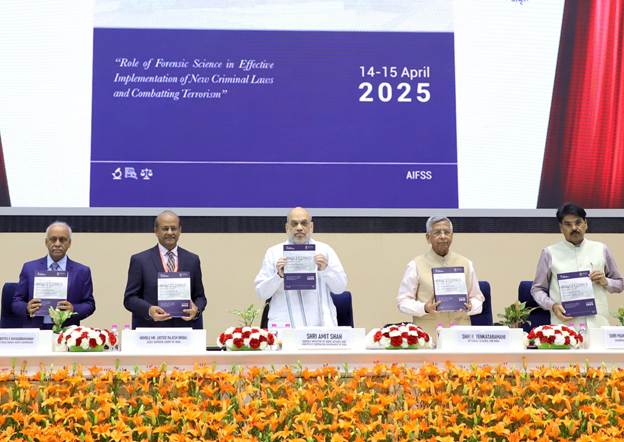
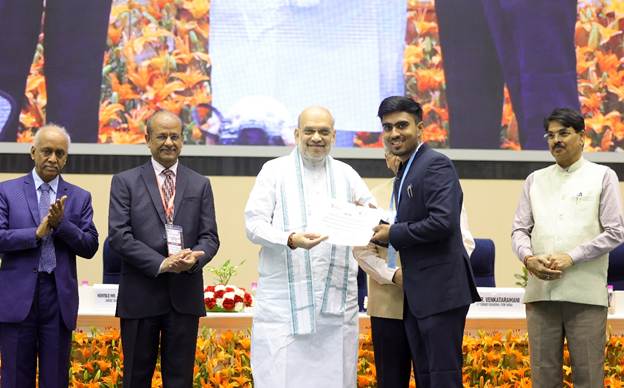
Union Home Minister and Minister of Cooperation Shri Amit Shah addressed the All India Forensic Science Summit 2025 organized by the National Forensic Sciences University (NFSU) in New Delhi today as the Chief Guest. The theme of the conference was ‘Role of Forensic Science in Effective Implementation of New Criminal Laws and Combating Terrorism’. The conference was attended by many dignitaries including Justice V Ramasubramanian, Chairperson, National Human Rights Commission (NHRC), Attorney General Shri R Venkataramani, Rajya Sabha MP and Chairman, Bar Council of India Shri Manan Kumar Mishra, Union Home Secretary Shri Govind Mohan and Vice Chancellor, NFSU Dr. J. M. Vyas.

Paying tribute to Bharat Ratna Babasaheb Dr Bhimrao Ambedkar on his birth anniversary, Union Home Minister Shri Amit Shah said that Babasaheb worked to finalize the Constitution of India. It was a Herculean task to finalize the Constitution after thousands of hours of intense discussion on every subject, but Babasaheb composed the Constitution by incorporating all aspects keeping in mind the needs of the country and with the idea of ​​maintaining the relevance of the Constitution for many years. Shri Shah said that our Constitution is not just a book. It has a system for the protection of the body, property and honor of every citizen and forensic science is now playing a very useful role in strengthening the criminal justice system associated with the protection of these three.

Shri Amit Shah said that under the leadership of Prime Minister Shri Narendra Modi, we are striving to make the justice system people-centric and scientific. Efforts are also being made to ensure that those seeking justice get justice on time and also have the satisfaction of getting justice. Through this, our aim is to create a safe, capable and competent India. Union Home Minister said that to strengthen the criminal justice system, the Government of India has brought three new criminal laws in the form of Bharatiya Nyaya Sanhita (BNS), Bharatiya Nagarik Suraksha Sanhita (BNSS) and Bharatiya Sakshya Adhiniyam (BSA).

Union Home Minister said that forensics is not a new idea in our country. Its detailed description is found in Charak Samhita, Sushruta Samhita and Kautilya’s Arthashashtra. Acharya Kautilya has guided the world in detail on topics like toxicology, identification of poison, body language of suspects, and identification of accused on the basis of speech.

Shri Amit Shah said that without forensic science, it is not possible to deliver timely justice and increase the rate of conviction. He said that the entire scenario of crime has changed today. Now criminals use different means of technology, information and communication, due to which crime has now become borderless. Earlier, crime used to happen in a small part of a district, state or country, but now crime has become borderless. Modern crimes now transcend city, state, national, and even international boundaries. In such a situation, the importance of forensic science has increased a lot. Shri Shah said that when PM Modi was the Chief Minister of Gujarat and he was the Home Minister, the seed of Gujarat Forensic Sciences University, planted by Shri Narendra Modi in 2009, has now grown into a banyan tree in the form of the National Forensic Sciences University — the first university of its kind in the world. He said that it is a matter of joy for him that when the National Forensic Sciences University was established on 1 October 2020, Shri Narendra Modi was the Prime Minister and he was the Home Minister of the country.

Union Home Minister said that PM Modi’s visionary leadership has brought significant transformation to the country’s criminal justice system. He emphasized that a system has been established where neither the accused nor the complainant is subjected to injustice. To ensure this balance, integrating forensic science into the criminal justice process is essential. Shri Shah highlighted that the steps taken in 2009 and 2020 to establish the Forensic Science University are not only producing skilled professionals but also paving the way for research across various fields. He noted that the university has become a trusted institution for forensic analysis in complex cases and has also evolved into a hub for equipping the country’s forensic laboratories with modern technology. He further added that the university offers a wide range of programs, including degree, diploma, PhD, and research courses. Additionally, it has developed and adopted numerous indigenous technologies and has created toolkits to supply these innovations to police forces across the nation.

Shri Amit Shah underlined that following the directive of Prime Minister Shri Narendra Modi to get rid the country of colonial-era laws, work on finalizing new criminal laws was carried out between 2019 and 2024. He noted that extensive discussions during this period revealed the extent to which the outdated laws were harming India’s criminal justice system. He emphasized that if laws are not updated in accordance with changing times, they become obsolete and irrelevant. He added that the original intent of the old criminal laws was not to deliver justice to Indian citizens but to uphold British rule. In contrast, the three new criminal laws introduced under PM Modi’s leadership have been crafted by Indians, for the protection and justice of Indian citizens. Shri Shah said that this represents the most significant legal reform of the 21st century. He further explained that the new laws provide a legal foundation for the use of modern technology and have been designed with a forward-looking approach — incorporating not only current technologies but also anticipating technological developments for the next 100 years.

Union Home Minister said that the new laws have formally defined e-documents and e-summons. He explained that the method of technology used is irrelevant as long as the law recognizes e-documents, and similarly, once people accept e-summons, the mode of delivery no longer matters. He emphasized that technology has been integrated at every stage of the criminal justice process — from the crime scene to investigation, and through to the trial. Forensic investigation has been made mandatory for all crimes that carry a punishment of more than seven years. He expressed confidence that these changes will lead to India achieving the highest conviction rate in the world in the coming decade.

Shri Amit Shah said that the conviction rate in the country is currently stands at 54 per cent. He said that terrorism has been defined in the new laws. Voice logs and digital voice mail have also been given a place. Arrangements have also been made in BNSS to give legal basis to audio, video recordings, videography of forensic evidence and digital records in interrogation. Arrangements have been made to ensure justice within the stipulated period by setting time limits for the police, prosecution and judicial system. He said that its results have also started coming. In some cases, the rapist was convicted in 23 days and within 100 days the triple murder case was solved and the culprit was punished. Union Home Minister said that this was possible because technical evidence was recognized in the trial. He said that efforts have also been made to digitize the digital system of the entire country.

Union Home Minister and Minister of Cooperation said that today 100 per cent police stations in the country have been computerized through Crime and Criminal Tracking Network and System (CCTNS). About 14 crore 19 lakh FIRs and their related documents have been made available online along with legacy data. 22 thousand courts have been equipped with the e-court facilities. Data of 2 crore 19 lakh is available through e-prison. Prosecution data of 1 crore 93 lakh cases is available through e-prosecution. 39 lakh forensic evidences are available online through e-forensics. He said that 16 lakh alerts have been generated from this. Fingerprints of 1 crore 53 lakh accused are available in the National Automated Fingerprint Identification System (NAFIS). These fingerprints have been shared with every police station. National Database of Human Trafficking Offender is also available. Shri Shah added that this data is separate right now, but in the next few years, the Home Ministry will hand over this data to the investigating teams using Artificial Intelligence. He said that then it will become very easy to formulate a strategy to prevent crime and it will also be very beneficial in controlling crime.

Union Home Minister said that due to the farsightedness of PM Modi, we had established the National Forensic Sciences University in the year 2020 itself, while three new criminal laws came into force in 2024. He said that seven campuses of the National Forensic Sciences University have been established in different states of the country. 9 more campuses will be established in the next 6 months. Apart from these, the establishment of 10 more campuses is proposed. Shri Shah said that there will be no state in the country where there is no campus of National Forensic Sciences University. We will work to make each campus the best unit in the world by giving it one subject. The students of the university will be helped in research and development so that they achieve heights in research and make the campus the best in the allotted subject. Home Minister said that after its completion, every year 36 thousand diploma and degree holder youth will pass out from these campuses and strengthen our criminal justice system.

Shri Amit Shah said that there is a need for 30,000 trained professionals to visit every crime scene where the punishment is more than seven years. He noted that each year, around 36,000 students will graduate from the National Forensic Sciences University, many of whom will go on to work in private forensic laboratories as well. He further mentioned that the Ministry of Home Affairs (MHA) is working on an agreement between private and government Forensic Science Laboratories (FSLs), allowing certain samples received by government FSLs to also be analyzed by private labs. He added that NFSU is advancing into several emerging fields, including drone forensics, smart city forensics, marine forensics, and corporate forensics. Shri Shah also highlighted the growing international presence of NFSU, stating that around 240 foreign students are currently enrolled, and that the university will continue to expand globally in the coming years.

Union Home Minister emphasized the need to categorize offenders into habitual criminals, those driven to crime by circumstances, and those who committed crimes out of necessity. He stressed the importance of providing psychological counseling to such individuals within jails, with the goal of encouraging them to become responsible citizens. He expressed confidence that, under the leadership of Prime Minister Modi, India will be able to develop a robust forensic science-based system for prisoner rehabilitation within the next couple of years. Shri Shah also said that a Modus Operandi Bureau has been established, which will play a vital role in controlling crime by analyzing criminal behavior patterns.

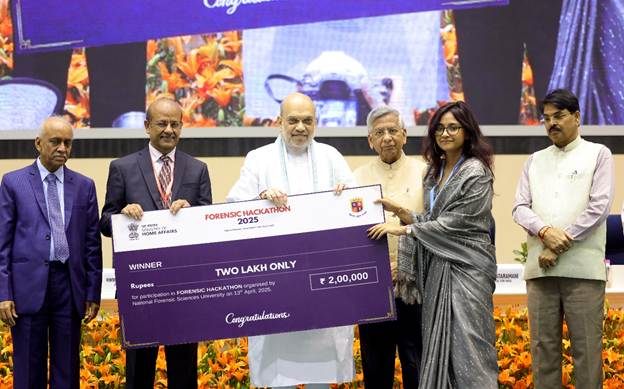
Shri Amit Shah acknowledged that the country faces numerous challenges, many of which can be addressed through the effective use of forensic science. He called for close collaboration between the Ministry of Home Affairs and the Forensic Sciences University to work toward building a crime-free society through scientific solutions. Union Home Minister said that, during the conference, young individuals were recognized for their outstanding performance in the hackathon and their efforts to promote the use of the Hindi language.

Vision of Dr B R Ambedkar Shaped the Constitution of India that Reflects the Soul of Bharat”: Sarbananda Sonowal

| Published on:

Union Minister Shri Sarbananda Sonowal called upon the youth to do further research and study the works of Babasaheb Dr. B.R. Ambedkar for his invaluable contributions, sacrifice and painstaking effort in shaping the modern day democracy of the Republic of India.

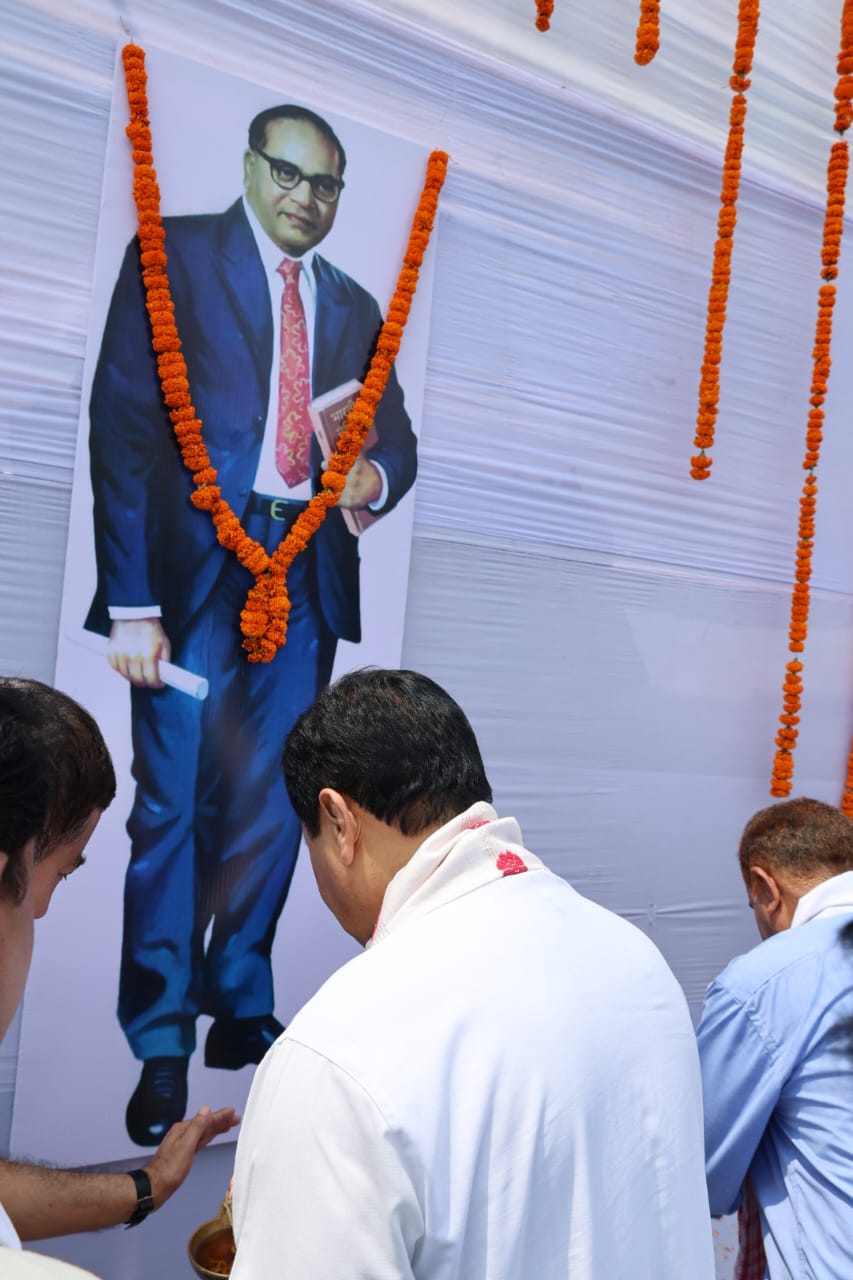
The Union Minister of Ports, Shipping and Waterways, Shri Sonowal attended a commemorative programme to mark the 135th Birth Anniversary of Dr Bhimrao Ramji Ambedkar, the father of Indian Constitution, in Dibrugarh today.

Speaking on the occasion, the Union Minister Sarbananda Sonowal said, “Baba Bhimrao Ambedkar ji’s tireless efforts to build an egalitarian society based on law laid the very foundation of modern India. His vision of justice, liberty, equality, and fraternity continues to guide our collective journey towards Viksit Bharat. Dr. Ambedkar ji did not merely draft a Constitution—he gave us a blueprint for an inclusive, empowered nation where every citizen has dignity and opportunity. The vision of Dr B R Ambedkar shaped the constitution of India which reflects the soul of Bharat. Ambedkar ji’s mantra of social harmony and constitutional morality remains our compass in shaping a just and developed India.”

Dignitaries and speakers present on the occasion paid tribute to the unparalleled contributions of Dr Ambedkar and remembered his legacy. Emphasising his vision for a just, progressive, and inclusive India, they urged everyone to actively participate in building a developed and equitable nation. The message of equality, fraternity, and justice that Dr Ambedkar championed was reiterated as the guiding path for a stronger society.

Adding further, Sarbananda Sonowal said, “During the government of Prime Minister Narendra Modi ji, the profound legacy of Dr. B.R. Ambedkar has received the recognition it truly deserves. On this Ambedkar Jayanti, I urge the youth of our nation to reflect upon Babasaheb’s monumental role in shaping the Indian Constitution — a document rooted in equality, justice, and the rule of law. His ideals continue to guide us in building an inclusive and egalitarian society, which forms the cornerstone of a truly Atmanirbhar Bharat.”

The event was jointly hosted by Dibrugarh District Scheduled Caste Council, All Assam Ravidas Youth Students Union, Dibrugarh District Committee and the Harijan Branch Committee. Rituparna Baruah, Chairman of Assam Tourism Development Corporation (ATDC); Saikat Patra, Mayor of Dibrugarh Municipal Corporation (DMC); Ujjal Phukan, Deputy Mayor of DMC; Asim Hazarika, Chairman of Dibrugarh Development Authority (DDA); and Dulal Bora, President of BJP Dibrugarh District, among other notable figures were present on the occasion.

PM greets everyone on occasion of Hanuman Jayanti

| Published on:

The Prime Minister Shri Narendra Modi greeted everyone on occasion of Hanuman Jayanti today.

In a post on X, he wrote:

“देशवासियों को हनुमान जयंती की ढेरों शुभकामनाएं। संकटमोचन की कृपा से आप सभी का जीवन सदैव स्वस्थ, सुखी और संपन्न रहे, यही कामना है।”

PM addresses gathering at Anandpur Dham, Madhya Pradesh

| Published on:

In line with his commitment to furthering the cultural and spiritual heritage of India, Prime Minister visited Anandpur Dham of Isagarh Tehsil in the Ashoknagar district in Madhya Pradesh today. He also performed darshan and pooja at Guru Ji Maharaj Temple and toured the temple complex at Anandpur Dham. Addressing the gathering, he welcomed the large number of devotees who had traveled from Delhi, Haryana, Punjab, and across the country. He expressed his happiness upon visiting Shri Anandpur Dham, sharing his experience of offering prayers at Guruji Maharaj’s temple which filled his heart with bliss.

Remarking on the sanctity of the land nurtured by the penance of saints, where altruism has become a tradition and the resolve for service paves the way for humanity’s welfare, Shri Modi highlighted the uniqueness of this land, quoting saints who said that sorrow fears to enter Ashok Nagar. He expressed his joy at participating in the celebrations of Baisakhi and the birth anniversary of Shri Guru Maharaj Ji, paying respects to the pratham Padshahi Shri Shri 108 Shri Swami Advait Anand Ji Maharaj and other Padshahi saints. He noted the historical significance of the day, marking the Mahasamadhi of Shri Dwitiya Padshahi Ji in 1936 and the union of Shri Tritiya Padshahi Ji with his true form in 1964. The Prime Minister offered his tributes to these revered Gurus and extended his salutations to Maa Jageshwari Devi, Maa Bijasan, and Maa Janaki Karila Mata Dham. He conveyed his greetings to everyone on the occasion of Baisakhi and Shri Guru Maharaj Ji’s birth anniversary celebrations.

“India is a land of sages, scholars, and saints, who have always guided society during challenging times”, exclaimed the Prime Minister, highlighting that the life of Pujya Swami Advait Anand Ji Maharaj reflects this tradition. He recalled the era when acharyas like Adi Shankaracharya expounded the profound knowledge of Advaita philosophy. He noted that during the colonial period, society began to lose touch with this wisdom. However, it was during this time that sages emerged to awaken the nation’s soul through the principles of Advaita, he added, emphasising that Pujya Advait Anand Ji Maharaj carried forward this legacy by making the knowledge of Advaita accessible and simple for the common people, ensuring its reach to the masses.

Addressing the pressing global concerns of war, conflict, and the erosion of human values amidst material progress, Shri Modi identified the root cause of these challenges as the mindset of division—of “self and other”—which distances humans from one another. “The solution to these issues lies in the philosophy of Advaita, which envisions no duality”, he emphasised, explaining that Advaita is the belief in seeing the divine in every living being and, further, perceiving the entire creation as a manifestation of the divine. He quoted Paramhans Dayal Maharaj, who beautifully simplified this principle as, ‘What you are, I am’. He remarked on the profoundness of this thought, which eliminates the divide of “mine and yours,” and noted that if universally embraced, it could resolve all conflicts.

The Prime Minister shared his earlier discussion with the chate Padshahi Swami Shri Vichar Purna Anand Ji Maharaj, who spoke about the teachings of the pratham Padshahi Paramhans Dayal Maharaj Ji and the service initiatives of Anandpur Dham. He highlighted the five principles of meditation established at Anandpur Dham, emphasizing selfless service as one of them. He remarked on the spirit of serving the underprivileged with a selfless attitude, seeing Narayan in the act of serving humanity, which forms the foundation of Indian culture. He expressed his happiness that Anandpur Trust is advancing this culture of service with dedication. He noted that the trust operates hospitals treating thousands of patients, organizes free medical camps, runs a modern cowshed for cow welfare, and manages schools for the development of the new generation. He also praised Anandpur Dham’s significant contribution to humanity through environmental conservation, highlighting the efforts of the ashram’s followers in transforming thousands of acres of barren land into greenery, with thousands of trees planted by the ashram now serving altruistic purposes.

“The spirit of service is at the core of every initiative undertaken by the government”, said Shri Modi highlighting that under the Pradhan Mantri Garib Kalyan Anna Yojana, every needy individual is free from the worry of food. Similarly, the Ayushman Bharat scheme has relieved the poor and elderly from concerns about healthcare, while the PM Awas Yojana is ensuring secure housing for the underprivileged. He noted that the Jal Jeevan Mission is addressing water issues in villages, and the establishment of record numbers of new AIIMS, IITs, and IIMs is helping even the poorest children realize their dreams. He reiterated the government’s commitment to environmental conservation through the ‘Ek Ped Maa Ke Naam’ campaign, under which crores of trees have been planted across the country. The Prime Minister remarked that the scale of these achievements is driven by the spirit of service. He reiterated the government’s resolve for the upliftment of the poor and marginalized, guided by the mantra of ‘Sabka Saath, Sabka Vikas’. “This spirit of service is both the policy and the commitment of the government”, he stressed.

Underlining the fact that embracing the resolve of service not only benefits others but also enhances one’s personality and broadens perspectives, the Prime Minister noted that the spirit of service connects individuals to larger objectives of society, the nation, and humanity. He acknowledged the dedication of those engaged in service, highlighting how overcoming hardships becomes second nature through acts of selfless service. He described service as a spiritual practice, likening it to a sacred Ganga in which everyone must take a dip. He remarked on the responsibility of developing regions like Ashok Nagar and Anandpur Dham, which have contributed immensely to the nation, pointing out the rich heritage of art, culture, and natural beauty in these areas, noting their vast potential for development and heritage. PM further highlighted efforts to boost progress in Madhya Pradesh and Ashok Nagar, including elevating Chanderi handloom through Geographical Indication (GI) tag for Chanderi sarees and the establishment of a Craft Handloom Tourism Village in Pranpur to accelerate economic growth in the region. He also noted that the Madhya Pradesh government has already commenced preparations for the Ujjain Simhastha.

Acknowledging the recent celebration of the grand festival of Ram Navami, Shri Modi highlighted the ongoing development of the “Ram Van Gaman Path,” noting that a significant portion of this path will pass through Madhya Pradesh. He remarked on Madhya Pradesh’s remarkable and unique identity, stating that these initiatives will further strengthen its distinctiveness.

The Prime Minister affirmed the nation’s ambitious goal of becoming a developed India by 2047 and expressed confidence in achieving it. He emphasized the need to preserve India’s ancient culture during this journey, noting that while many countries lost touch with their traditions in the pursuit of development, India must maintain its heritage. “India’s culture is not just tied to its identity but strengthens its capabilities”, highlighted the Prime Minister commending the Anandpur Dham Trust for its significant contributions in this regard and expressed confidence that the trust’s service initiatives will infuse new energy into the vision of Viksit Bharat. He concluded by extending his greetings on the occasion of Baisakhi and the birth anniversary celebrations of Shri Guru Maharaj Ji.

The Governor of Madhya Pradesh, Shri Mangubhai Patel, the Chief Minister of Madhya Pradesh, Shri Mohan Yadav, Union Minister Shri Jyotiraditya Scindia were present among others at the event.

Background

Anandpur Dham has been established for spiritual and philanthropic purposes. Spanning 315 hectares, it houses a modern gaushala (cowshed) with over 500 cows and runs agricultural activities under Shri Anandpur Trust campus. The trust has been operating a charitable hospital in Sukhpur village, schools in Sukhpur and Anandpur and various Satsang Centers across the country.

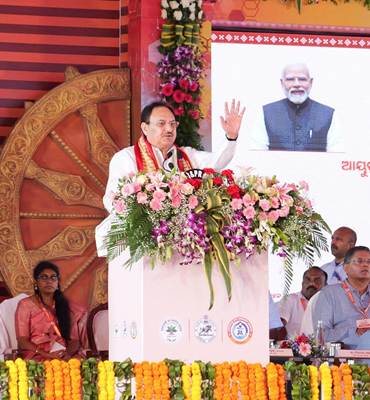
Union Health Minister launch AB-PMJAY & Gopabandhu Jan Arogya Yojana in Odisha

| Published on:

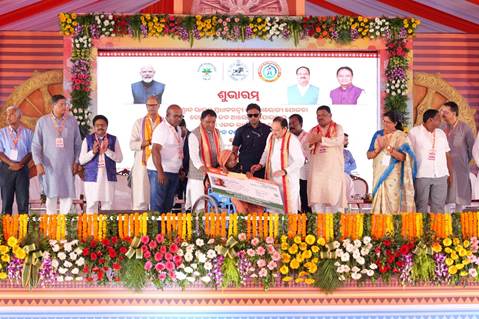
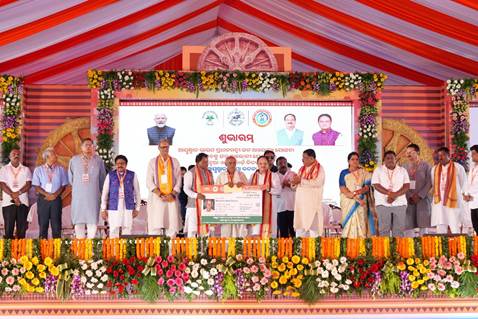
Union Health Minister Shri Jagat Prakash Nadda and Shri Mohan Charan Majhi, Chief Minister, Odisha, distributed cobranded cards of Ayushman Bharat Pradhan Mantri – Jan Arogya Yojana and Gopabandhu Jan Arogya Yojana, in Cuttack today. The Ayushman Vaya Vandana Yojana was also launched during the event. Shri Jual Oram, Union Minister of Tribal Affairs; Shri Mukesh Mahaling, Minister, Health and Family Welfare, Odisha and Members of Parliament and Legislative Assembly of Odisha were also present on the occasion.

Addressing the gathering, Shri JP Nadda said that “today is a historic day for Odisha as the AB PM-JAY, the world’s largest health coverage program under which 62 crore people are currently being benefitted, will connect approximately 1.3 crore families, almost 3.52 crore people of Odisha.”

Shri Nadda informed that more than 8.19 crore people have availed services under the scheme and Rs 1.26 lakh crore have been spent under the same to provide healthcare services to the people of the country.

The Union Health Minister highlighted that around 61 crore people are covered under the scheme now. He said, “earlier, more than 55 crore people were covered under the scheme. Then ASHAs, Anganwadi workers and their families i.e. approximately 36 lakh people were added in the scheme. “In October last year, people over 70 yrs of age were covered under the scheme and now, with the implementation of Ayushman Vaya Vandana in Odisha, all senior citizens aged 70 years and above, irrespective of their socio-economic status, will be covered”, he stated.

Shri Nadda pointed out that the out-of-pocket expenditure has declined from 62% to 38% today as a result of the Ayushman Bharat scheme”. He also highlighted that under the 100-day TB Intensified Elimination Programme, Odisha proactively participated identified 16,500 new cases. “Under PM ABHIM, Rs. 1,411 crores have been provided for strengthening the healthcare infrastructure of Odisha”, he stated.

Speaking on the occasion, Shri Mohan Charan Majhi highlighted that launch event as “another feather added to Odisha’s development story”. He stated that “from today onwards, beneficiaries of Odisha will get free healthcare facility. Odia people residing outside the state will also get the benefit. They can avail the facility in the hospitals outside the state.”

He stated that under the leadership of Prime Minister Modi, Ayushman Bharat scheme is benefiting people across the nation, especially the poor and underprivileged section.

Shri Majhi informed that more than 4,000 doctors have been appointed under the current administration and 5,000 more appointments are under process. He underlined the commitment of the state government to strengthen health infrastructure in the state and stated its aim to establish medical college in all the districts of the state.

Shri Jual Oram noted that tribals of Odisha will be greatly benefited under the scheme. He stated that “people of the state are elated with the implementation of the scheme.”

Shri Mukesh Mahaling highlighted that “3.50 Cr people of the state will get health insurance cards under Ayushman Bharat & Gopabandhu Jan Arogya Yojana and 23 lakhs elderly people in Odisha will also be benefited under the Vaya Vandana Yojana.”.

PM lays foundation stone, inaugurates development works worth over Rs 3,880 crore in Varanasi, UP

| Published on:

The Prime Minister Shri Narendra Modi laid the foundation stone and inaugurated various development projects worth over Rs 3,880 crore today in Varanasi, Uttar Pradesh. Addressing the gathering, he highlighted his deep connection to Kashi, expressing heartfelt gratitude to the people of his family and the region for the blessings and acknowledged the love and support that has been extended to him. He emphasized his indebtedness to this love, stating that Kashi is his, and he belongs to Kashi. Noting that tomorrow is the auspicious occasion of Hanuman Janmotsav, Shri Modi expressed his honor at having the opportunity to visit Sankat Mochan Maharaj in Kashi. He highlighted how, ahead of Hanuman Janmotsav, the people of Kashi have gathered together to celebrate the festival of development.

“In the last 10 years, the development of Varanasi has gained a new momentum”, exclaimed the Prime Minister, adding that Kashi has embraced modernity, preserved its heritage, and adopted a bright future. He remarked that Kashi is no longer just ancient but also progressive, now positioned at the center of Purvanchal’s economic map. He further noted that the Kashi guided by Lord Mahadev himself is now driving the chariot of Purvanchal’s development.

Mentioning the inauguration and foundation laying of numerous projects connected to Kashi and various parts of Purvanchal earlier in the event, Shri Modi emphasized the strengthening of connectivity through infrastructure projects, the campaign to provide tap water to every household, and the expansion of education, health, and sports facilities. He remarked on the commitment to provide better amenities to every region, family, and youth, stating that these initiatives will serve as milestones in transforming Purvanchal into a developed region. He noted that every resident of Kashi will benefit greatly from these schemes and extended congratulations to the people of Varanasi and Purvanchal for these development efforts.

The Prime Minister marked the occasion of Mahatma Jyotiba Phule’s birth anniversary today, recognizing his and Savitribai Phule’s lifelong dedication to the welfare of society and the empowerment of women. He highlighted the ongoing efforts to advance their vision and commitment to women’s empowerment. He further stated that their Government treads on the mantra of ‘Sabka saath, Sabka Vikas’. He extended congratulations to the livestock-rearing families of Purvanchal, particularly the hardworking women, who have set a new example for the region. He remarked that trust, when placed in these women, has created history. The Prime Minister noted the distribution of bonuses to livestock-rearing families associated with Uttar Pradesh’s Banas Dairy Plant. He emphasized that this bonus, exceeding ₹100 crore, is not a gift but a reward for their hard work and dedication, reflecting the value of their labor and perseverance.

Emphasising the transformative impact of Banas Dairy in Kashi, which has reshaped the lives and destinies of thousands of families, Shri Modi highlighted how the dairy has rewarded hard work and given wings to aspirations. He proudly noted that the efforts have enabled many women in Purvanchal to become “Lakhpati Didis,” transitioning from concerns of sustenance to a path of prosperity. He remarked that this progress is evident not only in Varanasi and Uttar Pradesh but across the country. “India has become the largest milk producer globally, with a nearly 65% increase in milk production over the past decade”, he highlighted, attributing this success to millions of farmers and livestock owners, recognizing that such achievements are the result of continuous efforts over the last ten years. He pointed out the initiatives undertaken to advance the dairy sector in mission mode, including linking livestock owners to Kisan Credit Card facilities, increasing loan limits, and introducing subsidy programs. The Prime Minister also mentioned the free vaccination program against Foot and Mouth Disease to protect livestock, as well as efforts to revive over 20,000 cooperative societies for organized milk collection, incorporating lakhs of new members. He underlined the focus on developing indigenous cattle breeds and improving their quality through scientific breeding under the Rashtriya Gokul Mission. These initiatives aim to connect livestock owners with new development pathways, better markets, and opportunities. He lauded the Banas Dairy complex in Kashi for advancing this vision across Purvanchal and noted that Banas Dairy has distributed Gir cows in the region, with their numbers steadily increasing, and has begun arrangements for animal feed in Varanasi. He commended the dairy for collecting milk from nearly one lakh farmers in Purvanchal, empowering them and strengthening their livelihoods.

The Prime Minister mentioned the privilege of distributing Ayushman Vay Vandana Cards to several senior citizens. He highlighted the sense of satisfaction evident on their faces, calling it a testament to the scheme’s success. He acknowledged the concerns families have had for their elders’ healthcare and recalled the difficulties faced across Purvanchal 10-11 years ago regarding medical treatment. Noting the drastic improvements in the region, he stated “Kashi is now becoming a health capital”. He remarked that advanced hospitals, once limited to cities like Delhi and Mumbai, are now accessible near people’s homes. He emphasized that this is the essence of development—bringing facilities closer to the people.

Emphasising the significant strides made in healthcare over the past decade, not only increasing the number of hospitals but also enhancing the dignity of patients, Shri Modi highlighted the Ayushman Bharat scheme as a boon for the poor, providing not just treatment but also instilling confidence. He remarked that thousands in Varanasi and lakhs across Uttar Pradesh have benefited from the scheme, with every treatment, operation, and relief marking a new beginning in their lives. He further noted that the Ayushman Bharat scheme has saved crores of rupees for lakhs of families in Uttar Pradesh, as the government has taken responsibility for their healthcare. Recalling his promise of free treatment for senior citizens, which led to the launch of the Ayushman Vay Vandana scheme, the Prime Minister highlighted that this initiative ensures free treatment for every senior citizen above 70 years of age, regardless of their income. He remarked that Varanasi has issued the highest number of Vay Vandana cards, with nearly 50,000 cards distributed. He emphasized that this is not just a statistic but a commitment to service, eliminating the need for families to sell land, take loans, or face helplessness for medical treatment. He assured that with the Ayushman card, the government now bears the financial responsibility for their healthcare.

The Prime Minister highlighted the remarkable transformation of Kashi’s infrastructure and facilities, which have earned widespread praise from visitors. He noted that millions of people visit Varanasi daily, offering prayers to Baba Vishwanath and bathing in the sacred Ganga, with many remarking on the city’s significant changes. He emphasized the challenges Kashi would have faced if its roads, railways, and airport had remained in the same condition as a decade ago. He recalled the traffic jams during small festivals, where travelers had to navigate through the entire city, enduring dust and heat. He remarked on the construction of the Phulwariya flyover, which has shortened distances, saved time, and brought relief to daily life. The Prime Minister also highlighted the benefits of the Ring Road, which has drastically reduced travel time for residents of rural areas in Jaunpur and Ghazipur, as well as those from Ballia, Mau, and Ghazipur districts heading to the airport, eliminating hours of traffic congestion.

Underlining the improved connectivity in the region which has led to faster and convenient travel to cities like Ghazipur, Jaunpur, Mirzapur, and Azamgarh with widened roads, Shri Modi remarked that areas once plagued by traffic jams are now witnessing the speed of development. He emphasized the investment of approximately ₹45,000 crore over the past decade in enhancing connectivity in Varanasi and surrounding regions. He stated that this investment has transformed not just infrastructure but also trust, benefiting Kashi and neighboring districts. He announced the expansion of infrastructure projects, including the foundation laying of projects worth thousands of crores. The Prime Minister highlighted the ongoing expansion of Lal Bahadur Shastri Airport and the construction of a six-lane underground tunnel near the airport to improve connectivity. He noted the initiation of projects connecting Bhadohi, Ghazipur, and Jaunpur, as well as the long-awaited construction of flyovers at Bhikharipur and Manduadih. He expressed happiness over the fulfillment of these demands. He also announced the construction of a new bridge connecting Varanasi city and Sarnath, which will eliminate the need for travelers from other districts to enter the city while heading to Sarnath.

The Prime Minister remarked that in the coming months, once the ongoing projects are completed, commuting in Varanasi will become even more convenient, stressing that this progress will boost both speed and business activities in the region. He highlighted the enhanced ease for those visiting Varanasi for livelihood and healthcare purposes. He also mentioned the commencement of the trial for the city ropeway in Kashi, which will position Varanasi among the select cities globally to offer such a facility.

Underscoring that every development and infrastructure project in Varanasi benefits the youth of Purvanchal, Shri Modi highlighted the government’s focus on providing continuous opportunities for Kashi’s youth to excel in sports. He remarked on the construction of new stadiums in Varanasi and the development of excellent facilities for young athletes. He noted the opening of a new sports complex, where hundreds of players from Varanasi are undergoing training. He also mentioned that participants in the MP Sports Competition have had the opportunity to showcase their talent on these grounds.

Emphasising India’s journey of balancing development and heritage, highlighting Kashi as the finest example of this model, the Prime Minister remarked on the flow of the Ganga and the consciousness of India, describing, “Kashi is the most beautiful representation of India’s soul and diversity”. He noted the unique culture in every neighborhood and the distinct colors of India visible in every lane of Kashi and expressed happiness over initiatives like the Kashi-Tamil Sangamam, which continue to strengthen the threads of unity. He announced the upcoming Ekta Mall in Kashi, which will showcase India’s diversity under one roof, offering products from various districts across the country.

The Prime Minister highlighted the transformation in Uttar Pradesh over recent years, noting that the state has not only changed its economic landscape but also its outlook. He remarked that Uttar Pradesh is no longer just a land of possibilities but has become a land of capability and achievements. He stressed on the growing resonance of ‘Made in India’ globally, with Indian-made products now becoming global brands. He noted the recognition of several products with Geographical Indication (GI) tags, describing these tags as more than just labels—they are certificates of identity for the land. He remarked that GI tags signify that a product is a creation of its soil, and wherever GI tags reach, they open pathways to greater market success.

Underscoring Uttar Pradesh’s leading position in GI tagging across the country, Shri Modi mentioned the growing international recognition of the state’s art, crafts, and skills. He noted that over 30 products from Varanasi and its surrounding districts have received GI tags, describing them as a passport of identity for these items. He listed products from the region that have been recognized, such as Varanasi’s tabla, shehnai, wall paintings, thandai, stuffed red chili, red peda, and tiranga barfi. He also mentioned that products like Jaunpur’s imarti, Mathura’s sanjhi art, Bundelkhand’s kathiya wheat, Pilibhit’s flute, Prayagraj’s moonj art, Bareilly’s zardozi, Chitrakoot’s woodcraft, and Lakhimpur Kheri’s Tharu zardozi have recently been awarded GI tags. “The fragrance of Uttar Pradesh’s soil is now crossing borders, spreading its legacy far and wide”, he added.

Remarking that preserving Kashi means safeguarding the soul of India, the Prime Minister concluded by emphasising the collective commitment to continually empower Kashi and to keep it beautiful and connect its ancient spirit with a modern identity.

The Governor of Uttar Pradesh, Smt Anandiben Patel, the Chief Minister of Uttar Pradesh, Shri Yogi Adityanath were present among others at the event.

Background

Prime Minister laid the foundation stone and inaugurated various development projects worth over Rs 3,880 crore in Varanasi. In line with his commitment to infrastructure development, particularly enhancing road connectivity in Varanasi, he inaugurated and laid the foundation stone for various road projects in the region. Furthermore, he laid the foundation stone for a road bridge between Varanasi Ring Road and Sarnath, flyovers at Bhikharipur and Manduadih crossings of the city and a highway underpass road tunnel on NH-31 at the Varanasi International Airport worth over Rs 980 crore.

Giving a boost to the electricity infrastructure, Prime Minister inaugurated two 400 KV and one 220 KV transmission substations and associated transmission lines of Jaunpur, Chandauli and Ghazipur districts of Varanasi division worth over Rs 1,045 crore. He also laid the foundation stone of a 220 KV transmission substation at Chaukaghat, Varanasi, a 132 KV transmission substation in Ghazipur and augmentation of the Varanasi city electricity distribution system worth over Rs 775 crore.

Prime Minister inaugurated a Transit Hostel at the Police Line and barracks at PAC Ramnagar Campus, to improve facilities for the security personnel. He also laid the foundation stone of new administrative buildings at various police stations and a residential hostel in Police Line.

In line with his vision to ensure education for all, Prime Minister inaugurated projects including a Government Polytechnic College at Pindra, Sardar Vallabhbhai Patel Government College at village Barki, 356 rural libraries and 100 Anganwadi centres also. He also laid the foundation stone for renovation of 77 primary school buildings under the Smart City Mission and the construction of a new building for Kasturba Gandhi School at Cholapur, Varanasi. Promoting sports infrastructure in the city, Prime Minister laid the foundation stone for a synthetic hockey turf with floodlights and spectator gallery at Uday Pratap College and a mini stadium at Shivpur.

Prime Minister also inaugurated the redevelopment of Samne Ghat and Shastri Ghat at Ganga river, 130 rural drinking water schemes under the Jal Jeevan Mission worth over Rs 345 crore, improvement of six municipal wards of Varanasi and landscaping and sculpture installations at various sites of Varanasi.

Prime Minister also laid the foundation stone for MSME Unity Mall for artisans, infrastructure development works of Transport Nagar Scheme at Mohansarai, 1 MW solar power plant at WTP Bhelupur, Community halls in 40 Gram panchayats and beautification of various parks in Varanasi.

Prime Minister presented Geographical Indication (GI) certificates to various local items and products including  tabla, painting, thandai, tiranga barfi among others. He also transferred over Rs 105 crore bonus to milk suppliers of Uttar Pradesh associated with Banas Dairy.