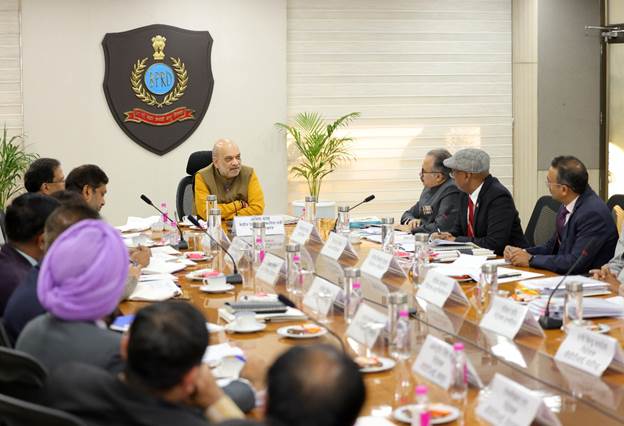

Union Home Minister chairs a regional conference on ‘Drug Trafficking and National Security’ in New Delhi

| Published on:

Union Home Minister and Minister of Cooperation, Shri Amit Shah, chaired a regional conference on ‘Drug Trafficking and National Security’ at Vigyan Bhavan in New Delhi today. The Home Minister also launched the Drug Disposal Fortnight, inaugurated the new office complex of Bhopal Zonal Unit of the Narcotics Control Bureau (NCB) and extension of MANAS-2 helpline to all 36 states and Union Territories.

The objective of the conference, organized by the Narcotics Control Bureau, is to focus on tackling the growing concern of drug trafficking and its impact on national security, with a special focus on eight states and union territories of northern India.

The Governor of Punjab and Administrator of Chandigarh Shri Gulab Chand Kataria, Lieutenant Governor of Jammu & Kashmir Shri Manoj Sinha, Chief Minister of Haryana Shri Nayab Singh Saini, Chief Minister of Himachal Pradesh Shri Sukhvinder Singh Sukhu, Chief Minister of Jammu & Kashmir Shri Omar Abdullah, Chief Minister of Punjab Shri Bhagwant Singh Mann and Chief Minister of Uttarakhand Shri Pushkar Singh Dhami joined the conference virtually. The Lieutenant Governor of Delhi Shri Vinai Kumar Saxena, Union Home Secretary, Director of Intelligence Bureau, Director General of Narcotics Control Bureau, senior officials from the eight participating States and Union Territories, senior officers from various Union Ministries, Departments and Law Enforcement Agencies also attended the conference.

Union Home Minister Shri Amit Shah emphasized that regional conferences have played a pivotal role in strengthening the nation’s fight against drugs. He highlighted that in 2024, the NCB and police forces across India seized drugs valued at Rs 16,914 crore—the highest figure since independence—indicating significant progress in the campaign against this menace. Shri Shah stressed the importance of timely policies, enhanced intensity, meticulous micro-planning, and consistent monitoring to address the challenges ahead. He underscored that achieving a drug-free India is crucial to realizing Prime Minister Shri Narendra Modi’s vision of a fully developed India by 2047. He called for unified efforts, urging both the union and state governments, along with all relevant departments, to work collaboratively with dedication and commitment to eradicate this evil. He said that we are determined to destroy the entire ecosystem of narco terror.

Union Home Minister and Minister of Cooperation, Shri Amit Shah, announced the launch of ‘Drug Disposal Fortnight’ dedicated to the destruction of confiscated narcotics. As part of this campaign, one lakh kilograms of narcotics valued at approximately Rs 8,600 crore will be destroyed over the next ten days, sending a powerful message to the public about the government’s commitment to eradicating drugs. He emphasized the need for a comprehensive, 360-degree “Whole of Government” approach to achieve total victory in the fight against drugs.

Shri Shah also inaugurated the regional unit in Bhopal and dedicated the extension of the MANAS-2 helpline across 36 states and union territories. He urged all states to actively promote the MANAS app and toll-free number, emphasizing the importance of prompt, result-oriented action on every call to enhance the helpline’s credibility. He noted that over 25,000 people have already engaged with the helpline and stressed the need for swift action on every call to ensure its effectiveness. Shri Shah reiterated that only through collective responsibility and dedicated efforts, the goal of a drug-free India can be realized.

Union Home Minister said that under the leadership of Prime Minister, Shri Narendra Modi, the fight against drugs has strengthened a lot in the past 10 years and it has yielded very good results. He mentioned that we are very close to success in this battle, and are moving in the right direction. Shri Shah said that between 2004 and 2014, 3.63 lakh kilograms of drugs were seized, which increased sevenfold to 24 lakh kilograms in 10 years from 2014 to 2024, which is a  huge achievement. It is an example that the public, the courts, and the entire ecosystem, down to the grassroots level, are responding positively to our efforts. He said the value of drugs destroyed in the 10 years between 2004 and 2014 was Rs 8,150 crore, which has increased seven-fold to Rs 56,861 crore in the last 10 years. The Home Minister said that this should not be interpreted as an increase in drug usage, but rather that action is now being taken and results are being achieved. He stated that the Modi government has worked at a rapid pace to destroy drugs, uncover the networks, and bring the entire ecosystem under the grip of the law.

Shri Amit Shah said that we have made several changes in investigations, not only exposing drugs but also uncovering the terrorism networks associated with them. The local police of Jammu & Kashmir, Punjab, Gujarat, and Uttar Pradesh, along with central agencies, have uncovered several cases of narco-terrorism. He mentioned that instead of being satisfied with these successes, we need to work with even more speed and enthusiasm. Shri Shah stated that the use of the dark web, crypto-currency, online marketplaces, and drones continues to pose a challenge for us. He said that all agencies should strengthen the resolve for a drug-free India by stopping drug smuggling through the dark web, crypto-currency, and drones. Shri Shah said that for the success of the ‘Nasha Mukt Bharat’ campaign, technical solutions to these challenges must be found by our agencies, state governments, and the youth involved in this field; only then this fight could be result-oriented. He mentioned that India is one of the largest producers of precursor chemicals, which is a concern in the fight against drugs. When strict measures are taken against traditional drugs, a natural diversion towards chemical drugs occurs. He added that at least 50 illegal labs have been caught across the country, which shows that due to our strict actions, the demand for drugs has increased, and they are being diverted through different channels. He emphasized that we need to stop this diversion immediately. The Home Minister urged all states to destroy illegal clandestine labs with rigor and take legal action against them with a ruthless approach.

Union Home Minister and Minister of Cooperation said that the Modi government has changed its approach against drugs since 2019. He mentioned that the Modi government is moving forward with a ruthless approach against the drug supply chain, a strategic approach for demand reduction, and a human approach for the victims. He also stated that we need to increase the use of PIT-NDPS (Prevention of Illicit Trafficking in Narcotic Drugs and Psychotropic Substances Act). He emphasized the need to strategically and cautiously expand the use of legal provisions for asset confiscation. Shri Amit Shah also urged states to take proactive steps to enhance the capacity of Forensic Labs (FSL) instead of relying solely on the Centre for support.

Shri Amit Shah stressed upon the importance of investigating drug cases using both ‘top-to-bottom’ and ‘bottom-to-top’ approaches. He highlighted that no narcotics case should be treated as an isolated incident, and investigations must continue until the entire network behind it is uncovered. He urged that each case should be seen as an opportunity to dismantle a broader network, ensuring the fight against drugs reaches its logical conclusion. Shri Shah emphasized the critical role of financial investigations in tackling the drug trade, including seizing properties linked to illicit activities. He stated that no major case should be concluded without a thorough financial investigation.

Union Home Minister Shri Amit Shah emphasized that to ensure the success of the Whole of Government Approach, NCORD meetings must be conducted with greater vigilance, increased frequency, and a focus on achieving tangible results with full sensitivity. He urged all states to hold district-level NCORD meetings, highlighting that making one district drug-free could pave the way for a drug-free nation. Shri Shah stressed the importance of devising district-level strategies and establishing mechanisms to escalate cases systematically, which would significantly enhance the effectiveness of the campaign. He called for moving beyond routine processes in NCORD meetings, urging organizers to take responsibility for ensuring actionable outcomes, effective decision-making, and the thorough implementation of resolutions.

Shri Amit Shah underscored the importance of incorporating geo-tagging, time stamping, and videography during seizures to ensure greater success in combating the menace of drugs. He also highlighted the Government of India’s efforts to develop an anti-drone system, urging the police forces of all border states to support this initiative by organizing hackathons and actively contributing to advancements in this area.

Union Home Minister and Minister of Cooperation Shri Amit Shah said that a public movement and awareness against drugs are also important, and the education department, social welfare department, and health department should work should also work with promptness. He added that state government officials should make maximum use of the NIDAAN (National Integrated Database on Arrested Narco Offenders) portal. Along with this, we will also need to make changes in the rules and procedures as necessary for financial investigations, so that proper investigations can be conducted in such cases. Shri Shah said that the NCB should train all state government’s narcotics units and prosecution teams to ensure a 100% conviction rate in drug cases. State governments must take the lead in establishing special NDPS courts so that delays in the action on registered cases do not hinder the fight against drugs.

Shri Amit Shah said that 7 per cent people in India use drugs illegally. He stated that now is the time when we can all contribute to this fight and succeed in winning it. He added that if we miss this opportunity today, there will be no chance to reverse it later. He also mentioned that we have the example of several western countries where drugs have become a serious issue, and they have no solution to it.

Union Home Minister said that often, people turn to drugs in desperation and end up ruining their lives. He stated that the illegal use of drugs is not just a crime, but it also destroys generations. The Home Minister emphasized that drug abuse is a cancer that destroys the nation’s generations, and we must defeat it. Shri Shah reiterated that if we fail to overcome this problem now, we may not be able to reverse the situation in future. He mentioned that it will ruin our generations, and the country’s potential will be harmed as well. He added that no country can move ahead in the race for development, achieve success, or remain secure with its youth entangled in drug abuse. The Home Minister said that everyone should join the ‘Nasha Mukt Bharat’ campaign with sensitivity and depth of heart and take a pledge that neither will we allow drugs to come into the country nor will we allow them to go for illegal sale anywhere outside our country and we will all work together to make India drug-free.

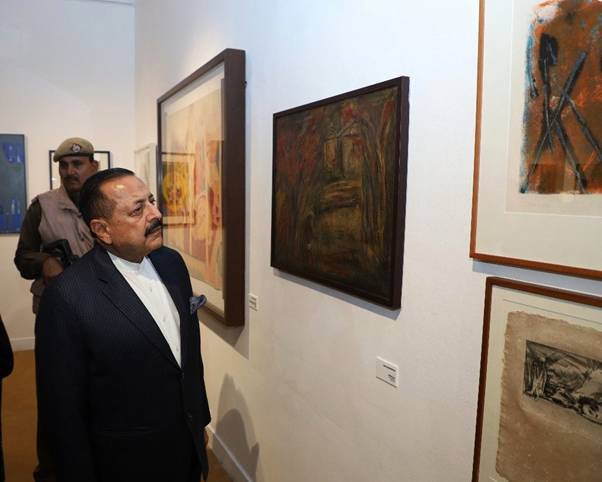
Dr. Jitendra Singh Inaugurates ‘The Art of India 2025’, Showcasing the Brilliance of Indian Art

| Published on:

Union Minister of State (Independent Charge) for Science and Technology; Earth Sciences and Minister of State for PMO, Department of Atomic Energy, Department of Space, Personnel, Public Grievances and Pensions, Dr. Jitendra Singh, inaugurated “Art of India 2025” Exhibition at Visual Arts Gallery, India Habitat Centre here. The Minister appreciated the symbiosis of traditional ethos with modern technology.

The fourth edition of this celebrated event brought together over 250 exquisite artworks from some of India’s most distinguished masters, emerging artists, and indigenous creators, offering a vivid portrayal of the country’s artistic evolution.

Dr. Jitendra Singh emphasized the role of art in fostering inclusivity and national pride. “Art is not just a reflection of our cultural heritage but also a medium of hope and unity in times of change. Events like The Art of India underscore the transformative power of creativity and serve as a testament to the talent and diversity of Indian artists,” he remarked, lauding Theorganisers for its continued dedication to promoting India’s rich artistic legacy.

“Through initiatives like The Art of India, it not only keeps the public informed about contemporary issues but also reconnects us with what is ancient, inherent, and eternal.” Reflecting on the art pieces showcased, including the striking depiction of the “Big Bull,” he noted how the exhibition symbolizes India’s ascent in the 21st century while grounding the nation in its timeless ethos. “This delicate balance—honouring our roots while embracing the future—is a testament to the values that have shaped our journey,” he added.

The Minister remarked that such initiatives preserve the artistic and cultural ethos that have shaped India’s journey, ensuring they remain integral to its future. “By reconnecting us with our roots and encouraging contemporary expression, this exhibition not only honours our past but also lays the cultural foundation for a developed India, as envisioned for 2047,” he stated.

Curated by the esteemed Dr. Alka Pande, The Art of India 2025 highlights a spectrum of artistic styles and narratives. From the timeless works of luminaries like Raja Ravi Varma, M.F. Husain, and S.H. Raza to innovative pieces by contemporary and indigenous artists, the exhibition offers a captivating journey through the nation’s artistic lineage. This year’s theme, celebrating Indian Masters, Contemporaries, and Folk Art, encapsulates the essence of hope, peace, and inclusivity.

Since its inception in 2022, The Art of India has emerged as a marquee event on the cultural calendar, drawing art aficionados, collectors, and enthusiasts nationwide. This year’s edition, featuring contributions from over 500 artists and galleries, promises to be a landmark celebration of India’s artistic diversity.

Attendees were treated to a visual feast, exploring the intersections of tradition and modernity, figurative and abstract, and historical roots and contemporary expressions. The exhibition also aims to inspire a broader appreciation of India’s artistic narrative, making it accessible to all generations.

The event concluded with a call to continue fostering platforms that elevate India’s art and culture on the global stage. Dr. Jitendra Singh’s participation as Chief Guest lent significant gravitas to the occasion, inspiring both veteran and emerging artists alike.

The Viksit Bharat Young Leaders Dialogue celebrates our Yuva Shakti, their dreams, skills and aspirations: PM

| Published on:

The Prime Minister, Shri Narendra Modi said that the Viksit Bharat Young Leaders Dialogue celebrates our Yuva Shakti, their dreams, skills and aspirations. Shri Modi also said he is looking forward to interacting with young minds on 12th January 2025.

Responding to the X post of Union Minister, Dr Mansukh Mandaviya about Viksit Bharat Young Leaders Dialogue, Shri Modi wrote;

“The Viksit Bharat Young Leaders Dialogue celebrates our Yuva Shakti, their dreams, skills and aspirations. I look forward to interacting with them on the 12th!”

“हमारे ज्यादा से ज्यादा युवा साथी राष्ट्र के नवनिर्माण का नेतृत्व करें, इसके लिए हम प्रतिबद्ध हैं। ‘Viksit Bharat Young Leaders Dialogue’ इसी से जुड़ी एक अहम पहल है, जिसको लेकर युवाओं का उत्साह देखते ही बन रहा है। मैं भी आपसे संवाद को लेकर बहुत उत्सुक हूं!”

Chief Minister of Uttar Pradesh meets Prime Minister

| Published on:

The Chief Minister of Uttar Pradesh, Shri Yogi Adityanath met with Prime Minister, Shri Narendra Modi today in New Delhi.

The Prime Minister’s Office said in X post;

“Chief Minister of Uttar Pradesh, Shri @myogiadityanath, met Prime Minister @narendramodi.”

Rajnath Singh calls for enhanced cohesiveness of the global community in view of the current security environment

| Published on:

Raksha Mantri Shri Rajnath Singh has called for enhanced cohesiveness of the global community in view of the current security environment which, he said, is in a state of flux with multiple conflicts and challenges. Addressing Ambassadors’ Round-Table, organised as a prelude to Aero India 2025, in New Delhi on January 10, 2025, Raksha Mantri stressed on the need to overcome the present geopolitical tensions for ensuring mutual prosperity and global peace.

“It is of paramount importance that the like-minded countries should strive together for collective actions for peace and prosperity. Without these, our future generations will not be able to take advantage of economic growth or technological innovations that we are experiencing in today’s era,” Shri Rajnath Singh told the Ambassadors and High Commissioners of various countries attending the event.

Raksha Mantri pointed out that India is emerging as a leading voice for the Global South, and it advocates for a multi-aligned policy approach, which ensures that diverse views are considered in the collective pursuit of prosperity. “Prime Minister Shri Narendra Modi has articulated India’s commitment to addressing global challenges through five guiding principles: Respect, Dialogue, Cooperation, Peace Prosperity. In today’s geopolitical landscape, fostering unity among like-minded nations is essential for ensuring mutual prosperity and peace, while addressing contemporary challenges. India has always championed shared prosperity and shared responsibility based on the fundamental principle of Vasudhaiva Kutumbakam, ‘One Earth, One Family’, which was also the theme for G-20 Summit in 2023,” he added.

Shri Rajnath Singh described Aero India, Asia’s largest aeroshow, as one such event, where nations come together and form bonds beyond boundaries. Elaborating on the vision behind the biennial event, he stated that it has proven itself to be the meeting ground for the aerospace and defence sectors to showcase their products/technologies. He defined it as a forum to forge strategic partnerships towards increasing opportunities for business, Transfer of Technology, joint development and co-production between various industries.

Raksha Mantri emphasised that, today, India possesses one of the largest defence industrial ecosystems in Asia and the Government is committed to further enhancing the capabilities. He added that the Indian aerospace and defence sector represents an attractive opportunity for foreign companies seeking to establish new ventures & partnerships. He cited the significant milestone of setting-up of the manufacturing facility of C-295 transport aircraft for the Indian Air Force through collaboration between Tata Advanced Systems Limited and Airbus Defence & Space.

Shri Rajnath Singh asserted that India has emerged as an attractive destination for investment, and Aero India 2025 presents an opportunity for friendly nations to jointly explore strengths and capabilities in the defence sector, addressing both strategic needs as well as tactical requirements. He added that the event will facilitate industry captains, technology leaders, intellectuals and entrepreneurs with new avenues for collaboration in defence industrial enterprises. “Aero India 2025 will serve as a vital forum for exploring partnerships that will from the base for future challenges. Together, we can create pathways for growth that are inclusive and sustainable,” he said.

Raksha Mantri emphasised that air and space power have become pivotal elements in shaping strategies as such assets, incorporated with Artificial Intelligence and Machine Learning systems, provide an unprecedented advantage in battle-field scenarios. He described Aero Space Power as the new frontier of military dominance which acts as strategic deterrence.

Highlighting India’s focus on self-reliance through strategic partnership and technological collaborations in defence & aerospace sectors, Shri Rajnath Singh said: “In recent years, the government has brought about several transformative policy reforms aimed at bolstering a robust defence industry ecosystem. This includes initiatives that promote domestic design, development, manufacturing and exports. Recognising its strategic importance and vast potential, the Government has designated aerospace as one of the core sectors of ‘Aatmanirbhar Bharat’. As a result of this, aerospace and defence in India is taking significant strides in developing cutting-edge technologies, both through public as well as private industry participation.

Raksha Mantri looked forward to welcoming the Ministers, Officials and Business Delegations from various countries at Aero India 2025 and utilising the platform to explore newer areas for enhancing collaboration.

During the Round-Table, Ambassadors and High Commissioners of various countries were briefed on the major events of Aero India 2025, and extended a personal invite from Raksha Mantri for their senior most leadership. Chief of Defence Staff General Anil Chauhan, Chief of the Army Staff General Upendra Dwivedi, Chief of the Naval Staff Admiral Dinesh K Tripathi, Chief of the Air Staff Air Chief Marshal AP Singh, Defence Secretary Shri Rajesh Kumar Singh, Secretary (Defence Production) Shri Sanjeev Kumar and other senior officials of the Ministry of Defence as well as the Government of Karnataka attended the Round-Table.

About Aero India 2025

This 15th edition of Aero India is scheduled to be held at the Air Force Station, Yelahanka in Bengaluru, Karnataka from February 10 to 14, 2025. The five-day event comprises a curtain raiser event, inaugural event, Defence Ministers’ Conclave, CEOs’ Round-Table, iDEX start-up event, breath-taking air shows, a large exhibition area comprising India Pavilion and a trade fair of aerospace companies. The broad theme is ‘The Runway to a Billion Opportunities’.

The first three days of the event (February 10th, 11th & 12th) will be business days, while 13th & 14th have been set as public days to allow people to witness the show. The event will provide a platform for forging partnerships between foreign & Indian firms and the discovery of newer avenues in the global value chain to accelerate the indigenisation process.

Aero India attracts a large number of exhibitors from the world’s leading industries in the field of aerospace and defence. It provides a unique opportunity for the industry to showcase their capabilities, products and services to the targeted audience. The biennial event serves as a platform for industry leaders to connect and shape the future of aerospace & defence industries.

PM inaugurates 18th Pravasi Bharatiya Divas convention in Odisha

| Published on:

The Prime Minister Shri Narendra Modi inaugurated the 18th Pravasi Bharatiya Divas convention in Bhubaneswar, Odisha today. Welcoming all the delegates and diaspora from various parts of the world, Shri Modi expressed confidence that the inauguration song would be played in the various Indian diaspora events, across the globe, in future. He lauded the Grammy award winning artiste Ricky Kej and his team for the wonderful rendition which captured the emotions and feelings of the Indian diaspora.

Thanking the Chief Guest, H.E. Christine Carla Kangaloo, President of the Republic of Trinidad & Tobago for the warm and affectionate words in her video message, the Prime Minister remarked that she was also talking about India’s progress and her words left an impact on all of them present at the event. Noting that now was the time for vibrant festivals and gatherings in India, Shri Modi said that in a few days, the Maha Kumbh would commence in Prayagraj and the festival of Makar Sankranti, Lohri, Pongal and Maag Bihu were also coming up. He added that there was a joyful atmosphere everywhere. Recalling that it was on this day in 1915, Mahatma Gandhiji returned to India after a long stay abroad, Shri Modi remarked that the presence of the diaspora in India at such a wonderful time added to the festive spirit. Remarking that this edition of Pravasi Bharatiya Divas (PBD) was special for another reason, he said, the event was held after a few days of the birth centenary of Shri Atal Bihari Vajpayee, whose vision was instrumental to PBD. “Pravasi Bharatiya Divas has become an institution to strengthen the bond between India and its diaspora”, he further added. Shri Modi highlighted that together we celebrate India, Indianness, our culture and progress along with connecting to our roots.

“The great land of Odisha, where we have gathered, is a reflection of India’s rich heritage”, exclaimed Shri Modi. He added that at every step we could witness our heritage in Odisha. The Prime Minister remarked that everyone would be filled with pride when one visits the historical caves of Udayagiri and Khandagiri, or the magnificent Sun temple of Konark or the ancient ports of Tamralipti, Manikpatna and Palur. Noting that hundreds of years ago, the traders and merchants from Odisha  undertook long marine voyages to places like Bali, Sumatra and Java, the Prime Minister said that Bali Yatra is celebrated even today in Odisha in its memory. He further added that Dhauli, a significant historical site in Odisha, represented the symbol of peace. He also noted that Samrat Ashoka had chosen the path of peace here  while the world was expanding empires through the power of the sword. Shri Modi urged that this legacy inspires India to tell the world that the future lies in Buddha and not in war. Therefore, he remarked that welcoming everyone to the land of Odisha is very special for him.

The Prime Minister emphasized that he has always considered the Indian diaspora as ambassadors of India. Expressing his joy in meeting and conversing with fellow Indians around the world, he said that the love and blessings he receives from them are unforgettable and always stay with him.

Expressing his heartfelt gratitude to the Indian diaspora and thanking them for giving him the opportunity to hold his head high with pride on the global stage, Shri Modi highlighted that over the past decade, he had met numerous world leaders, all of whom have praised the Indian diaspora for their social values and contributions to their respective societies.

“India is not just the mother of democracy, but democracy is an integral part of Indian life”, exclaimed the Prime Minister. He noted that Indians naturally embrace diversity and integrate seamlessly into the societies they join, respecting local rules and traditions. Shri Modi remarked that Indians serve their host countries with honesty, contributing to their growth and prosperity, while always keeping India close to their hearts. He added that they celebrate every joy and achievement of India with great enthusiasm.

Highlighting the incredible speed and scale of development in 21st century India, the Prime Minister remarked that in just 10 years, India had lifted 250 million people out of poverty and has risen from the 10th to the 5th largest economy in the world. He expressed confidence that India will soon become the 3rd largest economy.

Emphasising India’s achievements, such as the Chandrayaan mission reaching the Shiv-Shakti point, and the global recognition of Digital India’s strength, Shri Modi  stressed that every sector in India is advancing to new heights, breaking records in renewable energy, aviation, electric mobility, metro networks, and bullet train projects. He highlighted that India is now manufacturing “Made in India” fighter jets and transport aircraft. He envisioned a future where people will travel to India for Pravasi Bharatiya Divas in “Made in India” planes.

Underlining India’s growing global role due to its achievements and prospects, the Prime Minister said “Today’s India not only firmly asserts its own point but also strongly amplifies the voice of the Global South”. He highlighted the unanimous support for India’s proposal to make the African Union a permanent member of the G-20, emphasizing India’s commitment to “Humanity First.”

Shri Modi emphasized the global recognition of Indian talent, with professionals contributing to global growth through major companies. Extending his best wishes to those receiving the Pravasi Bharatiya Samman from President Droupadi Murmu, he highlighted that India will remain the world’s youngest and most skilled population for decades, meeting global skill demands. He stressed that many countries now welcome skilled Indian youth, and the Indian government is committed to ensuring that Indians going abroad are highly skilled through continuous skilling, re-skilling, and up-skilling efforts.

Stressing on the importance of convenience and comfort for the Indian diaspora and stating that their safety and welfare are top priorities, the Prime Minister remarked that “It is India’s responsibility to assist the diaspora during crisis situations, reflecting a key principle of India’s foreign policy”. He added that over the past decade, Indian embassies and offices worldwide have been sensitive and proactive.

Recounting the previous experiences of people who had to travel long distances and wait for days to access consular facilities, Shri Modi said that these issues were now being addressed, with fourteen new embassies and consulates opened in the last two years. He added that the scope of OCI cards was being expanded to include Persons of Indian Origin (PIOs) of the 7th generation from Mauritius and the 6th generation from Suriname, Martinique, and Guadeloupe.

The Prime Minister highlighted the significant history of the Indian diaspora worldwide, emphasizing their achievements in various countries as an important part of India’s heritage. He urged that these interesting and inspiring stories should be shared, showcased, and preserved as part of our shared legacy and heritage. Mentioning a recent effort he discussed in “Mann Ki Baat,” where several families from Gujarat settled in Oman centuries ago, Shri Modi lauded their 250-year journey as inspiring, and added that an exhibition was organized to digitize thousands of documents related to this community. Further he said that additionally, an “Oral History Project” was conducted, where senior members of the community shared their experiences. He was pleased to note that many of these families were present at the event today.

Emphasizing the need to undertake similar efforts with the diaspora in various countries, Shri Modi cited the example of the “Girmitiya” brothers and sisters. He urged the creation of a database to identify the villages and cities in India from where they originated and the places they settled. He remarked that documenting their lives, how they turned challenges into opportunities, could be showcased through films and documentaries. The Prime Minister highlighted the importance of studying and researching the Girmitiya legacy, proposing the establishment of a university chair for this purpose. He also urged organizing regular World Girmitiya Conferences and directed his team to explore these possibilities and work towards advancing these initiatives.

“Modern India is progressing with the mantra of development and heritage”, said the Prime Minister. He remarked that during the G-20 meetings, sessions were held across the country to provide the world with a firsthand experience of India’s diversity. He proudly mentioned events like Kashi-Tamil Sangamam, Kashi Telugu Sangamam, and Saurashtra Tamil Sangamam. The Prime Minister highlighted the upcoming Sant Thiruvalluvar Day and announced the establishment of Thiruvalluvar Culture Centers to spread his teachings. He noted that the first center has started in Singapore, and a Thiruvalluvar Chair is being established at Houston University in the USA. Shri Modi remarked that these efforts aim to take Tamil language and heritage, and India’s heritage to every corner of the world.

Highlighting the steps taken to connect heritage sites in India, the Prime Minister remarked that special trains like the Ramayana Express provided access to places associated with Lord Ram and Sita Mata. He added that Bharat Gaurav trains also connected important heritage sites across the country while semi-high-speed Vande Bharat trains link major heritage centers in India. The Prime Minister mentioned the launch of a special Pravasi Bharatiya Express train, which will take around 150 people on a tour of seventeen destinations related to tourism and faith. He encouraged everyone to visit the numerous significant sites in Odisha and highlighted the upcoming Mahakumbh in Prayagraj, urging people to seize this rare opportunity.

The Prime Minister acknowledged the significant role of the Indian diaspora in India’s independence in 1947 and remarked that the diaspora continues to contribute to India’s growth, making India the world’s top recipient of remittances. He emphasized the goal of making India a developed nation by 2047. Shri Modi highlighted the importance of the GIFT CITY ecosystem in meeting the financial services and investment needs of the diaspora and encouraged them to leverage its benefits to strengthen India’s journey towards development. “Every effort by the diaspora contributes to India’s progress”, said Shri Modi. Emphasizing the potential of heritage tourism, stating that India is not limited to its major metro cities but also includes Tier-2 and Tier-3 cities and villages, which showcase India’s heritage, the Prime Minister urged the diaspora to connect the world with this heritage by visiting smaller towns and villages and sharing their experiences. He encouraged them to bring at least five friends of non-Indian origin on their next visit to India, inspiring them to explore and appreciate the country.

Shri Modi appealed to the young members of the diaspora to participate in the “Bharat Ko Janiye” quiz to better understand India. He encouraged them to take advantage of the “Study in India” program and the ICCR scholarship scheme. The Prime Minister emphasized the importance of spreading the true history of India in the countries where the diaspora resides. He noted that the current generation in these countries may not be aware of India’s prosperity, long period of subjugation, and struggles. He urged the diaspora to share India’s true history with the world.

“India is now recognized as a Vishwa Bandhu”, exclaimed the Prime Minister and  urged the diaspora to strengthen this global connection by increasing their efforts. He suggested organizing award functions in their respective countries, specifically for the local residents. The Prime Minister remarked that these awards could be given to prominent individuals in various fields such as literature, art and craft, film, and theater. He encouraged the diaspora to award achievers with certificates, with the support of Indian embassies and consulates. This, he noted, would enhance personal connections and emotional bonding with the local people.

Stressing on the significant role of the diaspora in making local Indian products global, Shri Modi urged them to purchase “Made in India” food packets, clothes, and other items, either locally or online, and include these products in their kitchens, drawing rooms, and gifts. He remarked that this would be a substantial contribution towards building a developed India.

Making another appeal related to mother and mother earth, the Prime Minister mentioned his recent visit to Guyana, where he participated in the “Ek Ped Maa Ke Naam” initiative with the President of Guyana. He noted that millions of people in India are already doing this. He encouraged the diaspora to plant a tree or sapling in their mother’s name, wherever they are. He expressed confidence that when they return from India, they will carry the resolution of a developed India with them. Concluding the speech, the Prime Minister wished everyone a prosperous 2025, with good health and wealth, and welcomed them back to India.

The Governor of Odisha, Dr. Hari Babu Kambhampati, Chief Minister of Odisha, Shri Mohan Charan Manjhi, Union Ministers Shri S. Jaishankar, Shri Ashwini Vaishnaw, Shri Dharmendra Pradhan, Shri Jual Oram,and Union Ministers of State, Sushri Shobha Karandlaje, Shri Kirti Vardhan Singh,Shri Pabitra Margherita were present among other dignitaries at the event.

Background

The Pravasi Bharatiya Divas (PBD) Convention is the flagship event of the Government of India that provides an important platform to connect and engage with the Indian diaspora and enable them to interact with each other. The 18th Pravasi Bharatiya Divas Convention is being organized in partnership with the State Government of Odisha from 8th – 10th January 2025 in Bhubaneswar. The theme of this PBD Convention is “Diaspora’s Contribution to a Viksit Bharat”. A large number of Indian diaspora members from over 50 different countries have registered to participate in the PBD Convention.

Prime Minister remotely flagged-off the inaugural journey of the Pravasi Bharatiya Express, a special Tourist Train for the Indian diaspora, which will depart from the Nizamuddin Railway Station in Delhi and would travel to multiple destinations of tourism and religious importance in India for a period of three weeks. The Pravasi Bharatiya Express will be conducted under the Pravasi Teertha Darshan Yojana.

PM’s remarks at the start of Genome India Project

| Published on:

The Prime Minister Shri Narendra Modi delivered his remarks at the start of the Genome India Project via video message today. During the occasion, he said today India had taken a historic step in the field of research. He added that the Genome India project was approved 5 years ago and our scientists have diligently worked and completed the project despite the challenges posed by the Covid Pandemic. Shri Modi remarked that more than 20 illustrious research institutions such as IISc, IITs, CSIR and DBT-BRIC have played a major role in this research. He added that the data consisting of the genome sequences of 10,000 Indians was now available at the Indian Biological Data Center. Shri Modi expressed confidence that this project would prove to be a milestone in the field of biotechnology research and congratulated all the stakeholders involved in the project.

“Genome India Project is an important milestone in the biotechnology revolution”, exclaimed Shri Modi. He noted that this project has successfully created a diverse genetic resource by sequencing the genomes of 10,000 individuals from various populations.The Prime Minister noted that this data will now be available to scientists and researchers, aiding scholars in understanding India’s genetic landscape. He emphasized that this information will greatly assist in policy-making and planning for the country.

Addressing the experts and scientists and emphasizing India’s vastness and diversity, not just in food, language, and geography, but also in the genetic makeup of its people, the Prime Minister remarked that the nature of diseases varies greatly, making it essential to understand the genetic identity of the population to determine effective treatments. He highlighted the significant challenge of sickle cell anemia in the tribal communities and the national mission to combat it. He noted that the problem might differ across regions, and a complete genetic study is necessary to understand the unique genomic patterns of the Indian population. Shri Modi stressed that this understanding will help develop specific solutions and effective medicines for particular groups. He emphasized that the scope is much broader and sickle cell anaemia was just an example. The Prime Minister underlined there was lack of awareness in India about many genetic diseases that are passed from one generation to another and the Genome India Project would aid in developing effective treatments for all such diseases in India.

“The combination of biotechnology and biomass in the 21st century forms a crucial foundation for a developed India as a Bio Economy”, said Shri Modi. He remarked that the goal of the Bio Economy is the optimal use of natural resources, promotion of bio-based products and services, and creation of new employment opportunities in this sector. He added that the Bio Economy accelerates sustainable development and innovation. The Prime Minister was pleased to note that India’s Bio Economy has grown rapidly over the past decade, from $10 billion in 2014 to over $150 billion today. He highlighted that India is striving to elevate its Bio Economy to new heights and recently launched the Bio E3 Policy. Touching upon the vision of this policy, Shri Modi said it would help India to emerge as a leader in the global biotech landscape, similar to the IT revolution. He acknowledged the significant role of scientists in this endeavor and extended his best wishes to them.

Highlighting India’s evolving role as a major pharma hub, the Prime Minister remarked that over the past decade, India had taken revolutionary steps in public healthcare, providing free treatment to millions of Indians, offering medicines at an 80% discount through Jan Aushadhi Kendras, and building modern medical infrastructure. The Prime Minister emphasized that India’s pharma ecosystem proved its strength during the COVID-19 pandemic. He noted that efforts are being made to establish a robust supply and value chain for drug manufacturing within India. He remarked that the Genome India Project will further accelerate and energize these efforts.

“World is looking to India for solutions to global problems, presenting both a responsibility and an opportunity for future generations”, said Shri Modi. He remarked that India is building a vast research ecosystem, with a strong focus on research and innovation at all levels of education over the past decade.

“More than 10,000 Atal Tinkering Labs are enabling students to conduct new experiments daily”, said Shri Modi. He noted that hundreds of Atal Incubation Centers have been established across the country to support young innovators. He added that the PM Research Fellowship Scheme is also being implemented to support research during PhD studies. Highlighting that the National Research Fund was created to promote multidisciplinary and international research, the Prime Minister said the Anusandhan National Research Foundation will support sectors such as science, engineering, environment, and health. He remarked that the government had also decided to create a corpus of one lakh crore rupees to boost research and investment in sunrise technologies, which will aid the development of the biotechnology sector and support young scientists.

Touching upon the Government’s recent significant decision of “One Nation One Subscription”, the Prime Minister remarked that this initiative will ensure easy and cost-free access for Indian students and researchers to prestigious global journals. The Prime Minister emphasized that these efforts will greatly contribute to making India the knowledge and innovation hub of the 21st century.

“India’s Pro People Governance and Digital Public Infrastructure have set a new model for the world”, exclaimed the Prime Minister. Concluding his speech, he expressed confidence that the Genome India Project will similarly strengthen India’s image in the field of genetic research. The Prime Minister extended his best wishes for the success of the Genome India Project.

Union Home Minister chairs a review meeting at the Bureau of Police Research & Development (BPR&D), New Delhi

| Published on:

Union Home Minister and Minister of Cooperation, Shri Amit Shah chaired a review meeting at the Bureau of Police Research & Development (BPR&D), New Delhi. Union Home Secretary, Director General BPR&D, Senior Officials of the Ministry of Home Affairs, and the Bureau’s Officers were present in the meeting.

Home Minister took an overview of the six Divisions of BPR&D as well as outlying units (CAPT Bhopal and CDTIs), their achievements, ongoing tasks, and future roadmap.  He also took a special review of the efforts and initiatives by BPR&D towards the implementation of the New Criminal Laws (NCL).

Home Minister said under the leadership of Prime Minister Shri Narendra Modi, BPR&D is committed to transform the Indian Police Forces into SMART forces to successfully meet the challenges of policing as well as internal security by equipping them with the necessary intellectual, physical and organizational resources.

During the discussion in the meeting, the Union Home Minister said that in the Modus Operandi Bureau, the BPR&D, NCRB, prison officials, and forensic experts should analyse the modus operandi of crimes. He said that BPR&D should conduct research to identify the challenges faced in policing at the grassroots level and work towards finding solutions for them.

Shri Amit Shah stressed upon the importance of multi-stakeholder contributions, including collaboration with institutions of international repute in research studies, and projects. He gave instructions for a globally expanded scope and outreach for BPR&D projects and studies as well as publications to provide maximum benefit to police forces as well as to improve the public image of the police.

Union Home Minister appreciated the efforts of the Bureau in the NCL training and implementation, modernization of police forces through the upgradation of existing police and prison processes and practices, and for tackling new age challenges. He emphasized the role of BPR&D as the Nodal Agency connecting the Ministry with all States and UTs. Shri Shah gave directions for enhanced streamlining of the Bureau’s work for targeted help to all pillars of the Criminal Justice System based on their unique requirements. Home Minister underlined the need for a ‘Make in India’ model for meeting policing requirements as well as the need for greater involvement of Criminal Justice System stakeholders, States & UTs, and the Ministry for problem identification and effective solutions. Home Minister assured support and assistance to the Bureau for its smooth functioning.

Piyush Goyal launches 8th edition of National Programme for Organic Production

| Published on:

India’s total export value of organic farming has the potential to reach Rs 20,000 crore in the next three years. This was stated by Union Minister of Commerce & Industry, Shri Piyush Goyal today during his address at the launch of 8th edition of National Programme for Organic Production (NPOP)  at the Bharat Ratna C. Subramaniam Auditorium (NASC Complex), Pusa in New Delhi.

Shri Piyush Goyal along with Minister of State for Commerce & Industry, Shri Jitin Prasada, Minister of State for Cooperation, Shri Murlidhar Mohol, Minister of State for Cooperation, Shri Krishan Pal Gurjar, Secretary, Ministry of Cooperation, Dr. Ashish Kumar Bhutani and senior government officials unveiled a dedicated NPOP portal as well as Organic Promotion Portal which will provide more visibility and ease of operations for Organic stakeholders.

They also unveiled TraceNet 2.0 the upgraded online traceability system for seamless operations and enhanced tools for regulatory oversight. The redesigned APEDA portal was also showcased with enhanced user experience and information for the benefit of Agri and Processed food products’ stakeholders. The redesigned AgriXchange portal was also launched, it will enable more user-friendly data analysis and generation of reports & data of Agricultural exports making it accessible for the general public.

During the event, the Minister also distributed the first five registration certificates generated on TraceNet 2.0 to Organic operators.

Shri Goyal during his address said that Prime Minister Shri Narendra Modi underlined the importance of organic farming in his first Parliament speech. He also mentioned that the PM during his speech on 78th Independence Day noted the growing importance of organic farming across the world and its far reaching benefits on individual health and restoring soil nutrients.

The Minister also said that Union Minister of Home Affairs and Cooperation, Shri Amit Shah has made huge contributions in simplifying and reducing application costs for the electronic service portal TraceNet 2.0. Shri Goyal further said that Shri Shah also noted the growing community of organic farmers through Farmer Producer Organisations (FPOs) and Cooperatives in the country.

Organic farming as a form of sustainable farming practice will help combat water scarcity and overapplication of fertilisers and pesticides harming soil quality and crop yields in the country, the Minister noted. Highlighting the farmers’ efforts in ensuring food security, Shri Goyal said that there is a significant push from the Government to promote organic farming.

Organic farming has become a priority for the nation and will be regarded as a valuable way of farming across the world. Farmers adopting organic farming have seen an increase in yields and income, he said.  The Minister said that organic farming plays a crucial role in Indian agriculture. He noted that the Government will benefit from increased exports of organic products to the world.

The Minister also said that there is a need to put emphasis on packaging and marketing of the organic products for the farmers to receive the right price for their produce. He also pointed out that this value chain will also help generate employment and the nation will gain popularity across the world. Shri Goyal praised the efforts of Amul, National Agricultural Cooperative Marketing Federation of India Ltd. (NAFED) and National Co-operative Organics Limited (NCOL) for contributing to the growth of the organic sector. He also said the cooperative sector, farming sector and the trade sector will assist the organic sector to grow in the future.

There is a need to focus on market expansion and raise quality standards of the products. Capacity building for the farmers and research on utilising modern techniques for higher yields is also necessary. Higher yields will lead to higher availability of products which will help spur buying decisions of consumers, Minister Goyal said.

The 8th edition of the National Programme for Organic Production (NPOP) introduces key amendments aimed at promoting ease of operations and enhancing transparency for stakeholders, including farmers. Certification requirements for organic grower groups have been simplified, and these groups are now granted legal status in place of the Internal Control System (ICS). The revised derogation provisions allow for a potential reduction of up to three years in the land conversion period to organic, subject to conditions and safeguards. The ICS of organic grower groups must ensure the procurement of the entire organic produce or establish market linkages to support farmers. Transparency is enhanced through the disclosure of information about organic farmers and other relevant details in the public domain, bolstering system credibility. Additionally, oversight mechanisms have been strengthened with the integration of IT tools and the web-based traceability system, Tracenet, for monitoring, surveillance, and data analytics.

Details of portals unveiled during the event:

  • NPOP portal: The dedicated portal for the National Programme for Organic Production(NPOP) will provide more visibility and ease of operations for Organic stakeholders..
  • Organic Promotion Portal: Farmers, FPOs and exporters can showcase their certified organic products, generate Trade Leads and connect with global buyers. This will also include online Training and capacity building sessions for operators on Organic production and also information on Organic Trade events.
  • TraceNet 2.0:  The upgraded online Organic traceability system for seamless operations and enhanced tools for regulatory oversight. It will ensure transparency, traceability, and compliance for organic agricultural and processed food products from farm to market. By integrating technology with agriculture, TraceNet empowers stakeholders to streamline operations and meet global organic certification standards.
  • APEDA portal: Redesigned and revamped APEDA portal with enhanced user experience and information for the benefit of Agri and Processed food products’ stakeholders.
  • AgriXchange portal: Redesigned and revamped AgriXchange portal enables more user-friendly data analysis and generation of reports & data of Agricultural exports making it accessible for the general public. Exporters can seamlessly connect with international buyers and sellers as well as explore comprehensive trade insights at their fingertips.

The National Programme for Organic Production (NPOP) is a key government programme that strengthens India’s organic certification system, promoting sustainable farming practices and opening new opportunities for farmers and exporters. By setting high standards for organic products, NPOP enhances India’s competitiveness in the global organic market, while helping farmers adopt eco-friendly and economically viable practices.

With the launch of the 8th Edition of the NPOP, India is poised to strengthen its position as a leading global exporter of organic products, empowering stakeholders across the organic value chain. The new regulations underscore the government’s ongoing commitment to sustainable agriculture, farmer welfare and food security.

The occasion saw wide participation from government officials from both the Centre and State, embassy officials and representatives from major trading partners like USA, EU, Australia, South Korea, Japan, Taiwan, New Zealand, and UAE, industry leaders from international organizations like the FAO, IFOAM and FiBL, Farmer Producer Organisations (FPOs)/ Farmer Producer Companies (FPCs) and over 1000 farmers from the states of Haryana, Punjab, Uttarakhand, Himachal Pradesh, Uttar Pradesh, Mizoram, Manipur, Sikkim and Rajasthan.

Renowned companies from the Indian Organic Industry such as Organic India, Nature Bio Foods, Nature Pearls, Shresta, Jeev Amrit, Plantrich, PDS Spices, Amul and government Ministries and Departments like NAFED and NCOL respectively also showcased their products in the 11 stalls that were put up by APEDA.

The Agricultural and Processed Food Products Export Development Authority (APEDA) is the apex body under the Ministry of Commerce & Industry responsible for promoting the export of agricultural and processed food products. APEDA plays a crucial role in fostering the growth of India’s organic export sector.

Prime Minister condoles loss of lives due to stampede in Tirupati, Andhra Pradesh

| Published on:

The Prime Minister, Shri Narendra Modi has condoled the loss of lives due to stampede in Tirupati, Andhra Pradesh.

The Prime Minister’s Office said in a X post;

“Pained by the stampede in Tirupati, Andhra Pradesh. My thoughts are with those who have lost their near and dear ones. I pray that the injured recover soon. The AP Government is providing all possible assistance to those affected: PM @narendramodi”

PM lays foundation stone, inaugurates development works worth over Rs. 2 Lakh Crore in Andhra Pradesh

| Published on:

The Prime Minister Shri Narendra Modi laid foundation stone, inaugurated development works worth over Rs. 2 Lakh Crore in Visakhapatnam, Andhra Pradesh today. Paying his due respects to Lord Simhachalam Varaha Lakshmi Narasimha Swamy, Shri Modi said it was after a gap of 60 years, with the blessings of the people, a Union Government was elected for the third time in a row in the country. He added that officially, it was his first program in Andhra Pradesh after the formation of the Government. Shri Modi thanked the people for a grand welcome given to him during the roadshow prior to the event. He added that he respected the spirit of every word and feeling of Shri Chandrababu Naidu during his speech. The Prime Minister expressed confidence in achieving all the goals mentioned by Shri Naidu in his speech with the support of the people of Andhra Pradesh and India.

“Our Andhra Pradesh is a state of possibilities and opportunities”, exclaimed Shri Modi. He remarked that when these possibilities are realized, Andhra Pradesh will develop, and India will become a developed nation. The Prime Minister emphasized that the development of Andhra Pradesh is our vision and serving the people of Andhra Pradesh is our commitment. Shri Modi highlighted that Andhra Pradesh had set a target to become a $2.5 trillion economy by 2047. He remarked that to realize this vision, the government of Shri Chandrababu Naidu had initiated the ‘Swarna Andhra@2047’ initiative. The Prime Minister emphasized that the Union government was working shoulder to shoulder with Andhra Pradesh to achieve every goal and added that the central government was giving special priority to Andhra Pradesh in projects worth lakhs of crores. The Prime Minister remarked that today, projects worth more than ₹2 lakh crore were inaugurated and congratulated the people of Andhra Pradesh and the entire nation for these development projects.

Highlighting that Andhra Pradesh, due to its innovative nature, is a significant hub for IT and technology, the Prime Minister remarked “It is now time for Andhra Pradesh to become a center for futuristic technologies”. He emphasized the importance of leading in emerging technologies, such as green hydrogen. Shri Modi noted that the National Green Hydrogen Mission was launched in 2023, with a target of producing 5 million metric tonnes of green hydrogen by 2030. He added that in the initial phase, two green hydrogen hubs would be established, one of which will be in Visakhapatnam. The Prime Minister stated that Visakhapatnam will be among the few cities globally with large-scale green hydrogen production facilities. He highlighted that this green hydrogen hub will create numerous job opportunities and develop a manufacturing ecosystem in Andhra Pradesh.

Shri Modi remarked that he had the opportunity to lay the foundation stone for the bulk drug park project in Nakkapalli and highlighted that Andhra Pradesh was one of the three states in the country where such a park is being established. The Prime Minister emphasized that this park will provide excellent infrastructure for manufacturing and research, boosting investor enthusiasm and confidence while benefiting local pharma companies.

The Prime Minister noted that the government views urbanization as an opportunity and aims to make Andhra Pradesh an example of new-age urbanization. He added that to realize this vision, the foundation stone for the Krishnapatnam Industrial Area, also known as Kris City, was laid today. He remarked that this smart city will be part of the Chennai-Bengaluru Industrial Corridor, attracting thousands of crores in investment and creating millions of industrial jobs in Andhra Pradesh.

Remarking that Andhra Pradesh was already benefiting from Shri City as a manufacturing hub, Shri Modi underscored that the aim is for Andhra Pradesh to be among the top states in the country in the industrial and manufacturing sectors. The Prime Minister emphasized that the government was promoting manufacturing through initiatives such as Production Linked Incentive (PLI) scheme, resulting in India being counted among the top countries in the world for manufacturing various products.

The Prime Minister noted that the foundation stone for the South Coast Railway Zone headquarters was laid in the new city of Visakhapatnam. He highlighted the importance of this development for Andhra Pradesh, fulfilling a long-standing demand for a separate railway zone. The Prime Minister stated that the establishment of the South Coast Railway Zone headquarters will expand agricultural and trade activities in the region, and provide new opportunities for tourism and the local economy. He also mentioned the inauguration and foundation laying of connectivity projects worth thousands of crores. Shri Modi said that Andhra Pradesh was among the states with 100% railway electrification, and more than 70 railway stations are being developed under the Amrit Bharat Station Scheme. He highlighted that seven Vande Bharat trains and the Amrit Bharat train were being operated for the ease of travel for the people of Andhra Pradesh.

“The infrastructure revolution in Andhra Pradesh, with better connectivity and facilities, will transform the state’s landscape”, said Shri Modi. He remarked that this development will enhance ease of living and ease of doing business, forming the foundation for Andhra Pradesh’s $2.5 trillion economy.

Noting that Visakhapatnam and Andhra Pradesh’s coast have been gateways for India’s trade for centuries and continue to hold significant importance, the Prime Minister emphasized the promotion of the blue economy in mission mode to fully utilize maritime opportunities. He stressed the modernization of Visakhapatnam Fishing Harbour to increase the income and business of those involved in fisheries. He mentioned the provision of facilities like Kisan Credit Cards to fishermen and the steps being taken to ensure maritime security.

Shri Modi stressed the government’s commitment to inclusive and all-around development in every sector, ensuring that the benefits of development reach all sections of society. He reiterated the Union government’s dedication to building a prosperous and modern Andhra Pradesh. Concluding the speech, the Prime Minister congratulated everyone on the projects being inaugurated today, ensuring the prosperity of the people of Andhra Pradesh.

The Governor of Andhra Pradesh, Shri S. Abdul Nazeer, Union Minister for Civil Aviation, Shri Kinjarapu Rammohan Naidu, Chief Minister of Andhra Pradesh, Shri N. Chandrababu Naidu, Deputy Chief Minister, Shri Pawan Kalyan were present among other dignitaries at the event.

Background

In yet another key step towards his commitment for green energy and sustainable future, Prime Minister laid the foundation stone for the state-of-the-art NTPC Green Energy Limited Green Hydrogen Hub Project at Pudimadaka near Visakhapatnam in Andhra Pradesh, which is the first Green Hydrogen Hub under the National Green Hydrogen Mission. The project entails an investment of approx. ₹1,85,000 Crore. This includes investment in 20 GW renewable energy capacities, making it one of India’s largest integrated green hydrogen production facilities with a capacity of producing 1500 TPD Green Hydrogen and 7500 TPD Green Hydrogen derivatives including Green Methanol, Green Urea and Sustainable Aviation Fuel, primarily targeting the export market.  The project will contribute substantially in achieving India’s non-fossil energy capacity target of 500 GW by 2030.

Prime Minister also dedicated to the nation, laid the foundation stone and inaugurated various railway and road projects worth over Rs. 19,500 crore in Andhra Pradesh which includes foundation stone laying of South Coast Railway Headquarters at Visakhapatnam among various other projects. These projects will reduce congestion, improve connectivity and enhance regional social and economic growth.

Furthering his vision of accessible and affordable healthcare, Prime Minister laid the foundation for the Bulk Drug Park at Nakkapalli in Anakapalli district. The Bulk Drug Park will create thousands of jobs while helping accelerate economic growth due to its proximity to the Visakhapatnam-Chennai Industrial Corridor (VCIC) and Visakhapatnam-Kakinada Petroleum, Chemical and Petrochemical Investment Region.

Prime Minister also laid the Foundation Stone of Krishnapatnam Industrial Area (KRIS City) under Chennai Bengaluru Industrial Corridor, in Tirupati District of Andhra Pradesh. The Krishnapatnam Industrial Area (KRIS City), a flagship project under the National Industrial Corridor Development Programme, is envisioned as a greenfield industrial smart city. The project is set to attract significant manufacturing investments of approximately ₹10,500 crore and is also projected to create around 1 lakh direct and indirect jobs, significantly enhancing livelihoods and driving regional progress.

Raksha Mantri & Defence Minister of Maldives hold bilateral talks in New Delhi

| Published on:

Raksha Mantri Shri Rajnath Singh held bilateral discussions with the Defence Minister of Maldives Mr Mohamed Ghassan Maumoon in New Delhi on January 08, 2025, and comprehensively reviewed various aspects of bilateral defence & security cooperation. During the talks, both sides reasserted the firm commitment to work closely in realising the joint vision for India-Maldives Comprehensive Economic and Maritime Security Partnership.

Raksha Mantri reaffirmed India’s readiness to support the Maldives in capability enhancement for defence preparedness, including provisioning of defence platforms & assets to augment its capacities, as per its national priorities and in line with New Delhi’s ‘Neighborhood First’ policy and the vision of SAGAR (Security And Growth for All in the Region). Minister Maumoon appreciated India’s historical role as the ‘First Responder’ for the Maldives, and thanked New Delhi for assisting Male in augmenting the modern infrastructural capacities and training of defence & security personnel. On the Government of Maldives’ request, India handed over defence equipment and stores to the Maldives.

Minister Maumoon is on his first official visit to India. The visit is part of continued high-level engagements between the two sides. It has provided an opportunity to further deepen the bilateral defence & security ties for the mutual benefit of the two countries and the Indian Ocean Region.