Prime Minister participates in the 25th SCO Summit in Tianjin, China

| Published on:

Prime Minister Shri Narendra Modi participated in the 25th Meeting of the Council of Heads of State of the Shanghai Cooperation Organization (SCO), held in Tianjin, China, from 31 August to 1 September 2025. The Summit witnessed productive discussions on SCO Development Strategy, Reform of Global Governance, Counter-Terrorism, Peace and Security, Economic and Financial Cooperation, and Sustainable Development.

Addressing the Summit, Prime Minister highlighted India’s approach to strengthening cooperation under the SCO framework. In this regard, he noted that India seeks greater action under three pillars – Security, Connectivity and Opportunity. Emphasising that peace, security and stability remain key to progress and prosperity, he called upon member countries to take firm and decisive action to fight terrorism in all its manifestations. Prime Minister underlined the need for coordinated action against terror financing and radicalization. Thanking member countries for their strong solidarity in the wake of the Pahalgam terror attack, he emphasized that there should be no double standards in dealing with terrorism and urged the group to hold countries who perpetrate and support cross-border terrorism accountable.

Highlighting the role of connectivity in fostering development and building trust, Prime Minister stated that India strongly supported projects such as Chabahar port and International North-South Transport Corridor. He also spoke about opportunities in the fields of start-ups, innovation, youth empowerment and shared heritage, which must be pursued under the SCO umbrella. Prime Minister proposed commencing a Civilizational Dialogue Forum within the group to foster greater people-to-people ties and cultural understanding.

Prime Minister expressed support for the reform-oriented agenda of the group. In this regard, he welcomed the setting up of centres to deal with organized crime, drug trafficking and cyber security. He called for a similar approach by the group to reforming multilateral institutions, including the United Nations. Full address of PM may be seen here [Link].

Prime Minister thanked President Xi Jinping for his warm hospitality and congratulated him for the successful organization of the Summit. He also congratulated Kyrgyzstan on taking over the next Presidency of SCO. At the conclusion of the Summit, the SCO Member countries adopted the Tianjin Declaration.

Prime Minister’s bilateral meeting with Chinese President Xi Jinping

| Published on:

Prime Minister Shri Narendra Modi met with Mr. Xi Jinping, President of the People’s Republic of China, on the sidelines of the Summit of the leaders of the Shanghai Cooperation Organization (SCO) in Tianjin on 31 August 2025.

Both leaders welcomed the positive momentum and steady progress in bilateral relations since their last meeting in Kazan in October 2024. They reaffirmed that the two countries were development partners and not rivals, and that their differences should not turn into disputes. A stable relationship and cooperation between India and China and their 2.8 billion peoples on the basis of mutual respect, mutual interest and mutual sensitivity are necessary for the growth and development of the two countries, as well as for a multipolar world and a multi-polar Asia befitting the trends of the 21st century.

Prime Minister underlined the importance of peace and tranquility on the border areas for continued development of bilateral relations. The two leaders noted with satisfaction the successful disengagement last year and the maintenance of peace and tranquility along the border areas since then. They expressed commitment to a fair, reasonable, and mutually acceptable resolution of the boundary question proceeding from the political perspective of their overall bilateral relations and the long-term interests of the two peoples. They recognized the important decisions taken by the two Special Representatives in their Talks earlier this month, and agreed to further support their efforts.

The two leaders noted the need to strengthen people-to-people ties through direct flights and visa facilitation, building on the resumption of Kailash Manasarovar Yatra and tourist visa. On economic and trade relations, they recognized the role of their two economies to stabilize world trade. They underlined the need to proceed from a political and strategic direction to expand bilateral trade and investment ties and reduce trade deficit.

Prime Minister noted that India and China both pursue strategic autonomy, and their relations should not be seen through a third country lens. The two leaders deemed it necessary to expand common ground on bilateral, regional, and global issues and challenges, like terrorism and fair trade in multilateral platforms.

Prime Minister expressed support for China’s Presidency of the SCO and the Summit in Tianjin. He also invited President Xi to the BRICS Summit that India will be hosting in 2026. President Xi thanked Prime Minister for the invitation and offered China’s support to India’s BRICS Presidency.

Prime Minister also had a meeting with Mr. Cai Qi, Member of the Standing Committee of the Politburo of the Communist Party of China. Prime Minister shared with Mr. Cai his vision for bilateral relations and sought his support to realize the vision of the two leaders. Mr. Cai reiterated the Chinese side’s desire to expand bilateral exchanges and further improve relations in line with the consensus reached between the two leaders.

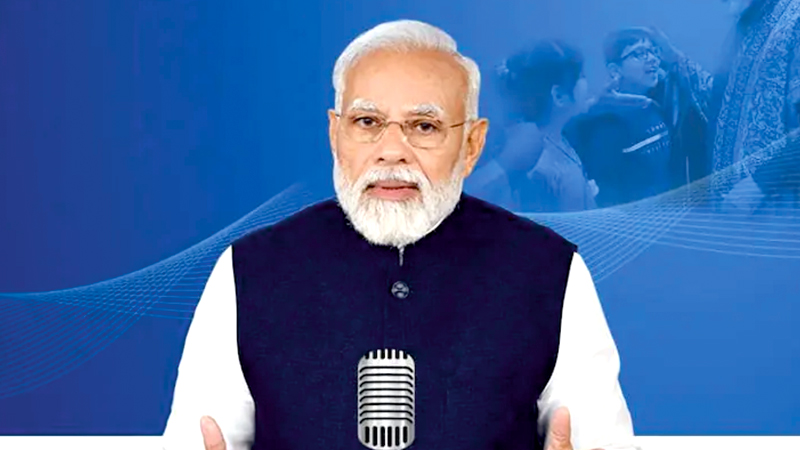
PM’s address in the 125th Episode of ‘Mann Ki Baat’

| Published on:

My dear countrymen, Namaskar. In this monsoon season, natural disasters are testing the country. During the last few weeks, we have witnessed grave devastation caused by floods and landslides. At places, homes were destroyed; at others, fields were submerged; families were ruined en masse, elsewhere, bridges were swept away amid the strong flow of water; roads were washed away; people’s lives were enmeshed in danger. These incidents have saddened every Indian. The pain of the families who lost their loved ones is our shared pain. Wherever the crisis struck, our NDRF-SDRF personnel, other security forces, everyone toiled day and night to save the people there. The soldiers have also availed of the aid of technology. With the help of myriad modern resources such as thermal cameras, life detectors, sniffer dogs and drone surveillance, a lot of efforts were undertaken to lend speed to the relief work. During this time, relief material was delivered by helicopters; the injured were airlifted. In the moment of disaster, the army came forward to help. Local people, social workers, doctors, the administration… everyone made every possible effort in this hour of crisis. I express heartfelt gratitude to every citizen who has kept humanity above everything else during this testing time.

My dear countrymen, amidst this devastation of floods and rains, Jammu and Kashmir has also attained two very special achievements. Not many people noticed them, but when you will come to know about those achievements, you will be extremely delighted. A record number of people gathered in a stadium in Pulwama, Jammu and Kashmir. Pulwama’s first ever day-night cricket match was played here.

Earlier this was impossible, but now my country is transforming. This match is a part of the ‘Royal Premier League’, in which different teams of Jammu and Kashmir are playing. Thousands of enthusiasts, especially youth, enjoying cricket at night in Pulwama… it was truly a sight to behold. Friends, the second event that caught attention was the first Khelo India Water Sports Festival in the country and that too was held at Dal Lake in Srinagar. Truly, what a special place that is to organize such a festival. Its objective is to make water sports more popular in Jammu and Kashmir. More than 800 athletes from all over India participated in it. Women athletes were also not far behind… their participation was also almost at par with men. I would like to congratulate all the players who participated in it. Special congratulations to Madhya Pradesh, which won the maximum number of medals, followed by Haryana and Odisha. I deeply appreciate the warmth and hospitality of the Government of Jammu and Kashmir and the people there.

Friends, to bring to you the experience of this event, I have thought of talking to two players who participated in it… one of them is Rashmita Sahu from Odisha and the other is Mohsin Ali from Srinagar. Let us listen to what they have to say.

Prime Minister: Rashmita ji, Namaste!

Rashmita: Namaste Sir.

Prime Minister: Jai Jagannath.

Rashmita: Jai Jagannath Sir.

Prime Minister: Rashmita ji, first of all congratulations to you for your success in the world of sports.

Rashmita: Thank you Sir.

Prime Minister: Rashmita, our listeners are very keen to know about you and your sports journey… I am also very eager… tell me!

Rashmita: Sir, I am Rashmita Sahu… from Odisha. And I am a canoeing player. I joined sports in 2017. I started canoeing and I have participated at the National level, National Championship and National Games. I have 41 medals. 13 Gold, 14 Silver and 14 Bronze Medals, Sir.

Prime Minister: How did you develop interest in this sport? Who first inspired you towards this? Is there a sports environment in your family?

Rashmita: No sir. The village I come from had no sports. Boating was going on in the river, so I went for swimming. I and my friends were swimming and there was a boat for canoeing-kayaking, I did not know anything about it. So I asked my friend “what is this?” So my friend told me that there is SAI Sports Centre in Jagatpur; sports are organised there, I am also going to go there. I found it very interesting. So what is this, I did not even know, how do kids do this in water? Do boating? I told him that I also wanted to go. How do I go? Tell me also? She told me to go there and talk. Then I immediately went home and said Papa, I want to go, Papa, I have to go. Then Papa said okay; he took me there. There was no trial at that time. Then the coaches said that the trial is held in February, so you should come during the trial in February or March. Then I came during the trial.

Prime Minister: Ok Rashmita, how was your own experience at the Khelo India Water Sports Festival held in Kashmir? You went to Kashmir for the first time?

Rashmita: Yes Sir, I went to Kashmir for the first time. Khelo India, First ‘Khelo India Water Sports Festival’ was organized there. I had two events in it. Singles 200 meter and 500 meter doubles. And I have won gold medals in both Sir.

Prime Minister: Oh wow! You won both!

Rashmita: Yes Sir.

Prime Minister: Many congratulations.

Rashmita: Thank you Sir.

Prime Minister: Well Rashmita, apart from water sports, what are your hobbies?

Rashmita: Sir, apart from water sports, I like running the most. Whenever I go on vacation, I go for running. I had learnt to play football at my old field, so whenever I go there, I run a lot and I also play football, a little bit Sir.

Prime Minister: So sports runs in your veins!

Rashmita: Yes Sir, when I was in school from 1st class to 10th class, I used to be 1st in every event I participated in, I used to be a champion Sir.

Prime Minister: Rashmita, if you have to give a message to those who want to progress in sports like you, what would that be?

Rashmita: Sir, many children are not even allowed to step out of their homes, and being a girl, “how will you go out”… and some are leaving sports because of exam issues… and in this Khelo India scheme, many children are getting financial help and many children are getting a lot of help, due to which many children are able to move ahead. And I would tell everyone not to leave sports, you can go a long way with sports. Sports is sports  but it also keeps every part of the body healthy and it is our duty to take sports forward and get medals for India, Sir.

Prime Minister: Well, Rashmita Ji, I felt very good. Once again, many many congratulations to you and please convey my regards to your father also because he gave so much encouragement to a daughter to move forward in the midst of so many difficulties. My best wishes are with you. Thank you.

Rashmita: Thank you Sir.

Prime Minister: Jai Jagannath.

Rashmita: Jai Jagannath Sir.

Prime Minister: – Mohsin Ali Namaste!

Mohsin Ali: – Namaste Sir.

Prime Minister: – Mohsin Ji, many congratulations to you and best wishes for your bright future.

Mohsin Ali: – Thank you Sir.

Prime Minister: – Mohsin, the first ever Khelo India Water Sports, its festival… and the first ever Gold Medal in that!  And you won that. How did you feel?

Mohsin Ali – Sir, I am very happy. I won a Gold Medal in Khelo India, which has happened for the first time here, in Kashmir.

Prime Minister: – What is the discussion among the people?

Mohsin Ali – There is a lot of talk Sir, the whole family is happy.

Prime Minister: – Your schoolmates?

Mohsin Ali – Everyone in school is also happy… in Kashmir, everyone says that you are a Gold Medalist.

Prime Minister: – So you have become a big celebrity now.

Mohsin Ali – Yes Sir!

Prime Minister: – Well, how did you develop an interest in water sports and what benefits do you see in it?

Mohsin Ali – In my childhood, I saw a boat sailing in Dal lake; my father asked me if I would do it, yes, I am also interested in it, then I went to the centre to meet madam, then madam taught me… Bilquis mam.

Prime Minister: – Well, Mohsin, people from all over the country had come, for the first time a water sports program was organized and that too took place in Srinagar, that too in Dal lake, so many people came from all over the country. How did the people there feel?

Mohsin Ali – I am very happy Sir, everyone is saying that it is a good place, everything is good here, the facilities are good. Everything was good here in Khelo India.

Prime Minister: – So have you ever gone outside Kashmir for sports?

Mohsin Ali – Yes Sir, I have been to Bhopal, Goa, Kerala, Himachal.

Prime Minister: – Well then you have seen the whole of India.

Mohsin Ali – Yes Sir

Prime Minister: – So…so many players had come there!

Mohsin Ali – Yes Sir

Prime Minister: – So did you make new friends or not?

Mohsin Ali – Sir, I made a lot of friends, we also roamed around together here in Dal Lake, Lal Chowk, we roamed around the whole place, we went to Pahalgam also; yes sir we also went around the entire place.

Prime Minister: – Look, I have seen that the sports talent in Jammu and Kashmir is amazing.

Mohsin Ali – Yes Sir

Prime Minister: – Our youth of Jammu and Kashmir should bring glory to the country, they have so much potential and you have proved it.

Mohsin Ali – Sir, my dream is to win a medal in Olympics, that is my dream.

Prime Minister: – Wow, well done!

Mohsin Ali – That exactly is my dream Sir

Prime Minister: – Look, I got goosebumps just by hearing that from you.

Mohsin Ali – Sir, that is my dream, to win a medal in Olympics. To get the national anthem played for the country, that is my only dream.

Prime Minister: – The son of a labourer family of my country dreams so big, it means this country is going to progress a lot.

Mohsin Ali – Sir, it is going to progress a lot. We are thankful to the Government of India who has organized Khelo India here… it has happened here for the first time sir.

Prime Minister: – That is why they must be cheering you in your school.

Mohsin Ali – Yes Sir.

Prime Minister: – Ok Mohsin, I really enjoyed talking to you and please convey my special thanks to your father. Because he made your life by living the life of a labourer and on your father’s words, you have worked hard for 10 years without resting. This is a great inspiration for a player and I also congratulate your coach who worked so hard to train you. My best wishes, many congratulations Bhaiya.

Mohsin Ali – Thank you sir, Namaskar Sir, Jai Hind!

Friends, the spirit of ‘Ek Bharat-Shrestha Bharat’; the unity of the country, is very important for the development of the country and certainly, sports play a big role in it. And that is why I say that the one who plays, blooms. The more tournaments our country plays, the more it will flourish. My best wishes to both you players and your colleagues.

My dear countrymen, you must have heard the name of UPSC. This institution conducts the Civil Services exam, one of the toughest exams in the country. All of us have heard many inspiring stories from the toppers of the Civil Services. These youngsters study under difficult circumstances and through their hard work get a place in this service – but friends, there is another truth about the UPSC exam. There are thousands of such candidates who are very capable; their hard work is no less than anyone else’s, but they are unable to reach the final list by a small margin. These candidates have to prepare afresh for other exams. That cost both their time and money. That is why, now a digital platform has been created for such sincere students and its name is ‘Pratibha Setu’.

‘Pratibha Setu’ stores the data of those candidates who cleared all the stages of various exams of UPSC, but their name did not appear in the final merit list. There is a databank of over ten thousand such bright youngsters on this portal. Some were preparing for civil services, some wanted to join the engineering services, others had cleared every stage of the medical services but were not finally selected – information of all such candidates is now being made available on the ‘Pratibha Setu’ portal. Through this portal, private companies can obtain information on these promising students and employ them. Friends, the results of this effort have also started coming in. Hundreds of candidates have got jobs immediately with the help of this portal and those youth who had got stuck by a small margin are now moving ahead with new confidence.

My dear countrymen, today the attention of the whole world is towards India. The whole world is eyeing latent possibilities in India. I want to share a pleasant experience related to this with you. You know that podcasts are in fashion these days. Different people watch and listen to podcasts related to various subjects. Recently, I too had participated in some podcasts. One such podcast was with the world’s very famous podcaster Lex Fridman.

A lot of things were discussed in that podcast and people from all over the world listened to it. And while the podcast was being discussed, I had raised a topic in the conversation. A German sportsperson listened to that podcast and his attention was focused on what I had mentioned in it. He connected so much with that topic that he first did research on it and then contacted the Indian Embassy in Germany and wrote a letter saying that he wanted to connect with India on that topic. You must be thinking what kind of topic did Modiji talk about in the podcast – which inspired a German player… what was this topic – let me remind you, in the podcast, I had by the way described a village related to the football craze of Shahdol in Madhya Pradesh. Actually, two years ago I had gone to Shahdol and met the football players there. During the podcast, in response to a question, I had also mentioned the football players of Shahdol. The same thing was heard by German football player and coach Dietmar Beiersdorfer. The life journey of young football players of Shahdol impressed and inspired him a lot. Truly, no one had imagined that talented football players from there would attract the attention of other countries. Now this German coach has offered to train some players of Shahdol in an academy in Germany. After this, the government of Madhya Pradesh has also contacted them. Very soon some of our young friends from Shahdol will go to Germany for a training course. I am also very happy to see that the popularity of football is constantly on the rise in India. I urge football lovers to visit Shahdol whenever they get time and witness the sporting revolution happening there closely.

My dear countrymen, you will feel very happy to know about Jitendra Singh Rathore who lives in Surat. Your heart will swell with pride. Jitendra Singh Rathore is a security guard and he has undertaken a wonderful initiative which is a great inspiration for every patriot. For the last few years, he has been collecting information about all those soldiers who have sacrificed their lives in defending Mother India.

Today, he has information about thousands of brave soldiers who have been martyred since the First World War. He also has thousands of photographs of the martyrs. Once, the words of a martyr’s father touched his heart. The martyr’s father had said, “So what if my son is gone, the country is safe, isn’t it?” This one statement filled Jitendra Singh’s heart with such a wonderful passion for patriotism. Today, he is in touch with the families of many martyrs. He has also collected soil from beneath the feet of the parents of about two and a half thousand martyrs. This is a living example of his deep love and attachment towards the armed forces. Jitendra Ji’s life teaches us the true lesson of patriotism.

My dear countrymen, these days you must have often seen, solar panels shining atop the roofs of houses, on big buildings, in government offices. People now understand its importance and are adopting it with an open mind. Our country is so blessed by the Sun God… so why not make full use of the energy radiated by him.

Friends, solar power is also transforming the lives of farmers. The same farm, the same hard work, the same farmer… but now the result of such hard work is much more substantial. This change is coming through solar pumps and solar rice mills. Today hundreds of solar rice mills have been set up in many states of the country. These solar rice mills have increased the income of the farmers as well as the glow on their faces.

Friends, Devki ji of Bihar has changed the fate of her village with a solar pump. Devki ji, who lives in Ratanpura village of Muzaffarpur, is now lovingly called “Solar Didi” by people. Devki ji… her life was not easy. She got married at a young age… a small farm… responsibility of four children and no clear picture of the future. But her spirit never dampened. She joined a self help group and there she got information about the solar pump. She started efforts for a solar pump and was successful in it too. After that, Solar Didi’s solar pump changed the picture of the village.

Whereas earlier, only a few acres of land could be irrigated; now water is reaching more than 40 acres of land through Solar Didi’s solar pump. Other farmers of this village have also joined this campaign of Solar Didi. Their crops have started turning green and incomes have started rising.

Friends, earlier Devki ji’s life was confined within the four walls. But today she is doing her work with full self confidence, earning money as a Solar Didi and the most interesting thing is, that she receives payment from the farmers of the area through UPI. She is now accorded great respect in the entire village. Her hard work and foresight have shown that solar energy is not just a means of electricity, but it is also a new power that brings new light to every village.

My dear countrymen, the 15th of September is the birthday of India’s great engineer Mokshagundam Visvesvaraya ji. We celebrate that day as Engineers’ Day. Engineers do not just create machines; they are karmayogis who turn dreams into reality. I appreciate every engineer of India. I wish them all the best.

Friends, the holy occasion of the puja of Bhagwan Vishwakarma is also on its way in September. Vishwakarma Jayanti is on the 17th of September. This day is also dedicated to the Vishwakarma brethren of ours, who are continuously passing on the traditional crafts, skills and knowledge-science from one generation to the other. Our carpenters, blacksmiths, goldsmiths, potters, sculptors, have always been the foundation of India’s prosperity. To help these Vishwakarma brothers of ours, the government has also launched the Vishwakarma Yojana.

Friends, I now want to play an audio recording for you.

Audio byte

(So what you have written in the certificate that whatever I did for the states or whatever our government did for Hyderabad, it was fine but you know how we handled the Hyderabad case, how difficult it was! We promised all the states, all the princes that we will not take any wrong decision for any prince or king. Everyone will be treated equally, whatever happens to everyone, they will also be treated the same. But to that extent, for them, we made a separate agreement.)

Friends, this is the voice of Iron Man Sardar Vallabhbhai Patel. You can feel the pain in his voice on the events of Hyderabad. Next month in September, we will also celebrate Hyderabad Liberation Day. This is the same month when we will remember the courage of all those heroes who took part in ‘Operation Polo’. You all know that when India got independence in August 1947, Hyderabad was in a different situation. The atrocities of Nizam and Razakars were increasing day by day. People were slaughtered even for hoisting the tricolor or chanting ‘Vande Mataram’. Atrocities were committed on women and the poor. At that time Baba Saheb Ambedkar had also warned that this problem was becoming too big. Finally, Sardar Patel took the matter in his own hands. He convinced the government to launch ‘Operation Polo’. In record time, our forces liberated Hyderabad from the dictatorship of Nizam and made it a part of India. The whole country celebrated that success.

My dear countrymen, wherever you go in the world, you will definitely find the influence of Indian culture there and this influence is not limited just to the big cities of the world but it can also be seen in small cities. Something similar was witnessed in a small town of Italy, Camp-Rotondo. There, a statue of Maharishi Valmiki was unveiled. Many important personalities of the area including the local mayor also attended this program.

People of Indian origin living in Camp-Rotondo are very happy with the installation of the statue of Maharishi Valmiki. The messages of Maharishi Valmiki inspire all of us.

Friends, earlier this month, a 51 feet tall statue of Lord Shri Ram was also unveiled in Mississauga, Canada. People were very excited about this event. Videos of the grand statue of Lord Shri Ram were shared a lot on social media.

Friends, this love for Ramayana and Indian culture is now reaching every corner of the world. There is a famous place in Russia – Vladivostok. Many people know it as a place where the temperature falls to -20 to -30 degrees Celsius in winters. This month, a unique exhibition was held in Vladivostok. Paintings made by Russian children on different themes of Ramayana were showcased there. A competition was also organised there. It is indeed heartening to see the growing awareness of Indian culture in different parts of the world.

My dear countrymen, that’s all for this time in ‘Mann Ki Baat’. At this time, the whole country is celebrating the pomp and fervour of ‘Ganesh Utsav’. The radiance of many festivals will spread in the coming days. You should never forget about Swadeshi during these festivals. Gifts should be those made in India, Attire should be that woven in India, decor should be that made from materials made in India, Luminary items from India-made frills – and many more; everything in every need of life should be Swadeshi. Say with pride ‘this is Swadeshi’, say with pride ‘this is Swadeshi’, say with pride ‘this is Swadeshi’. We have to move forward with this feeling. One mantra – ‘Vocal for Local’; One path – ‘Atmanirbhar Bharat’; One goal – ‘Developed India’.

Friends, amidst all this joy, keep emphasizing on cleanliness, because where there is cleanliness, the joy of festivals rises even more. Friends, keep sending me your messages in large numbers like this for ‘Mann Ki Baat’. Every suggestion of yours is very important for this program. Keep sending me your feedback. Next time when we meet, we will discuss more new topics.

Thank you very much, Namaskar.

Union Home Minister inaugurates Janrakshak projects under Dial 112 in Ahmedabad

| Published on:

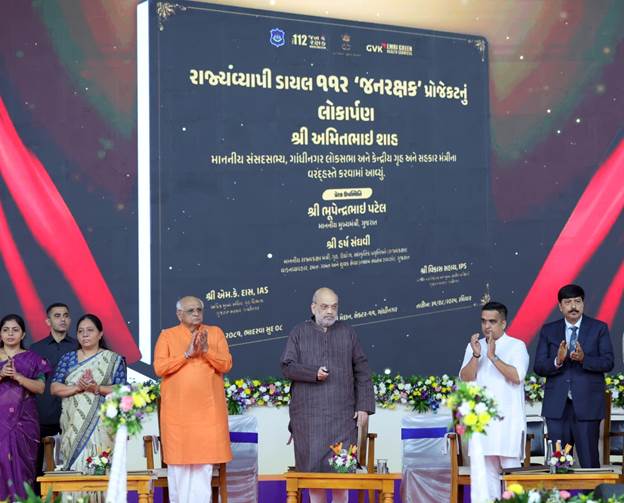
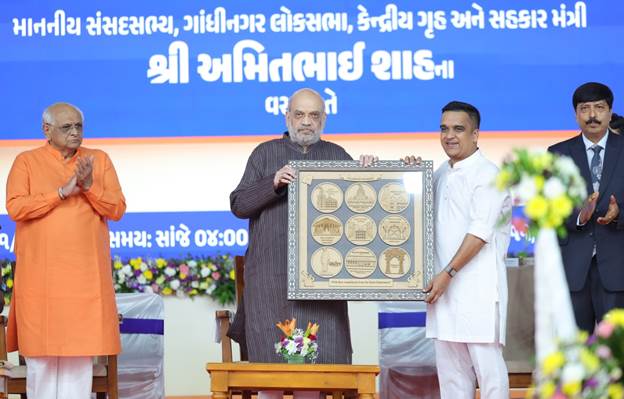
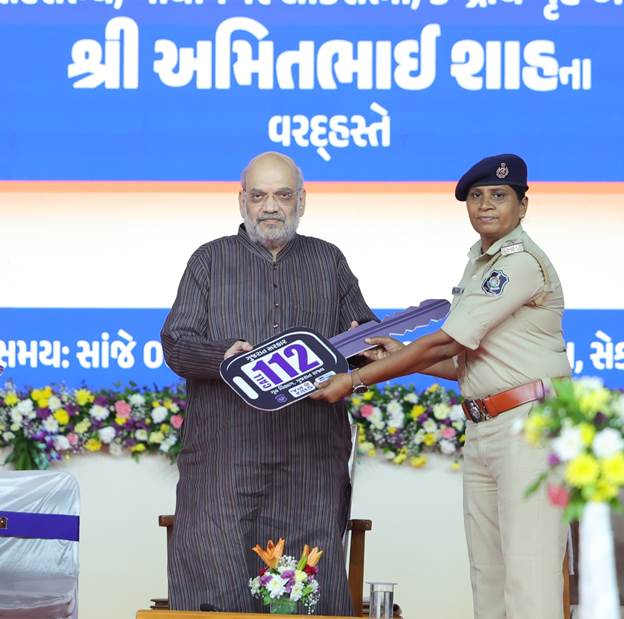
Union Home Minister and Minister of Cooperation, Shri Amit Shah today inaugurated the Janrakshak projects being launched under Dial 112 in Ahmedabad, Gujarat. Many dignitaries including Gujarat Chief Minister Shri Bhupendra Patel and Minister of State for Home, Shri Harsh Sanghavi were present on the occasion.

1st.JPG

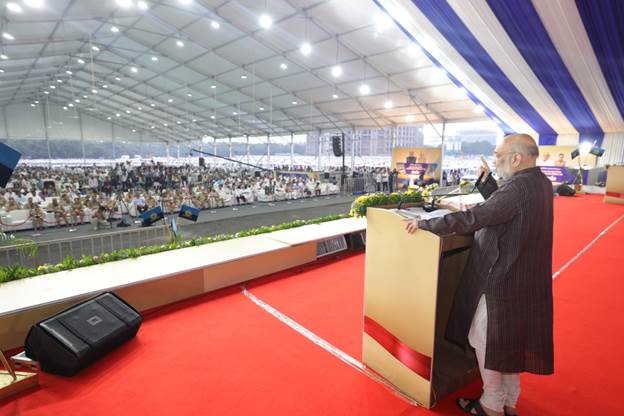
Addressing the event, Union Home Minister Shri Amit Shah said that the Home Department of the State Government has taken a historic step to ensure the security of Gujarat in the form of ‘112 Janrakshak’ project. He said that along with the inauguration of ‘112 Janrakshak’ project, newly constructed houses and offices were inaugurated by Gujarat Police Housing Corporation at a cost of Rs 217 crore and a fleet of 1000 police vehicles were also launched. Shri Shah said that what is particularly important for him is that the police station of Mansa has received BIS certification. He said that he was born in Mansa, grew up there and from there he became capable of contributing to the politics of Gujarat and the country, so it is a matter of happiness for him that the police station of Mansa has received BIS certification.

IMG_5214.JPG

Union Home Minister Shri Amit Shah said that the ‘112’ project is a visionary initiative of ​​Prime Minister Shri Narendra Modi to ensure internal security of the country, protect the rights of citizens, maintain law and order and provide timely assistance in case of any emergency. He expressed happiness that today Gujarat is registering its place in the map of ‘Dial 112 Janrakshak’. He said that till now the maze of different toll-free numbers, like 100 for police, 108 for ambulance, 101 for fire service, 181 for women helpline, 1098 for child helpline, 1070 and 1077 for disaster, was confusing the people. But now people will get any kind of security related service like disaster management, child helpline, women helpline, fire service, ambulance and police assistance in a very short time by just dialing one number, 112.

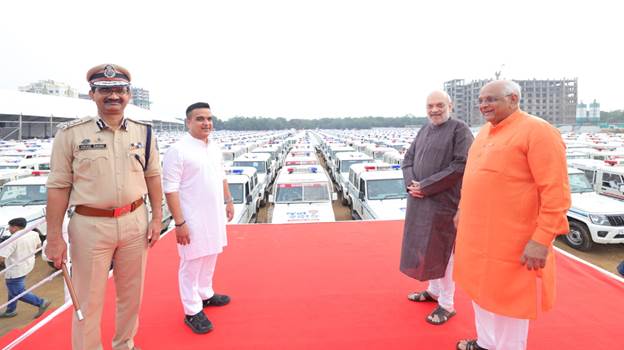
Shri Amit Shah said that all types of services will be coordinated through a highly advanced control room operated by state-of-the-art software and the vehicles equipped with GPS will work under a scientific system. He said that these vehicles, which include a large convoy of 108 ambulances, will find out the location of the person calling and will arrange to send information to the nearest police, ambulance or fire brigade vehicle. Shri Shah said that this is an important step taken by the Gujarat Government towards the New Age Smart Policing System. This project will be operated through the State Emergency Response Centre in Ahmedabad, which will be centrally managed and run 24 by 7. This call center with a capacity of 150 seats will remain alert every second and will be connected to all types of services through an integrated system. He said that the convoy of Dial 112 Janrakshak PCR vans, which includes a total of 1000 vehicles, will be deployed in the service of the public from today itself. The Gujarat Government will spend Rs 92 crore per year for the operation of the 112 project. All modern facilities like light bar, public address system, MDT wireless set, location tracker have been provided in these vehicles. Along with this, arrangement of trained staff has also been made available for their effective use. He said Prime Minister Narendra Modi’s call for smart policing the police across India has been excellently implemented by Gujarat with this advanced technology.

IMG_5200.JPG

Union Home Minister Shri Amit Shah said that Gujarat Police Housing Board has constructed various projects at a cost of Rs 217 crore for the work and residence of police, home guards and jail employees. He said that in the coming days, with the better facilities available in these buildings, police personnel, home guard jawans and jail employees will be able to serve the people of Gujarat more effectively.

IMG_5144.JPG

Union Home Minister Shri Amit Shah said that Gujarat is one of the most sensitive border states of the country. The entire border area from the northern border of the country to Gujarat is sensitive in many ways. Whether it is the sea coast of Gujarat, the border of Kutch, or the border of Banaskantha, security is of special importance in all these areas. He said that during the rule of the opposition party, many incidents that raised questions about the security of the country took place through the borders of Gujarat. But since his party came to power and especially since Shri Narendra Modi became the Chief Minister, the Gujarat government has worked to make the state’s borders impenetrable for enemies.

Shri Amit Shah said that Gujarat is the best example of how much change is possible if a leadership inspired by good governance takes over the reins of governance. He said that today Gujarat has not only strengthened border security and internal security, but has also effectively curbed various crimes like terrorism, narcotics, cyber crime. He said that the path paved by Modi Ji as the Chief Minister of Gujarat has been taken forward by the current Chief Minister Shri Bhupendra Patel and Minister of State for Home Shri Harsh Sanghavi. He said that our governments have achieved remarkable success in making Gujarat the safest state in the country.

Shri Amit Shah said that during the 11 years of Prime Minister Shri Narendra Modi’s tenure, it has been established for internal and external security of India, not only in India but in the entire world, that India’s army and its borders cannot be tampered with. He recalled that there was a time when bomb blasts used to take place in various parts of the country frequently during the rule of the opposition party, and no concrete response was given by the Central Government. Besides, some action taken by the state governments, no other action was taken. But after Modi Ji became the Prime Minister, whenever Pakistan carried out major attacks like Uri, Pulwama and Pahalgam, Modi government taught Pakistan a befitting lesson every time. He said that the first time was through surgical strike, the second time through air strike, and when there was no improvement even then, the third time the headquarters of the terrorists were destroyed not in Pakistan occupied Kashmir, but 100 kilometers inside the border of Pakistan through ‘Operation Sindoor’. Shri Shah said India has sent a strong message to the world that it is committed to self-defence and to go to any extent to protect its citizens and borders. He said ‘Operation Sindoor’ taught a lesson to the masterminds of terror incidents, and all the three Pakistani terrorists who carried out the Pahalgam attack were eliminated through ‘Operation Mahadev’.

Union Home Minister and Minister of Cooperation said that in the past 11 years, the Prime Minister of the country and the proud son of Gujarat, Shri Narendra Modi Ji has implemented the policy of ‘zero tolerance against terrorism’ not only in principle but also in reality. He said that whether it is the North-Eastern region of the country, Naxal-affected areas, or Kashmir, the Modi government has taught a lesson to terrorists and armed groups in all these three hotspots. More than 10,000 militants have surrendered in the North-East. He once again expressed confidence that Naxalism will be completely eliminated from the country by March 31, 2026 – this is the resolve of the Modi government.

Last.JPG

Before the inauguration ceremony of Janrakshak projects under Dial 112, the Union Home Minister participated in various programs in Ahmedabad. He inaugurated the Urban Health Center in Gota and Chandlodia wards and planted trees in Ranip, Stadium and Ghatlodia wards. Apart from this, the Union Home Minister visited and worshipped the ancient temple of Shri Bhadrakali Mataji, the Kuldevi of Ahmedabad city and inaugurated the ‘Sardar Baug’ redeveloped by Torrent Group-UNM Foundation.

Prime Minister interacts with Governors of Prefectures of Japan

| Published on:

Prime Minister Shri Narendra Modi met today with the Governors of various Prefectures of Japan. Sixteen Governors participated in the interaction.

In his address, Prime Minister noted that India-Japan contemporary ties, drawing vitality from the age-old civilizational connections between the two countries, have continued to flourish. Highlighting the momentum in the India-Japan Special Strategic and Global Partnership across domains, he emphasised that time had come to give a renewed push to State-Prefecture engagement, going beyond the ties centred around Tokyo and Delhi. In this context, he underlined the State-Prefecture Partnership Initiative launched at the 15th Annual Summit which would give a boost to trade, technology, tourism, skills, security and cultural linkages between the two countries. He urged the Governors and Indian State governments to leverage the new initiative and forge partnerships in the fields of manufacturing, technology, innovation, mobility, next-generation infrastructure, start-ups and SMEs.

Noting that each Prefecture in Japan has its niche economic and technological strengths, and likewise Indian states their own diverse capabilities, Prime Minister invited the Governors to participate in India’s growth story. He urged them to contribute towards youth and skills exchange commitments made by the two countries and optimally combine Japanese technology with Indian talent. The Governors noted that sub-national collaboration was key to take India-Japan business, educational, cultural and people-to-people ties to the next level of ambition.

15th India-Japan Annual Summit Joint Statement: Partnership for Security and Prosperity of our Next Generation

| Published on:

At the invitation of the Prime Minister of Japan H.E. Mr. Ishiba Shigeru, the Prime Minister of India Shri Narendra Modi paid an Official Working Visit to Japan on 29-30 August 2025 for the 15th India-Japan Annual Summit. Prime Minister Modi was received by Prime Minister Ishiba at the Prime Minister’s Office (Kantei) on the evening of 29 August 2025 where he received a ceremonial guard of honour. The two Prime Ministers held the delegation-level talks during which they recalled the longstanding friendship between India and Japan that is rooted in civilizational ties, shared values and interests, common strategic outlook and mutual respect for each other. The two Prime Ministers appreciated the significant strides made by the India-Japan partnership over the last decade and held constructive discussion on ways to strengthen the strategic and forward-looking partnership for achieving mutual security and prosperity in the coming decades.

The two Prime Ministers welcomed the sustained high-level exchanges, and ministerial and parliamentary engagements between both sides which reflect mutual trust and depth of relationship. The partnership has significantly expanded over the past decade into wide-ranging areas such as security, defense, trade, investment, commerce, science and technology, skills and mobility, and cultural and people-to-people links. The two Prime Ministers appreciated that India and Japan have more than seventy dialogue mechanisms and working groups across sectors which lead to intense engagement and collaboration between myriad ministries, agencies and departments.

The two Prime Ministers came to a common understanding that the India-Japan partnership stands at an important juncture and that it is imperative to develop a mutually complementary relationship by building upon our accomplishments and to leverage our respective strengths as well as excellent ties to pursue security and prosperity for the next generations. They resolved to continue working closely with each other to realize shared objectives and further advance the Special Strategic and Global Partnership. Towards this end, the two Prime Ministers made a series of announcements focusing on three priority areas: bolstering our defense and security cooperation, reinforcing our economic partnership and deepening our people-to-people exchanges. They welcomed the signing of important documents in key sectors, including clean energy, critical minerals, digital partnership, space, science and technology, cultural exchanges and diplomatic training. The leaders adopted:

(i) a Joint Vision for the Next Decade, which lays out whole-of-nation lines of efforts to steer the partnership in eight pillars such as economy, economic security, mobility, environment, technology and innovation, health, people-to-people ties and state-prefecture engagement;

(ii) a Joint Declaration on Security Cooperation, which elevates our defense and security ties to the next level, taking into account the contemporary geopolitical realities and security configurations in the region; and

(iii) an Action Plan for India-Japan Human Resource Exchange and Cooperation, which lays out a roadmap for talent mobility and deepening people-to-people ties through exchanges of more than 500,000 personnel in five years, including 50,000 skilled personnel and potential talents from India to Japan.

The two Prime Ministers also announced India-Japan Economic Security Initiative to provide momentum for bilateral cooperation in the field of economic security including securing and strengthening supply chains in critical goods and sectors and accelerating cooperation in critical and emerging technologies, with heightened priority on telecommunications, pharmaceuticals, critical minerals, semiconductors and clean energy. They appreciated the launch of the Dialogue on Economic Security, including Strategic Trade and Technology in November 2024. The two Prime Ministers tasked their Foreign Ministries to accelerate policy level exchanges on economic security with a view to identifying concrete outcomes and projects in strategic sectors, in tandem with industry and academia. In this context, both sides consent to work towards further protecting high technology trade while mutually easing export control challenges. Both sides issued an Economic Security Factsheet outlining certain ongoing collaboration in strategic sectors. The two Prime Ministers welcomed initiatives to promote business-to-business cooperation in the field of economic security to encourage Indian and Japanese companies towards supply chain diversification and resilience. They welcomed the signing of a Memorandum of Cooperation in the Field of Mineral Resources between the two sides to promote cooperation in the area of critical minerals with the intention of expansion of business opportunities.

The two Prime Ministers expressed satisfaction at the progress made under the India-Japan Digital Partnership, which promotes joint collaboration in emerging technologies through digital talent exchange, research and development, startups, and corporate partnerships. They welcomed the India-Japan Digital Partnership 2.0, which will elevate cooperation to the next stage of the digital revolution. The two Prime Ministers also announced the launch of a Japan-India AI Cooperation Initiative, which is aimed at deepening bilateral and multilateral cooperation on artificial intelligence including Large Language Models (LLMs), establishing platforms for exchange between industry and academia, supporting joint research projects, and facilitating the development and operations of data centers in India. Prime Minister Modi extended an invitation to Prime Minister Ishiba to attend the AI Impact Summit, which will be hosted by India on 19-20 February 2026. Furthermore, the two Prime Ministers emphasized the importance of support for startups and concurred in promoting activities of startups of both countries in India including through the Japan-India Startup Support Initiative (JISSI).

The two Prime Ministers expressed deep satisfaction that defense and maritime security cooperation between India and Japan is on an upward trajectory. They welcomed the holding of the third 2+2 meeting of their Foreign and Defence Ministers in August 2024 in New Delhi and instructed their Ministers to hold the fourth round in Tokyo at an early date. They expressed their satisfaction at the exchanges between the services since the last Summit in March 2022. They welcomed Japan Maritime Self Defense Force’s (JMSDF) participation in MILAN exercise, a multi-lateral exercise hosted by India, as well as the participation of the Japanese team in exercise Tarang Shakti, the first multilateral exercise hosted by the Indian Air Force. They also welcomed the conduct of the inaugural edition of the bilateral fighter exercise ‘Veer Guardian 2023’ between the Japan Air Self Defense Force (JASDF) and the Indian Air Force (IAF) and conduct of the bilateral exercises of all the three services in one calendar year for the first time in 2023. They acknowledged ongoing collaboration in the area of Defence Equipment and Technology Cooperation and directed the relevant authorities of the two sides to expedite efforts to materialize the concrete outcomes through the ongoing collaboration at the earliest while also identifying specific areas for the future to effectively support both sides’ operational approaches.

Acknowledging the significance of economic cooperation as a key pillar of the Special Strategic and Global Partnership, the two Prime Ministers welcomed the progress made towards the target of 5 trillion Yen in public and private investment and financing in five years from Japan to India since 2022. Noting the steps taken by India to improve the business environment for Japanese investors in India, as well as other measures to boost economic growth and improve ease of doing business, the two Prime Ministers set a new target of 10 trillion Yen in private investment in India from Japan. Prime Minister Ishiba recognized the immense potential for Japanese companies to deepen their supply chains in India, and requested the Indian side to continue with its regulatory and other reforms to meet this objective. Prime Minister Modi recognized the contribution of Japanese companies and institutions in creating employment opportunities and fostering growth and innovation in India. He recalled his intent to carry out additional regulatory and other reforms to facilitate investment into India and invited more Japanese businesses to avail of these. They endorsed bilateral efforts to support Japan Industrial Townships (JITs) and strengthen cooperation in logistics, textiles, food processing, agriculture, automotives, industrial capital goods and micro, small and medium enterprises (MSMEs) under the India-Japan Industrial Competitiveness Partnership (IJICP). The two Prime Ministers recognised the need to enhance and diversify bilateral trade including by accelerating further review of the implementation of Comprehensive Economic Partnership Agreement (CEPA) to make it more forward-looking.

The two Prime Ministers noted with satisfaction Japan’s development cooperation support to India over the past decades, which has significantly contributed to India’s economic and social development as well as peace and stability in the region. They reaffirmed their continued commitment to the development of India’s North Eastern Region, which has led and will lead to economic prosperity of the region at large. They renewed their intention to further strengthen their endeavours to enhance hard, soft and people-to-people connectivity and thus, unleash the great potential of this region through the Act East Forum (AEF) in close cooperation with regional partners.

The Prime Ministers noted the importance of the Mumbai-Ahmedabad High Speed Rail as a flagship project between India and Japan. They concurred to work towards the commencement of operations at the earliest and cooperate on the introduction of the latest Japanese Shinkansen technology in India. The Indian side appreciates Japan’s offer to introduce, in the early 2030s, the E10 series of the Shinkansen that runs on the Japanese signalling system. To this end, it was concurred to immediately commence work necessary for early installation of the signalling, including the Japanese system, as well as for the introduction of the General Inspection Train (GIT) and one set of E5 series Shinkansen rolling stock.

Acknowledging the importance of simultaneously ensuring energy security, promoting sustainable economic growth, and addressing climate change, the two Prime Ministers, based on the Clean Energy Partnership launched in 2022 and with the aim of further strengthening bilateral energy cooperation, reaffirmed their shared recognition that there is no single pathway to achieving a net-zero economy, but rather various pathways that reflect each country’s national circumstances. In this regard, they welcomed the signing of the Memorandum of Cooperation on the Joint Crediting Mechanism (JCM) and the Joint Declaration of Intent on Clean Hydrogen and Ammonia.

In the field of people-to-people connections, the two Prime Ministers reaffirmed their resolve to tap into economically beneficial complementarities in their endowment of human resource towards a new wave of people-to-people exchanges. They welcomed the opening of the Indian Consulate in Fukuoka that will deepen the links between the Kyushu region of Japan with India. They appreciated the progress made in Japanese language education in India through the Nihongo Partners programme and the 360-hour Teachers’ Training Course. The two Prime Ministers reaffirmed their shared resolve to build upon the achievements of the Japan-India Institutes for Manufacturing and Japanese Endowed Courses, that, since their inception in 2016, have created a talent pipeline of 30,000 people adept at Japanese manufacturing and managerial skills. The two Prime Ministers noted with satisfaction the growing interest among the people of India and Japan to discover each others’ country and culture, as reflected through the increasing tourist flows between the two countries. They appreciated the successful celebrations of the India-Japan Tourism Exchange Year (April 2023-March 2025) under the theme of “Connecting Himalayas with Mount Fuji”. Drawing on centuries-old civilizational linkages between the two countries, the leaders concurred to promote tourism exchanges in this field.

The two Prime Ministers noted with pleasure that the year 2025 is being celebrated as the India-Japan Year of Science, Technology and Innovation Exchange, marking the 40th anniversary of the first MoU on science and technology signed between the two countries. They welcomed the joint research collaborations between academic institutions, exchange visits of scientists and researchers of the two countries, and the newly launched industry-academia collaborations through the provision of internship opportunities in Japanese companies, in collaboration with the LOTUS Programme, and Sakura Science Exchange Program. The two Prime Ministers noted with satisfaction the progress made in the Lunar Polar Exploration (LUPEX) Mission between the Indian Space Research Organization and the Japan Aerospace Exploration Agency. They welcomed the recent extension of the Memorandum of Understanding on the Indian Beamline at KEK, Tsukuba for another six years. The two Prime Ministers appreciated the progress in the 11th Joint Committee Meeting on Science and Technology Cooperation held on 5 June 2025- particularly in the fields of new and emerging areas such as quantum technology, clean technology, disaster management, biotechnology and geospatial technologies.

Recognising that regional linkages play an important role in deepening economic and people-to-people connections between the two countries, the Prime Ministers welcomed the State-Prefecture partnerships established recently between Andhra Pradesh and Toyama, Tamil Nadu and Ehime, Uttar Pradesh and Yamanashi, Gujarat and Shizuoka, as well as the Kansai Coordination Meeting for Promotion of Business Exchange with India, the regional partnership in Kansai area. Prime Minister Modi congratulated Prime Minister Ishiba on the ongoing Expo 2025 Osaka, Kansai, Japan and appreciated Japan’s support for India’s active participation in the Expo, which has also given tremendous momentum to state-prefecture partnerships in recent months. Prime Minister Ishiba welcomed India’s participation in the GREEN x EXPO 2027 to be held in Yokohama.

The two Prime Ministers, taking into account the prevailing global situation, resolved to uphold the international order based on the rule of law and reaffirmed their steadfast commitment to a free and open Indo-Pacific that is peaceful, prosperous and resilient. They reiterated their strong support for the region’s economic development and prosperity by delivering tangible benefits through practical projects. They also reiterated their commitment to advancing cooperation among like-minded countries through multilateral frameworks such as Quad between Australia, India, Japan and the United States, to promote peace, stability, and prosperity in the region. In this regard, they welcomed the evolution of the Quad into a vital and enduring regional grouping, and looked forward to the next Quad Leaders’ Summit hosted by India later this year.

The two Prime Ministers expressed serious concern over the situation in the East China Sea and the South China Sea. They reiterated their strong opposition to any unilateral actions that endanger the safety as well as freedom of navigation and overflight, and attempt to change the status quo by force or coercion. They shared their serious concern over the militarization of disputed features. They reaffirmed that maritime disputes must be resolved peacefully and in accordance with international law, in particular the UN Convention on the Law of the Sea (UNCLOS).

The two Prime Ministers condemned North Korea’s destabilizing launches using ballistic missile technology and its continued pursuit of nuclear weapons in violation of multiple UN Security Council resolutions (UNSCRs). They reaffirmed their commitment to the complete denuclearization of North Korea in accordance with relevant UNSCRs, and urged North Korea to abide by all its obligations under the United Nations Charter and the UNSCRs. They called on North Korea to return to dialogue to promote peace and stability in the Korean peninsula. They stressed the importance of addressing continued concern regarding proliferation of nuclear and missile technologies to and from North Korea in the region and beyond. They urged all UN Member States to abide by their international obligations under the UNSCRs to implement sanctions, including the prohibition on the transfer to North Korea or procurement from North Korea of all arms and related materiel. They reconfirmed the necessity of immediate resolution of the abductions issue.

The two Prime Ministers unequivocally and strongly condemned terrorism and violent extremism in all its forms and manifestations, including cross-border terrorism. They condemned in the strongest terms the terrorist attack in Pahalgam, Jammu and Kashmir on 22 April 2025, and took note of the United Nations Security Council Monitoring Team Report of 29 July mentioning The Resistance Front (TRF). Prime Minister Modi further explained that the TRF had claimed responsibility for the attack. Prime Minister Ishiba noted this with concern. They called for the perpetrators, organizers, and financiers of this reprehensible act to be brought to justice without any delay. They also called for concerted actions against all UN-listed terrorist groups and entities including Al Qaeda, ISIS/Daesh, Lashkar-e-Tayyiba (LeT), Jaish-e-Mohammad (JeM) and their proxies, and to take resolute actions to root out terrorists’ safe havens, eliminate terrorist financing channels and its nexus with transnational crime, and halt cross-border movement of terrorists.

The two Prime Ministers welcomed the close cooperation between a Free and Open Indo-Pacific (FOIP) and Indo-Pacific Oceans’ Initiative (IPOI). They reiterated their strong support for ASEAN’s unity and centrality and their unwavering support for the “ASEAN Outlook on the Indo-Pacific (AOIP)”.

The two Prime Ministers remain deeply concerned by the worsening crisis in Myanmar and its impact on the regional security, displacement of people and the increase in transnational crimes. They called on all parties to immediately cease all acts of violence. The two Prime Ministers noted the recent announcement of ending the state of emergency and plans for holding an election. The two Prime Ministers strongly urged a return to the path of democracy that allows for inclusive dialogue among all stakeholders and free and fair elections, and urged the release of those who are detained. They reaffirmed their strong support for ASEAN’s efforts, including calling for the full and effective implementation of the Five Point Consensus in seeking an inclusive, durable, and peaceful resolution to the crisis.

The two Prime Ministers reaffirmed the importance of collaborative projects between India and Japan in the Indo-Pacific region including Africa. They welcomed the launch of the Japan-India Cooperation Initiative for Sustainable Economic Development in Africa aimed at promoting industrial concentration in India to establish an industrial hub for trade and investment with Africa. They also welcomed the successful convening of the 9th Tokyo International Conference on African Development (TICAD9) and shared views on the significant potential for strengthening connectivity and value chains in the Indian Ocean Region and Africa. In this context, Prime Minister Modi appreciated the Economic Region Initiative of Indian Ocean-Africa which was announced by Prime Minister Ishiba at TICAD 9. They concurred that collaboration among Japan, India and other countries in the region could bring prosperity to all stakeholders.

The two Prime Ministers expressed support for a just and lasting peace in Ukraine in accordance with international law, including the UN Charter. They also welcomed the ongoing diplomatic efforts by various countries to achieve a just and lasting peace.

The two Prime Ministers reiterated their commitment to peace and stability in the Middle East, calling on all parties concerned to show restraint, protect civilians, comply with international law, and refrain from taking actions that could further escalate the situation and compromise regional stability. They welcomed the ceasefire between Israel and Iran and stressed the importance of maintaining the ceasefire as well as resolving Iran’s nuclear issue through dialogue. The two Prime Ministers expressed grave concern over the humanitarian situation in Gaza. They strongly stressed the importance of reaching an agreement among the parties concerned regarding the release of all hostages and the immediate and sustainable ceasefire, as well as addressing the deteriorating humanitarian situation. In this regard, they welcomed ongoing efforts being made by various countries desirous of bringing peace to the region.

The two Prime Ministers resolved to continue to work closely together for an urgent reform of the UN Security Council (UNSC) including through the expansion of both permanent and non-permanent categories to better reflect the current geopolitical realities. They expressed their determination to accelerate UNSC reforms, particularly through the commencement of text-based negotiations under the Inter-Governmental Negotiations framework with an overall objective to achieve concrete outcomes in a fixed time-frame. They expressed their mutual support for each other’s candidature for a permanent seat in a reformed UNSC. They also underscored the need for UN reform to increase the efficiency and effectiveness of the UN that contributes to global governance in a changing world.

The two Prime Ministers reaffirmed the importance of the Annual Summit mechanism to progress India-Japan cooperation across a range of sectors. The 15th Annual Summit helped take stock of the progress made in India-Japan Special Strategic and Global Partnership since 2014 and create a framework for continued cooperation benefiting our next generation and beyond. The two Prime Ministers noted that the two nations are advancing together towards the 75th anniversary of India-Japan diplomatic relationship in 2027 which would be celebrated in a befitting manner. In this context, both leaders welcome a vibrant exchange of views, substantive inputs of ideas and policy recommendations, as well as active mutual collaborations among all the stakeholders of both nations in various fields of business, intellectual, science and culture. Prime Minister Modi thanked Prime Minister Ishiba for the warmth and hospitality extended to him and members of his delegation during the visit to Japan and extended an invitation to Prime Minister Ishiba to visit India on the occasion of the Quad Leaders’ Summit, to be hosted later this year. Prime Minister Ishiba accepted the invitation with pleasure. The visit reaffirmed the deep-rooted civilizational ties, vibrant people-to-people linkages, and shared democratic values that form the bedrock of the longstanding friendship between India and Japan.

India – Japan Joint Vision for the Next Decade: Eight Directions to Steer the Special Strategic and Global Partnership

| Published on:

India and Japan, as two countries with a common vision of a free, open, peaceful, prosperous, and coercion-free Indo-Pacific region based on the rule of law, two economies with complementary resource endowments, technological capacities and cost competitiveness, and two nations with long tradition of friendship and mutual goodwill, hereby express our intent to jointly navigate the changes and opportunities in our countries and the world at large over the next decade, to help attain our respective domestic goals, and to bring our countries and peoples of the next generation closer together than ever before.

To this end, by building upon the India-Japan Special Strategic and Global Partnership, we hereby lay out eight all-nation lines of effort with goals and targets over the next decade and steps towards their realization.

(I) Next Generation Economic Partnership

As the fourth and fifth largest economies in the world, we aim to harvest our mutual economic and financial strengths and catalyse the potential of our complementary resources and markets by:

• Building upon the progress made in the 2022-2026 target of JPY 5 trillion of public and private investment and financing from Japan to India and setting a new target of JPY 10 trillion of private investment;

• Enhancing and diversifying bilateral trade and investment through accelerating further review of the implementation of the India-Japan Comprehensive Economic Cooperation Agreement (CEPA);

• Strengthening India-Japan industrial cooperation for the “Make in India” initiative through the India-Japan Industrial Competitiveness Partnership (IJICP) to help upgrade product quality in India using high quality products necessary for Japanese firms;

• Exploring new projects under the India-Japan Fund, promoting Japanese corporations in the International Financial Service Centre of GIFT City in India and expanding the presence of key Indian industry associations, trade, and investment promotion agencies in Japan;

• Enhancing the collaboration on payment systems between Japan and India, including local currency transactions;

• Encouraging cooperation between small and medium enterprises (SMEs) by fostering visits of Japanese SMEs to India, expanding downstream industries and launching an India-Japan SME Forum;

• Promoting food security and encouraging agri-business collaboration through policy dialogue and business exchanges, and promoting investment based on the demonstration at model farms and development of culinary professionals for Indian and Japanese cuisine; and

• Exploring ICT cooperation and business opportunities among private sector entities.

We also aim to advance our bilateral cooperation to strengthen economic relations with the Global South and harness its growth potential. In pursuit of this, we welcome the launch of the India-Japan Cooperation Initiative for Sustainable Economic Development in Africa. To this end, under the spirit of India’s vision of Mutual and Holistic Advancement for Security and Growth Across Regions (MAHASAGAR) and Japan’s Economic Region Initiative of Indian Ocean-Africa, we will also promote private sector-led businesses and investments in India and the robust concentration of Japanese companies in India as a hub for invigorating business collaborations with other countries in South Asia and Africa.

(II) Next Generation Economic Security Partnership

As we take our bilateral partnership to new heights, we aim to launch an India-Japan Economic Security Initiative that provides momentum for strategic cooperation through whole of nation efforts in strengthening supply chains of key goods and materials, which foster market diversification and advance cooperation in cutting-edge technologies, including private sector led cooperation by:

• Identifying and implementing concrete projects in the areas of semiconductors, critical minerals, pharmaceuticals and biotechnology, telecommunication, clean energy and new and emerging technologies through the government and business tracks of the Dialogue on Economic Security including Strategic Trade and Technology;

• Sharing policy perspectives, intelligence and information on best practices on latest developments in the above areas;

• Promoting cooperation on resilient supply chains and market diversification through the Memorandum of Cooperation in the field of Mineral Resources, India-Japan Digital Partnership 2.0, Memorandum of Cooperation on Semiconductor Supply Chain Partnership, and other such mechanisms;

• Promoting private sector led cooperation, including by supporting the Joint Action Plan on Economic Security Cooperation by JETRO, CII and JCCII;

• Welcoming the launch of the business pillar, the India-Japan Private-Sector Dialogue on Economic Security, under the India-Japan Dialogue on Economic Security, including Strategic Trade and Technology to foster above Joint Action Plan;

• Implementing the Japan-India AI Cooperation Initiative (JAI) to promote bilateral and multilateral cooperation on AI and foster an innovative and trusted AI ecosystem; and

• Promoting India-Japan battery supply chain cooperation to foster a healthy battery market and ecosystem.

(III) Next Generation Mobility

Leveraging the strengths of Japanese advanced technologies and Indian talent, we will establish the Next Generation Mobility Partnership (NGMP) as a framework for comprehensive cooperation in infrastructure, logistics and mobility. Through this partnership, we aim to co-create solutions that will address the challenges in mobility fields where there is high demand in India and drive the development of a robust next-generation mobility and related industries that serves the vision of Make in India for the World. Utilising digital and smart technologies, focusing on sustainable and environment-friendly methodologies, and prioritising safety and disaster resilience, we will explore potential areas of collaboration, including but not limited to the following examples:

• High-speed rail systems, including “Make in India” next-generation rolling stock, functional signaling and operational control systems, seismic-proofing, AI-based maintenance and monitoring, energy transition in the railway sector, advanced metro rail systems and mass rapid transit systems, by building on the hitherto cooperation in railways;

• Transit-oriented development through integrated station area development, Mobility-as-a-Service platforms, inter-city road networks and end-to-end connectivity, including small-scale automated urban transportation systems such as Personal Rapid Transit (PRT);

• Smart cities and city decarbonization, to be planned through advanced modeling that address challenges such as traffic congestion and air pollution;

• Data utilization in the mobility field through connected technologies, driven by Software Defined Vehicle, aims to ensure safety and reliability in the mobility field;

• Manufacturing of automobiles and aircraft, shipping vessels, utilizing sustainable fuel and using environment-friendly fuel storage, and expanding transport infrastructure;

• Cold-chain logistic services for food and pharmaceutical transportation; and

• Utilising 3D city models in urban planning and development, such as disaster simulation, and the formulation of evacuation guidance plans in the event of a disaster.

We will actively promote collaborations between Indian and Japanese companies to manufacture the above products in India and export to the global market. We will also prioritise capacity building in India through technical training and human resource exchanges towards the cultivation of skilled personnel for design, operations and maintenance of these mobility solutions.

At the same time, we will aim to mainstream disaster risk reduction through development of resilient infrastructure and strengthening cooperation in multilateral mechanisms such as the Sendai Framework for Disaster Risk Reduction.

(IV) Next Generation Ecological Legacies

We aim to give effect to our vision for “one earth, one future” by promoting Sustainable Development Goals (SDGs) for our future generations and cooperation to meet each other’s climate adaptation, energy transition, waste-reduction and net-zero goals through:

• Ensuring energy security, low carbon economic growth, sustainable communities and lifestyles through Mission LiFE;

• Various pathways that reflect each country’s national circumstances to achieve net-zero economy;

• Strengthening of energy cooperation under the India-Japan Clean Energy Partnership through the India-Japan Energy Dialogue;

• Promoting a circular economy through cooperation on waste-to-energy technologies, waste segregation and recycling methods;

• Promoting sustainable farming practices, climate mitigation technologies to improve agricultural productivity, protection of marine and coastal ecosystems, sustainable forest management and biodiversity conservation, promotion of agroforestry and sustainable use of natural resources such as bamboo;

• Cooperation in clean energy and emission and pollution reduction through initiatives such as the Joint Crediting Mechanism (JCM), the Initiative of Clean Energy Mobility And Infra for Next-Generation (ICEMAN), green hydrogen value chain and utilisation of satellite technology for emission estimation; and

• Enhancing efforts in the multilateral environmental bodies such as the Leadership Group for Industry Transition (LeadIT) group.

(V) Next Gen Technology and Innovation Partnership

We aim to tap into each other’s scientific and technological capabilities, institutions and manpower to promote frontier research in foundational sciences and cross-sector collaboration on advancing commercialisation of new technologies via the following steps:

• Collaboration in fundamental research through the Indian Beamline at KEK, Tsukuba, quantum technologies, and high-performance computing for next generation research tools;

• Startup collaboration on open-innovation, social problem solving, advanced-tech, data-usage, incubation, and finance through the Japan-India Startup Support Initiative (JISSI) launched by Japan, and linking innovation ecosystems and enabling startups to expand their business in both countries;

• Mobilizing funds for start-up companies, including those in the AI field through the “India-Japan fund of funds”;

• Promoting ICT cooperation through a Joint Working Group under the India-Japan ICT Cooperation Framework;

• Enhanced cooperation in space technologies, including through the Lunar Polar Exploration (LUPEX) Mission and facilitating linkages between private commercial entities and start-ups in the space sector;

• Dialogue on fission and fusion technology, including ITER and joint research on small modular and advanced reactors; and

• Joint research in food technology and agricultural sciences, including on millets as aligned with G20 New Delhi Declaration and Advancing Innovations for Empowering Next Generation Agriculture (AI-ENGAGE).

(VI) Investing in Next Gen Health

We aim to invest in the health and well-being of our people to realize their full potential, with a goal of achieving universal health coverage (UHC) in mind, by jointly promoting clinical and medical research collaboration, tackling pandemics and emerging health trends, ensuring affordable access to life-saving medicines and utilising the potential of traditional and alternative medicine through the following steps:

• Strengthening cooperation between India’s Ayushman Bharat initiative and Japan’s Asia Health and Wellbeing Initiative as well as in the global health sector;

• Identifying further areas of cooperation through holding Joint Committee Meetings on a regular basis;

• Joint research on emerging fields of geriatric medicine, stem cell therapy, regenerative medicine, gene therapy, synthetic biology, cancer treatment, digital health and automated diagnostic solutions;

• Exploring collaboration with the “UHC Knowledge Hub” to accelerate the promotion of UHC;

• Promoting the exchange of medical professionals through greater collaboration between medical institutions and launching a fellowship for medical professionals;

• Facilitating the supply of critical medicines, APIs and medical equipment and strengthening medical infrastructure in our two countries; and

• Setting up centres of excellence that promote yoga, meditation, ayurveda and holistic wellness in Japan with the support of Ministry of AYUSH in India.

(VII) Next Gen People-to-People Partnership

Recognising the historical linkages and cultural affinities between our two countries and seeking to realise the potential of our human resources in bridging our respective economic and demographic challenges, we aim to further our people-to-people ties by:

• Launching an Action Plan for India-Japan Human Resource Exchange and Cooperation that targets an exchange of more than 500,000 personnel in both directions in the next five years, including 50,000 skilled personnel and potential talents from India to Japan;

• Expanding endowed courses and vocational training programmes in India and training of Indian personnel in Japan under India-Nippon Programme for Applied Competency Training (INPACT) built on the achievements of the Japan-India Institutes for Manufacturing (JIM) and Japanese Endowed Courses (JEC);

• Initiating employment promotion events, internship programmes, employment surveys and information dissemination, including through a dedicated website on promotion of talent mobility between the two countries under India-Japan Talent Bridge (IJTB) by METI, Japan;

• Strengthening exchanges of researchers and students through Sakura Science Exchange Program, the LOTUS Programme, HOPE meetings and the Inter-University Exchange Project by MEXT, Japan and supporting educational collaboration through the initiative of EDU-Port Japan;

• Enhancing organisational collaboration and workplaces through the e-Migrate portal, Global Capability Centers in India;

• Facilitating greater bilateral tourist flow, showcasing each other’s cultural heritage;

• Expanding the training opportunities for Japanese language teachers as well as to support to design efficient curricula and materials by dispatching specialists of Japanese language education; and

• Dispatching “NIHONGO Partners,” Japanese Language teaching assistants, to India to support Indian Japanese language teachers and students.

(VIII) Next-Gen State-Prefecture Partnership

Highlighting the crucial role played by Indian States and Japanese Prefectures in realizing many of the above lines of effort, we aim to create suitable platforms to tap their energies for a more comprehensive vision for India-Japan partnership by:

• Promoting new Sister-city and State-Prefecture partnerships to build on complementary resource endowments and historical connections;

• Boosting direct flight connectivity between Indian and Japanese cities;

• Strengthening commercial and business partnerships, including small and medium enterprises, reinvigorating local industries and promoting regional development through India-Kansai Business Forum, as well as exploring similar arrangements between India and Kyushu;

• Facilitating greater information exchange on regional opportunities within India and Japan and sharing of best practices between States and Prefectures to develop solutions to shared challenges; and

• Promoting visits of State-Prefectural level delegations with the Ministry of External Affairs of India and Ministry of Foreign Affairs of Japan taking the lead in organising 3 visits each per year;

Through the above eight lines of effort, we hope to usher in a transformative phase of India-Japan people-oriented partnership in the eighth decade of the establishment of our bilateral relations, and to bring tangible benefits and collaboration opportunities to our next generations.

We hereby adopt this document, reflecting our shared vision for the coming decade, during the visit of Prime Minister of India H.E. Shri Narendra Modi to Japan for the Annual Summit 2025 at the invitation of Prime Minister of Japan H.E. Mr. Ishiba Shigeru, on 29-30 August 2025 in Tokyo.

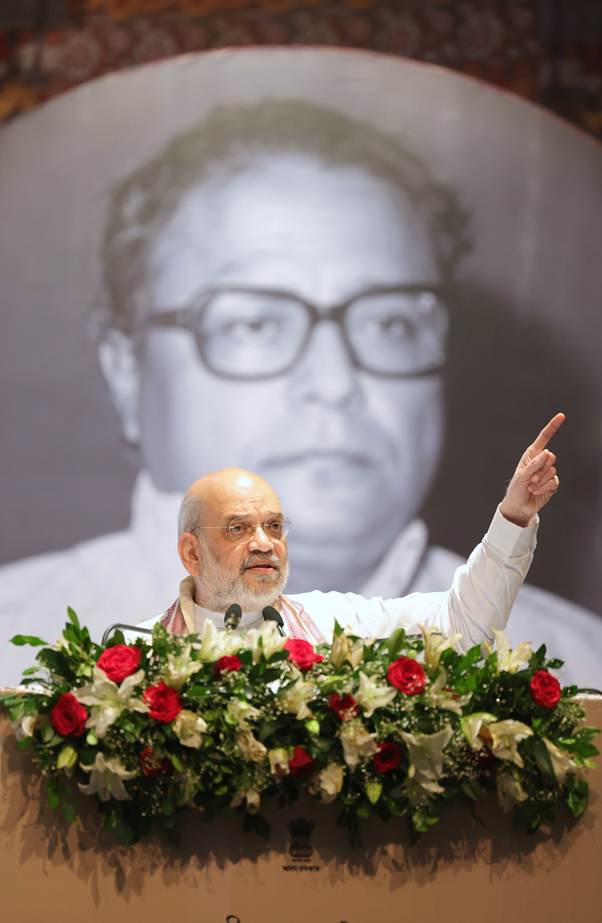
It is our resolve to make Assam and the entire country infiltrator-free, we will definitely fulfill it: Amit Shah

| Published on:

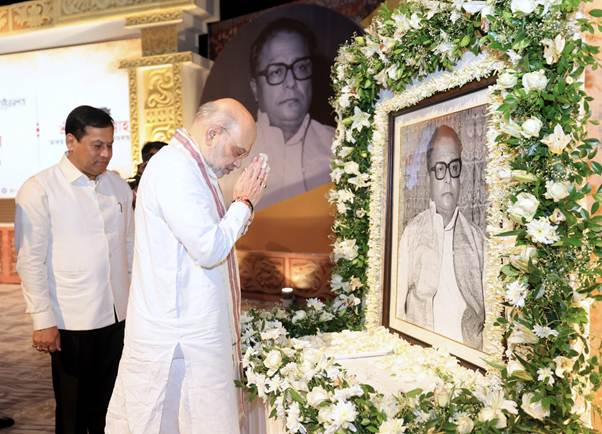
Union Home Minister and Minister of Cooperation Shri Amit Shah today addressed the birth centenary celebrations of former Chief Minister of the Assam Shri Golap Borbora, in Guwahati. Many dignitaries including Chief Minister of Assam Shri Himanta Biswa Sarma, Union Minister for Ports, Shipping and Waterways Shri Sarbananda Sonowal and Minister of State for External Affairs Shri Pabitra Margherita were present on the occasion.

Remembering the former Chief Minister of Assam, the Union Home Minister Shri Amit Shah said that Shri Golap Borbora translated into reality in Assam all the noble aspects of socialist ideology, the freedom movement, and the movement to safeguard democracy after independence. Referring to the quote of the famous Assamese singer Bhupen Hazarika, who was awarded the Bharat Ratna – ‘Human is for human and life is for life’ – Shri Shah said that Golap Borbora embodied this philosophy throughout his life. He said Borbora remained the voice of the oppressed and deprived, protected the sanctity of the Constitution, raised a banner against authoritarianism and corruption, and worked to awaken not only Assam’s unique identity but also the soul of India residing in Assam.

Union Home Minister and Minister of Cooperation said that when Golap Borbora Ji became the Chief Minister of Assam in 1978, it was the beginning of a major change in the political history of Assam. After independence, till 1978, no Chief Minister from any party other than the then ruling party had taken office in Assam. He said that Golap Borbora left an indelible mark as Chief Minister in a short tenure of just 17 months. Shri Shah said that Golap Borbora led the workers in the historic railway strike in 1974. He strongly opposed the then Prime Minister during the Emergency and Golap Borbora became the voice of Assam in the movement led by Jayaprakash Narayan. He was elected to the Rajya Sabha from Assam by a margin of just one vote — the deciding vote being that of Bhupen Hazarika, who played a crucial role in sending Borbora to the Upper House.

Shri Amit Shah said that during the rule of the main opposition party, schemes were launched, memorials built, and centenary celebrations held in the names of their own leaders. In a vast nation where diverse cultures coexist and many individuals contributed significantly to advancing the country and taking it to new heights, many such people neither received due respect nor any platform.  Our public life, he said, became narrow-minded, showing respect only to our own and not to others. Whoever came to power honored only their own party and ideology.

The Union Home Minister said that under the opposition’s rule, the contribution of Sardar Vallabhbhai Patel was completely ignored. Only after Prime Minister Shri Narendra Modi had the Statue of Unity built did they remember Patel’s contribution. Shri Shah further said that until Modi Ji installed the statue of Netaji Subhas Chandra Bose on Kartavya Path, that great leader, revered as ‘Netaji’ by the people, had no dignified place in the corridors of Delhi’s power. Similarly, Gopinath Bordoloi was awarded the Bharat Ratna only when the opposition party was not in power — despite Bordoloi himself belonging to that party.

Shri Amit Shah said that Golap Borbora Ji had no connection with the ideology of his party, but whoever did good work in public life by rising above party politics and self-interest, his contribution should always be made known to the youth of the state and the country. He appreciated that the Assam government has done this noble work.

Union Home Minister and Minister of Cooperation said that qualities like patriotism, socialism and sensitivity towards the poor did not come to Golap Borbora by chance. Shri Shah said that Golap Borbora, the third generation of Komol Borbora, who led Assam’s first industrial strike, dedicated his entire life to the progress of the workers, poor and backward people of Assam and the country by following socialist principles. From 1950 to 1960, Golap Borbora emerged as a key face of Assam’s socialist movement. Golap Borbora clearly said that Northeast India is not outside the country, but is an integral part of nation’s heart. During the Emergency, he was among the first to be imprisoned and the last to be released, spending a total of 19 months in jail. After independence, he was jailed nine times.

Shri Amit Shah said that Golap Borbora Ji, in his short tenure as Chief Minister, took decisions that will be remembered by the people of Assam for years. He made education up to 10th standard free in Assam and established more than 200 educational institutions in a year. Shri Shah said that Golap Borbora Ji permanently waived off the land tax of all those farmers who had land up to 10 bighas. He also opened tea garden farming for farmers by bringing the policy of small tea gardens. For the first time, he established the Banking Services Recruitment Board and the Railway Recruitment Board in Assam, thereby introducing skill-based employment opportunities in the state.

The Union Home and Cooperation Minister said he firmly believes that not a single infiltrator should remain in this country. He said that Golap Borbora was the first to raise awareness against infiltration in Assam by cleansing the electoral rolls. During his tenure as Chief Minister, voter lists were scrutinized, and despite limited resources and the absence of computerization, Borbora succeeded in removing 36,780 illegal infiltrators from the rolls. He said that if one were to trace the roots of the Assam Movement, they would find them in this voter list purification.

Shri Amit Shah said that today, the Election Commission is carrying out purification of electoral rolls through Special Intensive Revision (SIR), but some political parties are taking out marches in defense of infiltrators. He said that a country’s voter list is the heart of democracy, and foreign nationals should find no place in it. Sadly, moral decline in public life has grown to such an extent that, for the sake of vote-bank politics and capturing power at any cost, removal of infiltrators from voter lists is opposed. If Golap Borbora were alive today, he would certainly have opposed this.

Union Home Minister praised the Assam Government for freeing 1.26 lakh acres of land from infiltrators. He said that not only Kaziranga’s forests and wildlife areas were freed from encroachment, but also thousands of acres of land associated with saints Shankaradeva and Madhavdeva were reclaimed. He added that on 15th August 2025, Prime Minister Shri Narendra Modi announced the formation of a High-Power Demographic Changes Mission based on Golap Borbora’s principles. This mission will study demographic changes across the country, identify infiltrators, and work toward making the nation free of illegal infiltration. He commended Assam Government’s drive against encroachment, citing recovery of 49,500 bighas in Sonitpur, 17,095 bighas in Darrang, 13,438 bighas in Lakhimpur, 10,749 bighas in Hojai, and 8,280 bighas in Goalpara. He asserted that the resolve to make Assam and the entire country free of infiltrators will surely be achieved, and no better occasion than Golap Borbora’s centenary year could mark this commitment.

Union Home Minister Shri Amit Shah said that the Assam Government has named an important rural development institution after Golap Borbora. He added that spreading awareness of Borbora’s life, work, and ideas in every tehsil and district throughout the year will undoubtedly brighten Assam’s future.

Under the leadership of Modi Ji, the Northeast has seen unprecedented development in the last 11 years: Amit Shah

| Published on:

Union Home Minister and Minister of Cooperation, Shri Amit Shah, today inaugurated the Brahmaputra Wing at Raj Bhavan in Guwahati, Assam, and performed the inauguration and foundation laying of eight projects worth ₹322 crore through virtual mode. On this occasion, Assam Governor Shri Lakshman Prasad Acharya, Chief Minister Dr. Himanta Biswa Sarma, and Union Minister Shri Sarbananda Sonowal, along with several other dignitaries, were present.

In his address, Union Home Minister and Minister of Cooperation Shri Amit Shah said that despite enduring various ups and downs and violent conflicts, the Northeast is now progressing towards peace, development, and comprehensive growth. He remarked that from Maharaja Prithu to Lachit Borphukan, and from Chilarai to the sacrifices made by the youth of Assam who joined the armed forces for Mother India, the Northeast has always been a vital pillar of India’s security. Shri Shah further said that the Northeast is home to one of the world’s oldest and most diverse cultures. The art, languages, cuisine, attire, music, and natural beauty of this region make the entire Northeast uniquely remarkable on the global stage.

Shri Amit Shah said that during the struggle of the Assam Bachao Andolan, many youths made sacrifices, and the vision with which students led the movement at that time has been realized today by the duo of Prime Minister Shri Narendra Modi and Chief Minister Shri Himanta Biswa Sarma. He said that the Assam envisioned during the Assam Movement has not only been achieved but surpassed, and this pace of development will continue unabated.

Union Home Minister said that under the leadership of Prime Minister Shri Narendra Modi, the Northeast has witnessed unprecedented development over the past 11 years. Whenever the history of the Northeast is written, these 11 years of Prime Minister Shri Narendra Modi’s governance will be inscribed in golden letters. He said that in the last 11 years, Prime Minister Modi has brought about transformative changes in every sector of the country. Be it external and internal security, infrastructure development, power generation, lifting 25 crore people above the poverty line, or providing 60 crore people with homes, electricity, toilets, piped water, gas cylinders, and healthcare coverage up to ₹5 lakh in the last 10 years, Prime Minister Modi has not only formulated policies but also ensured their implementation on the ground. He added that as a result, progress has been made in every sector across the country, and the world is watching this with astonishment.

Shri Amit Shah said that under today’s program, eight projects worth over ₹322 crore have been inaugurated and their foundation stones laid. He said that the Modi government has repealed the three old criminal laws established by the British and introduced three new Indian laws for the criminal justice system. These new laws place significant emphasis on police investigations based on Forensic Science Laboratories (FSL) and efforts to ensure punishment for offenders. He added that under Prime Minister Shri Narendra Modi’s leadership, the entire country is realizing the dream of a Digital India. Shri Shah emphasized that cyber security is extremely important for citizens, and therefore, the Government of India established the first National Cyber Forensic Laboratory (NCFL) in Delhi under the I4C initiative in 2019, which helps protect citizens’ hard-earned money from cybercriminals. He said that after Delhi, the second NCFL has been established in Guwahati, Assam, which will safeguard the earnings of citizens across all eight Northeastern states. Furthermore, the NCFL will also prove instrumental in strengthening national security by countering those who use the dark net for narcotics, arms smuggling, and attempts to infiltrate by exploiting gaps in India’s borders.

Union Home Minister and Minister of Cooperation Minister said that through the NCFL established at the Lachit Borphukan Police Academy, policemen from all the eight states of the Northeast will work 24 hours a day to protect the country’s borders, help in the fight against narcotics and illegal smuggling and secure the earnings of citizens. He said that today many facilities have also been inaugurated for the soldiers of the Central Armed Police Forces (CAPFs) who protect our borders.

The Home Minister said that the Brahmaputra wing of the Raj Niwas, built at a cost of more than Rs 40 crore and in an area of more than 3300 square meters, will have facilities to run many constitutional activities smoothly. He said that this facility will act as a place for acknowledging students, artists, and researchers from various disciplines. Further, through a meaningful dialogue, the Governor will also make the Assam Government aware of public sentiments.

Shri Amit Shah said that today the respect of our Prime Minister along with India has increased in the whole world and 27 countries have honoured Prime Minister Modi with their highest civilian award which is a matter of pride for India. He said that on one hand the whole world respects Prime Minister Shri Narendra Modi. On the other hand, the leader of the main opposition party has started a negative politics of hatred and contempt. Shri Shah said that the main opposition leaders have done the most despicable thing by using abusive words for Prime Minister Modi’s late mother from the stage of a programme in Bihar. The Home Minister strongly condemned this and said that the kind of irrational protest, negativity and hate politics by the leader of the main opposition party will drag our public life into decline.

Union Home Minister and Minister of Cooperation said that since Shri Narendra Modi became the Chief Minister of Gujarat, many leaders of the main opposition party have used abusive language for the Prime Minister. He said that the main opposition party cannot win people’s appreciation by using such language. Shri Shah said that the opposition has used abusive language against the Prime Minister in every election and has faced defeat but still has not learnt anything. He said that elections are the soul of democracy in any democratic nation and if infiltrators enter the voter list and pollute the elections, then no nation can remain safe. He said that the people of the entire country are watching with shock and dismay the nefarious efforts started by the main opposition party and their efforts will not get public support.

Shri Amit Shah said that what happened two days ago has crossed all limits. He said that Modi Ji’s mother, while living in a poor household, has brought up all her children to such a level that her son has become a world leader. Shri Shah said that the people of India can never tolerate such abusive words against such a person, and there cannot be further degradation in politics and public life. Shri Shah told the leader of the main opposition party that he should apologize to the Prime Minister, his late mother and the people of the country for this.

Prime Minister attends India-Japan Economic Forum

| Published on:

Prime Minister Shri Narendra Modi and Prime Minister of Japan, H.E. Mr. Shigeru Ishiba attended the India-Japan Economic Forum, organized by the Confederation of Indian Industry and Keidanren [Japan Business Federation] in Tokyo on 29th August 2025. Leading industry figures from India and Japan, including CEOs of the India-Japan Business Leaders’ Forum, participated in the meeting.

In his address, Prime Minister highlighted the success of the India-Japan Special Strategic and Global Partnership, in particular the bilateral collaboration in the fields of investment, manufacturing and technology. Inviting Japanese companies to further enhance their footprint in India, he noted that the Indian growth story presented exciting opportunities for them. He stated that deepening economic partnership between trusted friends were particularly relevant in the context of the present turbulent global economic scenario. Prime Minister emphasised that political stability, policy predictability, commitment to reforms and Ease of Doing Business efforts gave a new confidence to investors in the Indian market, which is aptly reflected in the latest credit rating upgrade of India by global agencies.

Underlining the significant potential for collaboration in cutting edge technologies, manufacturing, investments and human resource exchanges between India and Japan, Prime Minister stated that India was contributing around 18% to global growth and was on course to become the third largest economy in the world in a few years. Given the complementarities of the two economies, he highlighted five key areas for greater business collaboration between Japan and India towards MAKE IN INDIA and other initiatives. They are: i] Manufacturing – in the fields of batteries, robotics, semiconductors, ship-building and nuclear energy; ii] Collaboration in Technology and Innovation, including in AI, Quantum Computing, Space and Biotech; iii] Green Energy Transition; iv] Next-Gen Infrastructure, including mobility, high speed rail and logistics; and iv] Skill development and people-to-people ties. Full remarks of Prime Minister may be seen here [Link]

Prime Minister Ishiba, in his address, noted the interest of Japanese companies in forming partnerships between Indian talent and Japanese technology to build resilient supply chains. He underlined three priorities between India and Japan: strengthening P2P partnerships, fusion of technology, green initiatives and market, and cooperation in critical sectors of high and emerging technologies, in particular semiconductor.

The report of the 12th India Japan Business Leaders’ Forum (IJBLF) was presented by the co-chairs of IJBLF to both leaders. Highlighting the burgeoning partnerships between Indian and Japanese Industry, Mr. Norihiko Ishiguro, Chairman and CEO of the Japan External Trade Organization (JETRO), announced various B2B MoUs signed between Indian and Japanese companies in a range of sectors such as steel, AI, space, education and skills, clean energy and human resource exchanges.

Departure Statement by PM on the eve of visit to Japan and China

| Published on:

At the invitation of Prime Minister Shigeru Ishiba, I am embarking on a two day visit to Japan for the 15th Annual Summit.

During my visit, we would focus on shaping the next phase in our Special Strategic and Global Partnership, which has made steady and significant progress over the past eleven years.  We would endeavor to give new wings to our collaboration, expand scope and ambition of our economic and investment ties, and advance cooperation in new and emerging technologies, including AI and Semiconductors.  The visit will also be an opportunity to strengthen our civilizational bonds and cultural ties that connect our peoples.

From Japan, I will travel to China to attend the Shanghai Cooperation Organisation Summit in Tianjin, at the invitation of President Xi Jinping. India is an active and constructive member of SCO. During our Presidency, we have introduced new ideas and initiated collaboration in the fields of innovation, health and cultural exchanges. India remains committed to working with the SCO members to address shared challenges and deepen regional cooperation. I also look forward to meeting President Xi Jinping, President Putin and other leaders on the sidelines of the Summit.

I am confident that my visits to Japan and China would further our national interests and priorities, and contribute to building fruitful cooperation in advancing regional and global peace, security, and sustainable development.

PM marks 11 transformative years of Pradhan Mantri Jan Dhan Yojana

| Published on:

The Prime Minister Shri Narendra Modi today marked the 11th anniversary of the Pradhan Mantri Jan Dhan Yojana (PMJDY), a transformative initiative that has reshaped financial inclusion across India. Shri Modi affirmed that PMJDY has enhanced dignity and gave people the power to script their own destiny by achieving the financial inclusion of the last mile.

Responding to posts by MyGovIndia on X, Shri Modi stated:

“From financial exclusion to empowerment! Here is a glimpse of how PM Jan Dhan Yojana has transformed lives across India.

#11YearsOfJanDhan “

“When the last mile is financially connected, the entire nation moves forward together. That is exactly what the PM Jan Dhan Yojana achieved. It enhanced dignity and gave people the power to script their own destiny.

#11YearsOfJanDhan