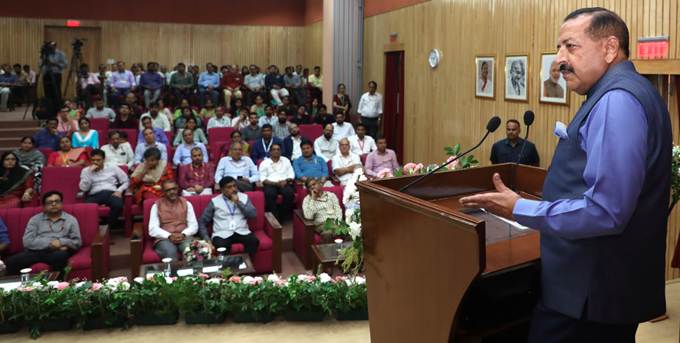
India’s victory in the Women’s Chess World Cup is testament to the sporting prowess of Bharat: Dr. Mansukh Mandaviya

| Published on:

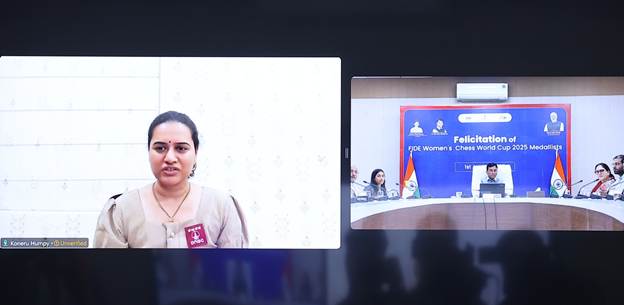
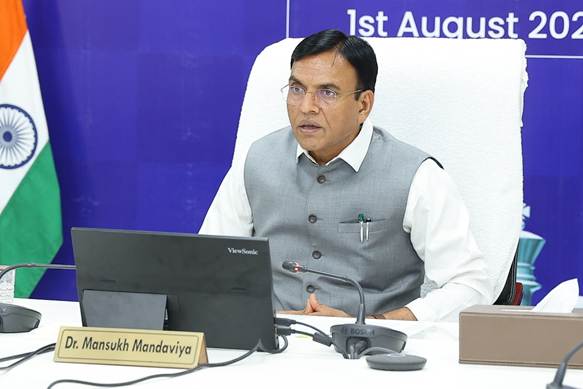
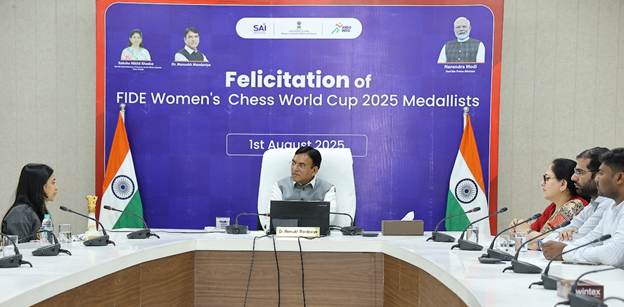
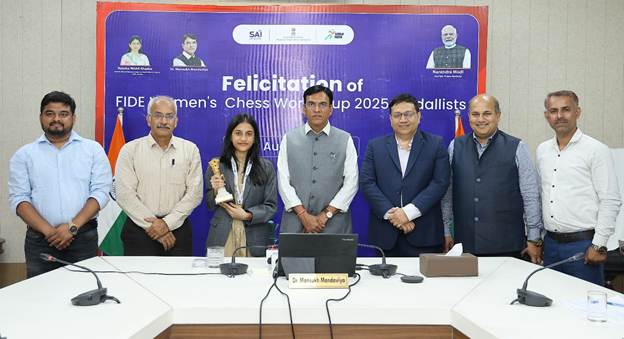
Union Minister for Youth Affairs & Sports and Labour & Employment, Dr. Mansukh Mandaviya, felicitated the FIDE Women’s World Cup 2025 medalists, Divya Deshmukh and Koneru Humpy, in New Delhi today. Indian chess prodigy Divya and veteran Grandmaster (GM) Koneru made the nation proud with a dominant performance at the recently concluded tournament in Batumi, Georgia.

Dr. Mandaviya personally felicitated Divya Deshmukh, who also became the 88th Grandmaster of the country and 4th Indian woman to become a Grandmaster, on becoming the first Indian woman to win the FIDE Women’s World Cup, as well as the youngest ever to do so. Koneru Humpy joined the ceremony virtually.

Addressing the duo at the event, the Union Minister said, “Grandmasters like you will serve as inspiration for the new generation. More youngsters will take interest in sports, especially a mind sport like chess. Chess may be considered one of India’s gifts to the world, and has been played since ancient times. I firmly believe that many daughters of India will rise in the world by drawing inspiration from both of you.”

“I’ve read about Humpy and I know that she has inspired many in her journey. She has played a long and distinguished innings. I remember going home and watching her games with my children,” Dr. Mandaviya added.

The FIDE Women’s World Cup 2025, held from July 5–28 in Batumi, saw a historic all-Indian final between 19-year-old Divya Deshmukh and seasoned GM Koneru Humpy. This marked the first time that two Indian women reached the final, and is also the first-ever Women’s World Cup title for India.Divya, hailing from Nagpur, defeated Humpy in a tense tiebreak after two drawn classical games. She also secured her first GM norm during the event, defeating top players like Zhu Jiner, Harika Dronavalli, and Tan Zhongyi.

“I am very happy that the title has come to India. Koneru played very well but I was lucky that I won. For me, the biggest joy was in knowing that no matter who won, the title would come to India,” stated Divya. “Today I feel so happy to be felicitated by Hon’ble Minister because this motivates athletes and gives youngsters the message that they have the support of the country. I also want to thank Sports Authority of India (SAI) and the Sports Ministry for the constant support to chess. Sustained encouragement of this kind will help the game grow in the country”, she added.


The seasoned Koneru Humpy, who became a GM at the age of 15 in 2002, recalled her experiences. “It was a very long and exhaustive tournament and I am happy that I was able to play till the end. India dominated the finals with chess players from two generations facing each other, and the title came to India.”

With India also set to host the FIDE Men’s World Cup 2025 in Goa this October, Dr. Mandaviya expressed positivity about the country’s sporting landscape. “India’s victory in the Women’s Chess World Cup is not only a testament to the sporting prowess of Bharat, but also highlights the sports ecosystem that Prime Minister Narendra Modi ji has established in the country. The government is not merely supporting sports on paper, but ensuring deep and structured support on the ground. A roadmap has been prepared to that effect. Several reforms will be seen in the coming days. Just last month, we had the announcement of the Khelo Bharat Niti. Now, a National Sports Governance Bill will be considered in Parliament to bring about good governance in sports. After its passage and implementation, the nation will witness further growth in sports development.”

Madhya Pradesh Chief Minister meets Prime Minister

| Published on:

The Chief Minister of Madhya Pradesh, Dr Mohan Yadav met the Prime Minister, Shri Narendra Modi in New Delhi today.

The PMO India handle posted on X:

“CM of Madhya Pradesh, @DrMohanYadav51, met Prime Minister @narendramodi.

@CMMadhyaPradesh”

PM to visit Varanasi on 2nd August

| Published on:

Prime Minister Shri Narendra Modi will lay the foundation stone and inaugurate multiple development projects worth around Rs 2200 crore in Varanasi, Uttar Pradesh on 2nd August at around 11 AM. He will also address the gathering on the occasion.

The projects cater to multiple sectors, including infrastructure, education, healthcare, tourism, urban development and cultural heritage aim at achieving holistic urban transformation, cultural rejuvenation, improved connectivity, and enhanced quality of life in Varanasi.

In line with his commitment to improve road connectivity in Varanasi, Prime Minister will inaugurate and lay the foundation stone of several key infrastructure projects. He will inaugurate the widening and strengthening of the Varanasi – Bhadohi road and Chhitauni- Shool Tankeshwar road; and Railway Overbridge at Hardattpur, to ease congestion on the Mohan Sarai – Adalpura Road. He will lay the foundation stone for comprehensive road widening and strengthening across multiple rural and urban corridors, including Dalmandi, Lahartara-Kotwa, Gangapur, Babatpur among others and Railway Overbridges at Level Crossing 22C and Khalispur Yard.

Strengthening the power infrastructure in the region, Prime Minister will lay the foundation stone of various works under the Smart Distribution Project and undergrounding of electrical infrastructure worth over Rs 880 crore.

In a major boost to tourism, Prime Minister will inaugurate the redevelopment of 8 riverfront Kuccha Ghats, development works at Kalika Dham, beautification of the pond and ghat at Rangildas Kutiya, Shivpur, and the restoration and water purification of Durgakund. He will lay the foundation stone for restoration work at Kardameshwar Mahadev Temple; development of Karkhiyaon, the birthplace of several freedom fighters; City Facility Centres at Sarnath, Rishi Mandvi, and Ramnagar Zones; redevelopment of Munshi Premchand’s ancestral house in Lamahi and upgradation of museum among others. He will also lay the foundation stone for development of an Urban Miyawaki Forest at Kanchanpur and for the redevelopment and beautification of Shaheed Udyan and 21 other parks.

In addition, to preserve culturally significant water bodies, Prime Minister will lay the foundation stone for water purification and maintenance works at various kunds including Ramkund, Mandakini, Shankuldhara and others, along with the installation of four floating pujan platforms. To ensure access to potable water in rural areas, Prime Minister will also inaugurate 47 Rural Drinking Water Schemes under the Jal Jeevan Mission.

Furthering his vision of quality education for all, Prime Minister will inaugurate the upgradation of 53 school buildings within the municipal boundary. He will also lay the foundation stone for several educational projects, including the construction of a new district library and rejuvenation of Government High Schools at Jakhini, Lalpur among others.

In a major boost to health infrastructure, Prime Minister will inaugurate advanced medical equipment installations, including robotic surgery and CT scan facilities, at Mahamana Pandit Madan Mohan Malaviya Cancer Centre and Homi Bhabha Cancer Hospital. He will also lay the foundation stone of a Homoeopathic College and Hospital. Further, he will inaugurate an Animal Birth Control Centre and associated Dog Care Centre.

Furthering his vision for world class sports infrastructure in Varanasi, Prime Minister will inaugurate a synthetic hockey turf at Dr. Bhimrao Ambedkar Sports Stadium. Enhancing facilities for law enforcement personnel, Prime Minister will inaugurate a 300-capacity Multipurpose Hall at Pradeshik Armed Constabulary (PAC) Ramnagar and lay the foundation stone for Quick Response Team (QRT) Barracks.

In a significant step towards farmer welfare, Prime Minister will release the 20th instalment of PM-KISAN. An amount of more than Rs 20,500 crore will be transferred directly to the bank accounts of over 9.7 crore farmers across the country. With this release, the total disbursement under the scheme since its inception will surpass Rs 3.90 lakh crore.

Prime Minister will also inaugurate the registration portal for various events and competitions under the Kashi Sansad Pratiyogita, including Sketching Competition, Painting Competition, Photography Competition, Khel-Kood Pratiyogita, Gyan Pratiyogita, and the Rojgar Mela. Prime Minister will also distribute more than 7,400 assistive aids to various Divyangjan and Elderly beneficiaries.

Cabinet approves total outlay of Rs.6520 crore for ongoing Pradhan Mantri Kisan Sampada Yojana

| Published on:

The Union Cabinet chaired by the Prime Minister Shri Narendra Modi today has approved a total outlay of Rs.6520 crore including additional outlay of Rs.1920 crore for ongoing Central Sector Scheme “Pradhan Mantri Kisan Sampada Yojana” (PMKSY) during 15th Finance Commission Cycle (FCC) (2021-22 to 2025-26).

Approval includes  (i)  Rs.1000 crore to support setting up of 50 Multi Product Food Irradiation Units under the component scheme-Integrated Cold Chain and Value Addition Infrastructure (ICCVAI)  and 100 Food Testing Labs (FTLs) with NABL accreditation under the component scheme – Food Safety and Quality Assurance Infrastructure (FSQAI) of Pradhan Mantri Kisan Sampada Yojana (PMKSY), in alignment with the budget announcement and (ii) Rs.920 crore, for sanctioning projects under various component schemes of PMKSY during the 15th FCC.

Both ICCVAI and FSQAI are demand driven component schemes of PMKSY. The Expression of Interests (EOIs) would be floated for inviting proposals from eligible entities across the country. The proposals received against the EOI would be approved after proper scrutiny as per eligibility criteria as per the extant scheme guidelines.

The implementation of the proposed 50 multi-product food irradiation units is expected to create total preservation capacity ranging from 20 to 30 Lakh Metric Tonnes (LMT) per annum, based on the type of food products irradiated under these units. The setting up of  the proposed 100 NABL-accredited food testing laboratories under private sector will lead to the development of advanced infrastructure for testing food samples, thereby ensuring compliance with food safety standards and supply of safe foods.

Cabinet approves Central Sector Scheme “Grant in aid to NCDC” with an outlay of Rs.2000 crore

| Published on:

The Union Cabinet chaired by the Prime Minister Shri Narendra Modi today has approved the Central Sector Scheme “Grant in aid to National Cooperative Development Corporation (NCDC)” with an outlay of Rs.2000 crore for a period of four years from 2025-26 to 2028- 29 (Rs.500 crore each year from FY 2025-26).

On the basis of grant in aid of Rs.2000 crore to NCDC from FY 2025-26 to FY 2028-29, NCDC will be able to raise Rs.20,000 crore from open market over a span of four years. These funds will be utilized by NCDC for granting loans to Cooperatives for setting up new projects / expansion of plants and loan for meeting the working capital requirements.

Financial implications:

The source of finance of Rs.2000 crore (Rs.500 crore each year from FY 2025-26 to FY 2028-29) grant to NCDC shall be through budgetary support from Government of India. On the basis of grant in aid of Rs.2000 crore to NCDC from FY 2025-26 to FY 2028-29, NCDC will be able to raise Rs.20,000 crore from open market over a span of four years.

Benefits:

Approximately 2.9 crore members of 13,288 Cooperative societies of various sectors like Dairy, Livestock, Fisheries, Sugar, Textile, Food Processing, Storage and Cold Storage; Labour and Women led cooperatives. across the country are likely to get benefitted.

Implementation strategy and targets:

(i)   NCDC will be the executing agency for this scheme for the purpose of disbursement, follow up, monitoring of implementation of project, and recovery of loan disbursed out of the fund.

(ii)  NCDC will provide loans to cooperatives either through state government or directly, as per NCDC guidelines. Cooperatives, which are meeting the criteria of direct funding guidelines of NCDC would be considered for financial assistance directly against admissible security or state government guarantee.

(iii) NCDC will provide loans to cooperatives, long term credit for setting up/ modernization/ technology upgradation/ expansion of project facilities for various sectors and working capital to run their businesses efficiently and profitably.

Impact, including employment generation potential:

i.        Funds provided to these cooperatives will lead to creation of income generating capital assets and provide cooperatives with much needed liquidity in the form of working capital.

ii.        In addition to economic benefits, cooperatives through their principles of democracy, equality and community concerns are an essential tool to bridge the socio-economic gap and increase participation of women in the workforce.

iii.        The availability of loans will help cooperatives in their capacity augmentation, modernization, diversification of activities, increasing their profitability and enable them to increase their productivity and generate more employment improving the economic conditions of the farmer members.

iv.        Additionally, term loans for the infrastructure development also create widespread employment opportunities across different skill levels.


Background:

The cooperative sector is contributing immensely to the Indian economy.  Cooperatives play a vital role in socio-economic upliftment, infrastructure development, and job creation in the rural sector. Cooperative Sector contributes substantially across all the sectors of their respective production in the country.  The cooperatives in India cover a wide array of activities, including credit and banking, fertilizer, sugar, dairy, marketing, consumer goods, handloom, handicraft, fisheries, housing, etc.  India has more than 8.25 lakh cooperatives with more than 29 crore members and 94 percent farmers are associated with cooperatives in some form or the other.

Due to their important socio-economic contribution to the rural economy, it is essential to support the weaker sectors like dairy, poultry & livestock, fisheries, sugar, textile, processing, storage & cold storage, labour cooperatives and women cooperatives etc. by granting them long term and working capital loans.

PM addresses the Lok Sabha during a special discussion on Operation Sindoor

| Published on:

Prime Minister Shri Narendra Modi addressed the Lok Sabha today during a special discussion on India’s strong, successful and decisive ‘Operation Sindoor’ in response to the terrorist attack in Pahalgam. Addressing the house, the Prime Minister recalled his interaction with the media fraternity at the beginning of the session, stating that he had appealed to all Honourable Members of Parliament by describing the session as a celebration of India’s victories and a tribute to India’s glory.

Highlighting that ‘Vijay Utsav’ referring to the complete obliteration of terrorist headquarters, Shri Modi remarked that Vijayotsav represents the fulfillment of the solemn vow taken with sindoor — a tribute to national devotion and sacrifice. “Vijay Utsav is a testament to the valour and strength of India’s armed forces”, he emphasised, further stating that Vijayotsav celebrates the unity, willpower, and collective triumph of 140 crore Indians.

Affirming that he has stood in the House with the spirit of victory to present India’s perspective, the Prime Minister stated that for those who fail to see India’s viewpoint, he has stood to hold up a mirror. He remarked that he has come to join his voice with the emotions of 140 crore citizens. Shri Modi emphasized that the resonance of these collective sentiments has been heard in the House, and he has risen to add his voice to that resounding spirit.

Expressing gratitude to the people of India for their unwavering support and blessings during Operation Sindoor, the Prime Minister stated that he remains indebted to the nation. He acknowledged the citizens’ collective resolve and conveyed appreciation for their role in the operation’s success.

The Prime Minister condemned the heinous incident that occurred in Pahalgam on 22 April 2025, where terrorists brutally shot innocent people after asking their religion — calling it the height of cruelty. He remarked that this was a calculated attempt to plunge India into the flames of violence and incite communal unrest. He thanked the people of India for defeating this conspiracy with unity and resilience.

Shri Modi recalled that after April 22, he issued a public statement, in English as well, to make India’s stance clear to the world. He declared it is India’s firm resolve to crush terrorism, emphasizing that even the masterminds will face punishment greater than imagination. The Prime Minister noted that he was on a foreign tour on April 22 but returned immediately to convene a high-level meeting. He stated that clear instructions were issued during the meeting to deliver a decisive response to terrorism, reiterating that this is a national commitment.

Affirming complete confidence in the capabilities, strength, and courage of India’s armed forces, Shri Modi stated that the military was given full operational freedom to decide the timing, location, and mode of response. The Prime Minister emphasized that these directives were clearly conveyed during the high-level meeting, and some aspects may have been reported in the media. He remarked with pride that the punishment delivered to the terrorists was so impactful that even their masterminds continue to lose sleep over it.

The Prime Minister stated that he wished to present India’s response and the success of its armed forces before the nation through the House. He remarked that following the Pahalgam attack, the Pakistani military had anticipated a major Indian response, prompting them to issue nuclear threats. Outlining the first dimension, he said that as scheduled, India executed its operation on the intervening night of 6th & 7th May 2025, rendering Pakistan unable to react, Shri Modi emphasized that the Indian armed forces avenged the April 22 attack by achieving their targeted objectives in just 22 minutes.

Shri Modi, presenting further outlining the second dimension of India’s strategic response through the House, remarked that although India has fought multiple wars with Pakistan in the past, this was the first time a strategy was executed that reached locations previously untouched. He highlighted that terrorist hideouts across Pakistan were decisively targeted, including areas no one imagined India could reach. He specifically mentioned Bahawalpur and Muridke, stating that these bases were razed to the ground, affirming that India’s armed forces had successfully destroyed terrorist bases.

Shri Modi emphasized the third dimension that Pakistan’s nuclear threats were proven hollow, and India has demonstrated that nuclear blackmailing will no longer be tolerated and nor will India ever bow before it.

Outlining the fourth dimension of India’s strategic response under Operation Sindoor, the Prime Minister stated that India demonstrated its advanced technological capabilities by delivering precise strikes deep within Pakistani territory, resulting in significant damage to Pakistan’s air base assets—many of which, he added, remain in critical condition. He remarked that we are now in an era of technology-driven warfare, and Operation Sindoor proved India’s mastery in this domain. Emphasizing that had India not undertaken the last ten years of preparedness, the country could have faced immense losses in this technological era, Shri Modi presented the fifth dimension, the Prime Minister stated that for the first time, the world has witnessed the strength of an Atmanirbhar Bharat during Operation Sindoor. He highlighted the effectiveness of Made-in-India drones and missiles, which exposed vulnerabilities in Pakistan’s weapons systems.

Highlighting a significant achievement in India’s defence structure—referring to his announcement of the Chief of Defence Staff (CDS), the Prime Minister remarked that Operation Sindoor witnessed a joint action by the Navy, Army, and Air Force, and the synergy between these forces rattled Pakistan comprehensively.

Shri Modi stated that while terrorist incidents had occurred in India earlier as well, the masterminds were previously undisturbed and continued planning future attacks with impunity. He emphasized that the situation has now changed. Today, after every strike, the masterminds lose sleep—knowing that India will strike back and eliminate threats with precision. The Prime Minister asserted that India has established a “new normal”.

Emphasizing that the global community has now witnessed the vast scale and reach of India’s strategic operations, stating that strikes were conducted across Pakistan from Sindoor to Sindhu, Shri Modi remarked that Operation Sindoor has established a new doctrine: any terrorist attack on India will result in a heavy cost for its masterminds and for Pakistan itself.

The Prime Minister outlined three clear principles arising from Operation Sindoor. First, India will respond to terrorist attacks on its own terms, in its own way, and at its chosen time. Second, Nuclear blackmail of any kind will no longer be tolerated. Thirdly, India will not distinguish between terrorist sponsors and the masterminds behind such attacks.

Shri Modi informed the House with clarity on global support for India’s actions during Operation Sindoor. He stated that no country in the world objected to India taking necessary action in defence of its national security. The Prime Minister emphasized that out of the 193 member nations of the United Nations, only three issued statements in support of Pakistan during the operation. He remarked that India received widespread backing from countries across the globe—including strategic groupings like QUAD and BRICS, and nations such as France, Russia, and Germany. The Prime Minister asserted that the international community stood in strong support of India.

Expressing deep disappointment that while India received support from the global community, the valour of the nation’s soldiers did not find backing from the opposition, Shri Modi remarked that just days after the April 22 terrorist attack, certain opposition leaders began mocking the government and alleged failure. The Prime Minister said this mockery, and their indulgence in political opportunism even in the wake of the Pahalgam killings, reflected a disregard for national grief. He stated that such statements were not only petty but demoralizing for India’s security forces. Shri Modi emphasized that some opposition leaders neither believe in India’s strength nor in the capabilities of its armed forces, and continue to cast doubt on Operation Sindoor. He asserted that chasing headlines might serve political interests, but it will not earn the trust or respect of the people.

The Prime Minister stated that on 10 May 2025, India announced the cessation of operations under Operation Sindoor. He acknowledged that this announcement led to varied speculations, which he described as propaganda originating from across the border. He criticized those who chose to amplify Pakistan’s disinformation instead of relying on the facts presented by India’s armed forces, and reaffirmed that India’s stance has always remained clear and resolute.

Recalling India’s targeted military operations over the years, emphasizing the strategic clarity and execution involved, Shri Modi  stated that during the surgical strikes, India set a clear objective to destroy terrorist launch pads within enemy territory, which was accomplished overnight before sunrise. He remarked that in the Balakot air strikes, India targeted terrorist training centres and successfully carried out the mission. The Prime Minister emphasized that under Operation Sindoor, India again operated with a clearly defined objective—striking the epicentre of terror and the infrastructure behind the Pahalgam attackers, including their planning bases, training hubs, funding sources, tracking and technical support, and arms supply chains. “India precisely attacked the nerve centre of these terrorists and dismantled the core of their operations”, said the PM.

“Once again the Indian forces achieved 100% of their targets, showcasing the nation’s strength”, stressed Shri Modi, criticizing those who deliberately choose to forget these milestones, affirming that the nation remembers well: the operation took place on the night of May 6 and morning of May 7, and by sunrise on May 7, the Indian Army held a press conference stating the mission was accomplished. The Prime Minister reiterated that India’s objectives were clear from day one—to dismantle terrorist networks, their masterminds, and their logistical hubs—and that the mission was completed as planned. Quoting Union Minister of Defence, Shri Rajnath Singh, the Prime Minister echoed with conviction that India’s armed forces conveyed its success to Pakistan’s military within minutes, making intentions and outcomes unmistakable. He asserted that Pakistan’s decision to openly stand with terrorists reflected a lack of prudence. Had they acted sensibly, they would not have made such a brazen error. The Prime Minister emphasized that although India was fully prepared and waiting for the right moment, its goal was to eliminate terrorism—not engage in conflict with a nation. However, when Pakistan decided to enter the battlefield in support of terrorists, India responded with a powerful counterstrike. He highlighted that on the midnight of May 9 and the morning of May 10, Indian missiles struck across Pakistan with such intensity that it surpassed their imagination.

The Prime Minister further stated on the floor of the house that India’s decisive action under Operation Sindoor forced Pakistan to its knees. He recalled how Pakistani citizens expressed shock, whose reactions were widely visible on television. Shri Modi remarked that Pakistan was so overwhelmed by the response that its Director General of Military Operations (DGMO) directly called India, pleading to stop the offensive—admitting they could not endure further assault. He reiterated that India had clearly stated, during the press conference on the morning of May 7, that its objectives were achieved and that any further provocation would prove costly. “India’s policy was deliberate, well-considered, and crafted in coordination with its armed forces—focused exclusively on dismantling terrorism, its sponsors, and their bases, India’s action was non-escalatory by design”, declared the PM.

The Prime Minister stated that no global leader objected to India’s operations. He revealed that on the night of May 9, the Vice President of the United States attempted to reach him multiple times while he was in a high-level meeting with Indian defence officials. After returning the call, the Prime Minister was informed that Pakistan might launch a major offensive. He responded unequivocally: “If that is Pakistan’s intent, it will cost them dearly.” He added firmly that India would retaliate with greater force, stating, “We will respond to bullets with canons.” The Prime Minister confirmed that India struck back powerfully on the night of May 9 and morning of May 10, dismantling Pakistan’s military infrastructure with overwhelming force. He noted that Pakistan now fully understands—every Indian response will be stronger than the last. “Should Pakistan dare again, it will face a fitting and formidable retaliation. Operation Sindoor remains active and resolute”, declared Shri Modi.

“Today’s India is full of self-confidence and is progressing rapidly with the spirit of self-reliance”, affirmed the Prime Minister, remarking that the nation is witnessing India’s march toward Atmanirbharta, but it is also seeing the unfortunate trend of the opposition becoming increasingly dependent on Pakistan for its political narratives. The Prime Minister stated that during the ongoing 16-hour discussion, opposition was seen importing issues from Pakistan—a matter of deep regret.

Underscoring the evolving nature of warfare, where information and narrative-building play a critical role, the Prime Minister cautioned that AI-powered disinformation campaigns are being used to weaken the morale of armed forces and sow public mistrust. He expressed concern that the opposition and its allies have effectively become spokespersons of Pakistan’s propaganda, undermining India’s national interest.

Highlighting repeated efforts to question and diminish India’s military achievements, Shri Modi stated that after India’s successful surgical strikes, opposition leaders demanded proof from the armed forces. He noted that as public sentiment shifted in favour of the military, Opposition leaders changed their stance—claiming they had also conducted such strikes citing differing numbers, from three to fifteen surgical strikes.

The Prime Minister remarked that following the Balakot air strikes, the Opposition could not challenge the operation outright but instead began demanding photographic evidence. He observed that they repeatedly asked where the strike hit, what was destroyed, how many were killed—questions, he pointed out, that echoed Pakistan’s own rhetoric.

The Prime Minister remarked that when Indian Air Force pilot Abhinandan was captured by Pakistan, celebrations in that country were expected. However, some individuals within India began whispering doubts, suggesting that the Prime Minister was in trouble and questioning whether Abhinandan would be brought back. The Prime Minister highlighted that Abhinandan’s return to India was secured “with bold resolve,” and upon his repatriation, such critics fell silent.

Shri Modi further stated that after the Pahalgam attack, when a BSF soldier was taken captive by Pakistan, certain groups believed they had gained a major opportunity to corner the government. He highlighted that their ecosystem spread numerous narratives across social media—raising speculative questions about the soldier’s fate, his family’s condition, and the likelihood of his return. He emphasized that despite these attempts, India responded with clarity and dignity, dispelling misinformation and reaffirming its commitment to protecting every soldier.

Stating that the BSF soldier captured after the Pahalgam incident also returned with honour and dignity, Shri Modi remarked that terrorists were grieving, their handlers were grieving—and seeing them, some individuals within India appeared to grieve as well. He observed that during the surgical strikes, attempts were made to play political games which failed to gain traction. During the air strike, similar attempts were made, but those too collapsed. He noted that when Operation Sindoor took place, critics shifted their stance again, first refusing to acknowledge the operation, then questioning why it was stopped. He commented that those opposing always seek a reason to object.

Highlighting that the Opposition has long displayed a negative attitude towards the armed forces, the Prime Minister pointed out that even during the recent commemoration of Kargil Vijay Diwas, the Opposition neither celebrated the victory nor acknowledged its significance. He remarked that history is witness to the fact that during the Doklam standoff, while the Indian forces displayed courage, Opposition leaders were secretly seeking briefings from questionable sources.

The Prime Minister further expressed astonishment that the Opposition appeared to give a clean chit to Pakistan. He questioned the demand raised by the Opposition for proof that the Pahalgam terrorists were Pakistani nationals, noting that this is the same demand being made by Pakistan itself. He remarked that such habits and audacity persist within Opposition, echoing external narratives. The Prime Minister remarked that today, with no shortage of evidence and facts plainly visible before the public, certain individuals still continue to raise doubts. He questioned how these individuals would have reacted if such clear proof had not been available, implying that their responses would have been even more misleading or irresponsible.

Underlining that while discussions often focus on one part of Operation Sindoor, Shri Modi there are moments of national pride and demonstrations of strength that also deserve attention. He praised India’s air defence systems, noting that they are widely acknowledged across the world and that they had dismantled Pakistan’s missiles and drones “like straw.” He cited data that on 9 May, Pakistan attempted a major offensive involving approximately one thousand missiles and armed drones targeting India. The Prime Minister emphasized that had these missiles landed, they would have caused widespread destruction. Instead, India’s air defence neutralized all of them mid-air. He stated that this achievement fills every citizen with pride.

Criticizing that Pakistan spread false reports about an attack on the Adampur airbase and attempted to widely promote that lie, Shri Modi  stated that he personally visited Adampur the very next day and exposed the falsehoods on ground, making it clear that such misinformation would no longer succeed.

The Prime Minister criticized that the current Opposition has governed India for a significant period and is fully aware of how administrative systems function. He expressed concern that despite this experience, they consistently refused to accept official clarifications. Shri Modi noted that whether it is a statement from the Ministry of External Affairs, repeated responses from the External Affairs Minister, or clarifications from the Home and Defence Ministers, the opposition refuses to trust them. He questioned how a party that has ruled for decades could show such lack of faith in the nation’s institutions, asserting that opposition now seems to operate according to Pakistan’s remote control, with its stance shifting accordingly.

Shri Modi criticized the senior leaders of opposition who prepare written statements and make the young MPs speak on their behalf. He condemned such leadership for lacking the courage to speak themselves, and for terming Operation Sindoor—a response to a brutal terror attack that claimed 26 lives—as “a spectacle.” He described this statement as akin to pouring acid on the memory of a horrific event and called it a shameful act.

Shri Modi shared that the terrorists involved in the Pahalgam attack were neutralized by Indian security forces in Operation Mahadev the previous day. He expressed astonishment that laughter and mockery accompanied questions about the timing of the operation—asking sarcastically whether it was scheduled for a holy Monday in the month of Sawan. He criticized this attitude as a reflection of extreme despair and frustration and commented that it shows the deteriorating condition of the opposition’s approach.

Quoting ancient scriptures, Shri Modi said that when a nation is protected by arms, the pursuit of knowledge and philosophical discourse can flourish. “A strong military at the borders ensures a vibrant and secure democracy”, said Shri Modi.

“Operation Sindoor stands as direct evidence of India’s military empowerment over the past decade”, exclaimed the Prime Minister,  noting that such strength did not emerge spontaneously, but was the result of focused effort—contrasting it with Opposition’s tenure, during which self-reliance in defence was not even considered. He remarked that even today, the term “self-reliance,” rooted in Gandhian philosophy, is mocked.

Asserting that during Opposition rule, every defence deal was an opportunity for personal gain, Shri Modi said that India remained dependent on foreign suppliers for even basic equipment. He listed deficiencies such as the absence of bulletproof jackets and night vision cameras, and pointed out that scandals were linked to every defence procurement—from jeeps to Bofors to helicopters. The Prime Minister highlighted that India’s forces had to wait decades for modern weapons and reminded the House that historically, India was a leader in defence manufacturing. He cited that even during sword warfare, Indian weapons were considered superior. He remarked that post-Independence, India’s robust defence manufacturing ecosystem was deliberately weakened and systematically dismantled.

Shri Modi remarked that avenues for research and manufacturing were blocked for years, and had those policies continued, India would not have been able to even imagine Operation Sindoor in the 21st century. He stated that under such circumstances, India would have struggled to find weapons, equipment, and ammunition in time, and feared interruptions during military action. He highlighted that over the past decade, weapons made under the Make in India initiative played a decisive role in the success of Operation Sindoor.

The Prime Minister recalled that a decade ago, Indians resolved to build a strong, self-reliant, and modern nation, prompting a series of security reforms that were implemented for the first time since independence. He noted that the appointment of the Chief of Defence Staff was a major reform—one that had long been debated and practiced globally, yet never executed in India. He applauded the wholehearted support and acceptance of this system by all three services.

Emphasising that the greatest strength now lies in jointness and integration, Shri Modi stated that integration across the Navy, Air Force, and Army has multiplied India’s defence capability, and Operation Sindoor reflected the success of this transformation.

The Prime Minister stated that reforms were introduced in government-owned defence production companies despite initial resistance, including unrest and strikes. He praised the workers for placing national interest first, embracing reforms, and becoming highly productive. He further highlighted that India opened its defence sector to private companies, and today, the private sector is making notable progress. Shri Modi pointed out that hundreds of startups in defence, many led by young professionals aged 27–30 from Tier 2 and Tier 3 cities—including young women—are contributing significantly to innovation.

The Prime Minister stated that activities in the drone sector are primarily led by individuals around the age of 30–35, and their contributions proved instrumental in Operation Sindoor. He extended his appreciation to all such contributors and assured them that the country will continue to move forward.

Underscoring that ‘Make in India’ in the defence sector was never merely a slogan, Shri Modi stated that budgetary increases, policy changes, and new initiatives were undertaken with a clear vision, enabling rapid progress in indigenous defence manufacturing. He highlighted that in the past decade, India’s defence budget has nearly tripled. Defence production has increased by approximately 250 percent, and defence exports have surged over 30 times in the last 11 years, now reaching nearly 100 countries.

The Prime Minister remarked that certain milestones have had a lasting impact on history, stating that Operation Sindoor has firmly positioned India within the global defence market. He noted that the rising demand for Indian weaponry would strengthen domestic industries, empower MSMEs, and create employment for youth. He affirmed that young Indians are now showcasing India’s strength through their innovations.

Shri Modi clarified that self-reliance in defence is essential not just for national interest but also for global peace in today’s competitive era. “India is the land of Buddha, not Yuddha (war), and although the nation desires prosperity and peace, the path to both requires strength and resolve”, said Shri Modi. He described India as the land of great warriors—Chhatrapati Shivaji Maharaj, Maharaja Ranjit Singh, Rajendra Chola, Maharana Pratap, Lachit Borphukan, and Maharaja Suheldev—emphasizing that strategic strength remains vital for development and peace.

The Prime Minister asserted that the opposition has never had a clear vision for national security and has consistently compromised on it. He stated that those now questioning why Pakistan-occupied Kashmir hasn’t been reclaimed must first answer who allowed Pakistan to take control of it in the first place.

Strongly criticizing post-independence decisions that continue to burden the nation, Shri Modi highlighted that critical misjudgments led to the loss of 38,000 square kilometers of Indian territory in Aksai Chin, which was wrongly labeled as barren land. He remarked that between 1962 and 1963, the then ruling party leaders had proposed surrendering key regions in Jammu & Kashmir, including Poonch, Uri, Neelam Valley, and Kishanganga.

The Prime Minister pointed out that the surrender was proposed under the guise of “Line of Peace.” He further criticized the Opposition for accepting mediation over the Rann of Kutch in 1966, resulting in the handing over of approximately 800 square kilometers of land, including the disputed Chhad Bet region, to Pakistan. He recalled that although Indian forces had reclaimed Hajipir Pass in the 1965 war, the then ruling dispensation returned it, undermining the nation’s strategic victory.

The Prime Minister emphasized that during the 1971 war, India had captured thousands of square kilometers of Pakistani territory and held 93,000 prisoners of war. Despite the favorable conditions, he said, the opportunity to reclaim Pakistan-occupied Kashmir (PoK) was missed. Even Kartarpur Sahib, located near the border, could not be secured. He expressed regret over the decision in 1974 to gift Katchatheevu Island to Sri Lanka, noting the ongoing hardships faced by fishermen from Tamil Nadu due to this transfer.

The Prime Minister underscored that the opposition carried a decades-long intent to withdraw Indian forces from Siachen, compromising national security.

The Prime Minister reminded the House that following the horrific 26/11 Mumbai attacks, the then government chose to resume dialogue with Pakistan just weeks after the tragedy, allegedly under foreign pressure. He remarked that despite the magnitude of 26/11, the then government did not expel a single Pakistani diplomat nor cancel even a single visa. The Prime Minister noted that Pakistani-sponsored terror attacks continued unabated, yet Pakistan retained the “Most Favoured Nation” status under the then government, which was never revoked.

Shri Modi emphasized that while the nation demanded justice for Mumbai, the then ruling party remained engaged in trade with Pakistan. He highlighted that while Pakistan was sending terrorists to wreak havoc, the then government held peace-oriented poetic gatherings in India.

The Prime Minister asserted that his government ended this one-sided traffic of terror and misplaced optimism by revoking Pakistan’s MFN status, halting visas, and shutting down the Attari-Wagah border. He further criticized the Opposition for repeatedly mortgaging India’s national interests, citing the Indus Waters Treaty as a prime example. He pointed out that the treaty was executed by the then Prime Minister, involving rivers originating from India—rivers that have long been part of India’s cultural and spiritual legacy.

Shri Modi said that rivers like the Sindhu and Jhelum, once synonymous with India’s identity, were handed over for arbitration to the World Bank—despite being India’s own rivers and water. He denounced this move as a betrayal of India’s self-respect and cultural ethos.

Condemning historical diplomatic decisions that compromised India’s water rights and development, particularly under the Indus Waters Treaty, the Prime Minister highlighted that the then PM agreed to allocate 80% of the water from rivers originating in India to Pakistan, leaving only 20% for a vast nation like India. He questioned the rationale behind this arrangement, calling it a failure of wisdom, diplomacy, and national interest.

Shri Modi remarked that rivers emerging from Indian soil belonged to the citizens, especially the farmers of Punjab and Jammu & Kashmir. He said the then ruling dispensation’s agreement pushed a large part of the country into water distress and sparked internal state-level water disputes, while Pakistan exploited the benefits.

The Prime Minister emphasized that India’s cultural and civilizational connection with these rivers was disregarded, and the people most affected—India’s farmers—were denied their rightful access.

He stated that if this situation had not arisen, numerous major water projects could have been developed on western rivers. Farmers across Punjab, Haryana, Rajasthan, and Delhi would have had ample water, and drinking water shortages would not have existed. Additionally, India would have generated power through industrial systems.

The Prime Minister noted that the then government even provided crores of rupees to Pakistan to build canals, further disadvantaging India’s interests. Shri Modi informed that the Government has now put the Indus water treaty under abeyance in view of national interest. “India has decided that blood and water will not flow together”, exclaimed the PM.

Noting that before 2014, the country lived under a constant shadow of insecurity, Shri Modi recalled how frequent announcements at public places—railway stations, bus stands, airports, temples—warned people to avoid unattended items due to the fear of bombs, describing it as a climate of fear that prevailed across the nation. He emphasized that weak governance under the then ruling dispensation led to countless civilian casualties, stating that the government had failed to protect its citizens. Shri Modi affirmed that terrorism could have been curbed and presented the progress made in the last 11 years as proof, highlighting a sharp decline in terror incidents that had plagued the country between 2004 and 2014.

The Prime Minister questioned why previous administrations did not take effective steps to control terrorism if it was indeed possible. He alleged that those dispensations allowed terrorism to flourish due to its politics of appeasement and vote bank considerations.

Shri Modi recalled the 2001 attack on Parliament and criticized the then ruling party for extending the “benefit of doubt” to convicted terrorist Afzal Guru. He highlighted how the 26/11 Mumbai attacks, despite the capture and global recognition of the Pakistani nationality of the terrorist Ajmal Kasab, were used to advance the narrative of “saffron terror.”

The Prime Minister cited that a leader from the then ruling party even told a top U.S. diplomat that Hindu groups posed a greater threat than Lashkar-e-Taiba, portraying this as an example of their  narrative-building abroad.

He strongly condemned opposition for preventing the full implementation of the Indian Constitution in Jammu & Kashmir, stating that Baba Saheb Ambedkar’s Constitution was barred from entering the region due to appeasement politics consistently compromising national security.

Shri Modi invoked a unifying sentiment, saying that political differences may persist, but unity of purpose must prevail in national interest. Referring to the Pahalgam tragedy, the Prime Minister highlighted how it deeply wounded the nation and prompted India’s decisive response through Operation Sindoor, which embodies courage, self-reliance, and national resolve.

He praised the Indian delegations who, with conviction and clarity, represented the nation globally. Their advocacy, he said, echoed the ‘Sindoor Spirit’ that now guides India’s posture both within and beyond its borders.

Expressing dismay over the reaction of some opposition leaders who allegedly opposed India’s assertive global messaging, the Prime Minister lamented attempts to silence those who spoke in the House in defense of the nation. Addressing this mindset, he shared a poetic expression that called for courageous and purposeful discourse.

Shri Modi urged the opposition to abandon political pressures that allegedly led to leniency towards Pakistan and warned against turning moments of national triumph into political ridicule.

The Prime Minister made it unequivocally clear: India will dismantle terrorism at its roots. Operation Sindoor remains ongoing, serving as a direct warning to Pakistan—until cross-border terrorism is halted, India will continue its responsive actions.

Shri Modi concluded with a firm resolve to ensure India’s future remains safe and prosperous, and expressed deep gratitude to the House for engaging in meaningful deliberation that reflects the sentiments of the people.

The root of all terrorism is Pakistan, which was created due to the mistake of the opposition: Amit Shah

| Published on:

Union Home Minister and Minister of Cooperation Shri Amit Shah participated in a special discussion in the Lok Sabha today on ‘Operation Sindoor’, India’s strong, successful and decisive response to the Pahalgam terror attack.

Participating in the discussion, Union Home Minister and Minister of Cooperation Shri Amit Shah strongly condemned the killing of innocent civilians in Pahalgam based on religion and expressed condolences to the families of those killed. He also expressed deep condolences to the Indian citizens killed and injured in the firing by Pakistan on Indian civilian targets in response to Operation Sindoor.

Union Home Minister informed the House about the elimination of three terrorists – Suleman, Hamza Afghani (Afghan) and Zibran – in Operation Mahadev, a joint operation of Indian Army, CRPF and Jammu and Kashmir Police in Dachigam, Kashmir yesterday. He said that Suleman was an ‘A’ category commander of LeT who was involved in the terrorist attacks in Pahalgam and Gagangir. Afghan and Jibran were also category ‘A’ terrorists of LeT who killed our innocent civilians in Baisaran Valley and these three terrorists were eliminated yesterday. Home Minister congratulated the jawans of Army’s 4 Para, CRPF and Jammu and Kashmir Police on behalf of the House and the entire nation for this success.

Union Home Minister said that Operation Mahadev was started on 22 May 2025. He said that the Pahalgam attack took place on 22 April 2025 at 1 pm and he himself had reached Srinagar at 5:30 pm. He said that a security meeting was held on 23 April, in which all the security forces, Army, CRPF and Jammu and Kashmir Police were involved and, in this meeting, it was decided that the terrorists involved in the Pahalgam terror attack should not leave the country and flee to Pakistan and we made strong arrangements for this and did not let them escape the country. He said that on 22 May 2025, the Intelligence Bureau (IB) received information about the presence of terrorists in the Dachigam area through a human intelligence. He said that continuous efforts were made by the IB and the Army from 22 May to 22 July to confirm this information received through the equipment made by our agencies to capture ultra signals in Dachigam. Our officers and jawans of IB, Army and CRPF kept moving on foot in the cold and high altitudes to receive their signals. He said that on 22nd July we got success through sensors and the presence of terrorists was confirmed. He said that then CRPF and Jammu and Kashmir Police personnel under the leadership of 4 Para surrounded the terrorists together and in yesterday’s operation all the three terrorists, who killed our innocent civilians, were killed.

Shri Amit Shah told the House that the National Investigation Agency (NIA) had already arrested the people who had given shelter to these three terrorists. He said that when the bodies of these three terrorists came to Srinagar, four people identified them and said that these three terrorists had carried out the terrorist incident in Pahalgam. He said that after this, on the basis of the FSL report of the cartridges found at the site of the Pahalgam terrorist attack, they were matched with the three rifles recovered from these three terrorists in Dachigam. He said that these three rifles were transported to Chandigarh last night by a special plane and their empty shells were generated by firing. He said that after this, the shells found in the Pahalgam attack were matched with the barrel of the rifles and the shells that came out after the firing and then it was confirmed that our innocent citizens were killed in Pahalgam with these three rifles.

Union Home Minister and Minister of Cooperation said that through Operation Sindoor, Prime Minister Shri Narendra Modi Ji worked to finish off the masters of the terrorists involved in the Pahalgam attack and yesterday our Army and CRPF also killed those three terrorists. He said that Operation Mahadev is a very big joint success of our country’s Army, CRPF and Jammu and Kashmir Police, on which 140 crore people of the country are proud. He told that after the terrorist attack, he himself went to Pahalgam and met the families of the deceased there. He said that Prime Minister Modi Ji killed those who sent the terrorists through Operation Sindoor and our security forces killed those terrorists who were involved. He said that through Operation Sindoor, such a lesson has been taught to the terrorists and their masters that no one will dare to do such a thing for a long time to come.

Shri Amit Shah said that the day Lashkar and its outfit TRF took responsibility for the Pahalgam attack, we had decided that NIA will investigate this attack. He said that NIA has expertise as a globally recognized agency in scientifically investigating terrorist cases and bringing the culprits to justice and NIA’s conviction rate is more than 96 per cent. He said that the investigation of the Pahalgam attack was immediately handed over to NIA and the Army, BSF, CRPF and Jammu Kashmir Police made full arrangements to ensure that these terrorists could not leave the country and flee to Pakistan. He told the House that at the beginning of the investigation of the attack, discussions were held with the families of the deceased, a total of 1055 people including tourists, mule owners, pony owners, photographers, employees and shop workers were interrogated for more than 3000 hours and all this was recorded on video. Shri Shah informed that based on the information received from interrogation, sketches of the terrorists were made and on 22 June 2025, Bashir and Parvez were identified who had given shelter to the terrorists the day after the Pahalgam attack. He said that Bashir and Parvez were arrested and they revealed that on the night of 21 April 2025 at 8 pm, three terrorists had come to them and they had two AK 47 and one M4 carbine rifle. Shri Shah informed the House that the mother of Bashir and Parvez has also identified the three killed terrorists and now this has been confirmed by FSL as well. He said that these three were the terrorists involved in the Pahalgam attack and 2 AK 47 and one M9 carbine recovered from them were used in this attack.

Union Home Minister said that yesterday the former Home Minister of the country had raised the question whether these terrorists had come from Pakistan. He said that we have all the evidence that these three were Pakistanis because Pakistani voter numbers of two out of three terrorists are available, rifles are also available, the chocolates found with them were also made in Pakistan. He said that the former Home Minister of the country is giving clean chit to Pakistan in front of the whole world and by doing so, he is also raising the question that why did we attack Pakistan? Shri Shah said that the whole world, wherever our MPs went, has accepted that the Pahalgam terrorist attack was carried out by Pakistan. He said that the former Home Minister of the country asks for proof of this but today the 140 crore people of the country have come to know about their conspiracy to defend Pakistan.

Shri Amit Shah informed the Lok Sabha that on April 22, 2025, there was a terrorist attack in Pahalgam in which 26 people were killed. Among the deceased, 25 were Indian citizens and one was a Nepali national. He said that he himself left for Srinagar after the attack and held a meeting with the security forces and all agencies at night to give instructions that the terrorists involved in the attack should not be allowed to escape the country. He said that Prime Minister Modi chaired the Cabinet Committee on Security (CCS) meetings on April 23 and on April 30. He informed that in the meeting on April 23, the first action taken by Prime Minister Modi was to suspend the Indus Water Treaty. Following that, the integrated check post operating through Attari was closed, SAARC visas of all Pakistani citizens were suspended and they were sent back to Pakistan, and defense, military, and naval advisors working at the Pakistani High Commission were declared persona non grata and their number was reduced from 55 to 30. He said that the CCS meeting resolved that wherever these terrorists are hiding, and those training them, they will be given an appropriate response by the Army, Jammu & Kashmir Police, CRPF, and BSF.

Shri Amit Shah said that no action could be more restrained than the retaliatory measures taken by our army. He said that our army destroyed nine terrorist bases and not a single civilian was killed in India’s actions. He mentioned that in both the “surgical strike” and “air strike”, the attacks were carried out in Pakistan-occupied Kashmir (POK) only. He asserted that Pakistan-occupied Kashmir (POK) is ours. He said that this time, under Operation Sindoor, we crossed 100 kilometers inside Pakistan and eliminated terrorists. He said that in the attacks carried out by the Indian forces on terrorist hideouts inside Pakistan, many wanted and dangerous terrorists were killed. Shri Shah said that during the opposition government’s tenure, after terrorist attacks on Indian soil, many terrorists went into hiding, and now our army has eliminated them one by one. He added that under Operation Sindoor, at least 125 terrorists have been neutralized.

Union Home Minister said that on May 7 at 1:22 AM, our DGMO (Director General of Military Operations) informed Pakistan’s DGMO that we had only attacked terrorist hideouts and their headquarters, which is as per our right to self-defence. He said that today the country has the government of Narendra Modi, and it is no longer possible that they come to attack us and we sit quietly and discuss. Shri Shah said that after the Uri terrorist attack, we carried out surgical strikes; after the Pulwama terrorist attack, we conducted air strikes; and now, after the Pahalgam terrorist attack, we have crossed 100 kilometers inside Pakistan’s border and eliminated nine terrorist hideouts and more than 100 terrorists.

Shri Amit Shah said that we attacked terrorist hideouts located in Pakistan, which Pakistan took as an attack on itself and started telling the whole world that Pakistan has nothing to do with terrorism. He said that when senior officers of the Pakistan Army attended the funerals of the terrorists, Pakistan was exposed in front of the entire world as a state-sponsored terrorism hub. Shri Shah said that on May 8, Pakistan attacked our residential areas and military establishments, damaging a Gurudwara, breaking a temple, and causing casualties among our civilians. He said that in response, the next day, the Indian Air Force gave a strong reply by damaging 11 of Pakistan’s airbases.

Union Home Minister and Minister of Cooperation said that Pakistan attacked our residential areas, but even then, we never attacked residential areas in Pakistan. He said that India targeted only Pakistan’s air bases and air defense systems, crippling their ability to launch attacks. He added that after this, Pakistan had no option but to seek refuge, and that is why on May 10, Pakistan’s DGMO called India’s DGMO by phone, and at 5 o’clock, we called a ceasefire to end the conflict. Shri Shah said that the opposition is questioning why we did not continue with the war if we were in such a strong position. He responded that war has many consequences, and the decision must be made thoughtfully. He said that if we look at the history of the country, in 1948, our forces were at a decisive stage in Kashmir, but despite Sardar Patel’s objections, Jawaharlal Nehru unilaterally called for a ceasefire. He said that if POK (Pakistan-occupied Kashmir) exists today, it is solely because of Nehru’s ceasefire. He added that similarly, in 1960, we were geographically and strategically very strong on the Indus waters, but even then, despite Sardar Patel’s opposition, Nehru signed the Indus Water Treaty and gave 80 percent of India’s water to Pakistan.

Shri Amit Shah said that during the 1965 war, we had captured strategic locations like Haji Pir but returned them to Pakistan in 1966. He said that in the 1971 war, we had 93,000 Pakistani prisoners of war and controlled 15,000 square kilometers of Pakistani territory. However, the then government signed the Shimla Agreement and forgot to take Pakistan-occupied Kashmir. He said that if we had taken Pakistan-occupied Kashmir at that time, the current situation would not have arisen. Shri Shah added that not only did we fail to take Pakistan-occupied Kashmir, but we also returned the 15,000 square kilometers of land already under our control back to Pakistan.

Shri Amit Shah questioned the opposition about what happened in the 1962 war and why 38,000 square kilometers of Aksai Chin were given to China? He said that during a discussion in Parliament, the then Prime Minister Shri Jawaharlal Nehru had said that not a single blade of grass grows there, so what is the use of that place. Shri Shah also said that Nehru ji had nearly said goodbye to Assam over Akashvani.

Union Home Minister Shri Amit Shah, referring to page 231 of Volume 29 of the “Selected Works of Jawaharlal Nehru” series, said that the United States had suggested that China be admitted to the United Nations but not included in the Security Council. However, Nehru ji said that this was unacceptable because it would damage our relations with China and upset a great country like China. Shri Shah said that today China is a member of the Security Council, while India is not.

Shri Amit Shah said that Rajiv Gandhi Foundation had signed an MOU with China but the details of the MoU were never revealed. He said that the time when our army personnel were sitting face to face with the Chinese army in Doklam, the Leader of Opposition Shri Rahul Gandhi was meeting the Chinese officials. He said that the root of all forms of terrorism is Pakistan and Pakistan is due to a “grave mistake” of the opposition party. If the opposition party had not accepted the partition of the country, Pakistan would never have come into existence. The opposition party has broken the country by accepting the partition during its rule.

The Union Home Minister said that in 2002, the then Prime Minister Shri Atal Bihari Vajpayee’s government brought the POTA law to end terrorism, which was opposed by the opposition party. He said that Atal ji’s government did not have a majority in the Rajya Sabha, due to which the law could not be passed. Later, a joint session of both the houses was called and only then the POTA law could be passed. The country can never forget this. Shri Shah asked that whom did the opposition party want to save by stopping the POTA law? POTA was against the terrorists, but the opposition wanted to save the terrorists by stopping POTA for vote bank politics. He said that in 2004, the opposition party’s government came and it repealed the POTA law. He asked that for whose benefit did the opposition party repeal the POTA law? POTA law was repealed in December 2004 and in 2005, Ram Lalla’s tent was attacked in Ayodhya and terrorists were killed. 187 people were killed in the bomb blast in Mumbai local train in 2006. In 2006 itself, Hindus were attacked in Doda-Udhampur, in which 34 people were killed. In the year 2007, 44 people were killed in the blast in Hyderabad. In 2007, 13 people were killed in Lucknow and Varanasi. In the year 2008, Rampur CRPF camp was attacked, in 2008 itself, an army convoy was attacked in Srinagar and 10 security personnel were killed. In the year 2008, there was a terrorist attack in Mumbai in which 246 people were killed. There were eight bomb blasts in Jaipur, in which 64 people were killed. In the year 2008, there were 21 bomb blasts in Ahmedabad, in which 57 people were killed. In 2008, there were 5 blasts in Delhi, in which 22 people were killed. 17 people were killed in Pune’s German Bakery. In the year 2010, there were blasts in Varanasi, in 2011, there were 3 blasts in Mumbai, in which 27 people were killed.

Shri Amit Shah said that the question is that during the rule of the opposition party from 2005 to 2011, terrorists carried out 27 heinous attacks in which about 1000 people were killed, but what did the then government do? He challenged the Leader of the Opposition to stand up in the House and tell the country what steps the then government took against those terrorist attacks. They just kept sending photos and dossiers of terrorists to Pakistan.

Union Home Minister said that the terrorist incidents that have happened in our time were sponsored by Pakistan and were mainly Kashmir-centric. There was hardly any terrorist incident in any other part of the country from 2014 to 2025. He said that it is the Narendra Modi government due to which youth is no longer turning towards terrorism in Kashmir but the situation has become such that they have to send terrorists from Pakistan.

Shri Amit Shah said that when Dawood Ibrahim Kaskar fled the country in 1986, the opposition party was in power. When Syed Salauddin fled in 1993, the opposition party was in power. When Tiger Memon fled in 1993, the opposition party was in power. When Anees Ibrahim Kaskar fled in 1993, the opposition government was in power even then. When Riyaz Bhatkal fled in 2007, the opposition party was in power even then. When Iqbal Bhatkal fled in 2010, the opposition party was in power even then. Shri Shah said that the Leader of the Opposition should answer on this issue.

Union Home Minister Shri Amit Shah said that the Modi Government is accountable to the people, Parliament and national interest. He said that there were 7,217 terrorist incidents in Kashmir between 2004 and 2014, while there were 2,150 terrorist incidents between 2015 and 2025, which is a 70 percent reduction in terrorist incidents. He said that 1,770 civilians died between 2004 and 2014, while this number was 357 between 2015 and 2025, which is an 80 percent reduction. Shri Shah said that 1,060 security personnel died between 2004 and 2014, while 542 security personnel died between 2015 and 2025. He said that during our Government, the number of deaths of terrorists has increased by 123 percent. He said that the abolition of Article 370 has destroyed the terrorist ecosystem in Kashmir. He added that Article 370 was protected by opposition governments for a long time that harboured the terrorist ecosystem.

Shri Amit Shah said that our government has made a zero terror plan, area domination plan, multi-level deployment, built security jails, 98 percent of trials are now being done through video conferencing. We have created resources of communication and have jailed 702 phone sellers and blocked 2666 SIM cards.

Union Home Minister Shri Amit Shah said that now wherever a terrorist is killed, he is buried right there. In Narendra Modi’s rule, there is no permission to take out a funeral procession to glorify any terrorist. He said that we have selectively put the relatives and supporters of terrorists in jails and canceled their passports, as well as cancelled the government contracts given to them. More than 75 terrorist supporters were dismissed from government jobs by obtaining orders from the court. Shri Shah said that the Bar Council was full of terrorists’ supporters, we suspended it and conducted a new popular election and banned many organizations. By forming a special UAPA court, we registered about 2,260 cases of UAPA between March 2022 and 2025. 374 confiscations were also done. Earlier, there was organized stone pelting, now their number has become zero. Earlier, strikes used to be announced from Pakistan, and Kashmir Valley used to be shut down, but now no one in Pakistan and the valley can do anything like this. During the rule of the opposition party, the valley used to remain closed for 132 days in a year, but for the last three years the number of strikes has come down to zero. Earlier, more than 100 people used to die every year in stone pelting, now the number of deaths and injuries of civilians has come down to zero.

Shri Amit Shah said that there was a time when Hurriyat leaders used to get VIP treatment, discussions used to be held with Hurriyat, when Hurriyat people used to arrive, they used to roll out the red carpet. But we have banned all the components of Hurriyat and all their leaders are behind the bars. We do not want to talk to Hurriyat. He said that he wants to reiterate the policy of Prime Minister Shri Narendra Modi in the House that Hurriyat is an outfit of terrorist organizations and we will not talk to them, we will talk to the youth of the valley. He said that earlier there used to be an atmosphere of fear during elections in Kashmir, now 98.3 percent voting took place in the Panchayat elections. After the year 2019, our government has banned many other terrorist organizations including TRF, People Anti Fascist Front, Tehreek-ul-Mujahideen, Jamaat-ul-Mujahideen, Bangladesh-Hindustan Jammu-Kashmir Ghaznavi Force, Khalistan Tiger Force, Hizb ul Tahrir.

Union Home Minister said that our soldiers protect the country by staying on mountains and near rivers and streams in minus 43 degree Celcius temperature. If someone enters our territory, he will not survive, we will either arrest him or he will be killed in an encounter. He said that those who oppose POTA will not like Narendra Modi’s anti-terrorists policy, those who create vote bank by defending terrorists will not like this policy. This is Narendra Modi government, we have zero tolerance policy against terrorism.

PM congratulates Divya Deshmukh on becoming a Grandmaster

| Published on:

The Prime Minister, Shri Narendra Modi has congratulated Divya Deshmukh on not only winning the 2025 FIDE Women’s World Cup but also becoming a Grandmaster.”Her accomplishment will motivate many people and contribute to chess becoming even more popular among the youth”, Shri Modi stated.

The Prime Minister posted on X:

“It’s been a phenomenal day for Indian Chess!

Divya Deshmukh has not only won the 2025 FIDE Women’s World Cup but also become a Grandmaster. Congratulations to her. Her accomplishment will motivate many people and contribute to chess becoming even more popular among the youth.”

@DivyaDeshmukh05

Rajasthan Chief Minister meets Prime Minister

| Published on:

The Chief Minister of Rajasthan, Shri Bhajanlal Sharma met the Prime Minister, Shri Narendra Modi in New Delhi today.

The PMO India handle posted on X:

“CM of Rajasthan, Shri @BhajanlalBjp met Prime Minister @narendramodi.

@RajCMO”

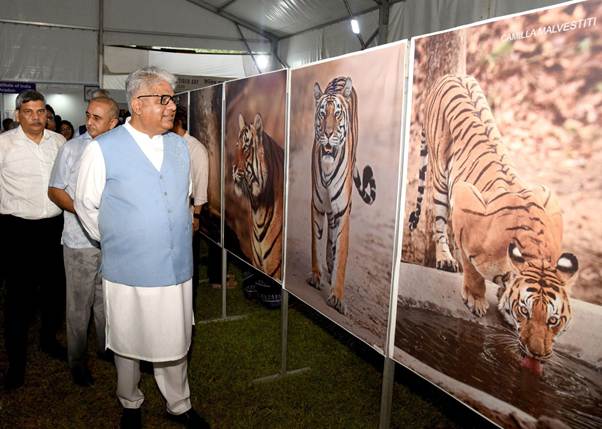
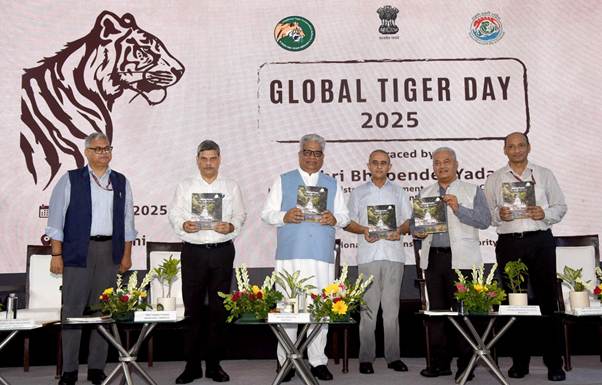
Bhupender Yadav presided over Global Tiger Day 2025 celebrations in New Delhi

| Published on:

Union Minister for Environment, Forest and Climate Change, Shri Bhupender Yadav, presided over the Global Tiger Day 2025 celebrations, held today at the National Zoological Park, New Delhi.

Speaking on the occasion, the Minister emphasized the importance of ecological balance, conservation awareness among children, and gratitude towards nature. Shri Yadav congratulated schools and teachers for sensitizing young minds about wildlife conservation and preserving biodiversity.

Highlighting the Government’s commitment to wildlife conservation, the Minister stated, “Under the leadership of Prime Minister Shri Narendra Modi, the number of tiger reserves in India has increased from 46 in 2014 to 58 till date. This growth reflects the Prime Minister’s unwavering commitment to protecting our national animal.”

The Minister announced the launch of a nationwide tree plantation drive, where over 1 lakh saplings will be planted across all 58 tiger reserves, making it one of the largest such campaigns in the world.

Calling for greater environmental consciousness, Shri Yadav urged children and citizens to plant at least one tree in their mother’s name under Ek Ped Maa Ke Naam, as a gesture of gratitude to both matru shakti and Dharti Maa (Mother Earth). He said, “Just as our mother nurtures us, so does Mother Earth. A tree offers shelter to birds, bears fruit without asking, and provides oxygen selflessly. Let us all plant a tree for our mothers and for the planet.”

Shri Yadav also drew attention to the International Big Cat Alliance (IBCA) launched by India, which aims to protect the seven big cats found globally. He informed that 24 countries have already agreed to join this global effort, with the IBCA headquarters to be based in India.

The Minister called upon the youth to live a life of determination, patience, and humility, and to contribute back to society through conservation efforts under Mission Life: “Let us not forget, true progress lies in maintaining harmony with nature. The most powerful creature, like the tiger, also teaches us humility. That is the essence of ecological balance.”

Also gracing the occasion were dignitaries including Union Minister of State (MoEFCC), Shri Kirti Vardhan Singh, along with a diverse group of stakeholders including government officials, frontline forest staff, scientists, conservationists, NGOs, students, and community representatives. The presence of different stakeholders highlighted the collective, multi-stakeholder effort required to sustain and build upon the gains made in tiger conservation.

A special highlight of the 2025 celebrations was the Eco-Shop Exhibition, featuring eco-shops from different Tiger Reserves across the country. The stalls offered a wide variety of community-based sustainable products and eco-development products from the Western Ghats and Southern landscapes. These products represent a fusion of cultural heritage and ecological responsibility.

The Eco-Shop Exhibition highlights the critical link between conservation and community livelihoods, showcasing how sustainable enterprise models can empower local communities, support forest-dependent families, and contribute directly to conservation goals by reducing pressures on tiger habitats and mitigating conflict.

During the event, Shri Yadav inaugurated plantation drives  across all 58 tiger reserves in India, through a virtual mode. As part of this initiative, each tiger reserve will plant 2,000 saplings of indigenous plant species in degraded areas to promote habitat restoration and strengthen the ecological foundations essential for tiger conservation. The event also included the inauguration of forest nurseries, at three locations in the Aravalli landscape, which will serve as a key resource for afforestation using native species and for fostering long-term ecological resilience. The day also marked the launch of the ‘Plastic-Free Tiger Reserves’ campaign, aimed at eliminating the use of all single-use plastics within tiger reserves.

The Minister also unveiled four important publications, each highlighting a unique aspect of India’s wildlife conservation narrative under the National Tiger Conservation Authority (NTCA):

  • Report on “Status of Small Cats in the Tiger Landscape of India”
  • STRIPES Magazine – Global Tiger Day Special Edition
  • Books – “Waterfalls of Tiger Reserves in India” and “Water Bodies inside Tiger Reserves of India” by Sh. Bharat Lal and Dr. S.P. Yadav

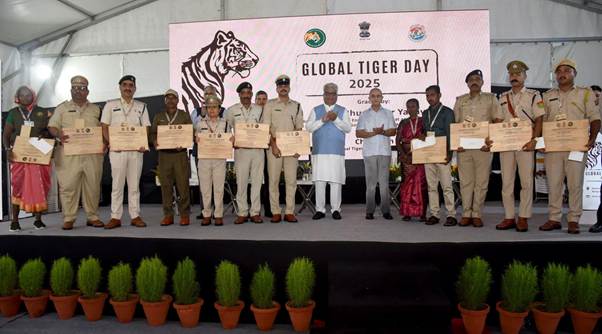
Shri Yadav also distributed NTCA awards under 7 categories that included, Posthumous/Life sacrificed in line of duty; Wildlife Crime Detection, Investigation and Prosecution; Wildlife Monitoring; Wildlife Habitat Management; Wildlife Protection and Anti-Poaching activities; People’s Participation & Eco-development and Voluntary Village Relocation works.

Altogether, the celebrations on Global Tiger Day 2025 reflect India’s long-standing commitment to tiger conservation, aligning grassroots participation with policy-level strategies. They illustrate a holistic approach that values ecological integrity, community well-being and international cooperation as essential elements for ensuring the long-term survival of tigers in the wild.

Overall politico-military objective of Operation Sindoor was to punish Pakistan for fighting a proxy war: Raksha Mantri

| Published on:

“The objective of Operation Sindoor was not to cross the border or capture the territory, it was to eliminate terror nurseries which Pakistan had nurtured for years, and provide justice to the innocent families who lost their loved ones in cross-border attacks,” said Raksha Mantri Shri Rajnath Singh in the Lok Sabha on July 28, 2025. He termed Pakistan-sponsored terrorism as not “Random Madness”, but a “well-planned strategy” and a “fundamental rage”, emphasising that the overall politico-military objective of Operation Sindoor was to punish Pakistan for fighting a proxy war in the form of terrorism.

Raksha Mantri asserted that, during Operation Sindoor, India not only demonstrated its military capability, but also its national resolve, morality and political acumen, stressing that New Delhi will give a decisive and clear answer to any terrorist attack. “Those who provide shelter and support to terrorism will not be spared. India is not going to bow down to any kind of nuclear blackmailing or other pressures,” he said.

Shri Rajnath Singh described the Pahalgam terrorist attack on April 22, 2025, when 26 innocent people, including a Nepali citizen, were killed on the basis of their religion, as the vilest example of inhumanity, which tested the limits of India’s tolerance. He stated that, immediately after the attack, PM Modi held a high-level meeting, and the Armed Forces were given the freedom to take decisive action keeping in mind discretion, strategic understanding and regional security situation.

“On May 06 & 07, 2025, the Indian Armed Forces launched Operation Sindoor, which was not just a military action, but an effective and decisive demonstration of the Government’s responsibility towards India’s sovereignty, its identity & the people of the country, as well as its policy against terrorism. Our military leadership not only showed its maturity but also demonstrated the strategic wisdom which is expected from a responsible power like India,” said Shri Rajnath Singh.

Raksha Mantri highlighted that the Armed Forces carried out Operation Sindoor after studying every aspect in depth. “There were a number of options on the table, but we chose the option in which the terrorists and their hideouts suffered maximum damage and the common citizens of Pakistan did not suffer any harm. According to an estimate, over 100 terrorists, their trainers, handlers and associates were killed in well-coordinated strikes by our forces at nine terror infrastructure targets in Pakistan and PoK with precision. Most of the terrorists belonged to organisations like Jaish-e-Mohammed, Lashkar-e-Taiba and Hizbul Mujahideen, which have the open support of Pakistan Army and ISI. Our action was completely in self-defence. It was neither provocative nor expansionist,” he said.

Shri Rajnath Singh further stated that, on May 10, 2025, Pakistan used missiles, drones, rockets and other long-range weapons on India, in addition to technologies related to electronic warfare, on a large scale, targeting Indian Air Force bases, Indian Army ammunition depots, airports and military cantonments. He informed the House with pride that India’s air defence system, counter-drone system and electronic equipment completely foiled the attack, highlighting the effectiveness of S400, Akash Missile System and air defence guns.

“Our security system was foolproof and every attack was foiled. Pakistan was unable to hit any of the Indian targets and none of the important assets were damaged,” said Raksha Mantri, while appreciating the soldiers for their bravery & determination.

Raksha Mantri termed India’s response to Pakistan’s attack as bold, firm and effective. “The Indian Air Force targeted Pakistan’s airbases, Command and Control centers, Military infrastructures, and Air Defense Systems on the Western Front, and the mission was successfully accomplished. Our retaliatory attack was swift, proportionate and precise,” he stated.

Shri Rajnath Singh added that the Indian Armed Forces only targeted those who were continuously involved in trying to attack India while supporting terrorists. The objective was never to wage war but to compel the adversary to bow down through demonstrative use of force,” he said, asserting that none of soldiers suffered any casualties during the operation.

Raksha Mantri informed the House that, on the morning of May 10, when the Indian Air Force struck heavy blows on multiple Pakistani airfields, Pakistan conceded defeat and offered to cease hostilities. “The offer was accepted with the caveat that the operation was only paused, and if there was any future misadventure on the part of Pakistan, it would lead to the resumption of the operation. The attacks by the Indian Air Force, strong retaliation by the Indian Army along the LoC and the fear of Naval attacks forced Pakistan to surrender. And this defeat of Pakistan was not simply a failure, but a defeat of its military strength and morale,” he said.

Shri Rajnath Singh stated that on May 10, the DGMO of Pakistan contacted the DGMO of India & appealed to halt the military operations, and after formal talks on May 12 between the two DGMOs, both sides decided to put a halt to the operations. He added that, after the operation, he visited the border areas to meet the soldiers, and was first-hand witness to their unwavering resolve. “Our soldiers are not only protecting the borders, but also safeguarding our national self-respect,” he said.

Raksha Mantri dubbed Operation Sindoor as a shining example of Tri-services coordination as the Indian Air Force attacked from the sky, Indian Army stood firm on the Line of Control and gave a befitting reply to every action, and the Indian Navy strengthened its deployment in the North Arabian Sea. “The Indian Navy gave a clear message to Pakistan that we are not only capable but also ready to attack their every important base, from sea to land,” he said.

Rejecting the claims that the operation was stopped under pressure, Shri Rajnath Singh termed them as “baseless and incorrect”. He stated that India halted the action as all the political and military objectives were fully achieved. He reiterated that Operation Sindoor has only been halted, and not ended. “If Pakistan again tries to carry out any nefarious act, we are fully prepared for an even more intense and decisive action,” he said.

Raksha Mantri asserted that, under PM Modi’s leadership, India does not tolerate, it responds and the Government is committed to completely eradicate terrorism in all its forms and manifestations.

Shri Rajnath Singh reiterated that India has always batted for cordial and cooperative relations with its neighbours including Pakistan, but its peace efforts have been misunderstood as naive. He stated that the Government adopted another path to ensure peace through surgical strike in 2016, Balakot air strike in 2019 and Operation Sindoor in 2025, and its stand has been clear that terrorism and talks cannot go together. “Talks are carried out between civilised, democratic countries. But, a nation which does not have even an iota of democracy in its existence and only has religious fanaticism, terrorism and hatred against India, dialogue cannot take place…,” he said.

Raksha Mantri informed the House that Pakistan is the nursery of global terrorism and it has made the menace the basis of its state policy. He stated that Pakistan arranged State Funeral for the terrorists, which was attended by military officers. “Pakistan cannot muster the courage to fight the soldiers on the border, so it makes innocent civilians, children and pilgrims the target of terrorism. Its Army and ISI use terrorism as a proxy war, and they dream of destabilising India. Those who dream to give India a thousand cuts must never forget that this is the New India led by PM Modi, which can go to any extent against terrorism,” he added.

Shri Rajnath Singh reasserted that India has never occupied even an inch of anyone’s land, and it does not believe in competing with a country like Pakistan, which is nowhere near in size, strength, power and prosperity. India’s policy, he said, is to take effective action against terrorism, and its opposition to Pakistan is due to the country’s support to the global menace.

Raksha Mantri stressed that India’s conflict with Pakistan is not a border conflict but the one of civilisation versus barbarism. “The leaders of Pakistan know that their soldiers cannot defeat India in the battlefield so they nurture terrorism while portraying themselves as innocents in front of the whole world. Pakistan used terrorism as a toolkit which is in opposition to the civilised code of conduct that the rest of the world prefers to abide by.

Shri Rajnath Singh informed the House that India’s fight against terrorism is being fought on the ideological front, and not only on the border. He expressed gratitude to all the delegations which presented, on global forums, India’s zero tolerance policy against terrorism and Operation Sindoor. He acknowledged the fact that political parties kept aside their ideologies and differences and showed solidarity with the nation, the soldiers and the government.

Raksha Mantri assured the House and the people of the country that the Government, the Armed Forces and democratic institutions are committed to taking every step necessary for the unity, integrity and security of the nation.

Dr. Jitendra Singh Unveils Major Initiatives on Earth Sciences Ministry’s Foundation Day

| Published on:

In a significant push toward building a climate-resilient and scientifically empowered India, Union Minister Dr. Jitendra Singh today unveiled a set of new scientific tools and digital services developed by the Ministry of Earth Sciences (MoES), while calling for deeper public engagement and wider awareness of science-driven citizen services. Marking the 19th Foundation Day of the Ministry at an event held in the national capital, the Minister said the past decade had seen a remarkable turnaround in the Ministry’s visibility, outreach, and real-time impact on people’s lives.

Dr. Jitendra Singh said that science and innovation were not just central to ecological sustainability but would also play a pivotal role in India’s economic rise in the coming decades. “We are now at a stage where even a casual user can access live weather alerts, cyclone warnings, air quality updates, and ocean forecasts on their mobile phones. This is the result of a Government that works in mission mode and a Ministry that has turned itself into a citizen-service institution,” he said.

During the celebrations, the Minister formally launched 14 major products and initiatives developed by various institutes under the MoES. These included rainfall monitoring and crop-weather calendars, advanced weather forecasting systems like the Bharat Forecast System – Extended Range Prediction (BharatFS-ERP), high-resolution rainfall datasets, updated wave atlases and seabed charts, air quality forecasting systems, marine biodiversity reports, and seismic microzonation studies of four Indian cities. A new documentary titled Life Saving Impact, produced by the India Meteorological Department, was also released.

Referring to the transformation over the last ten years, Dr. Jitendra Singh noted that the number of Doppler weather radars in the country had increased from just 15 to 41 today. Similarly, seismic and weather stations, upper-air observation systems, lightning detection networks, and rain gauges have all more than doubled. “From two to three minutes after an earthquake, we now issue alerts that are instantly accessed by lakhs of people online. Such is the demand that our servers crashed during a recent Delhi tremor due to the rush of users,” he observed.

He praised the IMD’s progress in cyclone forecasting and said that extreme weather alerts now have a lead time of up to 10 days. He recalled how Odisha’s loss of 10,000 lives in the 1999 super cyclone spurred many improvements, with recent storms being managed with minimal casualties thanks to timely alerts.

Dr. Jitendra Singh also highlighted how the Ministry’s work is supporting critical sectors like agriculture and fisheries. He said over seven lakh farmers are registered on the Ministry’s Meghdoot app, using its advisories to plan sowing, irrigation, and harvest schedules. Similarly, fishermen across the coast rely on daily SMS updates to determine safe and fuel-efficient fishing zones.

The Minister stressed the need to enhance communication and public outreach. “Many people still don’t know about the tools we’ve developed. We must communicate in the language people understand best,” he said, suggesting closer coordination with other ministries and government communication platforms.

He also drew attention to India’s efforts in ocean-based sustainability, especially in the Lakshadweep islands, where six Ocean Thermal Energy Conversion (OTEC) desalination plants now provide 1.5 lakh litres of potable water daily. “For centuries, these islanders had no fresh water despite being surrounded by the sea. Now they are not only water-sufficient but water-rich,” he said.

Calling the Deep Ocean Mission a potential game-changer, Dr. Jitendra Singh said India’s unexplored underwater wealth could be a major driver of future economic growth. “Just as we aim to send one Indian into space through Gaganyaan next year, we may soon see Indians diving 6 km below sea level with Samudrayaan. One up, one down—that’s the vision,” he remarked.

The Minister also noted that the Ministry’s budget had risen from ₹1,281 crore in 2014 to ₹3,658 crore in 2024, enabling ambitious projects and advanced research. He credited this shift to the sustained support of the current Government and urged the scientific community to carry this momentum forward.

The Foundation Day saw the participation of Secretary, MoES, Dr. M. Ravichandran; Joint Secretary, Shri D. Senthil Pandiyan; Director General, IMD, Dr. Mrutyunjay Mahapatra; Programme Head Dr. Vijay Kumar; and Guest of Honour Prof. Dev Niyogi, UNESCO Chair at the University of Texas, who joined virtually.