Prime Minister chairs meeting on India’s mission to eliminate TB

| Published on:

The Prime Minister, Shri Narendra Modi today chaired a meeting on India’s mission to eliminate TB. “Driven by active public participation, the movement has gained significant momentum over the last few years”, Shri Modi stated.

The Prime Minister posted on X;

“Chaired a meeting on India’s mission to eliminate TB. Driven by active public participation, the movement has gained significant momentum over the last few years. Our Government remains committed to working closely with all stakeholders to realise the vision of a TB-free India.”

Prime Minister interacts with the brave air warriors and soldiers

| Published on:

The Prime Minister Shri Narendra Modi visited and interacted with the brave air warriors and soldiers at the Air Force Station at Adampur today. Addressing them, he highlighted the power of the slogan ‘Bharat Mata Ki Jai’, emphasizing that the world has just witnessed its strength. Remarking that this is not merely a chant but a solemn oath taken by every soldier who risks their life to uphold the dignity of Mother India, the Prime Minister stated that this slogan is the voice of every citizen who wishes to live for the nation and make a meaningful contribution. He underscored that ‘Bharat Mata Ki Jai’ echoes both in the battlefield and in critical missions. He noted that when Indian soldiers chant ‘Bharat Mata Ki Jai’, it sends shivers down the enemy’s spine. He emphasized India’s military might, stating that when Indian drones demolish enemy fortifications and when missiles strike with precision, the enemy hears only one phrase—‘Bharat Mata Ki Jai’. Prime Minister Modi asserted that even in the darkest of nights, India has the capability to illuminate the sky, forcing the enemy to witness the indomitable spirit of the nation. He declared that when India’s forces dismantle threats of nuclear blackmail, the message reverberates across the heavens and the depths—‘Bharat Mata Ki Jai’.

Praising the courage and determination of India’s armed forces, stating that they have filled the hearts of millions of Indians with pride, Shri Modi remarked that every Indian stands taller today because of their unparalleled bravery and historic achievements. He added that it was indeed a great fortune to visit the brave heroes, emphasizing that when the nation’s heroism is discussed decades from now, the soldiers leading this mission will be the most celebrated figures. He asserted that they have become an inspiration not only for the present but also for future generations. Addressing the armed forces from the land of valiant warriors, he saluted the courageous personnel of the Air Force, Navy, Army, and the Border Security Force (BSF). He hailed their heroic efforts, declaring that the impact of Operation Sindoor is resonating across the nation. He noted that during the operation, every Indian stood firmly with the soldiers, offering prayers and unwavering support. He expressed the deep gratitude of the entire nation to its soldiers and their families, recognizing their sacrifices.

“Operation Sindoor is not an ordinary military campaign but a trinity of India’s policy, intent, and decisive capability”, emphasised the Prime Minister, highlighting that India is the land of both Buddha and Guru Gobind Singh Ji, who declared, “I will make one warrior fight against 125,000… I will make sparrows defeat hawks… only then will I be called Guru Gobind Singh.” He remarked that raising arms against injustice for the establishment of righteousness has always been India’s tradition. He affirmed that when terrorists dared to attack and harm India’s daughters, the Indian forces crushed them in their own hideouts. He stated that these attackers arrived in cowardly secrecy, forgetting whom they had challenged—the mighty Indian armed forces. He praised the bravery of India’s soldiers, noting that they struck directly, demolishing major terror hubs. Nine terrorist hideouts were destroyed, and over 100 terrorists were eliminated. The Prime Minister declared that the masterminds of terrorism now understand one undeniable consequence of provoking India—absolute destruction. Asserting that any attempt to shed innocent blood in India would lead only to devastation, he underscored that the Pakistani army, which harbored these terrorists, has been decisively defeated by the Indian Army, Air Force, and Navy. “The Indian Armed forces have sent a clear message to Pakistan—there is no safe haven left for terrorists”, stated the PM, affirming that India will strike them within their own territory, leaving no chance of escape. He declared that India’s drones and missiles have instilled such fear that Pakistan will lose sleep for days merely thinking about them. Quoting lines written about Maharana Pratap’s famed horse, Chetak, he remarked that these words now resonate perfectly with India’s advanced modern weaponry.

“The success of Operation Sindoor has strengthened the nation’s resolve, unified the country, safeguarded India’s borders and elevated India’s pride to new heights”, stated Shri Modi, lauding the extraordinary efforts of the armed forces, describing their actions as unprecedented, unimaginable, and remarkable. He highlighted the deep precision of the Indian Air Force’s strikes, noting that they successfully targeted terrorist hideouts deep within Pakistan. Shri Modi remarked that within just 20-25 minutes, Indian forces executed cross-border strikes with absolute accuracy, hitting pinpoint targets. He asserted that such operations can only be carried out by a modern, technologically equipped, and highly professional force. He commended the speed and precision of India’s military, stating that their swift and decisive actions left the enemy completely stunned. He remarked that the adversaries had no idea when their strongholds were reduced to rubble.

Underscoring that India’s objective was to strike terrorist headquarters deep inside Pakistan and eliminate key terror operatives, the Prime Minister stated that despite Pakistan’s attempt to shield its activities by using civilian aircraft as cover, the Indian forces responded with utmost caution and precision. He commended the armed forces for successfully executing their mission while maintaining vigilance and responsibility. He proudly declared that Indian soldiers fulfilled their objectives with absolute accuracy and determination. He highlighted that the operation not only dismantled terrorist hideouts and airbases within Pakistan but also crushed their malicious intentions and reckless audacity.

Shri Modi stated that following Operation Sindoor, the enemy, in frustration, repeatedly attempted to target multiple Indian airbases. However, each of Pakistan’s attempts to attack was decisively thwarted. He underlined that Pakistani drones, UAVs, aircraft, and missiles all failed before India’s powerful air defense system. He emphasized that India’s preparedness and technological strength ensured the complete neutralization of enemy threats. He expressed deep appreciation for the leadership overseeing the nation’s airbases and extended heartfelt admiration to every Air Warrior of the Indian Air Force. He commended their outstanding performance and unwavering dedication in defending the country.

Asserting that India’s stance against terrorism is now unequivocally clear, the Prime Minister declared that if there is another terrorist attack on India, the nation will respond decisively and forcefully. He recalled India’s firm actions during past surgical strikes and air strikes, stating that Operation Sindoor has now become the country’s new normal in tackling threats. He reiterated the three key principles which he expressed in his address to the nation last night. Firstly, if India is targeted by a terrorist attack, the response will be on its own terms and conditions. Secondly, India will not tolerate any form of nuclear blackmail. Third being, India will no longer differentiate between terrorist masterminds and the governments that shelter them. “The world is now recognizing this new and resolute India, adjusting to its firm approach toward national security and counterterrorism”, emphasised the Prime Minister.

“Every moment of Operation Sindoor stands as a testament to the strength and capability of India’s armed forces”, exclaimed Shri Modi, praising the exceptional coordination among the Army, Navy, and Air Force, stating that their synergy was remarkable. He highlighted the Navy’s dominance over the seas, the Army’s reinforcement of the borders, and the Indian Air Force’s dual role in attack and defense. He commended the Border Security Force (BSF) and other security forces for their outstanding performance. He underscored the effectiveness of India’s integrated air and land combat systems, declaring that this level of jointness has now become a defining characteristic of India’s military prowess.

Highlighting the remarkable coordination between manpower and advanced military technology during Operation Sindoor, the Prime Minister noted that India’s traditional air defense systems, which have witnessed multiple battles, were reinforced by indigenous platforms like Akash and modern, powerful systems such as the S-400. He emphasized that India’s robust security shield has become a defining strength. Despite Pakistan’s repeated attempts, Indian airbases and key defense infrastructure remained completely secure. The Prime Minister credited this success to the dedication and valor of every soldier stationed at the borders and every individual involved in the operation. He acknowledged their commitment as the foundation of India’s unwavering national defense.

Asserting that India now possesses cutting-edge technology that Pakistan cannot match, Shri Modi said that over the past decade, the Indian Air Force and other military branches have gained access to some of the world’s most advanced defense technologies. He acknowledged that with new technology come significant challenges and  maintaining and efficiently operating complex and sophisticated systems requires immense skill and precision. Lauding India’s armed forces for seamlessly integrating technology with tactical expertise, demonstrating their superiority in modern warfare, Shri Modi declared that the Indian Air Force has now mastered the art of countering adversaries not just with weapons but also with data and drones.

Stating that India’s military action has been temporarily halted only in response to Pakistan’s appeal, the Prime Minister stressed that if Pakistan engages in any further terrorist activities or military provocations, India will retaliate with full force. He affirmed that India’s response will be determined solely on its own terms and conditions. He credited this decisive stance to the courage, valor, and vigilance of the nation’s armed forces. Urging the soldiers to maintain their unwavering determination, passion, and readiness, stressing that India must remain alert and prepared at all times, the Prime Minister concluded by declaring that this is a new India—an India that desires peace but will not hesitate to crush adversaries if humanity is threatened.

PM congratulates everyone who has cleared the CBSE Class XII and X examinations

| Published on:

The Prime Minister, Shri Narendra Modi congratulated everyone who has cleared the CBSE Class XII and X examinations, today. “This is the outcome of your determination, discipline and hard work. Today is also a day to acknowledge the role played by parents, teachers and all others who have contributed to this feat”, Shri Modi added.

Prime Minister, Shri  Modi stated, “To those who feel slightly dejected at their scores, I want to tell them: one exam can never define you. Your journey is much bigger and your strengths go far beyond the mark sheet. Stay confident, stay curious because great things await”.

The Prime Minister posted on X;

Dear #ExamWarriors,

Heartiest congratulations to everyone who has cleared the CBSE Class XII and X examinations! This is the outcome of your determination, discipline and hard work. Today is also a day to acknowledge the role played by parents, teachers and all others who have contributed to this feat.

Wishing Exam Warriors great success in all the opportunities that lie ahead!

PM visits AFS Adampur to meet brave air warriors and soldiers

| Published on:

The Prime Minister, Shri Narendra Modi visited AFS Adampur today, to meet our brave air warriors and soldiers.  “It was a very special experience to be with those who epitomise courage, determination and fearlessness”, Shri Modi stated.

The Prime Minister posted on X;

“Earlier this morning, I went to AFS Adampur and met our brave air warriors and soldiers. It was a very special experience to be with those who epitomise courage, determination and fearlessness. India is eternally grateful to our armed forces for everything they do for our nation.”

Prime Minister addresses the nation

| Published on:

The Prime Minister Shri Narendra Modi addressed the nation via videoconference today. In his address, he remarked that the nation has witnessed both India’s strength and restraint in recent days. He extended his salute to the country’s formidable armed forces, intelligence agencies, and scientists on behalf of every Indian citizen. The Prime Minister highlighted the unwavering courage displayed by India’s brave soldiers in achieving the objectives of Operation Sindoor, acknowledging their valor, resilience, and indomitable spirit. He dedicated this unparalleled bravery to every mother, sister, and daughter of the nation.

Condemning strongly the barbaric terrorist attack in Pahalgam on April 22, stating that it shocked both the nation and the world, Shri Modi described the act as a gruesome display of terror, where innocent civilians enjoying their holidays were brutally killed after being questioned about their faith—right in front of their families and children. He stressed that this was not just an act of cruelty but also a vile attempt to fracture the nation’s harmony. Expressing his deep personal anguish over the attack, he highlighted how the entire nation—every citizen, every community, every section of society, and every political party—stood united in demanding strong action against terrorism. He asserted that the government had given the armed forces full freedom to eliminate the terrorists. He warned all terrorist organizations, declaring that they now fully understand the consequences of attempting to harm the dignity of the nation’s women.

“Operation Sindoor is not just a name but a reflection of the emotions of millions of Indians”, emphasised the Prime Minister, describing it as an unwavering pledge to justice, one that the world witnessed being fulfilled on May 6-7. The Prime Minister highlighted that the Indian armed forces executed precise strikes on terrorist hideouts and training centers in Pakistan, delivering a decisive blow. He remarked that the terrorists never imagined India would make such a bold move, but when the nation stands united with Nation First as its guiding principle, firm decisions are taken and impactful results are delivered. He stated that India’s missile and drone strikes on terrorist hubs in Pakistan shattered not only their infrastructure but also their morale. The Prime Minister pointed out that locations like Bahawalpur and Muridke had long operated as centers of global terrorism, linking them to major attacks worldwide, including 9/11 attacks of US, the London Tube bombings, and decades of terrorist incidents in India. He declared that since terrorists had dared to destroy the dignity of Indian women, India had eliminated the headquarters of terror. The operation resulted in the elimination of over 100 dangerous terrorists, including key figures who had openly plotted against India for decades, he added, affirming that those who orchestrated threats against India had been swiftly neutralized.

Shri Modi stated that India’s precise and forceful strikes had left Pakistan in deep frustration, pushing it into desperation. In its agitation, Pakistan resorted to a reckless act instead of joining the global fight against terrorism—it launched attacks on Indian schools, colleges, gurudwaras, temples, and civilian homes, also targeting military bases, he added. He highlighted how this aggression exposed Pakistan’s vulnerabilities, as its drones and missiles crumbled like straw before India’s advanced air defense systems, which neutralized them in the sky. He remarked that while Pakistan had prepared to strike India’s borders, India delivered a decisive blow to Pakistan’s core. Indian drones and missiles executed highly accurate strikes, severely damaging Pakistani airbases that it had long boasted about. Within the first three days of India’s response, Pakistan suffered destruction far beyond its expectations. Following India’s aggressive countermeasures, Pakistan began seeking ways to de-escalate, appealing to the global community for relief from rising tensions. He revealed that, after suffering severe losses, Pakistan’s military reached out to India’s DGMO on the afternoon of May 10. By then, India had already dismantled large-scale terrorist infrastructure, eliminated key militants, and reduced Pakistan’s terror hubs to ruins. Shri Modi noted that Pakistan, in its appeal, assured that it would cease all terrorist activities and military aggression against India. In light of this statement, India reviewed the situation and decided to temporarily suspend its counter-operations against Pakistan’s terrorist and military installations. He reiterated that this suspension is not a conclusion—India will continue to assess Pakistan’s every move in the coming days, ensuring that its future actions align with its commitments.

The Prime Minister emphasized that India’s armed forces—the Army, Air Force, Navy, Border Security Force (BSF), and paramilitary units—remain on high alert, ensuring national security at all times. “Operation Sindoor is now India’s established policy in the fight against terrorism, marking a decisive shift in India’s strategic approach”, he declared, stating that the operation has set a new standard, a new normal in counter-terrorism measures. The Prime Minister outlined three key pillars of India’s security doctrine; firstly the Decisive Retaliation, when Any terrorist attack on India will be met with a strong and resolute response. India will retaliate on its own terms, targeting terror hubs at their roots. The second is No Tolerance for Nuclear Blackmail; India will not be intimidated by nuclear threats. Any terrorist safe haven operating under this pretext will face precise and decisive strikes. Third pillar being No Distinction Between Terror Sponsors and Terrorists; India will no longer see terrorist leaders and the governments sheltering them as separate entities. He pointed out that during Operation Sindoor, the world once again witnessed Pakistan’s disturbing reality—senior Pakistani military officials openly attending funerals of eliminated terrorists, proving Pakistan’s deep involvement in state-sponsored terrorism. The Prime Minister reaffirmed that India will continue taking decisive steps to safeguard its citizens against any threat.

Asserting that India has consistently defeated Pakistan on the battlefield, and Operation Sindoor has added a new dimension to the nation’s military prowess, Shri Modi highlighted India’s remarkable capability in both desert and mountainous warfare while also establishing superiority in New Age Warfare. He emphasized that during the operation, the effectiveness of Made in India defense equipment was decisively proven. He remarked that the world is now witnessing the arrival of Made in India defense systems as a formidable force in 21st-century warfare.

Underscoring that unity is India’s greatest strength in the fight against all forms of terrorism, the Prime Minister reaffirmed that while this era is not one of war, it cannot be one of terrorism either. “Zero Tolerance against terrorism is the guarantee of a better and safer world”, he declared.

Shri Modi asserted that Pakistan’s military and government have continuously nurtured terrorism, warning that such actions will eventually lead to Pakistan’s own downfall. He declared that if Pakistan seeks survival, it must dismantle its terror infrastructure—there is no other path to peace. He reaffirmed India’s firm stance, stating that terror and talks cannot coexist, terror and trade cannot run parallel, and blood and water cannot flow together. Addressing the global community, he reiterated India’s long-standing policy that any discussions with Pakistan will focus solely on terrorism and any negotiations with Pakistan will center around Pakistan-Occupied Kashmir (PoK).

On the occasion of Buddha Purnima, the Prime Minister reflected on Lord Buddha’s teachings, emphasizing that the path to peace must be guided by strength. He underscored that humanity must progress towards peace and prosperity, ensuring that every Indian can live with dignity and realize the dream of a Viksit Bharat. The Prime Minister asserted that for India to uphold peace, it must be strong, and when necessary, that strength must be exercised. He stated that recent events have demonstrated India’s resolve in safeguarding its principles. Concluding his address, he once again saluted the valor of the Indian armed forces and expressed his deep respect for the courage and unity of the people of India.

Prime Minister greets everyone on Buddha Purnima

| Published on:

The Prime Minister, Shri Narendra Modi has extended his greetings to all citizens on the auspicious occasion of Buddha Purnima. In a message posted on social media platform X, the Prime Minister said;

“सभी देशवासियों को बुद्ध पूर्णिमा की ढेरों शुभकामनाएं। सत्य, समानता और सद्भाव के सिद्धांत पर आधारित भगवान बुद्ध के संदेश मानवता के पथ-प्रदर्शक रहे हैं। त्याग और तप को समर्पित उनका जीवन विश्व समुदाय को सदैव करुणा और शांति के लिए प्रेरित करता रहेगा।”

Prime Minister extends greetings on National Technology Day

| Published on:

The Prime Minister, Shri Narendra Modi today extended his greetings on the occasion of National Technology Day. Shri Modi also expressed pride and gratitude to our scientists and remembered the 1998 Pokhran tests. He has also reaffirmed commitment to empowering future generations through science and research.

In a X post, the Prime Minister wrote;

“Best wishes on National Technology Day! This is a day to express pride and gratitude to our scientists and remember the 1998 Pokhran tests. They were a landmark event in our nation’s growth trajectory, especially in our quest towards self-reliance.

Powered by our people, India is emerging as a global leader in different aspects of technology, be it space, AI, digital innovation, green technology and more. We reaffirm our commitment to empowering future generations through science and research. May technology uplift humanity, secure our nation and drive futuristic growth.”

Operation Sindoor not just a military action, but a symbol of India’s political, social & strategic willpower: Raksha Mantri

| Published on:

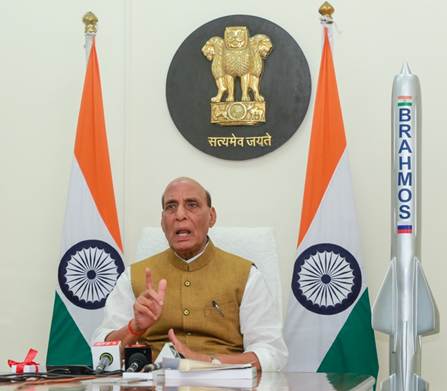
Operation Sindoor was not just a military action, but a symbol of India’s political, social and strategic willpower,” said Raksha Mantri Shri Rajnath Singh during his virtual address at the inauguration of BrahMos Integration and Testing Facility Centre in Lucknow, Uttar Pradesh on May 11, 2025. He described the operation as a demonstration of India’s strong willpower against terrorism and the capability & determination of the Armed Forces, which ensured justice to the innocent families who lost their loved ones at the hands of anti-India and terrorist organisations on the Indian soil.

Raksha Mantri termed Operation Sindoor as a proof that whenever India acts against terrorism, even the land across the border is not safe for terrorists and their masters. “Through the surgical strikes after the Uri incident, air strikes after Pulwama attack and now multiple strikes after Pahalgam attack, the world has witnessed what India can do if terror attacks are carried out on its soil. Following the policy of zero tolerance against terrorism, Prime Minister Shri Narendra Modi has made it clear that this New India will take effective action against terrorism on both sides of the border,” he said.

Shri Rajnath Singh asserted that the operation was launched to destroy terrorist infrastructure in Pakistan and PoK, and innocent civilians were not targeted, however, Pakistan targeted the civilian areas in India and tried to attack temples, gurudwaras and churches. “Our Armed Forces displayed valour & restraint and gave a befitting reply by attacking many military bases of Pakistan. Not only did we take action against military bases adjacent to the border, but the indignation of our Armed Forces reached even Rawalpindi, where the Pakistani military headquarters are located,” he said.

On the BrahMos Integration and Testing Facility Centre, Raksha Mantri said it will strengthen India’s efforts towards Aatmanirbharta in defence and contribute to the socio-economic development of the region by generating significant direct & indirect employment. He described the inauguration on National Technology Day as a landmark moment, which reflects India’s growing innovative energy and aligns with the rapid global transformation in critical, high end and frontier technologies.
A person sitting at a desk with two flagsDescription automatically generated

Shri Rajnath Singh called BrahMos as not just one of the world’s fastest supersonic cruise missiles, but a message of the strength of the Indian Armed Forces, a message of deterrence to adversaries, and a message of the nation’s unwavering commitment to safeguarding its borders. He added that BrahMos is a confluence of top defence technologies of India and Russia.

Quoting the Missile Man of India and former President Dr APJ Abdul Kalam who had said ‘Unless India stands up to the world, no one will respect us. In this world, fear has no place, only strength respects strength’, Rakha Mantri stated that India is one of the most powerful nations today and the centre will help in further strengthening India’s power.

Terming the facility as a matter of pride for the Uttar Pradesh Defence Industrial Corridor (UPDIC), Shri Rajnath Singh stated that it has already created around 500 direct and 1,000 indirect jobs, reflecting the state’s growing stature as a defence manufacturing hub. He emphasised that Prime Minister Shri Narendra Modi-led Government’s vision of setting-up the corridor rests on its goal of developing the state as the world’s top defence production and export destination.

“A total of 180 MoUs have, so far, been signed in UPDIC with a proposed investment of Rs 34,000 crore, and an investment of Rs 4,000 crore has already been made. Major investments have been made in Aircraft manufacturing, UAVs, Drones, Ammunition, Composite & Critical materials, Small Arms, Textile and Parachute etc. The highlight is that the participation of both public sector and the private sectors are being witnessed. In Lucknow itself, titanium and super alloy material plants are being started by PTC Industries Limited. In addition, the foundation of seven additional critical projects is being laid. This would accelerate the pace of India’s self-reliance in the defence sector,” Raksha Mantri said.

Shri Rajnath Singh reiterated the Government’s vision of ‘Make-in-India, Make-for-the-World’, stressing that self-reliance not only means catering to India’s own security needs, but it also envisages making the country a key exporter of defence equipment to the global market. Citing a recent report by the Stockholm International Peace Research Institute, which said that global military expenditure has risen to $2,718 billion in 2024, he stated that such a massive market is an opportunity India must seize. “The launch of the BrahMos facility is a firm stride towards making India a significant player in the world’s defence production ecosystem,” he said.

Raksha Mantri appreciated the efforts of the Uttar Pradesh government, led by Chief Minister Shri Yogi Adityanath, DRDO scientists, engineers, and other stakeholders for completing the project within 40 months. “Given the current circumstances, it is crucial that we continue to achieve our goals in a time-bound and efficient manner,” he said. He credited the state government for creating a strong development ecosystem and implementing initiatives such as setting-up of UPDIC, establishment of DRDO’s Defence Technology & Test Centre in Lucknow and hosting DefExpo in 2020.

Speaking at the inauguration site, UP Chief Minister Shri Yogi Adityanath expressed gratitude to Prime Minister Shri Narendra Modi and Raksha Mantri Shri Rajnath Singh for moving forward with the goal of making Lucknow a defence manufacturing hub. He said the facility in Lucknow will give a fillip to the Make-in-India initiative, Aatmanirbharta and investment in defence manufacturing.

On the state’s initiatives to promote defence manufacturing, Shri Yogi Adityanath said the work is proceeding with pace under all the six nodes of the UPDIC. He listed various projects in defence manufacturing that are being established in the state, covering both public and private industries.

The Chief Minister hailed Operation Sindoor as a message to the world that India no longer tolerates terrorism. There can be no solution to terrorism other than being absolutely crushed, he said.

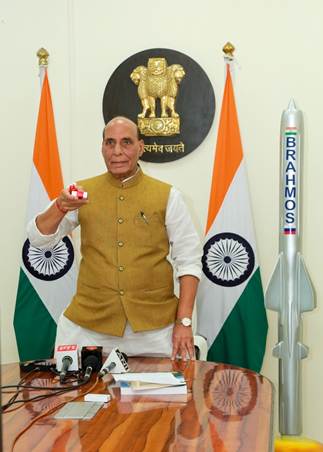
The 200-acre BrahMos Integration and Testing Facility Centre in Lucknow will have integration of Booster subassemblies, Avionics, Propellant, Ramjet engines. The programme center with Design & Administrative blocks are also being planned in the complex.

The approx. Rs 300 crore complex will pave the way for skill development for industry and entrepreneurs in a long way. The entire defence ecosystem of ancillary and sub-assemblies will be developed in the vicinity to support the complex. It will help in a big way in industrialisation and skill development of students of ITI, Supervisors, Engineers. It will ensure that people are not forced to migrate to look for job opportunities.
A person holding a small objectDescription automatically generated

Brahmos Aerospace has selected 36 trainees for the operation of the facility. Five of these newly selected trainees were felicitated by the UP Chief Minister as part of the inauguration.

Deputy Chief Ministers Shri Keshav Prasad Maurya and Shri Brijesh Pathak, Chief Secretary Shri Manoj Kumar Singh, Secretary, Department of Defence R&D and Chairman DRDO Dr Samir V Kamat, DG Brahmos Dr Jaiteerth R Joshi, public representatives and senior officials of the central & state governments were also present on the occasion.


Modern warfare is entirely technology driven and India’s supremacy stands proven over the last four days: Dr Jitendra Singh

| Published on:

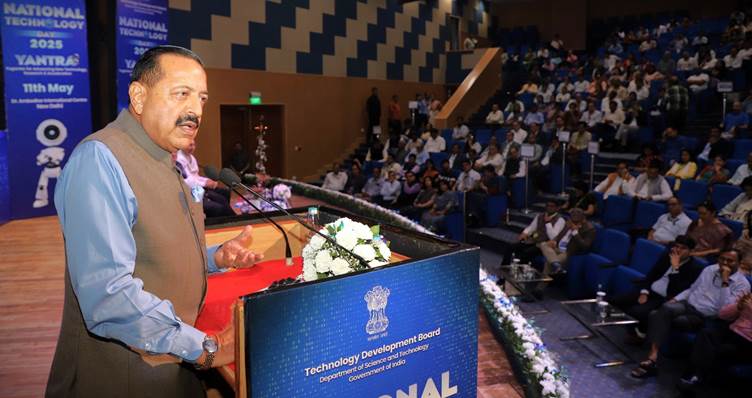
“Modern warfare is entirely technology driven and India’s supremacy stands proven over the last four days”, said Union Minister Dr Jitendra Singh while addressing the “National Technology Day” celebration at the Ambedkar International Centre, highlighting India’s rapid strides in indigenous technology development and its impact on modern warfare, during the last one decade of PM Narendra Modi regime.

Union Minister of State (Independent Charge) for Science and Technology, Minister of State (Independent Charge) for Earth Sciences, Minister of State in the Prime Minister’s Office, Department of Atomic Energy, Department of Space, and Personnel, Public Grievances, and Pensions, Dr. Jitendra Singh emphasized that modern warfare is technology-driven and events of the past four days have once again vindicated India’s technological prowess. He proudly stated that India, under the visionary leadership of Prime Minister Narendra Modi, has successfully developed and deployed home-grown technologies that have significantly enhanced national security and defence capabilities.

“Most of the technologies used today in defence are indigenously developed, and it is Prime Minister Modi who instilled the confidence in us to seek Aatmanirbhar Bharat,” said Dr. Jitendra Singh.

Recalling the origins of National Technology Day, Dr. Jitendra Singh noted that the day was first celebrated in 1998 to commemorate the successful Pokhran nuclear tests, conceptualized by then Prime Minister Atal Bihari Vajpayee. “The idea that inspired us in 1998 has matured under Prime Minister Modi’s leadership, transforming India into a global technology leader,” he added.

Dr. Jitendra Singh highlighted that indigenization has been a top priority since 2014, with Prime Minister Modi’s consistent push for self-reliance. “India is no longer dependent on external powers. Our success in modern warfare is a reflection of the progress towards Viksit Bharat @2047,” he remarked.

Expressing his satisfaction with scientific advancements, Dr. Jitendra Singh lauded the Technology Development Board (TDB) under the Department of Science and Technology (DST) for supporting pioneering initiatives, including the 1000-drone show during the Beating Retreat ceremony. He noted that drones, once symbolic, are now central to India’s evolving defence ecosystem.

Dr. Jitendra Singh appreciated TDB’s annual tradition of setting a new theme and highlighted this year’s theme “YANTRA”, which signifies transformation through advanced research and technological acceleration.

He proudly stated that India has scaled up its defence capacity substantially over the last decade and credited Prime Minister Modi for providing an enabling ecosystem for scientific growth. “India was never short of talent, but now we have leadership that fosters innovation,” he said.

Highlighting India’s remarkable progress in science, technology, and innovation, Dr. Jitendra Singh noted several key achievements that reflect the country’s growing global stature. He pointed out India’s impressive leap in the Global Innovation Index, moving from the 81st to the 39th position, and the fact that nearly 56% of patents are now filed by resident Indians—demonstrating a surge in domestic innovation. India has also emerged as the third-largest startup ecosystem in the world, fostering entrepreneurship and technological advancement. In the defence sector, exports have seen a substantial rise from ₹2,000 crore to ₹16,000 crore, showcasing the strength of indigenous capabilities. He further highlighted that budgetary allocations for Gross Expenditure on Research and Development (GERD) have more than doubled, from ₹60,000 crore to ₹1,27,000 crore, along with over a 100% increase in DST and DBT budgets. Notably, the space sector budget has nearly tripled, driven by the opening up of the sector to private participation—positioning India as a future-ready technological power.

Dr. Jitendra Singh also mentioned key initiatives like ‘One Nation, One Subscription’ and a single portal for fellowships under S&T departments, which have improved the ease of doing research in India.

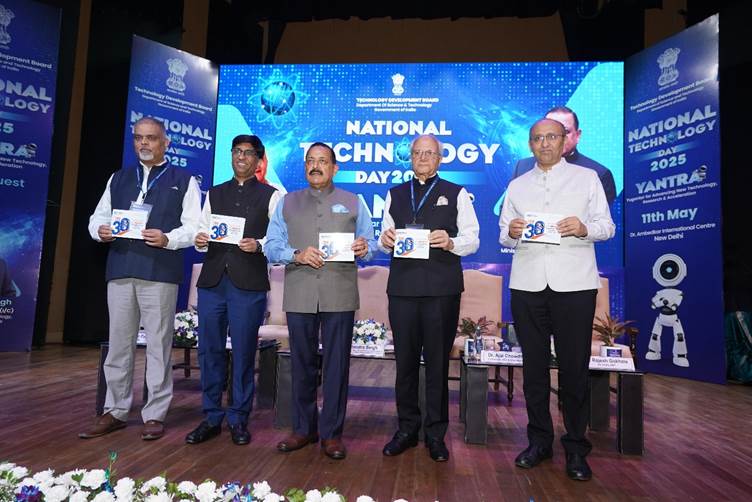
During the event, Dr. Jitendra Singh released a compendium of “Super 30 Startups” funded by TDB over the past five years and launched two new calls for proposals under the National Quantum Mission. He also handed over project grants to industry-academia consortia working on pilot projects for Carbon Capture, Utilization, and Storage (CCUS).

Concluding his address, Dr. Jitendra Singh said, “The 27th National Technology Day marks international recognition of India’s leadership in science and technology, setting the tone for India @2047.”

The event was also attended by Padma Bhushan Ajai Chowdhary, who emphasized the “Whole of Nation” approach to reducing dependence on foreign technology, and endorsed initiatives like Anusandhan NRF for achieving true Aatmanirbharta.

Also present were Dr. Abhay Karandikar, Secretary DST; Dr. Rajesh Gokhale, Secretary DBT; Dr. Rajesh Pathak, Secretary TDB; senior officials, scientists, and dignitaries from the science and technology community.

PM Modi Chairs High-Level Meeting with Secretaries of Government of India

| Published on:

The Prime Minister today chaired a high-level meeting with Secretaries of various Ministries and Departments of the Government of India to review national preparedness and inter-ministerial coordination in light of recent developments concerning national security.

PM Modi stressed the need for seamless coordination among ministries and agencies to uphold operational continuity and institutional resilience.

PM reviewed the planning and preparation by ministries to deal with the current situation.

Secretaries have been directed to undertake a comprehensive review of their respective ministry’s operations and to ensure fool-proof functioning of essential systems, with special focus on readiness, emergency response, and internal communication protocols.

Secretaries detailed their planning with a Whole of Government approach in the current situation.

All ministries have identified their actionables in relation to the conflict and are strengthening processes. Ministries are ready to deal with all kinds of emerging situations.

A range of issues were discussed during the meeting. These included, among others, strengthening of civil defence mechanisms, efforts to counter misinformation and fake news, and ensuring the security of critical infrastructure. Ministries were also advised to maintain close coordination with state authorities and ground-level institutions.

The meeting was attended by the Cabinet Secretary, senior officials from the Prime Minister’s Office, and Secretaries from key ministries including Defence, Home Affairs, External Affairs, Information & Broadcasting, Power, Health, and Telecommunications.

The Prime Minister called for continued alertness, institutional synergy, and clear communication as the nation navigates a sensitive period. He reaffirmed the government’s commitment to national security, operational preparedness, and citizen safety.

India has always played the role of a responsible nation: Raksha Mantri

| Published on:

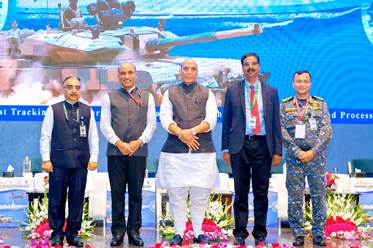
Operation Sindoor was successfully executed because our formidable & professionally-trained Armed Forces were equipped with high-quality equipment,” said Raksha Mantri Shri Rajnath Singh while addressing the National Quality Conclave in New Delhi on May 08, 2025. Raksha Mantri commended the precision with which the Armed Forces executed the operation without harming any innocent person and with minimum collateral damage, terming it as unimaginable and a matter of great pride for the nation.

“In Operation Sindoor, nine terror camps were destroyed in Pakistan & PoK, and a good number of terrorists were killed. It shows the crucial role ‘quality’ plays in securing national interests,” said Shri Rajnath Singh.

Raksha Mantri asserted that India has always played the role of a responsible nation exercising great restraint and it believes in resolving issues through dialogue, however, if anyone tries to take advantage of this restraint, they will face ‘quality action’. He assured the nation that no limit will become an obstacle for the Government in protecting India’s sovereignty. “We are fully prepared for such responsible responses in the future as well,” he said.

Sharing his views on the theme of the conclave ‘Fast-tracking of Quality Assurance through Integrated Approach and Technology Enabled Processes’, Shri Rajnath Singh stated that fast-tracking quality assessment is the need of the hour in view of the disruptive changes and new transformations being witnessed in the defence sector across the globe.

Raksha Mantri voiced the Government’s emphasis on the empowerment of the defence production sector since 2014, based on Prime Minister Shri Narendra Modi’s philosophy of Defence Sovereignty. He said: “Defence Sovereignty means that until a country is capable and self-reliant in its defence needs, its independence cannot be considered complete. If we buy weapons and other defence equipment from abroad, we are outsourcing our security and leaving it at the mercy of someone else. Our government thought over it seriously and took a decisive step to achieve self-reliance. The expanding defence industrial ecosystem is providing an unprecedented strength to India”.

Shri Rajnath Singh added that equal emphasis is being laid on quality and quantity in defence production with many revolutionary steps being taken in that direction, including corporatisation of Ordnance Factory Board (OFB). He termed Quality as the Government’s priority Reform Agenda, highlighting that since the corporatisation of OFB, DPSUs have become internationally competitive and export-oriented, with efforts being made to advance quality production.

Raksha Mantri pointed out that one of the objectives behind the progress of the public sector has been to develop a Healthy Competitive Private Defence Ecosystem, which will strengthen India’s security through quality. “In today’s world, a strong brand value is important than just a product. The brand, which assures consistent quality and reliability, succeeds,” he said.

Shri Rajnath Singh appealed to the Armed Forces, Government QA agencies, DPSUs, private industry, research institutions, academia, and MSME representatives present on the occasion to build a world-leading state-of-the-art Brand India.  “Brand India means if an Indian company has promised something, it will definitely happen. ‘Whenever in doubt, go for India’ should be our USP,” he said.

On the major changes being witnessed in the global order, Raksha Mantri stated that when developed countries move towards re-armament, the demand for arms & equipment will increase. He cited the report of Stockholm International Peace Research Institute which said that the world military expenditure has reached $ 2,718 billion in 2024. He expressed hope that with coordinated efforts, the Indian defence manufacturing sector can make its mark globally with the Brand India philosophy. “Defence exports crossed the record figure of about Rs 24,000 crore in Financial Year 2024-25. Our aim is to increase the figure to Rs 50,000 crore by 2029. The target is to make India a developed nation and the world’s largest defence exporter by 2047. To achieve the goal, we must develop global trust regarding the quality of our defence equipment,” he said.

While Shri Rajnath Singh acknowledged the efforts being made towards quality improvement, he stressed on the need to focus on using tools such as artificial intelligence, internet of things, and machine learning for real-time quality monitoring in today’s technology-driven era. He also called for updating standards and testing protocols to align with evolving global technologies. We need to focus on time-bound quality assurance clearances so that unwanted delays do not take place, he said.

Raksha Mantri added that quality assessment agencies should always keep an eye on their deficiencies and work on overcoming them through modernisation and development of testing infrastructure. Continuous gap analysis in the field of niche technology will be an essential step, he said.

Organised by the Directorate General of Quality Assurance (DGQA) under the aegis of Department of Defence Production, the conclave underscored the need to transition from legacy QA models to predictive, data-driven, and automated systems. Experts called for seamless collaboration across stakeholders to accelerate certification timelines, streamline inspections, and embed real-time quality oversight into defence production.

Secretary (Defence Production) Shri Sanjeev Kumar spotlighted the role of innovation and industry collaboration in making India a leading defence exporter. In a transparent and interactive Open House session, he addressed queries from defence industry representatives and user agencies, reinforcing the Ministry’s resolve to simplify, digitalise, and modernise QA systems.

Key Highlights & Announcements

  • A landmark session introduced the Industry 4.0/QA 4.0 Roadmap, developed jointly by DGQA and industry partners. It includes deployment of smart technologies like Internet of Things-enabled test benches, automated data capture, digital dashboards, and AI-powered analytics—aimed at reducing human error, enhancing efficiency, and enabling continuous quality monitoring across defence product life-cycles.
  • The Draft Indian Military Airworthiness Bill was formally presented for final inputs. The Bill, crafted through an inclusive process involving multiple stakeholders, including MoD, DRDO, Services, DPSUs, and industry, proposes a statutory framework for the certification of military aircraft and airborne systems. A dedicated interactive session captured final feedback from user representatives and industry forums.
  • A dedicated session explored strategies to boost the indigenous development of Explosives and Ordnance (E&O) stores. Experts examined the role of emerging technologies – AI/ML, Big Data, Additive Manufacturing, Silicon Photonics, Semiconductors, and Advanced Materials—in modernising E&O production, safety validation, and certification. The session reinforced the need for technological self-reliance in critical munitions and precision systems.

The National Quality Conclave 2025 concluded with a united commitment from all stakeholders to redefine defence QA as a strategic enabler, not just of compliance, but of national security, export capability, and indigenous innovation. The outcomes of the conclave are expected to catalyse India’s transformation into a global benchmark for defence quality assurance.

DG, DGQA Shri N Manoharan emphasised that the conclave had significantly strengthened the partnership between industry and defence stakeholders, while also advancing efforts toward standardisation and innovation in quality assurance.

Director General of Naval Armament Inspection Rear Admiral Rupak Barua, Director General of Aeronautical Quality Assurance Shri Sanjay Chawla, CMDs of DPSUs, senior MoD officers were also present on the occasion.

PM addresses the Global Conference on Space Exploration (GLEX) 2025

| Published on:

Prime Minister Shri Narendra Modi addressed the Global Conference on Space Exploration (GLEX) 2025 via videoconferencing today. Welcoming the distinguished delegates, scientists, and astronauts from across the globe, he highlighted India’s remarkable space journey at the GLEX 2025, stating that, “space is not merely a destination but a declaration of curiosity, courage, and collective progress”. He emphasized that India’s space achievements reflect this spirit, from launching a small rocket in 1963 to becoming the first nation to land near the Moon’s South Pole. “Indian rockets carry more than payloads—they carry the dreams of 1.4 billion Indians”, he remarked, stating that India’s space advancements are significant scientific milestones and proof that the human spirit can defy gravity. He recalled India’s historic achievement of reaching Mars on its first attempt in 2014. He highlighted that Chandrayaan-1 helped discover water on the Moon, Chandrayaan-2 provided the highest-resolution images of the lunar surface, and Chandrayaan-3 furthered understanding of the Moon’s South Pole. “India developed cryogenic engines in record time, launched 100 satellites in a single mission, and successfully deployed over 400 satellites for 34 nations using Indian launch vehicles”, he pointed out, underlining India’s latest accomplishment—docking two satellites in space this year—calling it a major step forward in space exploration.

Shri Modi reaffirmed that India’s space journey is not about competing with others but about reaching greater heights together. He emphasized the collective goal of exploring space for the benefit of humanity. He highlighted India’s commitment to regional cooperation, recalling the successful launch of a satellite for South Asian nations. He announced that the G20 Satellite Mission, introduced during India’s Presidency, would be a significant contribution to the Global South. He remarked that India continues to advance with renewed confidence, constantly pushing the boundaries of scientific exploration. “India’s first human spaceflight mission, ‘Gaganyaan,’ reflects the nation’s growing aspirations in space technology”, he pointed out. Shri Modi revealed that, in the coming weeks, an Indian astronaut would travel to space as part of a joint ISRO-NASA mission to the International Space Station. He further outlined India’s long-term vision, stating that by 2035, the Bharatiya Antariksha Station would facilitate groundbreaking research and international collaboration. He declared that by 2040, an Indian astronaut would leave footprints on the Moon and added that Mars and Venus remain key targets in India’s future space ambitions.

Emphasizing that for India, space is not just about exploration but also empowerment, the Prime Minister highlighted how space technology enhances governance, improves livelihoods, and inspires generations. He noted the vital role of satellites in ensuring the welfare of every Indian, citing their contributions to fishermen alerts, the GatiShakti platform, railway safety, and weather forecasting. He underscored India’s commitment to fostering innovation by opening its space sector to startups, entrepreneurs, and young minds. He pointed out that India now has over 250 space startups, contributing to advancements in satellite technology, propulsion systems, imaging, and other pioneering fields. “Many of India’s space missions are being led by women scientists”, he proudly acknowledged.

“India’s space vision is rooted in the ancient philosophy of ‘Vasudhaiva Kutumbakam’”, reaffirmed Shri Modi, stressing that India’s space journey is not just about its own growth but about enriching global knowledge, addressing shared challenges, and inspiring future generations. He emphasized India’s commitment to collaboration, stating that the nation stands for dreaming together, building together, and reaching for the stars together. Concluding his remarks, he called for a new chapter in space exploration, guided by science and the collective aspiration for a better future.