Union Minister of Health and Family Welfare launches SAHI and BODH initiatives

| Published on:

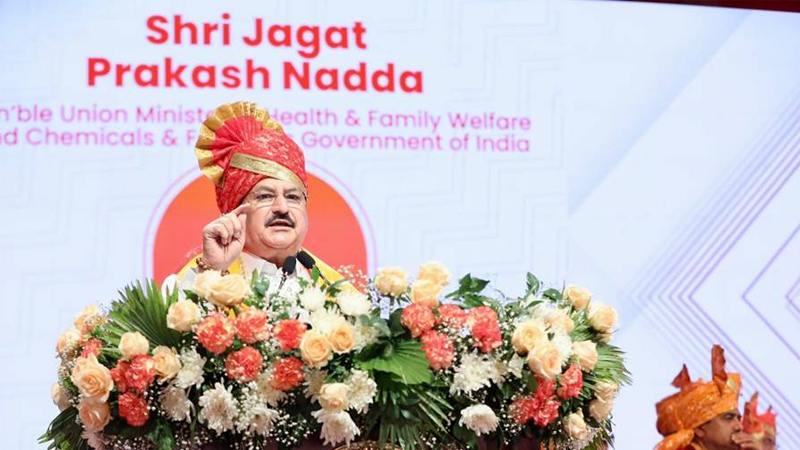
Union Minister for Health and Family Welfare,  Shri Jagat Prakash Nadda, today launched two pioneering digital health initiatives — SAHI (Strategy for Artificial Intelligence in Healthcare for India) and BODH (Benchmarking Open Data Platform for Health AI) — during the India AI Impact Summit 2026. The launch marks a significant milestone in advancing safe, ethical, and evidence-based deployment of Artificial Intelligence (AI) in India’s healthcare ecosystem.

Describing the Summit as both timely and necessary, Shri Nadda emphasized that AI does not operate in isolation, but thrives on strong digital infrastructure and high-quality data. Recognizing this early, India began laying its digital foundations nearly a decade ago. In 2015, under the leadership of the Hon’ble Prime Minister, the Government launched the Digital India programme to transform India into a digitally empowered society and knowledge economy.

The Minister noted that the health sector aligned itself decisively with this national vision. The National Health Policy, 2017 envisaged the creation of a comprehensive digital health ecosystem that would be interoperable, inclusive, and scalable. Building on this vision, the Government launched the Ayushman Bharat Digital Mission (ABDM) in 2020 to establish a robust digital public architecture for healthcare.

Highlighting the progress achieved, Shri Nadda stated that sustained efforts have led to the creation of a strong digital public infrastructure in health. Interoperable systems have been enabled across platforms, and large-scale, consent-based health data frameworks are being developed to empower citizens while ensuring data privacy and security.

In this context, the Minister referred to the launch of SAHI, the Strategy for Artificial Intelligence in Healthcare for India, describing it as not merely a technology strategy but a governance framework, policy compass, and national roadmap for the responsible use of AI in healthcare. He stated that SAHI will guide India in leveraging AI in a manner that is ethical, transparent, accountable, and people-centric.

Shri Nadda also emphasized that SAHI provides a structured framework for collaboration, ensuring that innovation flourishes while public interest remains paramount.

The Minister also underlined the transformative potential of AI in pharmaceuticals and life sciences. AI-driven tools can accelerate drug discovery, shorten research timelines, enhance clinical trial precision, and make research processes more cost-effective, thereby strengthening affordable healthcare delivery.

He further highlighted the critical role of academic institutions in developing a future-ready healthcare AI workforce. The collaboration between Government and academia has led to the development of BODH — the Benchmarking Open Data Platform for Health AI — which provides a structured mechanism for testing and validating AI solutions before deployment at scale.

Shri Nadda reiterated that AI solutions must be rigorously evaluated for performance, reliability, and real-world readiness. Together, SAHI and BODH represent India’s commitment to building a trustworthy, inclusive, and globally competitive health AI ecosystem grounded in innovation, responsibility, and public trust.

Addressing the gathering, Union Health Secretary, Punya Salila Srivastava, stated that under the visionary leadership of the Hon’ble Prime Minister, India has made tremendous strides in leveraging technology to make governance more inclusive, transparent, and efficient.

She emphasized that the launch of SAHI and BODH marks an important step in advancing the application of AI in healthcare. SAHI, she said, represents a long-term policy commitment of the Government and provides a common framework for the Union and State Governments, as well as private partners, to guide AI evaluation, adoption, and integration within the healthcare ecosystem.

Smt. Srivastava further highlighted that BODH will play a critical role in ensuring that AI tools used by clinicians are safe, reliable, and validated against real-world parameters before deployment. She stressed that trust, safety, and accountability must remain central to India’s health AI journey.

Dr. Catharina Boehme, Officer-in-Charge, World Health Organization South-East Asia Regional Office, also addressed the Summit and commended India’s leadership in digital health innovation. She noted that India is among the first countries to adopt a national AI strategy for health, setting an important global benchmark.

Dr. Boehme stated that the strategy has been designed to strengthen healthcare delivery, improve decision-making, and extend the reach of services to underserved populations. She emphasized that the approach reflects a simple but powerful principle — innovation must strengthen systems, expand access, and build trust.

Highlighting the importance of collaboration, she observed that India’s whole-of-government and whole-of-society approach ensures that SAHI reflects the realities of implementation on the ground, thereby enhancing its effectiveness and sustainability.

SAHI has been conceptualized as a comprehensive framework to promote secure, interoperable, and trustworthy AI solutions in the health sector. The initiative will facilitate collaboration among healthcare institutions, technology developers, researchers, and policymakers to ensure that AI tools meet rigorous standards of safety, efficacy, and ethical compliance prior to large-scale adoption.

The platform will also serve as a knowledge-sharing and governance hub, promoting best practices in health AI development and implementation, with strong safeguards for patient data protection and algorithmic accountability.

BODH (Benchmarking Open Data Platform for Health AI), developed by the Indian Institute of Technology Kanpur in collaboration with the National Health Authority, will enable systematic evaluation of AI models using diverse, anonymized real-world health datasets.

The platform is designed to assess performance, robustness, bias, and generalizability of AI systems before their deployment at population scale. By institutionalizing benchmarking standards, BODH aims to ensure that AI solutions are reliable, clinically relevant, and aligned with national public health priorities.

The launch of SAHI and BODH at the AI India Summit reflects India’s forward-looking vision of integrating digital innovation with public health priorities. These initiatives will foster responsible innovation while reinforcing trust in AI-enabled healthcare solutions.

The event witnessed the participation of senior officials from the Ministry of Health and Family Welfare, representatives from premier academic institutions, healthcare professionals, AI innovators, and industry stakeholders.

PM Inaugurates India AI Impact Expo 2026 in New Delhi

| Published on:

Prime Minister Shri Narendra Modi inaugurated the India AI Impact Expo 2026 at Bharat Mandapam in New Delhi today.

Shri Modi said that being among innovators, researchers, and technology enthusiasts, highlights the extraordinary potential of Artificial Intelligence, Indian talent, and innovation. He emphasized that India’s progress in AI will not only shape transformative solutions for the nation but also contribute to global advancement.

In a post on X, Shri Modi stated:

“Inaugurated the India AI Impact Expo 2026 at Bharat Mandapam.

Being here among innovators, researchers and tech enthusiasts gives a glimpse of the extraordinary potential of AI, Indian talent and innovation. Together, we will shape solutions not just for India but for the world!”

Prime Minister Welcomes Global Leaders to AI Impact Summit in Delhi

| Published on:

Prime Minister Shri Narendra Modi today welcomed the world leaders, captains of industry, innovators, policymakers, researchers, and technology enthusiasts from across the globe to the AI Impact Summit at Bharat Mandapam, New Delhi.

The Summit, themed “Sarvajana Hitaya, Sarvajana Sukhaya — Welfare for All, Happiness for All”, reflects India’s commitment to harnessing Artificial Intelligence for human-centric progress and inclusive development.

The Prime Minister highlighted the transformative role of AI across diverse sectors including healthcare, education, agriculture, governance, and enterprise. He expressed confidence that the deliberations at the Summit will enrich global discourse on innovation, collaboration, and responsible use of AI, shaping a future that is progressive, innovative, and opportunity-driven.

Prime Minister Modi underscored India’s leadership in the global AI transformation, powered by the strength of its 1.4 billion people, robust digital public infrastructure, vibrant startup ecosystem, and cutting-edge research. He emphasized that India’s strides in AI reflect both ambition and responsibility, positioning the nation at the forefront of technological advancement.

Sharing a thread post on X, Shri Modi wrote:

“Bringing the world together to discuss AI!

Starting today, India hosts the AI Impact Summit at Bharat Mandapam in Delhi. I warmly welcome world leaders, captains of industry, innovators, policymakers, researchers and tech enthusiasts from across the world for this Summit. The theme of the Summit is Sarvajana Hitaya, Sarvajana Sukhaya or welfare for all, happiness for all, reflecting our shared commitment to harnessing Artificial Intelligence for human-centric progress.”

“AI today is transforming several sectors, including healthcare, education, agriculture, governance and enterprise. The AI Impact Summit will enrich global discourse on diverse aspects of AI, such as innovation, collaboration, responsible use and more. I am confident that the outcomes of the Summit will help shape a future that is progressive, innovative and opportunity-driven.”

“Thanks to the 1.4 billion people of India, our nation stands at the forefront of the AI transformation. From digital public infrastructure to a vibrant StartUp ecosystem and cutting-edge research, our strides in AI reflect both ambition and responsibility.”

Raksha Mantri reviews projects of indigenous military gas turbine engine development during visit to DRDO’s GTRE in Bengaluru

| Published on:

Raksha Mantri Shri Rajnath Singh, on February 16, 2026, visited DRDO’s Gas Turbine Research Establishment (GTRE) in Bengaluru, and reviewed the status of ongoing projects relating to indigenous military gas turbine engine development. He was briefed on the establishment’s projects on the anvil, interactions with the Indian Industry, academia and R&D institutes, and the support provided to the defence forces. He also visited the exhibition showcasing various indigenous engines & their parts and witnessed the full afterburner engine test of the Kaveri engine.

Interacting with the scientists and officials, Raksha Mantri praised GTRE for its efforts towards bolstering national security through self-reliance, describing DRDO as the foundation of India’s strategic capability. He underscored the critical importance of achieving Aatmanirbharta in aero engine technology in the present rapidly evolving geopolitical landscape, and stated that every effort is being made to prioritise the development of aero engines in India. “Supply chains are breaking and new ecosystems are developing. Nations possessing indigenous critical technologies will remain safe, secure, and sustain themselves,” he stated, reiterating Prime Minister Shri Narendra Modi-led Government’s commitment to achieving self-reliance in every field.

Acknowledging GTRE’s efforts in this critical technology domain, Shri Rajnath Singh exhorted the lab to strive and focus on next generation engines by building a nationwide robust ecosystem, while achieving self-reliance in aero engines. He added that “We are rapidly moving towards the design and development of the Advanced Medium Combat Aircraft (AMCA). We have made numerous attempts in the past to achieve expertise in the field of aero engines. Now, the time has come to complete those efforts. We cannot limit ourselves to only 5th generation engines. We must begin the development of 6th generation, advanced technologies as soon as possible. Research on them is the need of the hour. The use of Artificial Intelligence, Machine Learning and new materials is increasing. We must stay ahead of the curve.”

Raksha Mantri described aero engine development as an extremely complex endeavour, integrating thermodynamics, material science, fluid mechanics and advanced mechanical engineering. Noting that even developed nations often take 25-30 years to develop next-generation engines, he urged Indian scientists to compress timelines in view of the nation’s strategic needs. “We must assume that 20 years have already passed and we now have only 5-7 years left,” he said, describing it as a call to action aligned with national aspirations.

Referring to Operation Sindoor, Shri Rajnath Singh emphasised that during the operation, the defence forces demonstrated India’s growing Aatmanirbharta in the defence sector. “Whether it was communication systems, surveillance equipment, or attack weapons, everything was indigenous. This boosted the morale of our soldiers and instilled pride among citizens. In view of the evolving challenges, it is imperative to focus more on indigenous methods and provide our forces with world-class systems and equipment,” he said.

Raksha Mantri praised GTRE for the joint study with the UK for aero engine development, adding that the process has been initiated with France as well for aero engines under the National Aero Engine Mission. “Both France and UK are very advanced in aero engine technology. These collaborations will not only provide us with the opportunity to learn new technologies, but also help us to understand the challenges they have faced over the past decades,” he said.

Shri Rajnath Singh also highlighted the dual-use potential of such complex technologies, stating that GTRE is making high-temperature composites, which could significantly benefit civil aviation, power generation and space sectors in the future. He stated that India is one of the fastest-growing civil aviation markets in the world and technological advancements achieved today in defence aero engines could play a transformative role in civil aviation and economic growth tomorrow.

Raksha Mantri called for capitalising on the numerous opportunities India provides, making special mention of the free trade agreement between India and the European Union, which had been pending for 18 years, has now been completed. This trade agreement is an acknowledgement of India’s growing economic and political power, he said. He also referred to his recent meeting with the Defence Minister of Greece, who he said, views India not as an emerging power, but as a superpower.

Secretary, Department of Defence R&D and Chairman DRDO Dr Samir V Kamat and senior scientists & officials of GTRE were present on the occasion.

Union Home Minister addresses the 79th Raising Day ceremony of Delhi Police  New Delhi

| Published on:

Union Home Minister and Minister of Cooperation Shri Amit Shah addressed the 79th Raising Day ceremony of the Delhi Police as the Chief Guest in New Delhi today. On this occasion, many dignitaries including Delhi Police Commissioner, Shri Satish Golchha were present.

Union Home Minister and Minister of Cooperation, Shri Amit Shah said that from its establishment till today, the Delhi Police has never left any stone unturned in fulfilling its commitment to peace, service, and justice. He stated that Delhi, besides being the capital of the country, is the heartbeat and the center of the nation’s democracy and identity. As the national capital, it is extremely important that Delhi’s security meets the highest global standards. Shri Amit Shah said that due to the many national and international events held in Delhi, as well as the offices and residences of the President and the Prime Minister, the responsibility of the Delhi Police increases significantly. He added that the Delhi Police has always remained at the forefront and discharged its responsibilities with excellence and success.

Shri Amit Shah said that to further strengthen the Delhi Police, the e-foundation stone laying of the Special Cell’s integrated headquarters was carried out today. Built at a cost of approximately ₹368 crore, this integrated headquarters of the Special Cell will become the country’s most modern center for tackling narcotics and terrorism. He said that the headquarters will be equipped with a state-of-the-art indoor firing range, war room, cyber lab, training hall, and various modern facilities, and will serve as a model Special Cell headquarters for police forces across the country. Shri Shah added that the Special Cell of Delhi Police has played a successful and significant role in investigating narcotics syndicates, fake Indian currency notes, complex cybercrimes, organized crime, and several major terrorist incidents not only in Delhi but across the country.

Union Home Minister said that today the foundation stones for 10 new projects of the Delhi Police have been laid, and the first phase of the Safe City Project, built at a cost of about ₹857 crore, has also been inaugurated. Under this, the modern Integrated Command, Control, Communication and Computer Centre (C4I) has been dedicated to the people of Delhi. He further said that under the first phase of the program to connect Delhi with 10,000 cameras, 2,100 cameras have already gone live, and the work of integrating more than 15,000 existing cameras with the system has been completed. Shri Shah added that the Safe City Project will significantly enhance Delhi’s security in the coming days.

CR5_3918.JPG.jpeg

Shri Amit Shah said that over the past 11 years, under the leadership of Prime Minister Shri Narendra Modi, the country has achieved several significant milestones. He stated that whenever justice is discussed in the country, the three new Nyaya Sanhita will certainly be mentioned. He said that the laws enacted by the British 150 years ago have now been repealed and a justice-centric legal system has been established. The Home Minister added that within the next two years, after the full implementation of these laws, any FIR filed anywhere in the country will receive a final decision up to the Supreme Court within three years.

Union Home Minister said that in the new Nyaya Sanhita, a separate chapter has been added for crimes against children and women, and e-FIR and Zero FIR have been given legal backing. Under ICJS (Integrated Criminal Justice System), the police, judiciary, forensic science, prosecution, and prisons have been integrated, and their services have been made online. He said that for the first time, community service has been legally introduced as a form of punishment for minor offenses. Shri Shah said that forensic visits have been made mandatory in crimes having a punishment of more than 7 years. For the first time in the country’s laws, terrorism has been defined, and a provision for trial in absentia has been made for fugitives who flee the country. He said that provisions have been made to attach the properties of declared offenders located outside India. Further, in the new laws, the Director of Prosecution has been given more importance. The definition of documents has been expanded to grant legal recognition to electronic and digital records.

CR3_3766.JPG.jpeg

Shri Amit Shah said that after the full implementation of the new Nyaya Sanhita, our justice system will become the most modern in the world. He said that the new laws will reduce delays in the justice system and will also help in increasing the conviction rate. Shri Amit Shah said that an unprecedented rise in the conviction rate has been recorded in states such as Assam, Haryana, and Gujarat.

Union Home Minister and Minister of Cooperation said that under the leadership of Prime Minister Modi Ji, the 12 years from 2014 to 2026 will always be recorded in the history of the country’s internal security as a golden period. He said that before 2014, our country faced three problems—Jammu and Kashmir, Left-wing extremism, and the Northeast—that had been challenging our internal security for decades.

Shri Amit Shah said that Naxalism, which has spread across 11 states, has always been a major challenge to the country’s internal security. The Home Minister said that we are very close to completely eradicating Naxalism, and we will certainly succeed in making the entire country free from Naxal violence by March 31, 2026. He said that in the Northeast as well, more than 10,000 youths have laid down their arms and joined the mainstream, and through more than 12 peace agreements, we have done very significant work in establishing peace in the Northeast.

CR3_3360.JPG.jpeg

Union Home Minister and Minister of Cooperation said that in the coming time, the Ministry of Home Affairs (MHA) will weave a network of CCTV cameras across the entire country to establish a new security system. He said that the entire focus of the MHA will remain on modernizing security system at every land border of the country, making the nation free from infiltrators, and the full implementation of the three new Nyaya Sanhita.

Assam will continue to move ahead on the path of peace, security and rapid development: PM

| Published on:

PM Modi addressed a massive public rally in Guwahati, where he said the recent Union Budget has further strengthened the vision of the BJP-NDA for the development of Assam and the North East. Calling the North East “Ashtalakshmi,” he said the region was ignored for decades by Congress but is now being served with dedication.

He said this year’s Budget places strong emphasis on making the North East economically self-reliant. Assam will receive nearly fifty thousand crore rupees as its share of taxes this year, compared to only ten thousand crore rupees during the Congress era. He questioned whether a party that hesitated to give funds for Assam’s development could ever truly develop the state.

The Prime Minister said the Budget has further boosted connectivity in the region, noting that improved highways and road projects worth thousands of crores will expand employment and tourism. Referring to Pariksha Pe Charcha held aboard a cruise on the Brahmaputra, he said river tourism will be expanded further with provisions made in the Budget.

Highlighting a historic moment, PM Modi said the landing of an Air Force aircraft on a highway in Moran reflects Assam’s growing strength. He said there was a time when the North East was associated with broken roads, but today, highways are being built where even aircraft can land. He credited the BJP government in Assam and the spirit of “Mera Booth Sabse Majboot” for this transformation. He urged workers to safeguard every vote at every booth.

On national security, the PM said the new emergency landing strip symbolises a New India that is fully prepared to defend itself. Paying tribute to the brave soldiers martyred in the Pulwama attack, he said the world has seen how India responds firmly to terrorism. He stated that Congress never prioritised national security and kept the North East in fear and instability.

Contrasting development under BJP and Congress, PM Modi said that in seventy years of Congress rule, only three bridges were built over the Brahmaputra. In the last ten to eleven years, BJP-NDA has completed five major bridges. He said Congress gave Assam problems while BJP delivered solutions. He added that several more bridges are under construction, which will accelerate growth across Assam and the North East.

PM Modi said that the BJP ensures that every major national initiative benefits Assam and the North East simultaneously. Assam was connected early to Vande Bharat trains and recently became the starting point of the country’s first Vande Bharat sleeper train. He said Assam is emerging as a growth engine in the semiconductor sector.

On digital connectivity, he said, while Congress failed to expand 3G and 4G effectively to the region, the BJP ensured 5G reached villages across Assam and the North East through a saturation approach. Guwahati youth are now benefiting from high-speed internet, and the new NIC Data Centre will create further opportunities.

In healthcare, PM Modi said that in 2014, India had only six AIIMS, but today there are more than twenty, including AIIMS Guwahati. Several medical colleges and cancer hospitals have also been established in Assam. He announced approval of the PM Relief Scheme.

He highlighted the expansion of higher education institutions such as IIM Palashbari, the modernisation of IIT Guwahati, and the establishment of IARI in Assam, which will create new technology leaders.

Speaking about peace and stability, PM Modi said Congress kept Assam disturbed for decades with violence, blockades and unrest. He said the BJP NDA has restored peace, with several groups, including Bodo, Karbi, Adivasi, DNLA and ULFA, choosing the path of the Constitution over violence. He warned that Congress, frustrated after being out of power for ten years, wants to push Assam back into instability and hand it over to infiltrators. He said the people must remain alert and protect Assam’s identity.

Concluding his address, PM Modi thanked the people of Assam for their continued trust and said with Modi ki Guarantee and a strong BJP NDA government, Assam will continue to move ahead on the path of peace, security and rapid development.

In Puducherry, the NDA’s historic victory is certain with a 60% vote share and more than 24 seats: Amit Shah

| Published on:

Hon’ble Union Home Minister and Minister of Cooperation Shri Amit Shah addressed a massive public rally in Karaikal, Puducherry on Saturday. Earlier in the day, the launch of Bharatiya Janata Party’s Assembly election campaign in Puducherry was marked through wall writing at Kamaraj Salai, Kottucherry, in Karaikal. During the public meeting in Puducherry, a detailed report card of the achievements of the double-engine government in the Union Territory was presented, along with a sharp critique of the Congress and the INDI alliance. Under the leadership of Hon’ble Prime Minister Shri Narendra Modi Ji and Chief Minister Shri N. Rangasamy, Puducherry has witnessed the end of corruption, the return of political stability, and the restoration of its autonomous identity. The previous Congress government was called out for corruption and administrative disorder. A renewed commitment was reiterated toward development, industry, information technology, and the welfare of fishermen and farmers under the BJP-led alliance. The people of Puducherry were urged to once again form an NDA government to accelerate the Union Territory’s progress. Present on the dais during the programme were BJP Puducherry Assembly election in-charge and Union Minister Shri Mansukh Mandaviya, Puducherry BJP State President Shri S. Ramalingam, Puducherry State in-charge Shri Nirmal Kumar Surana, Assembly Speaker Shri R. Selvam, Puducherry Government Ministers Shri A. Namassivayam and Shri A. John Kumar, MLA Shri S. Selva Ganapathy, MP Shri Kalyanasundaram, along with several other senior leaders and party functionaries.

Shri Shah asserted that this massive public gathering has two clear objectives. The first objective is to present before the people the report card of the work carried out by the Double-Engine government under the leadership of Hon’ble Prime Minister Shri Narendra Modi Ji and Shri Rangasamy. The second objective is to expose and unmask the deceptive politics of the UPA and the INDI alliance. Five years ago, the people of Puducherry formed an NDA government under the leadership of Hon’ble Prime Minister Shri Narendra Modi Ji and Shri Rangasamy. This government has accomplished three major tasks. First, corruption has been eliminated from Puducherry. Second, while the previous Congress government had turned Puducherry into an ATM for its masters sitting in Delhi, the present government has worked to establish Puducherry as a truly autonomous Union Territory. Third, political stability has been ensured in Puducherry.

Hon’ble Union Home Minister highlighted that on this very day in 2019, 40 brave CRPF personnel were martyred in the Pulwama terror attack. First and foremost, heartfelt tributes were paid to those 40 courageous soldiers who made the supreme sacrifice for the nation. During the Congress regime, Pakistani terrorists frequently carried out attacks on Indian security forces, and such incidents were reduced to a routine, often without any immediate response from the then Prime Minister, Home Minister, or Defence Minister. However, Hon’ble Prime Minister Shri Narendra Modi Ji established a new tradition. In response to the Pulwama attack in 2019, an air strike was carried out, entering Pakistan’s territory and eliminating terrorists on their own soil. First the Surgical Strike, then the Air Strike, and finally Operation Sindoor delivered a strong and decisive response to Pakistan under the leadership of the Hon’ble Prime Minister Shri Narendra Modi Ji. Today, under the leadership of Hon’ble Prime Minister Shri Narendra Modi Ji, India stands secure, and no force in the world dares to cast an aggressive eye toward the nation. Along with making India prosperous, Hon’ble Prime Minister Shri Narendra Modi Ji has also ensured the country’s security.

Shri Shah noted that the people of Puducherry have reposed their trust in NDA–BJP leader Shri Rangasamy and Hon’ble Prime Minister Shri Narendra Modi Ji.   This time, the alliance of the Bharatiya Janata Party, AINRC, and AIADMK is set to win more than 24 seats with around 60 percent of the vote share. The damage left behind by Narayanasamy has been steadily repaired by the government led by Shri Rangasamy over the past five years. The Congress government had created an environment of corruption and misgovernance in Puducherry, whereas over the last five years, the BJP-led government has worked to eliminate corruption and transform disorder into an orderly system. The focus now is on shaping a “Viksit Puducherry” over the next five years, moving forward with a commitment to balanced and inclusive development. Earlier, decisions for Puducherry were taken in Delhi Darbar by the Gandhi Pariwar. Today, Puducherry takes decision for Puducherry. BJP government will place special emphasis on three key areas. First, a strong ecosystem will be created to ensure that the products of Puducherry’s fishermen reach global markets. Second, Puducherry will be developed as a hub for IT- and AI-based software industries and data centres, creating opportunities for the youth. Third, ensuring employment opportunities for youth in Puducherry remains a core objective of the BJP government.

Hon’ble Union Minister remarked that Hon’ble Prime Minister Shri Narendra Modi Ji recently visited Malaysia, where a large number of Tamil brothers and sisters reside. During this visit, Hon’ble Prime Minister Shri Narendra Modi Ji announced the establishment of a Thiruvalluvar Centre at the University of Malaya and the launch of the Thiruvalluvar Scholarship for the Tamil community living in Malaysia. In addition, the Tamil language has also been accorded the status of an official minority language in Malaysia. The Narayanasamy government had turned Puducherry into an ATM for the Gandhi family, with the sole objective of filling the coffers of the Delhi high command. During that tenure, PG and diploma seats were openly auctioned, and even SC and ST reserved seats were sold to wealthy individuals for monetary gain. The Congress government was involved in the CENTAC scam, which is currently under investigation by the CBI. Transport mafias were given a free hand, leading to harassment of the general public. A recent CAG report has revealed that the Narayanasamy-led Congress government indulged in corruption and irregularities amounting to ₹15,000 crore in development funds, an amount equivalent to nearly three years of Puducherry’s total budget. The Congress government insulted the SC community, grabbed land belonging to a Dalit MLA, and sold seats reserved for the SC community. Not a single industry was established in Puducherry during Narayanasamy’s tenure. In contrast, over the past five years under the government led by Shri Rangasamy, notable industrial development has taken place. Zoho has set up a software development centre in Puducherry, and more recently, Acer has established a laptop manufacturing unit in the Union Territory. Laptops manufactured at this facility are now being exported to nearly 70 countries across the world.

Shri Shah stated that, through the BioPharma Shakti initiative in this budget, a major ecosystem for volume-driven, high-value research will be established in Puducherry. Under Samarth 2.0, efforts will be made to revive old textile factories so that Puducherry’s textiles reach global markets. At the same time, significant initiatives will be undertaken under the Coconut Promotion Scheme, including large-scale replantation using improved coconut breeds. It was stated that Congress leader Rahul Gandhi is creating a new pattern of making false statements on a daily basis. The Free Trade Agreements signed by Hon’ble Prime Minister Shri Narendra Modi Ji with the European Union and the United Kingdom, along with the trade deal concluded with the United States, are expected to bring the maximum benefit to the country’s fishermen. However, attempts are being made to mislead fishermen and farmers by spreading misinformation and false narratives. From this platform, I issue a clear response to Rahul Gandhi, with an appeal to carefully study the details of the trade deal and FTAs. It was emphasized that Hon’ble Prime Minister Shri Narendra Modi Ji has ensured 100 percent protection for the country’s farmers and livestock rearers, and that neither the FTAs nor the trade deal will cause any harm to farmers. In contrast, the farmers suffered losses during the Manmohan Singh government, when several global agreements were signed at the cost of farmers’ interests. Under the leadership of Hon’ble Prime Minister Shri Narendra Modi Ji, full protection has been extended to farmers, livestock-rearing brothers and sisters, and fishermen. The approach attributed to Rahul Gandhi was described as repeatedly and loudly spreading falsehoods in public, but it was asserted that the people of the country have already recognized this pattern of misinformation. It was further stated with confidence that in 2029 as well, the NDA government led by Hon’ble Prime Minister Shri Narendra Modi Ji and Bharatiya Janata Party will return to power, and the opposition, including Rahul Gandhi, will once again remain out of office.

Hon’ble Union Minister mentioned that the purpose of this outreach was to reassure the farmers, fishermen, and those associated with the textile industry in Puducherry that neither the textile sector nor the fishing community has suffered any harm. On the contrary, Hon’ble Prime Minister Shri Narendra Modi has ensured one hundred percent protection for farmers. The functioning and growth of the textile and fisheries sectors are set to expand further, and comprehensive safeguards for farmers have been firmly ensured under the leadership of Hon’ble Prime Minister Shri Narendra Modi Ji. It was further stated that the Hon’ble Prime Minister Shri Narendra Modi Ji will soon be visiting Puducherry to interact with the people, announce several new development initiatives, and inaugurate multiple projects. The commitment made by Hon’ble Prime Minister Shri Narendra Modi Ji to transform Puducherry into a Viksit Puducherry will be fulfilled, with the next five years dedicated as five years of development. Shri Shah appealed to the voters of Puducherry to once again form an NDA government and to take Puducherry’s development forward under the leadership of Shri Rangasamy and Hon’ble Prime Minister Shri Narendra Modi Ji.

Cabinet approves Startup India Fund of Funds 2.0 to Mobilize Venture Capital for India’s Startup Ecosystem

| Published on:

In a major boost to India’s growing startup ecosystem, the Union Cabinet chaired by the Prime Minister, Shri Narendra Modi, has approved the establishment of the Startup India Fund of Funds 2.0 (Startup India FoF 2.0) with a total corpus of Rs. 10,000 crore for the purpose of mobilizing venture capital for the startup ecosystem of the country.

The Scheme is designed to accelerate the next phase of India’s startup journey by mobilising long-term domestic capital, strengthening the venture capital ecosystem, and supporting innovation-led entrepreneurship across the country.

Launched under the Startup India initiative, Startup India FoF 2.0 builds on nearly a decade of sustained efforts to make India one of the world’s leading startup nations. Since the launch of Startup India in 2016, India’s startup ecosystem has witnessed an extraordinary transformation growing from fewer than 500 startups to over 2 lakh Department for Promotion of Industry and Internal Trade (DPIIT)-recognised startups today, with 2025 marking the highest ever annual startup registrations.

Building on Fund of Funds for Startups 1.0

The Startup India FoF 2.0 follows the strong performance of the Fund of Funds for Startups (FFS 1.0), which was launched in 2016 to address funding gaps and catalyse the domestic venture capital market for startups.

Under FFS 1.0, the entire corpus of Rs. 10,000 crore has been committed to 145 Alternative Investment Funds (AIFs). Such supported AIFs have invested over Rs. 25,500 crore in more than 1,370 startups across the country in sectors such as agriculture, artificial intelligence, robotics, automotive, clean tech, consumer goods & services, e-commerce, education, fintech, food & beverages, healthcare, manufacturing, space tech, and biotechnology amongst others.

FFS 1.0 played a pivotal role in nurturing first-time founders, crowding in private capital, and helping build a strong foundation for India’s venture capital ecosystem.

Key Features of the Scheme:

While the first phase built the ecosystem, Startup India FoF 2.0 is designed to take Indian innovation to the next level. The new fund will have a targeted, segmented funding approach to support:

    1. Deep tech and tech-driven innovative manufacturing: Prioritizing breakthroughs in high-tech areas that require patient, long-term capital.
    2. Empowering early-growth stage founders: Providing a safety net for new and innovative ideas, reducing early-stage failures caused by lack of funding.
    3. National reach: Encouraging investment beyond major metros so that, the innovation thrives in every corner of the country.
    4. Designed to address high‑risk capital gaps: Directing greater capital to priority areas which are important for self-reliance and boosting economic growth.
    5. Strengthen India’s domestic venture capital base, particularly smaller funds to further boost the domestic investment landscape.

Startup India FoF 2.0 is expected to play a pivotal role in shaping India’s economic trajectory, leading to transformational impact.

Startup India Fund of Funds 2.0 is expected to play a critical role in advancing India’s innovation-led growth agenda. By supporting startups that build globally competitive technologies, products, and solutions, the Fund will contribute to strengthening India’s economic resilience, boosting manufacturing capabilities, generating high-quality jobs, and positioning India as a global innovation hub.

Aligned with the national vision of Viksit Bharat @ 2047, the Fund represents the Government’s continued commitment to empowering entrepreneurs, fostering innovation, and unlocking the full potential of India’s startup ecosystem.

Cabinet approves Rs. One Lakh Crore Urban Challenge Fund

| Published on:

The Union Cabinet chaired by the Prime Minister, Shri Narendra Modi, yesterday approved the launch of the Urban Challenge Fund (UCF) with a total Central Assistance (CA) of Rs. One lakh crore. CA will cover 25% of the project cost, subject to raising minimum 50% of the project cost from market. This will lead to a total investment of Rs. Four lakh crore in urban sector in next five years, marking a paradigm shift in India’s urban development approach from grant- based financing to market-linked, reform-driven and outcome-oriented infrastructure creation.

The Urban Challenge Fund will leverage market finance, private participation and citizen- centric reforms for delivery of high-quality urban infrastructure. The Fund aims to build resilient, productive, inclusive and climate-responsive cities, positioning those as key driver of the country’s next phase of economic growth.

The Fund will be operational from FY 2025–26 to FY 2030–31, with an extendable implementation period up to FY 2033–34. It gives effect to the Government’s vision announced in Budget 2025–26 to implement proposals relating to Cities as Growth Hubs, Creative Redevelopment of Cities, and Water and Sanitation.

Salient Features of the Urban Challenge Fund:

  1. A minimum of 50 per cent of project financing have to be mobilised from market sources, including municipal bonds, bank loans and Public–Private Partnerships (PPPs). The remaining share may be contributed by States, Union Territories (UTs), Urban Local Bodies (ULBs) or other sources.
  2. Projects will be selected through a transparent and competitive challenge mode, ensuring support to high-impact and reform-oriented proposals.
  3. There will be a strong thrust on reforms across Urban Governance, Market & Financial systems, Operational efficiency, and Urban Planning
  4. Private sector participation will be encouraged through structured risk-sharing frameworks and benchmarking of service delivery standards
  5. A dedicated ₹5,000 crore corpus will enhance the creditworthiness of 4223 cities including Tier- II and Tier-III cities, particularly for first-time access to market finance.
  6. Positioning ULBs as Bankable Asset Class.

Credit Repayment Guarantee for Smaller Cities:

In order to facilitate first-time access to market finance for all Cities/ULBs in Northeastern & Hilly States and smaller ULBs (<1,00,000 population) in other States/UTs, a Credit Repayment Guarantee Scheme of ₹5,000 crore has been approved. The scheme will provide a Central guarantee of up to ₹7 crore or 70 per cent of the loan amount (whichever is lower) for first-time loans. On successful repayment of first loan, central guarantee of ₹7 crore or 50 per cent of the loan amount (whichever is lower) will be provided. This will effectively support projects of minimum Rs.20 crore for the first time and Rs.28 crore for subsequent projects in smaller cities.

Challenge-Based Project Selection:

Projects under the Fund will be selected through a challenge-based framework including transformative impact, sustainability & reform orientation. Funding will be linked to reforms, milestones and clearly defined outcomes. Continuation of reforms will be a prerequisite for further fund release. Paperless monitoring of projects and reforms will be facilitated through a single digital portal of the Ministry of Housing and Urban Affairs.

Project Verticals:

Cities as Growth Hubs, identification of city regions, important economic nodes, integrated spatial economic & transit planning – including greenfield and semi-greenfield developments, and development along transit and economic corridors, urban mobility, critical infrastructure projects to enhance economic competitiveness;

Creative Redevelopment of Cities, covering renewal of central business districts and heritage cores, brownfield regeneration, Transit Oriented Development and retrofitting of legacy infrastructure, Climate resilience, disaster mitigation and countermagnets to decongest the existing cities in Northeastern & Hilly States; and

Water and Sanitation, including upgradation of water supply, sewerage and stormwater systems, Rurban infrastructure, water grids and integrated solid waste management, including legacy waste remediation, focusing on swachhata.

Coverage:

The Fund will cover:

  • All cities with a population of 10 lakh or more (2025 estimates);
  • All State and Union Territory capitals not covered above; and
  • Major industrial cities with a population of 1 lakh or more.

Additionally, all ULBs in hilly States, North-Eastern States, and smaller ULBs with population below 1 lakh will be eligible for support under the Credit Repayment Guarantee Scheme. In principle all cities will be covered under UCF

Reform-Linked Funding Framework:

Funding under the Urban Challenge Fund is anchored to a comprehensive reform agenda covering:

  • Governance and digital reforms;
  • Market and financial reforms to strengthen creditworthiness;
  • Operational reforms for improved service delivery and utility efficiency;
  • Urban planning and spatial reforms, including transit-oriented development and green infrastructure; and
  • Project-specific reforms with defined Key Performance Indicators (KPIs), third-party verification and sustainable Operation & Maintenance mechanisms.

Outcome Orientation:

  1. Projects will be evaluated on their ability to deliver transformative outcomes- economic, social and climate, including revenue mobilization, private investment, job creation and, improved safety, inclusiveness, service equity and cleanliness.
  2. The Urban Challenge Fund is expected to catalyse large-scale private investment, strengthen urban governance, and accelerate the creation of future-ready cities aligned with national development priorities.

LINK TO FREQUENTLY ASKED QUESTIONS ON URBAN CHALLENGE FUND

Prime Minister remembers the brave heroes of Pulwama

| Published on:

The Prime Minister, Shri Narendra Modi remembered the brave heroes who laid down their lives in Pulwama on this day in 2019.  Shri Modi stated that their devotion, resolve and service to the nation remain forever etched in our collective consciousness, and every Indian draws strength from their enduring courage.

Shri Modi posted on X:

“Remembering the brave heroes who laid down their lives in Pulwama on this day in 2019. Their devotion, resolve and service to the nation remain forever etched in our collective consciousness. Every Indian draws strength from their enduring courage.”

Prime Minister addresses ET Now Global Business Summit 2026

| Published on:

Prime Minister Shri Narendra Modi addressed the ET Now Global Business Summit 2026 in New Delhi today. Speaking on the occasion, the Prime Minister extended greetings to all present at the Global Business Summit and remarked on the theme, – ‘A Decade of Disruption, A Century of Change’. He highlighted that the past decade of the 21st century has witnessed unprecedented disruptions, including the global pandemic, tension and wars in different regions, and supply chain breakdowns that shook global balance. He emphasized that crises reveal the true strength of a nation and expressed pride that despite these disruptions, India’s decade has been marked by remarkable development, outstanding delivery, and the strengthening of democracy. Shri Modi recalled that when the last decade began, India was the eleventh largest economy, and amidst turmoil there were fears of decline, but today India is rapidly advancing to become the world’s third largest economy. Underlining that India will be a major foundation for the Century of Change, Shri Modi noted that India currently contributes more than sixteen percent to global growth and expressed confidence that this contribution will continue to rise year after year. He affirmed that India will drive global growth and emerge as the new engine of the world economy.

The Prime Minister remarked that after the Second World War, a new global order had emerged, but seven decades later that arrangement is breaking down and the world is moving towards a new order. He questioned why this is happening and explained that the earlier system was built on a One Size Fits All approach. He noted that it was assumed the world economy would remain at the core, supply chains would stay strong and reliable, and nations would be seen only as contributors. He highlighted that this model has now been challenged and is losing relevance, with every country realizing it must build its own resilience.

Shri Modi emphasized that what the world is discussing today, India had already made part of its policy in 2015. He recalled that when NITI Aayog was established a decade ago, its founding document clearly set out India’s vision—that the country would not import a single development model from abroad but would pursue its own approach to development. He underlined that this policy gave India the confidence to take decisions according to its own requirements and interests. He stressed that this has been a major reason why, even in a decade of disruptions, India’s economy did not weaken but continued to grow stronger.

“In this decade of the 21st century, India is riding the Reform Express”, exclaimed the Prime Minister, stating that its greatest strength lies in the fact that reforms are being driven not by compulsion but by conviction and commitment. He highlighted that experts and economic leaders present have witnessed the pre-2014 era when reforms were undertaken only under crisis or compulsion. He recalled that the 1991 reforms came when the country faced bankruptcy and had to mortgage gold, and noted that earlier governments followed the same pattern—introducing reforms only when forced. Shri Modi further cited examples such as the formation of NIA after the 26/11 terror attack, reforms in the power sector only after grid failures, and the Food Security Act introduced when inflation soared and hunger spread in tribal areas, yet even then it was poorly implemented. The Prime Minister emphasized that reforms born out of compulsion never yield proper results for the nation. He expressed pride that in the past eleven years, reforms have been carried out with conviction, across policy, process, delivery, and even mindset. He stressed that if policy changes but processes and mindset remain the same, reforms remain only on paper, which is why his government worked to transform the entire system. Shri Modi elaborated on process reforms, citing the example of cabinet notes, which earlier took weeks or months to prepare, slowing development. His government made decision-making time-bound and technology-driven, ensuring that files could not remain pending indefinitely, and the results are visible today.

Citing the example of railway over-bridge approvals, which earlier took years and required multiple clearances, Shri Modi said it has now been streamlined, leading to rapid infrastructure growth. He also highlighted border infrastructure, recalling that earlier even a simple road in border areas required permissions from Delhi, creating barriers for local decision-making. Post-2014, his government empowered local administration, resulting in fast-paced border infrastructure development.

The Prime Minister underscored that one reform which has created global impact is UPI, India’s digital payment system, which is not just an app but proof of convergence of policy, process, and delivery. He noted that UPI has brought banking and financial benefits to citizens who never imagined access to such services. Shri Modi further emphasized that Digital India, the digital payment system, and the Jan Dhan-Aadhaar-Mobile trinity were not born out of compulsion but conviction, driven by the vision of including citizens who were earlier left out. He affirmed that even today, the government continues to move forward with the same conviction.

Underlining that India’s new outlook is reflected in the budget as well, the Prime Minister highlighted that earlier discussions around the budget focused only on outlay—how much money was allocated, what became cheaper or costlier, how many new trains were announced—without questioning the outcomes of those announcements. He emphasized that his government made the budget outcome-centric along with outlay-centric. Shri Modi noted another major change in Budget, stating that before 2014, off-budget borrowing dominated discussions, whereas now off-budget reforms are the focus. He recalled reforms outside the budget such as next-generation GST, the creation of NITI Aayog in place of the Planning Commission, the abrogation of Article 370, the law against triple talaq, and the enactment of the Nari Shakti Vandan Adhiniyam. The Prime Minister underlined that whether announced in the budget or outside it, the Reform Express continues to gain momentum. He pointed out that in just the past year, reforms were carried out in the ports and maritime sector, initiatives were taken for the shipbuilding industry, reforms were advanced under the Jan Vishwas Act, the SHANTI Act was introduced for energy security, labor law reforms were implemented, the Bharatiya Nyaya Sanhita was brought in, reforms were made in the Waqf Act, and a new Viksit Bharat G RAM G bill was enacted to generate rural employment. He stressed that numerous such reforms have been consistently undertaken throughout the year.

The Prime Minister remarked that this year’s budget has further advanced the Reform Express and emphasized two important factors—capital expenditure and technology. He highlighted that, as in previous years, infrastructure spending has been increased to nearly 17 lakh crore rupees, noting the significant multiplier effect of capex in boosting capacity, productivity, and job creation across multiple sectors. He pointed to announcements such as the construction of five university townships, the development of city economic regions for tier-2 and tier-3 cities, and seven new high-speed rail corridors, describing them as true investments in the youth and the future of the nation.

Underscoring that over the past decade, technology and innovation have been recognized as core drivers of growth, with the promotion of startup and hackathon culture, Shri Modi noted that India now has more than two lakh registered startups working across diverse sectors. He added that the government has encouraged risk-taking and rewarded innovation, with visible results. He stated that this year’s budget strengthens these priorities, particularly with significant announcements for sectors such as biopharma, semiconductors, and artificial intelligence.

The Prime Minister further remarked that as India’s economic strength has grown, the government has also empowered states. He cited figures showing that between 2004 and 2014, states received around 18 lakh crore rupees through tax devolution, whereas from 2014 to 2025, states have already received 84 lakh crore rupees. He added that with the nearly 14 lakh crore rupees proposed in this year’s budget, the total tax devolution to states under his government will reach close to 100 lakh crore rupees, enabling state governments to advance development work across the country.

The Prime Minister remarked that India’s free trade agreements are being widely discussed and analyzed globally, but he offered an important perspective on why such deals were not possible before 2014. He questioned why, despite the same country, youth power, and government system, comprehensive trade deals with developed nations were absent earlier. He explained that the change lies in the government’s vision, policy, intent, and India’s enhanced strength. He highlighted that during the period when India was counted among the Fragile Five economies, suffering from policy paralysis and surrounded by scams, no country was willing to trust India. Shri Modi noted that before 2014, India’s manufacturing base was weak, and earlier governments feared that trade deals with developed nations would lead to market capture and product dumping. He recalled that in that atmosphere of despair, the previous government managed only four comprehensive trade agreements. In contrast, he emphasized that in the past decade India has concluded trade deals covering 38 countries across diverse regions. The Prime Minister underlined that today’s India is confident, ready to compete globally, and has built a strong manufacturing ecosystem over the past eleven years. He affirmed that this strength and empowerment have earned the trust of the world, forming the basis of a paradigm shift in India’s trade policy, which has become an essential pillar of the journey towards a developed India.

Underlining that the government is working with full sensitivity to make every citizen a participant in development, prioritizing those who were left behind, Shri Modi highlighted that earlier governments only made announcements for Divyang citizens, but their government institutionalized Indian Sign Language as an example of true sensitivity. He noted that the transgender community had long struggled for rights, and their government enacted a law to provide them dignity and protection. He emphasized that in the past decade, millions of women were freed from the practice of triple talaq, and reservation for women in Lok Sabha and state assemblies was secured. The Prime Minister underlined that the mindset of government machinery has also changed, becoming more sensitive, which is evident in schemes like free ration distribution. He criticized the opposition for mocking the scheme, pointing out that while 25 crore people have come out of poverty, free ration ensures that those entering the neo-middle class do not fall back into poverty. He stated that the government has spent lakhs of crores on this scheme, providing immense support to the poor and neo-middle class.

Shri Modi further remarked on the difference in vision, noting that some question why he speaks of 2047 and developed India, dismissing it as uncertain. He countered that if freedom fighters had thought similarly, India would never have achieved independence. He stressed that when the nation comes first, every decision and policy is for the country. The Prime Minister affirmed that the government’s vision is clear—to continuously work towards making India developed. He added that whether or not today’s generation remains till 2047, the nation and its future generations will, and therefore it is the duty of the present to dedicate itself so that the future is secure and bright.

The Prime Minister remarked that the world must now be prepared to live with disruptions, noting that their nature will continue to evolve but systems will change rapidly. He highlighted the disruptions already visible due to artificial intelligence and emphasized that AI will bring even more revolutionary changes in the future, for which India is ready. Shri Modi announced that in a few days, the Global AI Impact Summit will be held in India, with participation from numerous countries and technology leaders from across the world. He concluded by affirming that together, efforts will continue to build a better world and, with this confidence, extended his best wishes for the success of the Summit.

PM addresses the inaugural event of Seva Teerth and Kartavya Bhavan-1 & 2 in New Delhi

| Published on:

Prime Minister Shri Narendra Modi addressed the inaugural event of Seva Teerth and Kartavya Bhavan-1 & 2 in New Delhi today. Speaking on the occasion, the Prime Minister remarked that today all are witnessing the making of a new history. He highlighted that on Vikram Samvat 2082, during Phalgun Krishna Paksha, on the auspicious occasion of Vijaya Ekadashi, on Magh 24, and on Shaka Samvat 1947, which in the present calendar is 13 February 2026, the day has become a witness to a new beginning in India’s development journey. He emphasized that in the scriptures, Vijaya Ekadashi has held great significance, as the resolve taken on this day always leads to victory. Shri Modi stated that today, with the resolve of a developed India, all are entering the Seva Teerth and Kartavya Bhavan. He underlined that the divine blessings for victory in this goal are with them. He extended congratulations to everyone, including the PMO team, the Cabinet Secretariat, and employees of various departments, on Seva Teerth and the new buildings. He expressed gratitude to all engineers and worker colleagues associated with their construction.

Highlighting that after Independence, many important decisions and policies for the nation were made from buildings such as South Block and North Block, the Prime Minister remarked that these structures, however, were built as symbols of the British Empire, intended to keep India chained in slavery for centuries.

Shri Modi recalled that Kolkata once served as the capital of the country, but during the 1905 Bengal Partition, it had become a strong center of anti-British movements. Therefore, in 1911, the British shifted the capital from Kolkata to Delhi. He noted that subsequently, keeping in mind the needs and mindset of colonial rule, the construction of North Block and South Block began. The Prime Minister pointed out that when the buildings on Raisina Hills were inaugurated, the then Viceroy had said that the new structures were built in accordance with the wishes of the British monarch, meaning they were a medium to impose the thinking of Britain’s king on the soil of enslaved India. He emphasized that Raisina Hills was chosen so that these buildings would stand above all others, allowing none to be equal. Shri Modi contrasted this with the new Seva Teerth complex, which is not on a hill but more connected to the ground. Underlining that while South Block and North Block were constructed to implement the colonial mindset, the Prime Minister exclaimed that today, Seva Teerth and Kartavya Bhavan have been built to fulfill the aspirations of the people of India. He stressed that the decisions taken here will not reflect the thinking of any monarch but will serve as the foundation to advance the expectations of 140 crore citizens. With this spirit, the Prime Minister dedicated Seva Teerth and Kartavya Bhavan to the people of India.

The Prime Minister remarked that the first quarter of the 21st century has now been completed, and it is essential that the vision of a developed India is reflected not only in policies and schemes but also in workplaces and buildings. He emphasized that the places from where the nation is governed must be effective and inspiring, impressive and motivating. He highlighted that with new technologies rapidly emerging, the old buildings were proving inadequate for expanding facilities and adopting new tools. Shri Modi pointed out that South Block and North Block faced space constraints and limited amenities, and being nearly a hundred years old, they were deteriorating from within, along with several other challenges. The Prime Minister stated that it is important to continuously inform the nation about these challenges, noting that even decades after Independence, numerous ministries of the Government of India were functioning from more than 50 different locations in Delhi. He underlined that every year, ₹1,500 crore was being spent on rent for these ministry buildings, while daily logistics costs were incurred for 8,000 to 10,000 employees moving between offices. He stressed that with the construction of Seva Teerth and Kartavya Bhavan, these expenses will reduce and employees’ time will be saved.

Shri Modi acknowledged that amidst this change, memories of years spent in the old buildings will remain, as many important decisions were taken there, giving new direction to the nation and initiating reforms. He affirmed that those premises are an immortal part of India’s history. Therefore, Prime Minister announced the decision to dedicate the old building as a museum for the nation, making it part of the Yuge Yugeen Bharat Museum. He underlined that the building will serve as a center of inspiration for future generations, and when young people visit, the historical legacy will guide them.

The Prime Minister emphasized that in the journey of a developed India, it is vital to move forward free from the colonial mindset. He remarked that unfortunately, even after Independence, symbols of colonial rule continued to be carried. He pointed out that the Prime Minister’s residence was once called Race Course Road, the Vice President had no designated residence, and the road leading to Rashtrapati Bhavan was called Rajpath in a democracy. He highlighted that independent India had no memorial for soldiers who sacrificed their lives, nor for police personnel who laid down their lives. Shri Modi underlined that the capital of a free nation remained deeply entangled in colonial mentality, with Delhi’s buildings, public places, and historical sites filled with such symbols. The Prime Minister stated that time never remains the same, and in 2014 the country resolved that the colonial mindset would no longer continue. He noted that a campaign was launched to change this mindset, leading to the creation of the National War Memorial in honor of martyrs, and the Police Memorial to recognize police bravery. He recalled that Race Course Road was renamed Lok Kalyan Marg, which was not merely a change of name but an effort to transform the attitude of power into a spirit of service.

The Prime Minister stressed that behind these decisions lay a deep sentiment and vision, connecting India’s present, past, and future with national pride. He explained that the place once known as Rajpath lacked adequate facilities and arrangements for common citizens, and was redeveloped as Kartavya Path, which today has become a vibrant public space for families, children, and citizens. He highlighted that in this very complex, a grand statue of Netaji Subhas Chandra Bose has been installed, ensuring that the capital now honors great heroes and inspires the new generation. Shri Modi added that changes were also made in the Rashtrapati Bhavan complex, with Mughal Gardens renamed Amrit Udyan. He remarked that when the new Parliament building was constructed, the old building was not forgotten but given a new identity as ‘Samvidhan Sadan.’ He noted that when ministries were brought together in one complex, the buildings were named ‘Kartavya Bhavan.’ He underlined that these initiatives of renaming are not mere changes of words, but reflect a consistent ideological thread—an independent India with its own identity, free from colonial imprints.

The Prime Minister remarked that the new Prime Minister’s Office has been named Seva Teerth, underscoring that the spirit of service is the soul of India and its true identity. He recalled the words of Shri Ramakrishna Paramhans Ji, who said that serving humanity with the knowledge of Shiva is not merely a spiritual thought but a philosophy of nation-building. He emphasized that this building will constantly remind everyone that governance means service and responsibility means dedication. Highlighting the scriptural teaching, “Seva Paramo Dharmah,” meaning service is the highest duty, Shri Modi affirmed that this is the vision of the Prime Minister’s Office and the government. He stated that Seva Teerth is not just a name but a resolve—a sacred place through service to citizens, a site to carry the pledge of service to fulfillment. He explained that the meaning of Teerth as one which has the capacity to liberate and help achieve goals, and today India too has the goals of becoming a developed nation, achieving self-reliance, freeing millions from poverty, and liberating the country from the colonial mindset, all of which will be accomplished through the power of service.

The Prime Minister highlighted that as India rides the Reform Express, writing a new chapter in international relations, opening new doors through trade agreements, and moving rapidly towards saturation targets, the new pace of work and renewed confidence in Seva Teerth and Kartavya Bhavans will play a major role in achieving national goals.

Underlining that Indian culture teaches that before every auspicious work there must be a resolve for welfare, guided by noble thoughts flowing from all directions, Shri Modi stressed that this should be the soul of the building, as in India’s great democracy, the thoughts of the people are the true strength, their dreams the real capital, their expectations the priority, and their aspirations the guiding light. He stated that there must be no wall and no distance between these sentiments and the building, as policies become alive only when the dreams of the people are understood, and decisions become effective only when their aspirations are felt.

The Prime Minister noted that in the past eleven years, a new model of governance has emerged, where the citizen is at the center of decision-making. He emphasized that “Nagrik Devo Bhava” is not just a phrase but the working culture, which must be embraced as officials enter these new buildings. Shri Modi declared that every decision taken in Seva Teerth, every file moved, and every moment spent must be dedicated to improving the lives of 140 crore citizens. He urged every officer, employee, and karmayogi to pause whenever they step into the building and ask themselves whether their work that day will make the lives of millions of citizens easier, stressing that this self-reflection will become the greatest strength of this place.

Emphasising that we have come not to display authority but to fulfill responsibility, Shri Modi said when governance is driven by the spirit of service, the results are extraordinary. He highlighted that this is how 25 crore people have risen out of poverty and how the economy has gained new momentum.

The Prime Minister underlined that Developed India 2047 is not merely a goal but India’s pledge before the world, and therefore every policy and decision made here must be inspired by the continuous spirit of service. He remarked that one day, when officials retire or move on from this building, they will look back and recall their days here, finding solace in knowing that every moment in Seva Teerth and Kartavya Bhavan was dedicated to serving citizens and every decision was taken in the national interest, which will be their greatest achievement and personal capital, filling their lives with pride.

Recalling Mahatma Gandhi’s belief that the foundation of duty builds the grand edifice of rights, the Prime Minister remarked that when duty is performed, even the greatest challenges can be confronted and resolved. He stressed that this is why the framers of the Constitution placed strong emphasis on duty, reminding that the dreams of crores of citizens rest on this foundation. Shri Modi elaborated that duty is the beginning, the lifeblood of a living nation, bound by compassion and diligence, the hope of resolutions, the pinnacle of effort, the solution to every problem, the trust of a developed India. He declared that duty is equality, duty is affection, duty is universal and all-encompassing, woven into the spirit of “Sabka Saath, Sabka Vikas.” He described duty as the sentiment of dedication to the nation, the willpower that lights every life, the joy of self-reliant India, the guarantee of a bright future for coming generations, the flagbearer of Mother India’s energy, and the awakened path of “Nagrik Devo Bhava.” He urged that with this supreme spirit of duty, all must enter Seva Teerth and the newly built complexes.

Emphasising that India is advancing rapidly towards new heights and a new era, Shri Modi remarked that in the coming years, the nation’s identity will not be defined only by its economy but by the quality of governance, the clarity of policies, and the dedication of karmayogis. He stressed that every decision taken in Seva Teerth and Kartavya Bhavan will not be just a file’s approval but will shape the direction of Developed India 2047. He reminded that 2047 is not just a date but the timeline of 140 crore dreams, where every institution, every officer, every employee, and every karmayogi is significant. The Prime Minister expressed his vision that Seva Teerth should become a symbol of sensitive governance and a role model of citizen-centric administration, a place where service is visible instead of power, commitment instead of position, responsibility instead of authority. He affirmed his confidence that this resolve will write history and the collective effort will guide generations. He recalled his words from the Red Fort that “this is the time, the right time,” urging everyone to use every moment in the spirit of Nation First, so that future centuries will say this was the time when India redefined its destiny and took the first step towards a thousand years of bright future. With this conviction, he concluded by extending his best wishes once again to all.

Union Ministers, Parliamentarians and officials of the Government of India were present among other dignitaries at the event.

Background

Prime Minister Shri Narendra Modi earlier in the day unveiled the name of the building complex Seva Teerth. He, thereafter formally inaugurated Seva Teerth and Kartavya Bhavan-1 & 2.

The inauguration marks a transformative milestone in India’s administrative governance architecture and reflects the Prime Minister’s commitment to building a modern, efficient, accessible and citizen-centric governance ecosystem.

For decades, several key government offices and ministries functioned from fragmented and ageing infrastructure spread across multiple locations in the Central Vista area. This dispersion led to operational inefficiencies, coordination challenges, escalating maintenance costs and sub-optimal working environments. The new building complexes address these issues by consolidating administrative functions within modern, future-ready facilities.

Seva Teerth houses the Prime Minister’s Office, the National Security Council Secretariat, the Cabinet Secretariat, all of which were previously located across different locations.

Kartavya Bhavan-1 & 2 accommodate several key ministries, including the Ministry of Finance, Ministry of Defence, Ministry of Health & Family Welfare, Ministry of Corporate Affairs, Ministry of Education, Ministry of Culture, Ministry of Law & Justice, Ministry of Information & Broadcasting, Ministry of Agriculture & Farmers Welfare, Ministry of Chemicals & Fertilizers and Ministry of Tribal Affairs.

Both building complexes feature digitally integrated offices, structured public interface zones and centralized reception facilities. These features will foster collaboration, efficiency, seamless governance, improved citizen engagement and enhanced employee well-being. Designed in accordance with 4-Star GRIHA standards, the complexes incorporate renewable energy systems, water conservation measures, waste management solutions and high-performance building envelopes. These measures significantly reduce environmental impact while enhancing operational efficiency. The building complexes also include comprehensive safety and security frameworks, such as smart access control systems, surveillance networks and advanced emergency response infrastructure, ensuring a secure and accessible environment for officials and visitors.